Agricultural Engineer Job Interview: The 2026 Strategic Mastery Guide
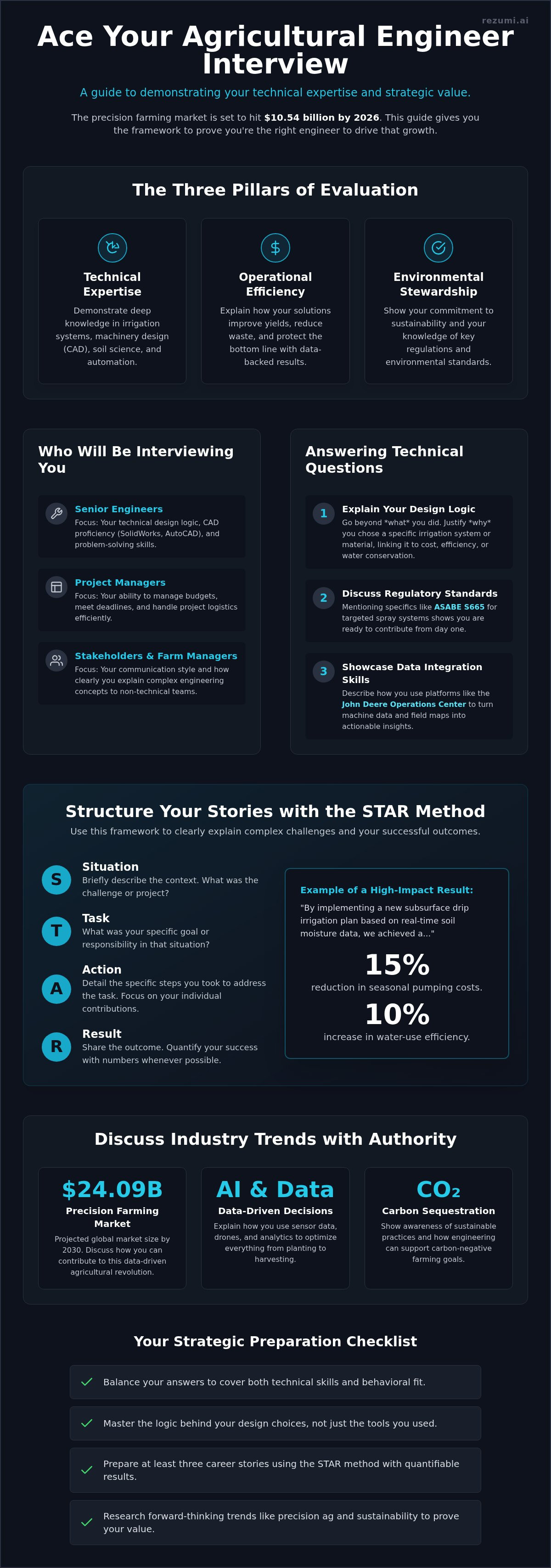
By 2026, the precision farming market is projected to reach $10.54 billion, yet many talented professionals still struggle to land their dream role. You might have mastered GPS guidance and soil sensors, but walking into an agricultural engineer job interview requires a different set of skills. It is common to feel anxious about explaining complex engineering concepts to non-technical stakeholders or handling difficult behavioral questions. You deserve a strategy that turns your technical depth into a competitive advantage.
This guide provides the mastery you need to secure your next position in the North American market. We offer a clear list of the most likely technical and behavioral questions you will face. You will get a framework for high-impact answers that prove your value to recruiters and hiring managers alike. We focus on tangible outcomes so you can walk into the room with calm, technological confidence. Our approach replaces the anxiety of a difficult process with the reassurance of a data-backed plan.
We will also show you how to discuss 2026 industry trends with authority. From the latest ASABE spray standards to shifting fertilizer costs, you will be prepared to lead the conversation. This article breaks down the essential steps to prepare for your next career move. It is time to stop worrying about the process and start focusing on your results.
Key Takeaways
- Learn to balance your technical expertise with behavioral fit to meet the specific requirements of North American agricultural firms.
- Master the logic behind your design choices and CAD modeling to answer technical questions with high-impact precision.
- Apply the STAR method to your agricultural engineer job interview stories so you can explain complex challenges clearly to any stakeholder.
- Prepare for 2026 industry trends like data-driven precision agriculture and carbon sequestration to prove your forward-thinking value.
- Sync your interview responses with your resume keywords and practice your delivery using advanced AI coaching tools.
What to Expect in an Agricultural Engineer Job Interview
Prepare for a high-stakes assessment of your engineering logic and your personal character. An agricultural engineer job interview in the North American market is rarely just a conversation about tractors. It is a calculated evaluation of how you apply what is agricultural engineering to real-world profitability and sustainability. Expect the process to be split evenly between technical proficiency and behavioral fit. You will likely face a mix of office-based design questions, such as CAD modeling for irrigation, and field-based problem-solving scenarios involving machinery failure or soil health.
Hiring managers want to see that you understand 2026 industry standards, such as the ASABE S665 for targeted spray systems. Many firms now include a technical assessment or a case study review as part of the process. They might hand you a dataset on crop yields and ask for a drainage plan or a precision farming strategy. You can use Rezumi's AI Interview Prep to simulate these specific scenarios and refine your delivery before you step into the room. This ensures you are ready for the specific pressures of a high-level agricultural engineer job interview.
The Three Pillars of Agricultural Interviews
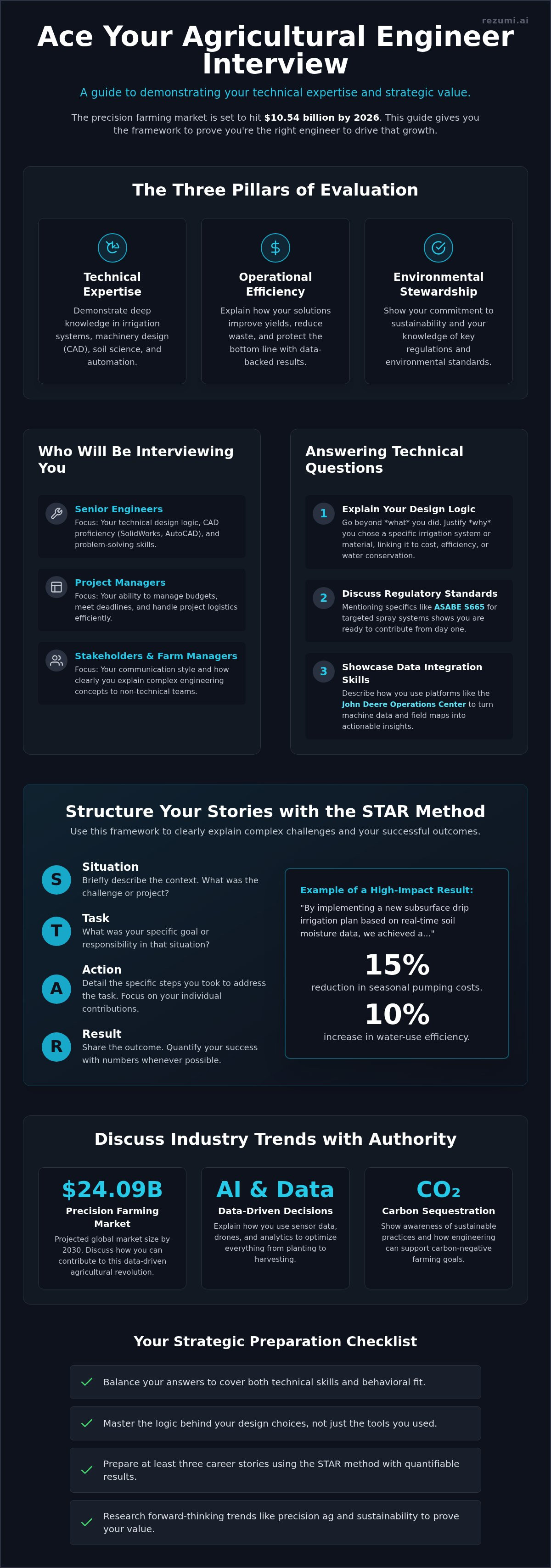
Your success depends on proving you can handle three specific areas of the business. First is your technical expertise. You must demonstrate deep knowledge of irrigation systems, machinery design, and soil science. Second is operational efficiency. Recruiters want to know how you improve yields and reduce waste to protect the bottom line. Third is environmental stewardship. With new 2026 regulations like California’s Assembly Bill 411 on on-farm composting, your commitment to sustainable and regulatory standards is a major hiring factor.
Who Will Be Interviewing You?
You will meet different experts throughout the day, and each has a different goal. Senior Engineers will focus on your technical design capabilities and CAD proficiency. Project Managers will look at your ability to meet strict deadlines and manage budgets. Finally, you may speak with Stakeholders or Farm Managers. These individuals assess your communication style and how well you explain complex engineering to people who work in the field every day. Make sure your interview stories align with the keywords found by Rezumi's ATS scanner to show you are the right fit for the whole team.
Answering Core Technical Questions with Precision
Precision is the standard for any agricultural engineer job interview. You must go beyond listing your daily duties. Instead, focus on the logic behind your design choices. If you selected a specific subsurface drip irrigation system, explain how it reduced water waste compared to overhead alternatives. This level of detail proves you understand the positive Agricultural Engineer job outlook and the demand for high-performance, cost-saving solutions.
Be ready to discuss your proficiency with CAD software like SolidWorks, AutoCAD, or specialized ag-modeling tools. Mention how you use these programs to simulate stress loads or fluid dynamics before a single piece of hardware is built. In the North American market, regulatory compliance is a major hurdle. Discuss your familiarity with the 2026 ASABE S665 standards for targeted spray systems. Mentioning specific standards shows you're ready to contribute immediately without extensive training on basic industry requirements.
Expect questions regarding machinery automation and sensor integration. The global precision farming market is forecast to expand to $24.09 billion by 2030, so employers want engineers who can bridge the gap between mechanical hardware and digital data. Discuss how you use platforms like the John Deere Operations Center to consolidate machine data and field maps. Explain how you interpret this data to inform operational decisions or improve machine performance across varying soil conditions.
Irrigation and Resource Management
Hiring managers often ask how you design systems for areas with limited water access. Your answer should highlight variable rate irrigation (VRI) and real-time soil moisture sensor integration. Explain your experience with drainage tile design and runoff management, specifically how you prevent nutrient leaching into local watersheds. Describe a time you optimized a system for better resource efficiency, using concrete numbers like a 15% reduction in seasonal pumping costs or a 10% increase in water-use efficiency.
Machinery and Power Systems
Your approach to designing ergonomic and safe farm equipment is a frequent topic. Focus on how you integrate operator safety with high-efficiency power systems. Explain how you incorporate GPS guidance and telemetry into existing machinery to improve field mapping accuracy. When asked about a complex mechanical failure, walk them through your diagnostic process. Show how you identified the root cause in a hydraulic system or an electronic control unit (ECU) to minimize downtime during a critical harvest window.
Preparing for these technical deep-dives is easier when you have a structured plan. You can check our interview coaching options to get personalized feedback on your technical explanations and delivery.
Using the STAR Method for Behavioral Questions
Behavioral questions often trip up even the most talented engineers. In an agricultural engineer job interview, these prompts bridge the gap between your office designs and field reality. The STAR method (Situation, Task, Action, Result) provides a logical structure for your answers. It keeps your stories punchy and result-oriented so you don't get lost in the weeds of technical jargon.
First, set the Situation. Briefly describe the context, but don't spend more than two sentences here. Next, define the Task. What was the specific engineering challenge or goal? The Action section is the most important part of your response. Detail the exact steps you took, such as recalibrating a sensor array or redesigning a drainage layout. Mention the software you used or the specific mechanical adjustments you made. End with the Result. Share the outcome using concrete data. This could be a 12% reduction in fuel consumption or a 5% increase in bushel yield. Providing these numbers proves you understand the financial impact of your engineering work. This data-backed approach shows you're focused on tangible outcomes and profitability.
Handling Conflict and Safety
Safety is a non-negotiable priority in North American agriculture. Be prepared to discuss a time you had to halt work because of a safety concern. Explain how you identified the risk, like a faulty hydraulic line or an unstable structure. Describe the specific protocol you followed to fix it. If you faced a disagreement with an on-site contractor, describe how you used technical data to resolve the conflict. Hiring managers want to see that you can lead with authority and maintain professional standards. Giving an example of a mid-project design pivot shows you can handle the unpredictability of field environments without losing focus on the final goal.
Project Management and Deadlines
Harvest season creates a high-pressure environment where deadlines are absolute. You must show how you prioritize multiple projects when every hour counts. Describe your system for managing technical documentation and reporting to ensure nothing slips through the cracks. This might include digital field logs or automated status updates. If a project fell behind, explain the specific recovery plan you executed to get back on track. Use Rezumi's AI Interview Prep to practice these stories until they feel natural. This tool helps you bridge the communication gap between technical engineering and stakeholder management. It ensures your field-to-office stories are balanced, professional, and ready for the most demanding interviewers.
Addressing 2026 Trends: Precision Ag and Sustainability
The 2026 agricultural engineer job interview focuses heavily on how technology solves economic and environmental pressures. Precision farming is no longer optional. It is a $10.54 billion market. Hiring managers expect you to speak fluently about variable rate technology (VRT) and automated guidance. You must demonstrate how you use data to drive field-level efficiency. It is not enough to know the hardware. You must explain how you integrate AI for predictive maintenance and targeted spraying. For instance, John Deere’s See & Spray Ultimate can reduce herbicide use by up to 90%. Mentioning specific tech like this proves you are ready for 2026 standards. Ensure your interview stories match the keywords found by Rezumi's ATS scanner to show you are aligned with these modern requirements.
Sustainability is now a regulatory requirement rather than just a goal. New rules like the EU Packaging and Packaging Waste Regulation (PPWR) enter into force on August 12, 2026. This changes how we design supply chains and equipment. You should also be ready to discuss climate resilience. Engineering systems to withstand extreme weather is a top priority for North American firms facing unpredictable growing seasons. Discussing these trends shows you understand the high-stakes urgency of the current professional landscape.
Data and Analytics in Engineering
Translating raw sensor data into actionable designs is a core skill. You might be asked how you use Big Data to plan irrigation or drainage projects. Explain your experience with remote sensing and GIS mapping to identify soil variability. If you have used integrated farm management software to consolidate machine data and yield metrics, say so. This shows you can move from field data to high-level strategy without friction. It proves you understand the hidden mechanics of complex systems better than the average candidate.
The Green Shift in Agriculture
The industry is moving toward net-zero goals. Your designs should contribute to carbon sequestration and reduced chemical inputs. Discuss the balance between high production and long-term soil health. Many farms are also looking for renewable energy integration. This includes solar arrays for irrigation pumps or biomass for heating. Be prepared to explain how your engineering choices reduce a farm's carbon footprint while maintaining profitability. Use Rezumi's AI Interview Prep to practice explaining these 2026 trends with calm, technological confidence.
Strategic Preparation and Closing the Interview
Finalizing your agricultural engineer job interview strategy requires more than just technical knowledge. It demands a cohesive narrative. Your interview stories must perfectly mirror the skills and keywords that passed the ATS scanner on your resume. If your resume highlights precision irrigation, your interview examples should dive deep into that specific technology. This consistency builds trust with the hiring team and proves you are exactly who you claim to be on paper. It eliminates the friction between what you've written and how you present your expertise.
Refining your delivery is the final step in moving from uncertainty to control. Use Rezumi's AI Interview Prep to simulate the high-pressure environment of a modern engineering firm. This tool provides instant feedback on your tone, pace, and technical clarity. It helps you identify where your explanations might become too dense for farm managers or non-technical stakeholders. Practicing with a data-backed system ensures you walk into the room with calm, technological confidence. You will be ready to handle the transition from office-based design talk to field-based problem-solving without missing a beat.
Pre-Interview Checklist
Before you log in to a virtual meeting or walk through the office door, run through this final list. Research the company's specific crop focus or machinery line to tailor your answers to their current fleet. Review your resume for the specific keywords that got you the call in the first place. Finally, use Rezumi's pricing plans to access AI interview prep tools and polish your performance. This ensures every answer you give is optimized for the North American market standards.
Questions You Should Ask Them
An interview is a two-way technical assessment. Asking sharp questions demonstrates your interest and your high-level perspective on the industry's future. It shows you're not just looking for a job, but are ready to be a strategic partner. Consider asking these three questions:
- What is the biggest engineering challenge your team currently faces?
- How does the company plan to integrate AI into its 2027 roadmap?
- What does success look like for this role after the first six months?
Close the process with a strategic follow-up email within 24 hours. Do not just send a generic thank-you note. Instead, reinforce your value proposition by referencing a specific technical challenge discussed during the agricultural engineer job interview. Propose a brief thought or mention a relevant industry standard that addresses that specific challenge. This final touch positions you as a visionary guide who is already thinking about the company's long-term success. It replaces the anxiety of waiting for a call with the reassurance of a professional, high-impact closing strategy.
Master Your Engineering Career Path
Success in your agricultural engineer job interview depends on your ability to bridge the gap between complex field data and stakeholder profitability. You've learned how to frame your technical expertise through the STAR method and how to lead discussions on 2026 sustainability standards. It is no longer enough to just be a great designer. You must be a strategic partner who understands how precision agriculture drives a farm's bottom line across the North American market.
Rezumi provides the ATS-optimized resume templates and AI-driven interview coaching you need to stand out. These tools are specifically tailored to help you transition from the anxiety of a difficult process to the reassurance of a data-backed plan. You have the engineering talent. We have the strategy to ensure hiring managers recognize your readiness for the high-stakes demands of 2026. This approach replaces uncertainty with total control.
You are ready to lead the next generation of agricultural innovation. Trust your preparation and walk into your next interview with total confidence.
Frequently Asked Questions
What are the most common agricultural engineer job interview questions?
Common questions for an agricultural engineer job interview focus on technical design, resource management, and behavioral fit. You will likely be asked how you optimize irrigation for water-limited areas or to describe a complex mechanical failure you diagnosed. These questions target your ability to balance yield with environmental stewardship while maintaining profitability. Be ready to explain the logic behind every design choice you make in the field.
How should I prepare for a technical agricultural engineering assessment?
Review CAD proficiency and modeling tools like SolidWorks or AutoCAD to prepare for a technical assessment. You might be asked to solve a drainage problem or a case study involving precision ag data. Focus on the 'why' behind your design choices rather than just the 'what'. This proves you understand the economic impact of your engineering and can provide data-backed solutions to complex farm challenges.
What is the best way to explain complex engineering to a farmer?
Focus on tangible outcomes like yield increases, cost savings, and reduced downtime when talking to farmers. Avoid technical jargon and use plain English to describe how your system improves their daily operations. Proving you understand the financial stakes of their farm builds immediate trust and authority. You must show that your engineering designs translate into real-world benefits that a farm manager can see in their seasonal bottom line.
Is a Master's degree required for senior agricultural engineering roles?
A Master's degree is not always mandatory for senior roles, but it helps for specialized R&D positions. Many senior jobs prioritize professional engineering (PE) licensure and a proven track record of managing large-scale field projects. Experience with 2026 trends like AI-driven crop monitoring often outweighs an advanced degree in the eyes of many hiring managers. Focus on your tangible results and your ability to lead complex engineering teams.
How do I show my knowledge of North American safety standards?
Reference specific standards like ASABE S665 for spray systems or OSHA guidelines for farm equipment to show your safety knowledge. Discussing your familiarity with 2026 regulations, such as California’s Assembly Bill 411, shows you are ready to work immediately. It proves you can operate within the specific legal frameworks of the US and Canada. Always tie safety protocols back to protecting personnel and reducing the risk of costly operational shutdowns.
What should I wear to an agricultural engineering interview?
Business professional is the standard for the first interview, even for field-based roles. Wear a suit or a professional blazer to show respect for the process and the hiring team. If a second interview involves a site visit, confirm with the recruiter if you should bring steel-toed boots or field-ready gear. Dressing professionally signals that you are a serious candidate who understands the corporate and operational sides of the business.
How can AI help me prepare for my engineering interview?
Use Rezumi's AI Interview Prep to simulate specific agricultural engineer job interview scenarios before the big day. The AI provides real-time feedback on your technical clarity and delivery. This helps you refine your stories to match the keywords on your resume and ensures your answers are balanced for both engineers and farm managers. It replaces the anxiety of a difficult process with the reassurance of a data-backed preparation strategy.
What are the key skills employers look for in 2026?
Employers prioritize precision agriculture, data analytics, and climate resilience in 2026. You must be comfortable with autonomous machinery, drone monitoring, and GIS mapping. Proficiency in Variable Rate Technology and an understanding of the 13.1% CAGR growth in precision farming are essential for proving your value. Show that you can engineer systems that withstand extreme weather events while maintaining high production levels. This combination of skills is what modern recruiters want.
Disclaimer
This article is provided for general informational purposes only and does not constitute professional, legal, financial, or career advice. While Rezumi strives for accuracy, we make no warranties as to the completeness or reliability of this content. Hiring practices, ATS behavior, and job-market conditions vary by employer, industry, and region — always verify against your specific situation. Any action you take based on this article is at your own risk.