AI Cover Letter Help for Applicants Without Direct Experience
Lack of direct experience doesn’t mean you have nothing relevant to say. An AI cover letter for a job you’re not qualified for can connect your transferable skills to the role, as long as you provide truthful examples and review the draft yourself. Use one to three examples from school, volunteer work, a portfolio, or a personal project to show what you can do.
It’s understandable to worry that an employer will focus on the experience you lack. A stronger approach is to acknowledge the gap honestly, then show how your skills and achievements relate to the work. AI can help you identify those connections, but it shouldn’t invent qualifications or replace your judgment.
This guide explains how to identify relevant skills, give AI useful details from the job posting, and turn the draft into a clear, personal cover letter. You’ll also learn how to structure your examples and tailor the final version to explain why you’re ready to take the next step.
Key Takeaways
- Give AI your resume and the job posting, then ask it to connect your experience to the role’s key responsibilities.
- Use examples from school, volunteering, personal projects, or other work to prove transferable skills.
- Build a clear cover letter around one main idea per paragraph, even if you’re new to the field.
- Replace generic AI wording with specific details you can explain and support.
- Use prompts that set clear limits: keep your claims truthful, focus on relevant achievements, and preserve your voice.
What is the fastest workflow to create an AI cover letter draft for a specific posting?
Start with your resume and the full job posting, then ask AI to connect your experience to the role. Keep the draft grounded in details you can explain. Remove common mistakes such as generic praise, copied phrases, unsupported claims, and statements that don’t match your resume.
Resume and Job Description Inputs
Provide your current resume and the complete job description. Remove personal details you don’t want to share, then ask AI to compare the responsibilities with your actual background. For example, a class project that involved tracking deadlines may demonstrate organizational skills if you managed those deadlines.
Before drafting, identify the skills and projects you want the letter to include. If the posting asks for customer communication, note a real example from work, volunteering, or school. This gives AI useful context and helps separate a requirement from a qualification you already have.
Tailored Draft Generation
Ask AI to connect your strongest evidence to 2-4 responsibilities in the posting. Tell it to name each responsibility, use a related example, and avoid claiming experience you lack. For instance, coordinating a student event may show planning, but shouldn’t be described as professional event-management experience.
Keep the first draft focused. Austin Belcak recommends using AI to produce about 80% of a cover letter draft, then proofreading and personalizing it. Treat that as a starting point. Ask the tool to leave out any result or qualification that doesn’t appear in your resume or notes.
Personalizing the Letter
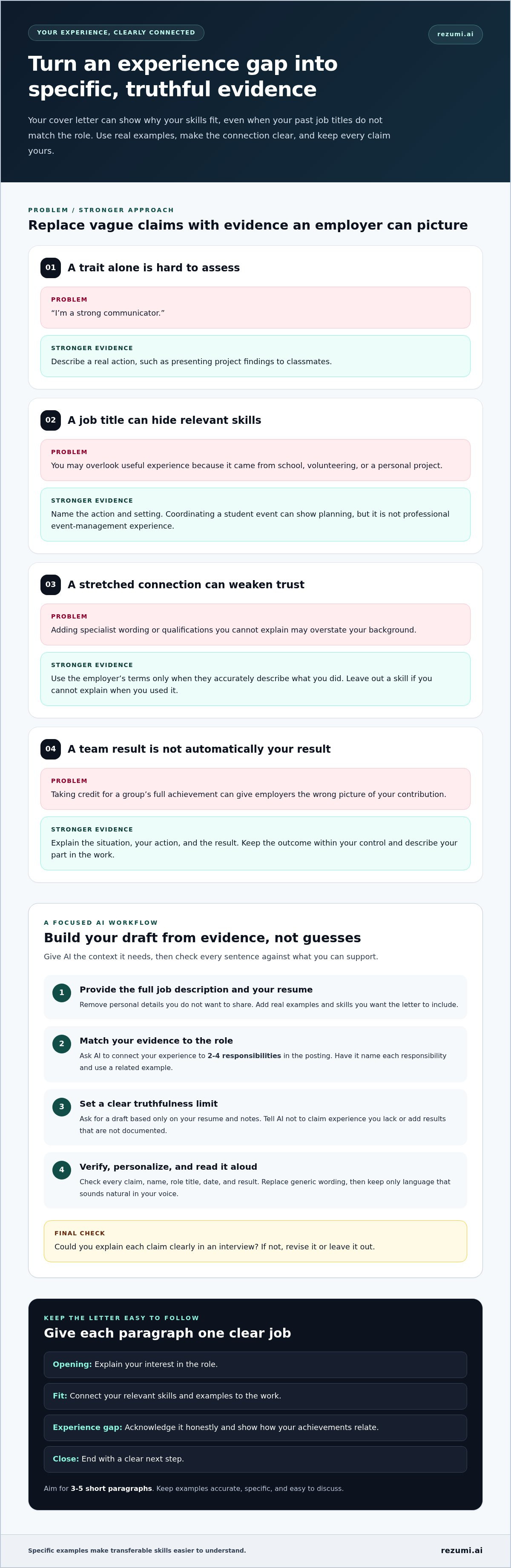
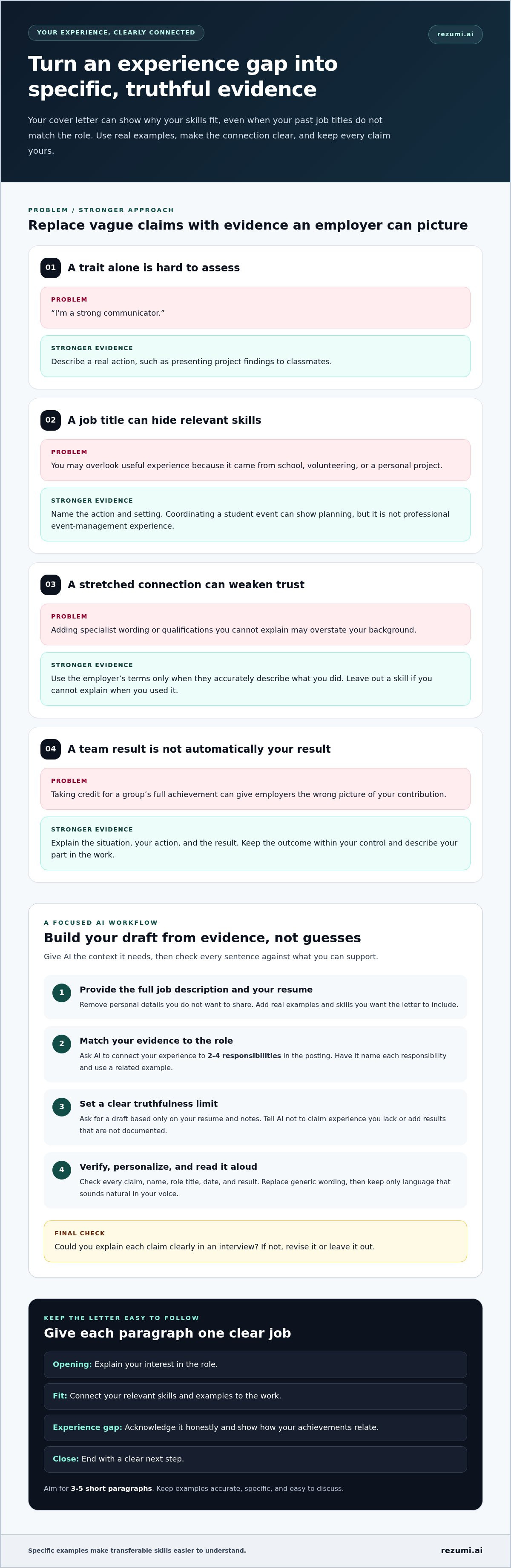
Check every sentence against your resume and the posting. Replace “I’m a strong communicator” with a detail you can discuss, such as presenting project findings to classmates. Verify names, role titles, dates, and results. Delete any claim you couldn’t explain clearly in an interview.
Answer AI’s follow-up questions with details you know, such as what you built, who used it, or why the employer’s work interests you. Don’t let the tool invent an answer to fill a gap. Read the final letter aloud and keep wording that sounds natural in your voice.
Use this sequence for each posting:
- Provide the job description and your resume.
- Ask AI to identify matching skills and 2-4 relevant responsibilities.
- Request a draft based only on your documented experience.
- Verify each claim, personalize the opening, and read the letter aloud.
Check whether the letter adds context your resume doesn’t show. For example, it could explain how you kept classmates on schedule during a group assignment. Keep the detail accurate, remove repetition, and correct any statement that overstates your role.
Connecting transferable skills and achievements to a role
A transferable skill is a way of working that remains useful in a different setting. Describe the action behind your experience, not just a trait. “Good under pressure” is hard to assess. “Stayed calm while resolving a scheduling conflict” gives the reader a concrete example.
Look beyond job titles
A job title describes where you worked, not every skill you used. Break down your responsibilities into actions such as explaining, organizing, reviewing, troubleshooting, or coordinating. Then consider where else those actions matter. For example, a caregiver who arranged appointments and kept family members informed may have experience with scheduling and clear updates, even without office experience.
Make the setting clear so an employer understands both the skill and where you gained it. Don’t present personal or unpaid work as a formal job. Instead, describe what you did and the judgment or effort it required.
Describe the skill in plain language
Translate vague traits into actions a hiring manager can picture. Instead of “detail-oriented,” explain that you checked figures against source records before submitting a report. Instead of “adaptable,” describe how you adjusted a plan when a supplier changed a delivery date. Plain language makes the skill easier to understand and discuss.
Use the employer’s terms only when they accurately describe your experience. If the posting asks for “stakeholder communication,” you might describe sharing updates with people affected by a decision. Don’t add specialist wording just to sound experienced. Accurate language makes the connection easier to explain in an interview.
Show what your contribution changed
An achievement can show value without a percentage or award. Explain the situation, your action, and the result in everyday terms. For example, a home baker who changed a preparation routine to avoid missing custom orders can describe the process and its effect. Keep the result within your control, and don’t claim a wider impact without evidence.
Separate your contribution from what the group achieved. If a team completed a project, describe your part rather than taking credit for everyone’s work. This gives employers a fair sense of your contribution and helps you answer follow-up questions with confidence.
Choose language you can stand behind
Before adding a skill to your letter, ask whether you can explain when you used it and what you learned. If the answer is clear, describe it directly. If the link feels stretched, leave it out. A focused AI cover letter draft can help you test whether your wording reflects your experience, but keep only claims you can support.
Cover letter structure for applicants with no direct experience
Use 3-5 short paragraphs, with each paragraph doing a different job. A clear letter can introduce your interest, explain your fit, address a gap, and close with a next step. This structure keeps the reader focused on your case rather than on the experience you haven’t had. Keep the tone direct, and make sure each paragraph moves the application forward.
Opening: Use 2-3 sentences to name the role and explain why you’re applying. Give the reader a clear reason to continue, not a broad claim about being the perfect candidate. For a junior research assistant role, you might point to your interest in the employer’s work and the type of research you hope to support. Keep this opening focused on the specific opportunity.
First body paragraph: Use this space to show your most relevant strength. Explain what you understand about the work and how your current abilities could help. If the role involves writing clear summaries, you might describe how you turn complex information into concise notes. Focus on the skill and its relevance, not every task you’ve completed.
Second body paragraph: Address a gap only if it matters to the role. State your current level plainly, then explain your next step. For example, if the posting asks for familiarity with a reporting tool you haven’t used, mention your experience with similar software and your plan to learn the named tool. Don’t imply that related knowledge is the same as direct experience.
Closing: Use 2-3 sentences to restate your interest and invite a conversation. Name the contribution you’re prepared to make, then end with a professional thank-you. Avoid phrases that sound like a guarantee, such as “I know I’ll be the best choice.” A grounded close shows confidence while leaving the employer room to assess your fit.
Draft each paragraph around one clear purpose. Then check the transitions: the opening should lead into your case, the body should explain it, and the close should point ahead. A 3-5 paragraph letter doesn’t need to repeat your resume or cover every qualification. Remove any sentence that serves no clear purpose, and keep the final version focused on the role and your reasons for applying.
Before submitting, read the letter once for structure and once for tone. Check that the opening identifies the role and the closing ends cleanly. Then replace apologies with direct statements about your readiness. “I’m still building experience with this work” is clearer than “I’m sorry I don’t have enough experience.”
Tailoring a cover letter to a job posting
Tailor each letter to the actual posting, not a generic version of the role. Identify the employer’s key needs, connect them to accurate evidence, and replace broad claims with specific details. This makes your fit easier to understand without suggesting you meet qualifications you don’t have.
Choose the responsibilities your evidence supports
Read the posting and mark 2-4 responsibilities that match your experience or skills. Separate tasks you’ve done from tasks you’re ready to learn. For a customer support role, “explain information clearly” may connect to tutoring, while “use the company’s ticketing system” may be new. Keep that difference clear in your letter.
Ask AI to map each selected responsibility to a real example from your background. Tell it not to claim direct industry experience. For example, a volunteer who answered questions at a community event might demonstrate patience and clear communication, but shouldn’t be described as an experienced call-center representative.
Replace generic phrases with specific evidence
Review every broad phrase in the draft. Replace wording such as “I’m a hardworking team player” with 1-2 specific details that show what you did. You might describe how you shared research with a project group or helped organize a student club’s event schedule. Choose examples you can explain in an interview.
AI can also leave placeholders such as “[insert achievement]” or add polished but empty claims. Replace placeholders with 2-3 concrete items you can discuss, such as a portfolio piece, a course project, or a volunteer task. If you lack a result that can be measured, describe the finished work instead of inventing a number.
Address a missing qualification directly
Don’t hide a required certification or skill gap behind vague wording. State the relevant qualification you do have, then explain how you’ll address the gap. For a job with a missing required certification or skill, according to the National Initiative for Cybersecurity Education, applicants can offer to gain it within 6 months of starting the position if the employer needs it.
Use that commitment only if you can meet it. A useful sentence might be, “I’m prepared to complete the required training within 6 months of starting, if needed.” Don’t imply that you already hold the certification. If the posting treats a qualification as essential, your letter should make your current status and proposed next step unmistakable.
Run a posting-specific final check
Compare the final letter with the posting, line by line. Confirm the employer and role names, and check that every skill claim matches your background. Remove duties the posting doesn’t mention, resume details that are repeated, and phrases that could fit any company. The final draft should explain why your evidence fits this role, not simply why you want a job.
What prompts can I use to generate a cover letter for a job I'm underqualified for?
Write prompts that give AI a role, evidence, and clear limits. A useful prompt names the job, provides your experience, and tells the tool not to invent qualifications. Build the letter in stages: identify relevant evidence, draft, then revise for accuracy and voice.
Prompt AI to identify relevant evidence
First, ask AI to compare your resume with the posting before it drafts anything. This helps distinguish skills you can demonstrate from requirements you haven’t met. For a junior operations role, your prompt could be:
“Compare my resume with this job description. List the role’s main responsibilities, then match each one to evidence I actually provide. Label gaps clearly. Do not invent experience, skills, results, or qualifications.”
Review the matches yourself. If the posting asks for scheduling and your resume describes planning a campus event, that may be relevant. If AI says you managed a professional calendar, correct it. The prompt should produce a useful comparison, not turn a school or personal project into paid work.
Request a focused first draft
Once you’ve chosen your evidence, ask for a short draft built around it. Specify the role and employer, the examples to include, and the tone you want. For example:
“Draft a cover letter for the [role] at [employer]. Use my event-planning project to show organization and communication. Address my lack of direct experience briefly. Do not claim I’ve used tools or held responsibilities absent from my resume.”
Replace each bracketed item before submitting the prompt. If you’re applying for a lab assistant role, provide a relevant course or research project instead of the event example. Clear inputs help AI create content tied to your application rather than a generic letter.
Ask for a stronger skills connection
If the draft lists traits without evidence, request a specific revision. Try: “Replace broad claims with details from my experience. For each skill, state what I did and how it relates to one responsibility in the posting. Keep my role accurate.” For a tutoring example, AI might connect explaining a difficult topic to communicating clearly with customers.
Use a final accuracy and voice check
Finish with a review prompt: “Check this letter against my resume and the job description. Flag unsupported claims, repeated ideas, incorrect names, and wording that sounds unlike a direct, professional applicant. Suggest edits without adding new facts.” Then verify every suggested change yourself. Confirm the employer name, role title, project details, and any stated result.
Read the final letter aloud. If “I’m passionate about your mission” feels generic, replace it with a real reason, such as interest in the employer’s public work. Keep phrases you’d use naturally in an interview. Your final edit, not the prompt, decides what represents you.
Rezumi: ATS Resume Optimization
Rezumi helps you align your resume and cover letter with a specific job posting. Use ATS Resume Optimization to tailor your resume, then the AI Cover Letter Generator to draft a letter connecting your experience to the role. Review every claim before applying, especially when explaining a skill gap.
When your application is ready, AI Interview Prep can help you practice discussing your transferable skills and examples using the CAR-framework. Resume Design & PDF Export lets you prepare a polished resume file for submission. These tools support your application process, while your experience and final decisions remain your own.
Visit rezumi.ai to explore the tools for your next application.
Make your next application a deliberate step
An AI cover letter for a job you’re not qualified for should make a focused case, not disguise a gap. Before applying, decide whether the missing requirement is something you can learn or a core qualification you don’t have. That helps you focus on roles where your current strengths can matter.
Treat each application as a chance to sharpen your professional story. Keep a record of the experience you highlighted, the questions employers ask, and any part of your story that feels difficult to explain. Use those signals to refine future applications without adding claims that don’t match your background.
Your next move doesn’t need to be a perfect career plan. Choose a role that interests you, make an honest case for your potential, and keep building the experience that supports your goals.
Each clear, truthful application is progress. Keep going, and let your real experience lead.
Frequently Asked Questions
Can an AI cover letter help when I have no experience?
Yes. AI can help explain why experience outside paid work may matter to the role. Provide details about a course assignment, community activity, or personal project, and ask how those tasks relate to the employer’s needs. For example, documenting research for a class project may support a role involving report writing. Keep the connection accurate, and make sure the letter reflects your own interest.
What if I do not have much experience?
Focus on a small amount of strong, relevant evidence instead of trying to fill space. A recent graduate applying for an office role could describe a class project that involved organizing shared files and meeting deadlines. Explain what you did and what the task involved. If your work history is brief, you can also state what you’re prepared to learn, then keep the rest of the application clear and focused.
Will an AI cover letter sound fake or generic?
A letter can sound generic if the prompt includes little detail or the draft repeats broad lines such as “I admire your company.” Give AI a real reason for your interest, such as a product, community program, or type of work described by the employer. Then read the letter aloud. Replace phrases you wouldn’t use in conversation and remove claims that could apply to any applicant.
How can AI help write a cover letter for a job I'm underqualified for?
AI can help organize your case by separating relevant strengths from missing requirements. Ask it to identify where your experience connects to the role, then request a draft that states those connections plainly. For example, if a posting asks for client communication, you might draw on answering questions at a community event. Review the result carefully so it doesn’t turn that experience into a job title you never held.
How do I address missing qualifications in a cover letter without sounding unqualified?
Be direct about the gap, then focus on what you can contribute now. If a design role asks for a tool you haven’t used, don’t imply proficiency. Mention related software you know, describe a design task you’ve completed, and show you’re ready to learn the required tool. Keep the explanation brief. The goal is to give the employer an accurate picture, not apologize for your background.
How can I highlight transferable skills for a job I don't meet all requirements for?
Connect a skill to a task the new role actually involves. A restaurant worker applying for an office coordinator position could describe tracking orders, relaying changes, and keeping service moving during a busy shift. These details may demonstrate organization and communication. Don’t label the experience as office coordination. Explain the task clearly, then let the employer see how the skill could transfer.
Should I apply if I don't meet all the job qualifications?
Consider applying if you can handle the role’s main duties and support your fit with real evidence. Read the posting closely: a preferred skill may differ from a qualification presented as essential. For example, if a junior role lists a specific software package as preferred, related experience may still be relevant. If you lack a core qualification needed for the job, focus on roles that match your current readiness.
How do I tailor an AI-generated cover letter to a specific job posting?
Check that the final letter reflects this employer, not just the job title. Confirm the organization’s name, the team or product mentioned in the posting, and the responsibilities you chose to discuss. Add a specific reason the work interests you, based on information you can explain honestly. Then compare the letter with your resume to catch mismatched dates, skills, or descriptions of your role.
Disclaimer
This article is provided for general informational purposes only and does not constitute professional, legal, financial, or career advice. While Rezumi strives for accuracy, we make no warranties as to the completeness or reliability of this content. Hiring practices, ATS behavior, and job-market conditions vary by employer, industry, and region — always verify against your specific situation. Any action you take based on this article is at your own risk.