Choosing a Resume Tool for a Career Change
Rezumi can help career changers tailor a resume and translate existing skills for a new field, but its ATS score isn’t a hiring decision. In one test, a resume scored 92 out of 100 on Rezumi’s internal scale. That score can guide revisions, but it doesn’t show how every employer’s system will read your file.
Changing careers can make resume decisions harder. You need to show how your experience fits a new role, even if your job titles come from another industry. A resume platform can help you organize that story, but the wording and evidence must reflect your actual skills.
This guide explains whether Rezumi is good for career changers, what its ATS features and templates can and can’t tell you, and how to evaluate its capabilities for your needs. You’ll also see how your job-search pattern, from a focused search to occasional applications, can shape your choice.
Key Takeaways
- Use AI-generated bullet points to connect your current skills to a new field, then edit each one to match your real experience.
- Choose a resume tool based on how often you expect to apply, not just how many features it offers.
- Keep your resume layout simple, and compare how each tool balances ATS-focused formatting with design choices.
- ATS results can vary by platform, so review your resume’s extracted details as well as its score.
- Tailor your resume to each role, and use the tool’s feedback to sharpen your evidence rather than add unsupported claims.
Is Rezi actually ATS-friendly?
Rezi is built around ATS-focused resume writing, and its AI-generated bullet points can help connect your past work to a new field. Its score can guide revisions, but it doesn’t show how every employer’s system or recruiter will assess your application.
Rezi scored a test resume 92 out of 100 on its own scale. That number can help you spot areas to revise, but it isn’t a hiring score. A reported example showed a resume scoring 94 or higher and still being rejected by human reviewers. Your actual experience, role fit, and evidence of results still matter.
Start with a target job description. Ask Rezi to generate bullet points that connect your current skills to its requirements. For example, a retail supervisor applying for an operations role could highlight scheduling, inventory control, and team coordination. Keep only claims that match work you’ve actually done, and choose examples you can explain clearly in an interview.
Review every resume bullet before using it. Check that the action, skill, and result are accurate. Replace broad wording such as “managed projects” with the actual task, tools, and outcome. Add relevant terms from the job description where they fit naturally. This shows how your experience applies without turning your resume into a list of copied keywords.
Formatting matters, too. Rezi launched ATS Hack Mode in June 2024, a feature that injects invisible keywords into resumes. Hidden terms don’t show a recruiter how your experience matches a role. Use visible, truthful wording instead, and make sure each bullet supports the skills you claim.
Compare the approaches before choosing what to keep:
| Option | Accuracy | ATS relevance | Career-change value |
|---|---|---|---|
| AI-generated bullet | Needs your fact-check | Can reflect job-description terms | Suggests transferable skills |
| Your edited bullet | Grounded in actual work | Uses relevant terms naturally | Explains how past work fits |
| Hidden keywords | May not reflect visible evidence | Doesn’t clarify your experience | Doesn’t explain the career shift |
Keep a bullet when it connects a real task to a requirement for your target role. Is Rezi good for career changers? It can help you draft and tailor a resume, while your review makes the career shift credible. Use its Profile Editor and ATS optimization tools to shape your resume, then tailor the rest of your application to the role and your experience.
Rezi's AI-generated bullet points can help career changers translate existing skills into a new industry. Use a draft to frame familiar responsibilities in terms that fit the role you want, but retain only details that accurately describe your work. Connect each claimed skill to a task or result you can discuss, and revise wording that sounds too broad or unfamiliar.
A resume bullet should make the link between your prior experience and the new field clear without suggesting experience you do not have. Compare the final version with the job description, then remove language that does not support an accurate account of your background. Ground your career shift in evidence, so your experience, not a generated phrase, carries the application.
Choosing a tool for an active or periodic job search
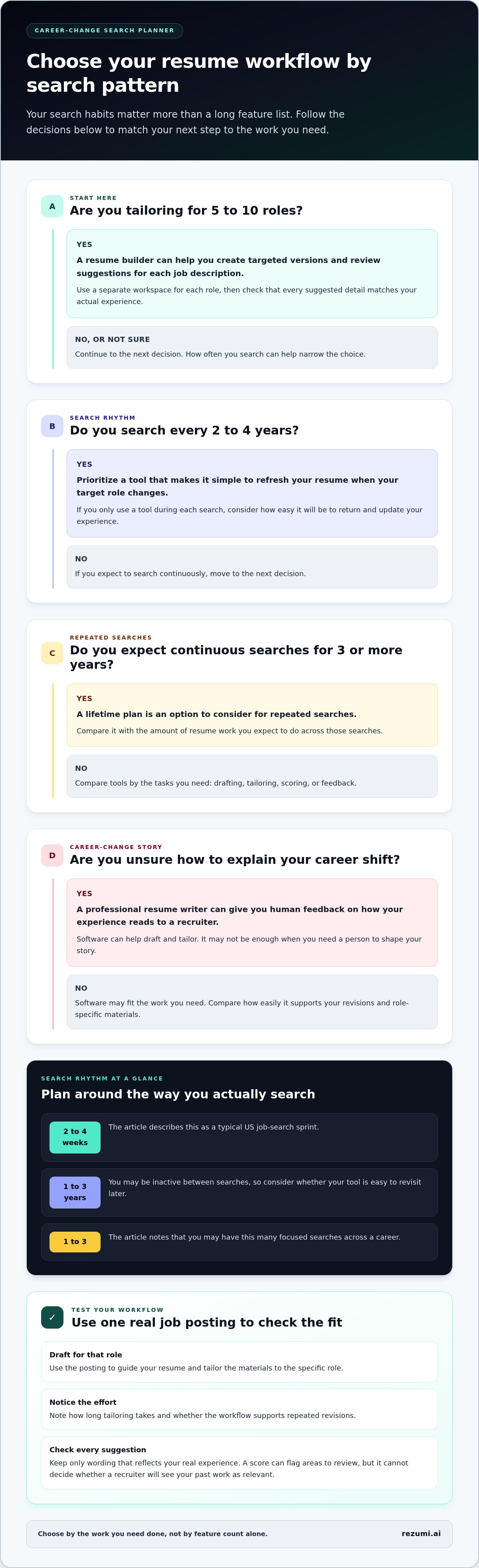
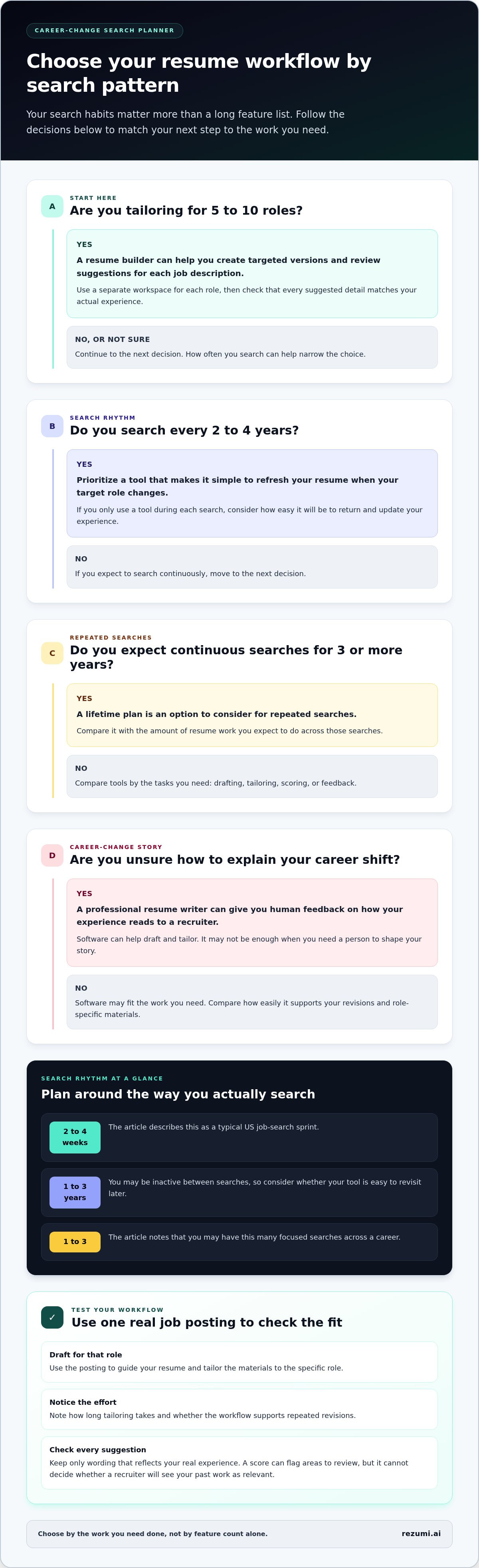
Rezi may fit an active search if you’re tailoring a resume for around 5 to 10 roles. For an occasional search, choose a builder that makes it easy to update your experience and return later. Rezi, Teal, and Jobscan are tools to compare; a professional resume writer adds human feedback to the process.
Your search habits matter more than a long feature list. The article cites a typical US job-search sprint of two to four weeks, with job seekers sometimes inactive for one to three years between searches, and one to three focused searches across a career. If you search every two to four years, consider whether you will use a tool between applications or only during each search.
Use these patterns to narrow your choice:
- Applying to 5 to 10 roles: A resume builder can help you create targeted versions and review suggestions for each job description.
- Searching every two to four years: Prioritize a tool that makes it simple to refresh your resume when your target role changes.
- Expecting continuous searches for three or more years: Rezi Lifetime is an option to consider for repeated searches.
- Unsure how to explain your career shift: A professional resume writer can provide human feedback on how your experience reads to a recruiter.
Rezi, Teal, and Jobscan are software options, while a professional resume writer provides a human service. Compare them by the work you need done: drafting, tailoring, scoring, or feedback on your career-change story. A score can flag areas to review, but it can’t decide whether a recruiter will see your past work as relevant.
Before choosing a resume workflow, take one real job posting and test it. Draft a resume for that role, note how long tailoring takes, and review whether the suggestions reflect your actual experience. Rezumi’s per-job workspaces help you tailor materials to specific roles. If you need a person to shape your story, software alone may not meet that need.
For a periodic search, consider whether the tool will still be useful after your current sprint ends. For a continuous search, compare how easily it supports repeated revisions. You can review resume-tool plan options as part of that decision.
ATS compatibility and templates
Rezi’s templates are designed for resumes that need to be read by applicant tracking systems, or ATS software. More than 97% of Fortune 500 companies use an ATS to manage applications. A clean format helps keep your work history, skills, and contact details easy for the system to identify.
Rezi’s template library has approximately 4 to 6 designs, based on information from April 2026. Harvard and Jake’s Resume templates were added in January 2025. This is a small selection compared with tools built around many visual styles, but fewer options can make it easier to focus on clear structure instead of decoration.
For a career change, choose a resume layout that puts your transferable skills near the top. If you are moving from customer service into project coordination, for example, list relevant scheduling or process-improvement experience before less related duties. Make your target position clear in your summary, then support it with work history and specific examples.
Keywords matter, but they need context. A keyword is a term from a job description, such as “budget tracking” or “client communication.” Add it where it accurately describes your work. If a required skill is missing from your resume, do not insert the phrase by itself. Show a related task or project that demonstrates the skill, or leave the claim out.
Use this quick template check before applying:
- Structure: Confirm your name, contact details, experience, and education appear in clear sections.
- Readability: Check that headings and dates are easy to scan on screen and in a PDF.
- Relevance: Move the experience tied to the target position closer to the top.
- Accuracy: Remove any keyword or skill that doesn’t match your actual background.
Rezi is designed to optimize resumes for ATS use in under 30 minutes. That speed supports a focused review, not a reason to skip one. Read the exported file from top to bottom, check that section order remains clear, and confirm no details are missing or misplaced.
An 80% parsing threshold is identified as the point below which resume information may reach recruiters incomplete or misattributed. Treat that as a practical warning: a strong-looking design can still create problems if an ATS reads its content incorrectly. Simple formatting, clear labels, and visible keywords give your experience a direct path to the recruiter.
For a career-change resume, choose a design that makes your relevant evidence easy to find, not one that relies on visual effects.
ATS platform compatibility
A resume’s parsing results can differ across applicant tracking systems. In a test of one Rezi PDF across five platforms, its average parse rate was 76.6%. The individual results ranged from 68% on Taleo to 88% on Greenhouse. These figures describe that test file, not every resume created with Rezi.
The platform results show why a single score cannot represent every application. Workday parsed 74% of the tested PDF, while Lever parsed 82%. iCIMS recorded 71%, and Taleo recorded 68%. A resume that reads clearly in one system may have details misplaced or missed in another.
For your application, make sure your work history, dates, education, and skills are clear. After exporting your resume as a PDF, open the file and check that the text is selectable and the sections appear in order. Then compare those details with the application fields before submitting.
Use Rezumi’s ATS Score as a prompt to review your resume, not as a guarantee of compatibility with an employer’s system. The score can help you assess content, but it does not show how a particular PDF will be parsed by a system such as Workday or Taleo. Check the exported file’s structure and confirm your target-role skills remain visible.
For a career change, checking how a file is parsed is only one part of the review. Your skills must also make sense to a recruiter reading the extracted text. For example, if your resume says “client support” but the role asks for “customer success,” explain the related work clearly. Do not add a term unless your experience supports it.
Use this review before tracking an application as submitted:
- Check the exported file: Confirm the text can be selected and copied from the PDF.
- Review section order: Make sure dates stay beside the correct employer and title.
- Verify skills: Confirm relevant abilities appear as text, not only in graphics or design elements.
- Match the application: Compare the resume with the fields shown in the employer’s ATS.
A lifetime plan or repeated use doesn’t change how an employer’s tracking system reads a file. Your resume’s content and formatting still determine whether details are clear. Treat each job application as a separate check, especially when the employer uses a different system.
Parsing does not predict an interview, either. It checks how information is read, not whether your experience meets the hiring team’s needs. Pair the technical review with careful writing: connect relevant skills to the position, use clear examples, and remove details that distract from your career-change story.
Advice for using Rezi
Use Rezi to shape a targeted draft, then check every suggestion against your actual experience. Its limits matter: an AI resume builder can organize and optimize your content, but it can’t decide which career-change story a recruiter will find convincing.
Using Rezi for a Career-Change Resume
Rezumi supports resume drafting and editing, with per-job tailoring to help connect your experience to a role’s needs. For example, show how coordinating schedules or tracking budgets supports a move into project coordination. Keep each claim accurate, specific, and easy to explain during an interview.
Use this sequence to build a focused draft:
- Choose a target position and note its required skills.
- Update your summary and experience bullets to show relevant work.
- For an entry-level resume, use Rezi’s suggested 3-6 bullet points per role as a guide. Senior resumes can use up to 10 per role.
- Review each suggestion for accuracy before adding it.
- Compare the finished resume with the job description and remove unrelated details.
Rezi also advises adding sections for projects, certifications, relevant coursework, volunteer work, awards, or publications. A career changer can use a relevant project to show practical experience, even when previous job titles don’t match the target field.
Rezi Limitations for Career-Change Resumes
Rezumi’s ATS Score and keyword matching can help you review your writing and identify job-description terms to consider, but they cannot provide evidence you have not supplied. Human feedback can offer a different perspective on how your career story reads. Treat the ATS Score as a content check, not a recruiter’s decision or a measure of interview readiness.
Some resume choices also need your judgment. Rezi advises omitting a graduation year when your degree is more than 10 years old, and leaving off a GPA below 3.5. References are usually unnecessary unless requested. Apply those suggestions to your target position and the details you want employers to notice.
Rezumi helps you prepare application materials, while you submit each application yourself. Use the dashboard to track your applications and follow up. Before submitting, check that your resume matches the role, the file reads clearly, and every skill has supporting evidence. That final review can catch issues a score alone may miss.
Rezumi: ATS Resume Optimization
Rezumi helps you tailor a resume to a target role with ATS optimization. For a career change, use its real-time ATS Score, Job Match %, and Keyword % to review your resume, then check each edit for accuracy. A strong resume is one part of your application. You can also generate a cover letter to explain why your past experience fits the new position and use interview training with the CAR-framework to practise discussing that transition.
Choose Rezumi when you want structured support with application materials and interview practice. It offers software tools, not job placement or human-written resumes. Keep your examples grounded in work you have actually done.
Visit rezumi.ai to explore tools for your career-change application.
Make your next application a focused test
The useful test of whether Rezi is good for career changers is whether its workflow helps you explain your next move in your own words. Choose one role you genuinely want and write down why you are making the shift. Then check that your resume, cover letter, and interview examples tell the same story. Consistency makes your decision easier to understand, while specific evidence gives readers something concrete to assess.
Do not present every part of your background as equally relevant. Select the experience that supports your direction and make the connection clear. If your target changes, revisit your story instead of reusing language that no longer fits. Your career change is a decision you can explain clearly, not a gap you need to disguise.
Take the next step with a focused story and evidence you can stand behind. Your experience can support a new direction.
Frequently Asked Questions
Does Rezi work well for career changers with limited experience in a new field?
Yes, Rezumi can help you organize relevant experience when you lack a job title in the new field. Start with projects, coursework, or volunteer work that shows how you use related skills. For an entry-level role, put that evidence before less relevant duties. If your experience is limited, focus on what you have learned and completed rather than implying expertise you have not gained.
How does Rezi tailor a resume to a career change and target job description?
Use the job description as a comparison document. Separate core requirements from preferred qualifications, then match each one to evidence from your background. Update your summary and reorder relevant experience for that role. Keep a separate version for each distinct target so one resume does not try to speak to unrelated positions at once.
Does Rezi help translate transferable skills into industry-specific resume language?
Rezumi’s keyword matching can help you identify clearer wording for skills that apply across fields. Translate the function, not the job title. For example, if you handled vendor invoices for a nonprofit, describe the invoice-processing work accurately. Do not call it accounts payable management unless your duties support that broader claim. The goal is to help hiring teams recognize relevant experience without overstating your background.
What Rezi features are useful for career changers, such as AI writing and resume scoring?
Job-specific tailoring, ATS scoring, and design tools can support different parts of your application workflow. Tailor a draft to one role, then use Design view and PDF export to prepare the version you will submit. Treat any score as one editing input. Your own review should decide whether the resume makes a clear, believable case for your career change.
What steps should career changers follow to build a resume with Rezi?
Begin by writing a short career-change goal, such as moving from classroom teaching into learning design. Gather examples that support that direction, including projects and relevant training. Choose one target role, draft a resume for it, and remove details that distract from your case. Save a copy for that role, then record which version you submit so you can prepare for employer follow-up.
Do Rezi resumes pass applicant tracking systems, and are there risks of generic or inaccurate AI content?
Using Rezumi does not mean every application will pass an employer’s screening process. AI-generated content can sound polished while missing your personal context or overstating what you did. Read each line aloud and ask whether you could explain it with a real example in an interview. Remove any phrase that does not match your responsibilities, knowledge, or results.
Disclaimer
This article is provided for general informational purposes only and does not constitute professional, legal, financial, or career advice. While Rezumi strives for accuracy, we make no warranties as to the completeness or reliability of this content. Hiring practices, ATS behavior, and job-market conditions vary by employer, industry, and region — always verify against your specific situation. Any action you take based on this article is at your own risk.