Confidence Boost for Job Interviews: A Practical Guide
Confidence isn’t a personality trait you either have or lack. It grows when you know what you want to say and have practised saying it. A confidence boost for job interviews starts with preparation you can rely on, not pressure to act fearless.
If you’re worried about freezing, rambling, or being judged, you’re not alone. Trying to predict every question can feel overwhelming. You don’t need to memorize perfect answers. Focus on explaining your experience clearly, using specific examples, and staying steady if a response doesn’t go as planned.
This guide gives you a practical plan: identify the skills the role calls for, connect them to examples from your experience, and practise answering out loud. You’ll also learn how to manage nerves before the interview and recover if you lose your train of thought. Focused preparation helps you communicate your qualifications clearly, even when you feel nervous.
Key Takeaways
- Build a confidence boost for job interviews by preparing flexible talking points, not memorizing scripts.
- Match the role’s needs to specific examples from your experience, then use STAR to keep each answer focused.
- Choose a practice method you’ll repeat, and use feedback to make your answers clearer and more concise.
- Set a simple pre-interview routine for research, notes, and logistics so you can focus on the conversation.
- Keep your résumé and interview examples aligned to the same accurate account of your experience.
Why a Confidence Boost for Job Interviews Starts With Preparation
Confidence improves when you know what you want to say and have practised saying it. A confidence boost for job interviews doesn’t mean you’ll feel calm every second. It means you have relevant examples ready and can adapt when a question takes an unexpected turn.
Uncertainty adds pressure. If you’re not sure what the role requires, which examples to share, or whether the conversation will be structured or informal, it’s harder to focus on your answers. A job interview can take different forms, so find out what you can about the format and prepare to talk about your experience in that setting.
Grounded confidence is trust in your preparation, paired with the flexibility to respond honestly when the conversation changes. It’s different from pretending you’re fearless or assuming you know how the interview will end.
What interview confidence looks like in practice
Confident answers are clear and relevant, not perfect or memorized word for word. You can explain what you did, why it mattered, and how it connects to the role. If you need a moment to think, pause briefly before answering. A thoughtful pause is more useful than rushing into a long response.
Your preparation is within your control. The hiring decision isn’t. You can prepare carefully and still face unexpected questions or an outcome shaped by factors you can’t see. Measure your readiness by whether you can communicate your experience accurately, not by whether you feel certain you’ll get an offer.
Why preparation can make interviews feel more manageable
Start with the job description. Note the skills and responsibilities that appear central, then choose examples from your work, education, or other relevant experience that show those skills. This gives each example a clear purpose. Instead of searching your memory for a story that might fit, you’ll have relevant experiences ready to adapt to the question.
A simple plan also cuts down on last-minute decisions. Review the role, prepare key examples, and practise explaining them aloud. That structure can reduce mental clutter, leaving you more attention to listen and respond. Preparation can’t control the employer’s decision, but it gives you a practical way to present your qualifications clearly.
Build Interview Confidence by Turning Your Experience Into Evidence
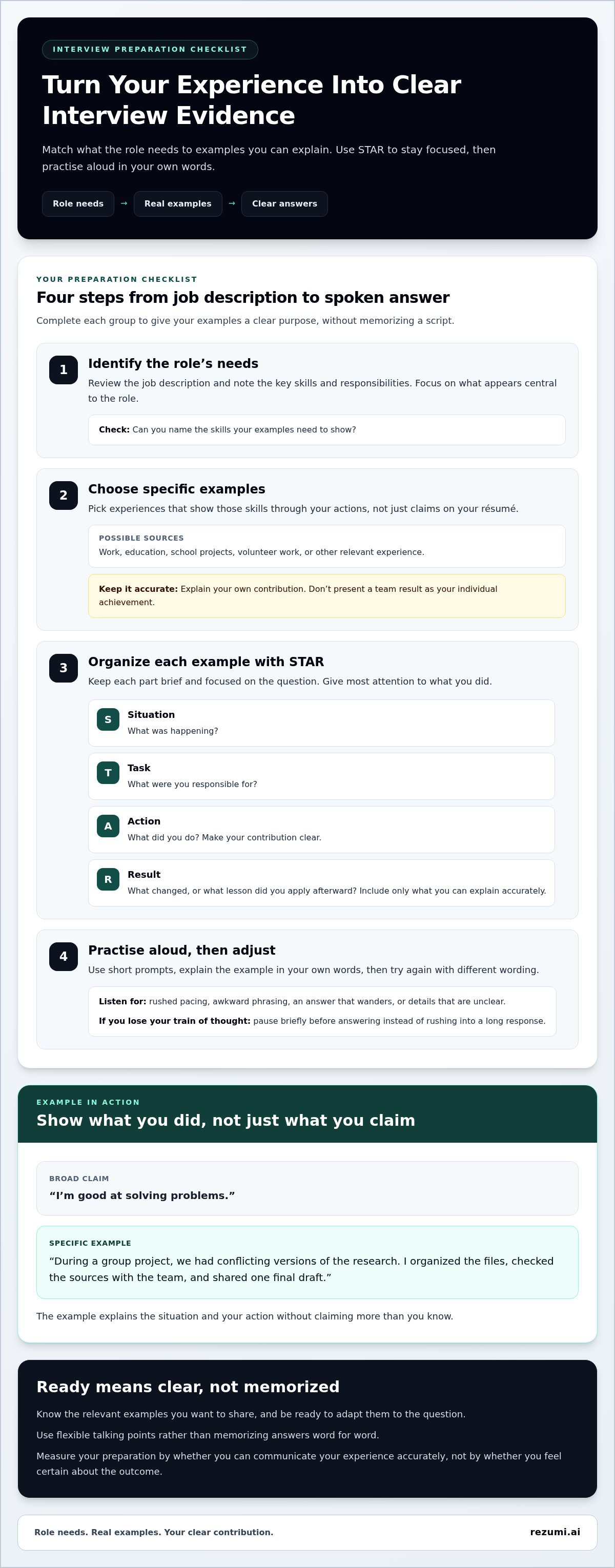
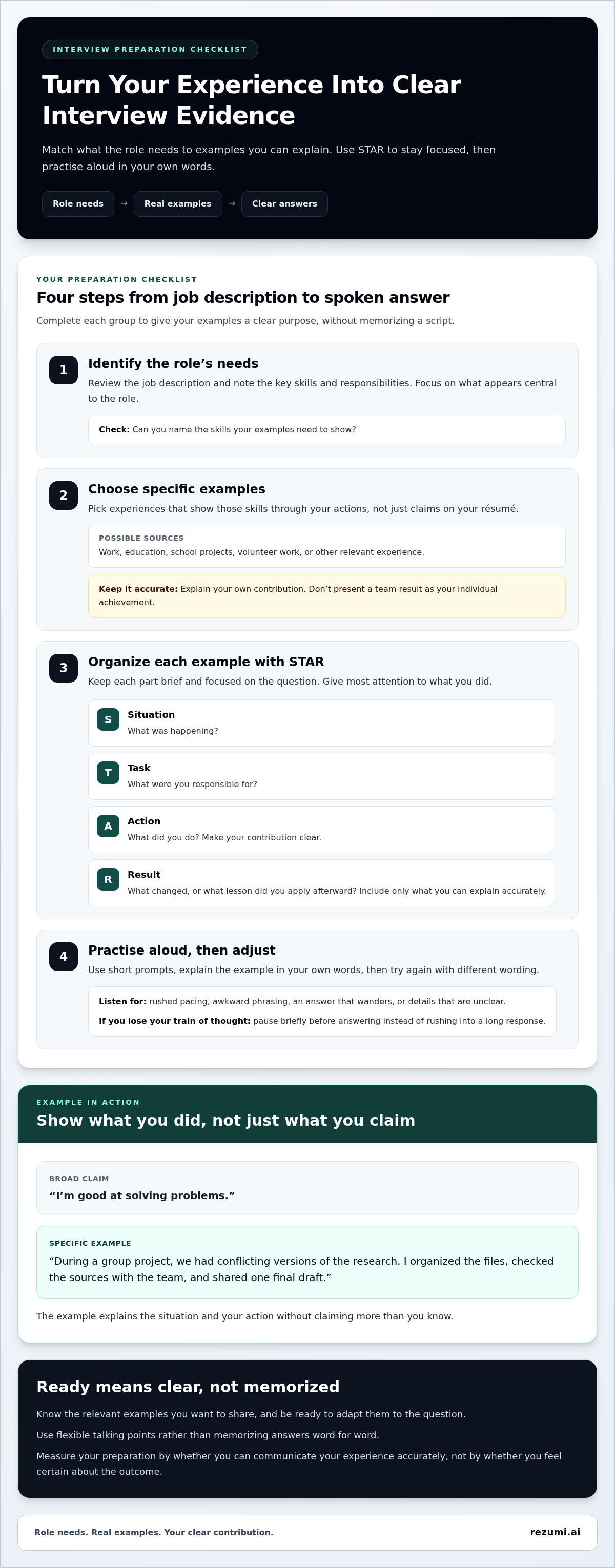
Strong interview answers connect what a role needs to something you’ve actually done. Use this process to choose relevant examples, organize the details, and practise speaking about them without memorizing a script.
- Identify role needs. Review the job description and note the key skills and responsibilities.
- Select examples. Choose experiences that show those skills through your actions, not just claims from your résumé.
- Structure the key points. Use STAR: Situation, Task, Action, and Result. Keep each part brief and focused on the question.
- Practise aloud. Explain the example in your own words, then try again with different wording.
Concrete examples make your answers easier to support because they show what you did, not just what you say you can do.
Match your experience to the role
Start with the role’s main needs, then look for examples that demonstrate them. If the posting calls for clear communication, choose a time you explained a process, resolved a misunderstanding, or presented information. Your résumé may name the skill. Your answer should show it in action.
You can draw on school projects, volunteer work, or other relevant experience if you’re a new graduate or changing careers. Be clear about your role and contribution. Don’t present a team result as your individual achievement. If an example came from a group project, explain what you specifically handled and how it helped the team.
Use STAR without memorizing a script
Write short prompts for each part of STAR: what was happening, what you were responsible for, what you did, and what changed. Focus on your contribution. Include an outcome only if you can explain it accurately, whether it’s a clear result or a lesson you applied afterward.
For example, “I’m good at solving problems” is hard to assess. A more specific answer might be: “During a group project, we had conflicting versions of the research. I organized the files, checked the sources with the team, and shared one final draft.” That example explains the situation and your action without claiming more than you know.
Practise from prompts, not a memorized paragraph. Rezumi’s AI interview preparation tools give you a structured way to practise while you make the answers your own.
Compare Interview Practice Methods and Choose One You Will Repeat
The most useful practice method helps you spot unclear answers and improve them. Comfort matters, but if you only rehearse what you already know, you may miss where your explanation gets vague, rushed, or too long. Compare each option by how realistic it feels, what feedback it offers, how easy it is to use, and whether it helps you communicate clearly.
Solo rehearsal, mock interviews, and AI practice
- Solo spoken practice: Answer questions out loud instead of reading notes silently. It’s convenient and easy to repeat, and it can reveal rushed pacing, awkward phrasing, or answers that wander. It offers less outside feedback, so record yourself or listen for one specific issue to improve.
- Mock interview with another person: A friend, mentor, or colleague can ask follow-up questions and tell you what was clear from their point of view. This can feel closer to a live conversation, though it takes coordination and the quality of feedback depends on the person.
- AI-supported practice: An AI interview preparation tool gives you a structured way to rehearse and organize your answers. It’s convenient for repeat practice, but treat it as a preparation aid, not a substitute for your judgment or a guarantee of interview results.
Choose based on the gap you need to close. If your answers sound unclear, get an outside perspective. If you need more speaking practice, rehearse aloud. If you want a repeatable structure, AI-supported practice may fit. A confidence boost for job interviews comes from practice that helps you improve, not just practice that feels easy.
How to practise without sounding rehearsed
Prepare the main points and evidence for each example, not a full speech. Keep the facts and message steady, then vary the wording each time you practise. That makes it easier to respond naturally when the interviewer asks the same thing in a different way.
Ask a practice partner, or yourself, for feedback on three points:
- Clarity: Can someone follow what happened and what you did?
- Relevance: Does the example connect to the skill the question asks about?
- Length: Does the answer make its point without adding unrelated detail?
Rezumi’s AI interview preparation tools can help you structure your practice. Use the suggestions that fit your actual experience, and leave out anything that doesn’t. The goal isn’t a flawless performance. It’s an answer you can explain clearly and adapt in conversation.
Use a Simple Pre-Interview Routine to Manage Nerves
A short routine helps you handle what’s within your control before the interview, so you’re not making basic decisions at the last minute. Prepare the details the day before, then use a brief review to settle into the conversation. Nerves may still show up, but they don’t erase your preparation or experience.
Prepare the practical details before interview day
The day before, review the job description and the interviewer’s professional background. Note the role’s main needs and keep a few short prompts for examples you may want to discuss. Prompts should jog your memory, not become a script to read.
- Confirm the interview time, format, location or meeting link, and any materials you need.
- Set out what you’ll bring or keep open, such as your résumé, the job description, and a short list of questions.
- For a video interview, test the device, internet connection, audio, and camera setup you plan to use.
Just before the interview, check your notes once. Focus on the role’s priorities and the examples you’ve prepared. Avoid trying to learn everything again. A final review should remind you where to focus, not start a new round of cramming.
Reset when nerves interrupt your answer
If you lose your train of thought, pause and take a steady breath. You can ask for a moment to think or request that the interviewer repeat a question. If the question isn’t clear, ask for clarification rather than guessing what they mean.
Then return to one main point and a relevant example. If you start listing too many details, bring the answer back to the action you took and why it matters to the role. A pause doesn’t undo your answer. It gives you a chance to make it clearer.
Keep this reminder close: nerves don’t erase your preparation, your skills, or the work you’ve already done. You don’t need to feel fearless to respond thoughtfully. Use your notes as a guide, listen to the full question, and take the time you need to answer it.
A repeatable routine can give you a practical confidence boost for job interviews by reducing last-minute uncertainty. Add structured practice with Rezumi’s AI interview preparation.
Turn Interview Preparation Into a Repeatable Confidence System
Make preparation a cycle you can use for each role: review the job, prepare evidence, practise your answers, then refine them. A repeatable process gives you a clear next step instead of leaving you to start from scratch every time. It can also help you build a confidence boost for job interviews grounded in your actual experience.
Keep your résumé and interview examples consistent. Your résumé may highlight a skill or result, while your answer adds context: what the situation called for, what you did, and what happened. Both should describe the same accurate account of your work. Don’t add achievements or results you can’t explain and support in conversation.
Connect your résumé to your interview examples
Before practising, scan your résumé for the experience most relevant to the role. Select examples that support those claims and match the job’s needs. If your résumé says you improved a process, be ready to explain what you changed and how you know it helped. If the result wasn’t measured, describe the change without inventing a number.
This link between your résumé and your answers makes it easier to give a clear, consistent picture of your qualifications. An applicant tracking system (ATS) is software employers use to organize and review applications. When you tailor your résumé to a specific posting, Rezumi’s ATS resume optimization guide can support that work alongside your interview notes.
Make your next practice session specific
Pick one target role before you practise. Identify its main skills, prepare several examples that show your relevant experience, and choose questions that let you explain those examples. After speaking your answers aloud, refine any response that feels too broad, hard to follow, or disconnected from the role.
Rezumi’s AI interview preparation helps organize role-focused practice and shape your answer preparation. Use it to create structure, then adapt each response in your own words. Keep the details accurate, choose examples that fit the question, and leave out claims you can’t support.
For your next session, follow this simple loop:
- Review: Identify the role’s key needs.
- Prepare: Match those needs to evidence from your experience.
- Practise: Explain your examples aloud in a natural way.
- Refine: Adjust answers for clarity, relevance, and accuracy.
Repeat the cycle for each role, updating your examples to fit instead of reusing answers without thought.
Make Your Preparation a Habit
A confidence boost for job interviews comes from a process you can repeat, not from trying to eliminate every nerve. Review the role, choose examples that show your relevant experience, practise explaining them, then refine answers that feel unclear or too broad.
Keep your résumé and interview examples aligned. Your résumé shows the experience you bring, and your answers add context about your actions and results. When both tell the same accurate story, it’s easier to speak clearly and support your qualifications.
Rezumi’s AI interview preparation tools help you organize role-focused practice, while its centralized job-search workspace keeps your applications together. Use these tools to structure your preparation, then make each answer your own.
You don’t need to feel fearless to make a strong impression. Prepare one example, practise saying it in your own words, and take that steady progress into your next conversation.
Frequently Asked Questions
How can I boost my confidence before a job interview?
Prepare a few role-specific examples and practise explaining them aloud. Review the job description, identify the skills it emphasizes, and match each one to an experience you can describe accurately. Then confirm the interview details and keep brief prompts nearby. This confidence boost for job interviews comes from knowing what evidence you can share, not from trying to predict every question or force yourself to feel calm.
Can you be confident in an interview even if you feel nervous?
Yes. Confidence doesn’t require you to feel completely calm. You can feel nervous and still listen carefully, give a clear answer, and take a moment to think before you speak. Focus on what you can control: explain your role honestly, use relevant examples, and ask for clarification if needed. Readiness means you can respond thoughtfully, not that you’re certain how the interviewer will judge you.
How do I stop freezing during a job interview?
If your mind goes blank, pause and take a steady breath instead of rushing to fill the silence. Ask the interviewer to repeat or clarify the question if you need to. Then start with the main point you want to make and connect it to one example. Practising from short prompts can help you recall key details without relying on a memorized script.
How should I practice for an interview without sounding rehearsed?
Practise the ideas behind your answers, not complete speeches. For each example, remember the situation, your responsibility, the action you took, and the result you can support. Say it aloud in different words each time. You can also ask someone to listen for clarity, relevance, and extra detail. This keeps your answers consistent while leaving room to respond to the interviewer’s exact question.
What should I do the night before a job interview?
Review the role and interviewer’s professional background, then prepare brief prompts for examples that match the job’s needs. Confirm the time, format, location or meeting link, and any materials you’ll need. For a video interview, test your device, connection, audio, and camera. Finish with a quick review of your notes, then stop preparing. The aim is to reduce last-minute decisions, not memorize every possible answer.
Does practicing interview answers actually improve confidence?
Practice can make it easier to organize your thoughts because you’ve already tried explaining your experience aloud. It also helps you catch answers that are unclear, too broad, or missing a useful example. It can’t control the interview outcome or guarantee that nerves will disappear. Treat each practice session as a chance to refine one part of your answer, then keep the wording natural and accurate.
What if I give a bad answer during an interview?
Don’t assume one imperfect answer has ruined the conversation. If you notice you’ve gone off track, pause and return to the question’s main point. You can briefly correct a detail or add the example you meant to share, then move on. If you’re unsure what the interviewer wants, ask for clarification. A clear recovery can help the interviewer understand your experience more accurately.
Disclaimer
This article is provided for general informational purposes only and does not constitute professional, legal, financial, or career advice. While Rezumi strives for accuracy, we make no warranties as to the completeness or reliability of this content. Hiring practices, ATS behavior, and job-market conditions vary by employer, industry, and region — always verify against your specific situation. Any action you take based on this article is at your own risk.