Director Interview Questions: Strategic Answers for the 2026 Market
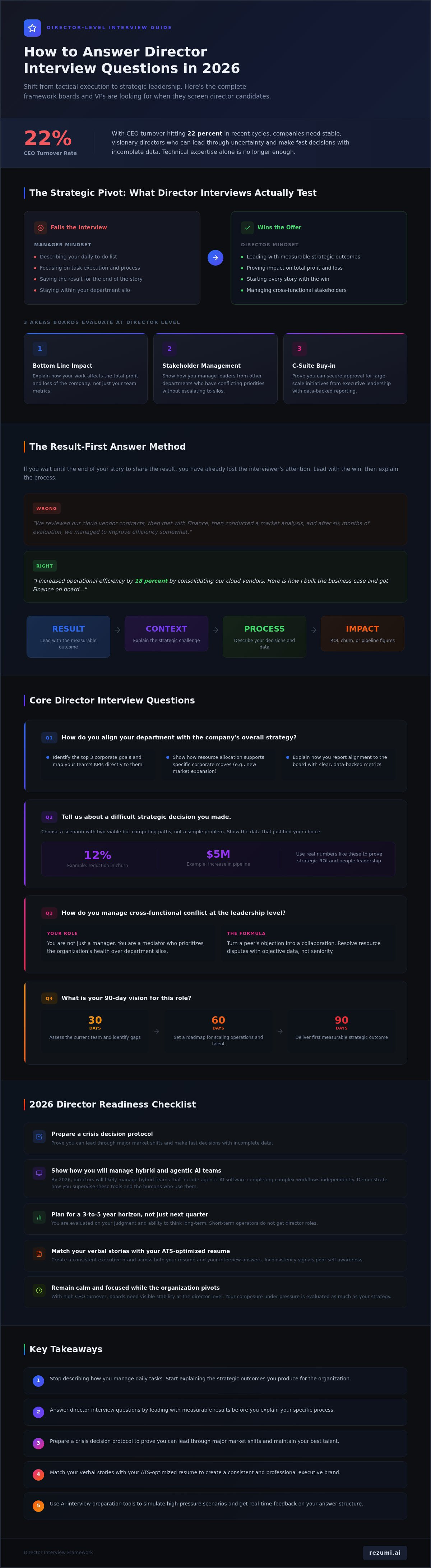
What if your deep technical expertise is actually holding you back from your next promotion? Many senior leaders walk into the room ready to discuss how they manage tasks. They leave without an offer because they failed to answer director interview questions with a strategic mindset. It is frustrating to feel over-qualified and still face rejection. You know how to run a department, but boards are looking for more than just stability. With CEO turnover signals hitting 22 percent, companies now demand leaders who can steer through rapid change.
You must shift your focus from tactical execution to high-level strategic impact to win the role. This guide shows you how to quantify your leadership and align your experience with 2026 corporate standards. We will provide a clear framework for executive answers and show you how to handle the curveball leadership questions that often trip up even the most seasoned candidates. You'll move from feeling anxious about AI-driven screening to feeling in total control of your career narrative.
Key Takeaways
- Stop describing how you manage daily tasks and start explaining the strategic outcomes you produce for the organization.
- Answer director interview questions by leading with measurable results before you explain your specific process.
- Prepare a crisis decision protocol to prove you can lead through major market shifts and maintain your best talent.
- Match your verbal stories with your ATS optimized resume to create a consistent and professional executive brand.
- Use AI interview preparation tools to simulate high-pressure scenarios and get real-time feedback on your answer structure.
The Strategic Pivot: How Director Interviews Differ from Management
Directors aren't hired to manage tasks. They are hired to manage risk and deliver results. If you answer director interview questions by listing your daily to-do list, you will fail the interview. You must demonstrate how you align your department with the company's financial goals. Think of the interview as a business consultation rather than a standard Q&A session. The board or VP is presenting a problem, and you are presenting a solution backed by data.
From Execution to Influence
Your impact must reach beyond your immediate team. Successful directors understand director-level responsibilities and governance, which means protecting shareholder value while driving growth. You are being evaluated on your judgment and your ability to plan for the next three to five years, not just the next quarter. To succeed, focus on these three areas:
- Bottom Line Impact: Explain how your work affects the total profit and loss of the company.
- Stakeholder Management: Show how you manage leaders from other departments who have conflicting priorities.
- C-Suite Buy-in: Focus on your ability to secure approval for large-scale initiatives from executive leadership.
The 2026 Performance Bar
The hiring environment is shifting rapidly. CEO turnover has reached 22 percent in recent cycles, creating a need for stable, visionary directors who can lead through uncertainty. You must prove you can remain calm and focused while the organization pivots. High-stakes director interview questions will test your ability to make fast decisions with incomplete data, a standard requirement for North American leadership roles.
Your team structure is also changing. By 2026, you will likely manage hybrid teams that include agentic AI (software that can complete complex workflows independently). You must show how you will supervise these tools and the humans who use them. Rezumi helps you practice these high-level responses through our AI Interview Prep tool, ensuring your narrative matches the speed and precision expected in the current market.
Core Director Interview Questions and Strategic Answers
Leading with outcomes is the only way to stand out in a competitive hiring market. If you wait until the end of your story to share the result, you have already lost the interviewer's attention. Start with the win. For example, you might say, "I increased operational efficiency by 18 percent by consolidating our cloud vendors." Then explain the process. This "result-first" method proves you are focused on the bottom line, which is exactly what boards look for when asking director interview questions.
How do you align your department with the company's overall strategy?
Answer this by identifying the top three corporate goals and mapping your team's Key Performance Indicators (KPIs) directly to them. If the company wants to expand into the Canadian market, show how your department's resource allocation supports that specific move. Explain your process for cutting low-value tasks that don't move the needle. You should also mention how you report this alignment to the board. Clear, data-backed reporting proves you understand director and executive job outlook data and the high standards of modern leadership.
Tell us about a time you had to make a difficult strategic decision.
Don't pick a simple problem. Choose a scenario where you had to choose between two viable but competing paths. Perhaps you had to decide between investing in new technology or expanding the sales team. Explain the data you used to justify the choice. Focus on the Return on Investment (ROI) and how you handled the team's emotional response to the change. Directors must show they can handle the people side of a pivot as well as the profit side. Use real numbers to show the success of your choice, such as a 12 percent reduction in churn or a 5 million dollar increase in pipeline value.
How do you manage cross-functional conflict at the leadership level?
You aren't just a manager; you're a mediator. When a peer in Finance disagrees with a peer in Marketing, you must prioritize the organization's health over department silos. Describe a time you turned a peer's objection into a collaboration. Explain your framework for resolving resource disputes using objective data rather than seniority. This shows you are ready for the complexity of the North American market. Practicing these high-stakes scenarios is easier when you use AI interview preparation to refine your delivery and timing before the actual meeting.
Finally, prepare for the 90-day vision question. You must show you can scale operations and talent simultaneously. Explain how you will assess the current team, identify gaps, and set a roadmap for the first two quarters. This level of preparation shows you aren't just looking for a job, but are ready to take ownership of the department's future.
Behavioral Scenarios: Leading Through Crisis and Change
Standard director interview questions often pivot to behavioral scenarios. You need a protocol for the first 72 hours of any major threat. This shows you have a framework for decision making. You aren't just reacting. You are leading. A successful protocol includes:
- Identifying the immediate risk to the core business.
- Communicating a clear plan to all stakeholders.
- Stabilizing your team to prevent panic.
Your response should prove that you can stop the bleeding while maintaining the trust of your executive peers. Change fatigue is a real risk in 2026. Constant pivots wear teams down. You must position yourself as the leader who can solve this problem. Explain how you maintain competitive differentiation by keeping your team focused on high-value outcomes while the technology around them shifts. This approach turns a potential weakness into a strategic advantage.
Talent retention during mergers or workforce shifts is a key metric. You are being evaluated on your ability to keep high performers from jumping ship. This aligns with current director and executive role requirements where leadership stability is a top priority. Boards want to see that you can protect the company's best people during high-stakes transitions.
Managing Compound Threats
Imagine facing a talent cliff and a sudden budget cut at the same time. You must show how you prioritized actions to keep the core business running. You stay calm. You provide clear direction. You don't hide the truth from your team, but you give them a path forward. This level of transparency builds a culture where people stay because they trust your leadership, not just their paycheck.
Building a Culture of Execution
Speed of execution is your competitive advantage. You build this by creating internal talent marketplaces. Upskilling your existing staff is cheaper and faster than hiring from scratch. You also need to build coalitions across boards, investors, and regulators. This ensures your department has the support it needs to move fast without breaking compliance. When you answer director interview questions, emphasize these cross-functional wins to prove your readiness for the role.
Use AI Interview Prep to practice these high-pressure scenarios. It helps you find the right balance between being authoritative and being empathetic. You will learn to deliver your crisis protocol with the confidence that North American hiring managers expect. Don't leave your executive narrative to chance.
Preparing Your 2026 Executive Narrative
Your interview story must be a perfect match for your data. Hiring managers will cross-reference your verbal answers with your application materials. Any mismatch creates doubt. You must map your career milestones to the North American market's demand for rapid execution and clear ROI. This consistency builds the trust needed to secure a director-level offer.
Prepare a "Day 1 Readiness" playbook. This is a mental framework showing how you will take control of the department. It proves you aren't just a candidate. You are a strategic partner ready to deliver. When you answer director interview questions, your delivery must be authoritative but accessible. You want to sound like the person who already has the solution.
Step 1: Audit Your Strategic Impact
Review your past roles and extract three major strategic wins. These wins must be backed by hard data. If you saved a company money, state the exact dollar amount. If you grew a team, state the percentage of growth. Ensure these wins align with the keywords in your ATS resume to maintain a unified brand. Write a one sentence summary for each win that leads with the result. For example: "I reduced operational overhead by 14 percent through automated vendor management."
Step 2: Align with the Job Description
Identify the top three pain points the company is trying to solve. Every hire is a solution to a problem. Tailor your answers to show you have solved these exact problems before. Use ai resume builder tools to find hidden gaps in your profile that might trigger a red flag. Addressing these gaps early in the interview prevents the hiring committee from forming negative assumptions about your fit for the role.
Step 3: Refine Your Board-Room Presence
Respect the interviewer's time by practicing short answers. Aim for 90 seconds or less per response. Focus on your posture and tone. You should sound calm and confident, even when facing difficult director interview questions. Handle interruptions with grace. If an executive cuts you off, listen first and then pivot back to your strategic point. Record your practice sessions. This helps you identify and eliminate filler words or hesitant phrasing that can undermine your authority.
Mastering the Interview with AI Coaching
Modern leadership requires more than just experience. It requires the ability to articulate that experience under extreme pressure. AI interview preparation tools allow you to simulate high-stakes scenarios anytime. You can practice complex director interview questions without the scheduling conflicts or high costs of traditional human coaching. This on-demand access builds the muscle memory you need to stay calm during a board-level review.
You get a safe space to fail and refine your narrative. The 2026 market is unforgiving for those who appear hesitant. Practicing with thousands of director-level variations ensures you aren't surprised by curveball questions. You move from a state of anxiety to a state of total control. This transition is vital for securing high-compensation roles in North America.
The Power of Instant Feedback
Guesswork has no place in executive preparation. You need to know exactly how your answers land with a hiring committee. Learn how AI identifies if your answers are too tactical or too vague. If you spend too much time on daily operations, the system flags the lack of strategic impact. This allows you to pivot your language before you ever step into the interview room.
Objective measurement replaces subjective opinion. You can adjust your tone and pace based on data. Directors should speak with a steady, authoritative rhythm. If you speak too fast, you sound nervous. If you speak too slow, you lose momentum. AI tools provide the specific metrics you need to command the room with confidence. Knowing your answers are already optimized for success removes the fear of the unknown.
Ready to Command Your Next Interview?
Preparation is the only thing that separates winners from drifters in the 2026 market. Companies are looking for leaders who are ready to hit the ground running. You cannot afford to "wing it" when the stakes involve a director-level salary and significant corporate responsibility. Ensure your resume and interview skills are both at the executive level to maximize your success rate.
Your career path is a series of strategic choices. Choosing the right tools is the first step toward your next promotion. Use data-backed insights to refine your narrative for specific North American industries. You will walk into your next meeting knowing your answers are already aligned with the highest standards of excellence. Check out the Rezumi pricing plans to start your AI-driven coaching today.
Secure Your Seat at the Executive Table
Success in a high-stakes interview requires a fundamental shift in how you present your value. To master director interview questions, you must stop acting like a manager and start thinking like a strategic partner. Focus on the specific outcomes you produce rather than the tasks you complete. Boards in the 2026 market demand leaders who can steer through crisis and manage AI-human hybrid teams with confidence.
Consistency is your greatest asset in the North American market. Your verbal narrative must be a perfect match for your ATS optimized resume to build immediate trust. Rezumi provides the tools you need to bridge this gap. Our AI-driven interview prep offers real-time feedback on your leadership narrative, ensuring your answers are refined for the highest corporate standards. You can practice thousands of variations until your delivery is calm, authoritative, and precise.
You have the experience to lead a department to success. Now you have the data-backed strategy to prove it to the hiring committee. Step into your next interview with the reassurance that your preparation is complete.
Frequently Asked Questions
How do I answer 'Tell me about yourself' at the director level?
Lead with your most significant achievement that matches the current role's needs. Summarize your career as a series of strategic wins rather than a list of duties. Connect your past success to the company's future goals. This proves you are ready to solve their specific problems from day one. Avoid personal hobbies or early-career details that don't demonstrate high-level leadership. You want to sound like a partner, not just an applicant.
What are the most common director interview questions in 2026?
In 2026, you'll face director interview questions about managing AI-human hybrid teams and navigating market volatility. Expect questions like "How do you align departmental KPIs with board-level vision?" or "Describe your protocol for handling a sudden talent cliff." Interviewers are looking for evidence of agility and the ability to scale operations. They want to see that you can protect profit margins while maintaining a high-performance culture during rapid technological shifts.
How should I discuss my leadership style in an executive interview?
Define your style by the outcomes it produces rather than using vague adjectives. Instead of saying you are "collaborative," explain how you build coalitions across conflicting departments to hit revenue targets. Discuss how you adapt your approach based on team maturity and project complexity. This shows you are a nuanced leader who understands how to drive execution in the North American corporate environment without being rigid. Always tie your style back to measurable team performance.
How do I prepare for a director-level behavioral interview?
Prepare five to seven hero stories that demonstrate your ability to handle crisis, conflict, and growth. Focus on the data-backed results of your actions. A director-level answer should spend 20 percent of the time on the problem and 80 percent on the strategic solution and its long-term impact. Practice these stories until you can deliver them naturally without sounding like you are reading from a script. Use real numbers to prove your impact.
What questions should a director candidate ask the interviewers?
Ask questions that show you are already thinking about the company's success. You might ask, "What does success look like for this role in the first 12 months?" or "How does the board plan to navigate the current industry shift toward automation?" These questions prove you are looking at the big picture. They also help you determine if the organization's strategic goals align with your leadership strengths and your career trajectory.
How long should my answers be in a senior leadership interview?
Keep your answers between 90 seconds and two minutes to respect the interviewer's time. Executive interviews are often tightly scheduled, and brevity is a sign of confidence. If a question requires more detail, give a high-level summary first and then ask if they would like you to expand on a specific part. This approach keeps the conversation engaging and ensures you are focusing on what the hiring committee actually cares about.
Can AI tools really help me prepare for a high-level executive role?
AI tools like Rezumi's AI Interview Prep are essential for simulating high-pressure board scenarios. They provide objective feedback on your tone, pace, and the strategic alignment of your answers. You can't get this level of data-driven insight from practicing in a mirror or with a friend. These tools help you identify and fix tactical tells that might make you sound like a manager rather than a director. It's about data, not just practice.
What is the best way to show strategic thinking during an interview?
Always link your decisions to the company's financial goals and long-term vision. When describing a project, explain the "why" behind the "what." Show how you assessed risks and identified opportunities that others missed. This demonstrates that you aren't just following a plan; you are actively shaping it to ensure the organization remains competitive. Strategic thinking is about seeing the ripple effects of every departmental move on the total business.
Disclaimer
This article is provided for general informational purposes only and does not constitute professional, legal, financial, or career advice. While Rezumi strives for accuracy, we make no warranties as to the completeness or reliability of this content. Hiring practices, ATS behavior, and job-market conditions vary by employer, industry, and region — always verify against your specific situation. Any action you take based on this article is at your own risk.