Flight Attendant Resume: How to Show Safety, Service, and ATS-Relevant Skills
Your flight attendant resume should show more than customer service. Airlines put passenger safety first, so connect your experience to clear communication, following procedures, staying composed under pressure, and helping people in demanding situations.
If you’re coming from retail, hospitality, healthcare, or another field, you may already have relevant skills. The key is to describe them accurately and show how you used them. When your resume’s wording doesn’t reflect the job description, an applicant tracking system (ATS) may not recognize the match.
This guide shows you how to connect your experience to airline priorities, write specific achievement bullets, and use relevant keywords naturally. You’ll also learn how to tailor each application so recruiters and ATS software can find the strongest evidence quickly.
Key Takeaways
- Build your flight attendant resume around truthful evidence of safety, service, communication, and teamwork.
- Turn task lists into concise bullets that show what you did and how you helped customers or supported a team.
- Use relevant wording from each job description, but include only skills and experience you can support.
- Keep a strong base resume, then tailor its evidence and wording to each airline posting.
- Use Rezumi’s workflow to review ATS Score, Job Match %, and Keyword %, prioritize P1 critical terms, and prepare with the CAR-framework.
What a Flight Attendant Resume Needs to Show Recruiters
A flight attendant resume should connect your work history to the skills needed in a cabin crew role. Show, with truthful examples, how you follow procedures, support customers, communicate clearly, and work with others. Prior aviation experience can help, but it isn’t the only way to demonstrate those strengths. Hospitality, retail, healthcare, and other people-focused roles can provide relevant evidence too.
A targeted flight attendant resume is a clear, truthful summary of your experience, skills, and training, selected to match a specific airline job posting. The role combines passenger safety and comfort, as described in this overview of the Flight attendant profession. Make your relevant strengths easy to find without suggesting you’ve performed duties you haven’t.
Which resume sections should you include?
Use familiar section names so recruiters can scan your information and resume-parsing software can sort it into expected categories. Put the most relevant details first, and leave out sections that don’t support your application.
- Contact details: Include your name, phone number, professional email, and city and state or province.
- Summary: Write a brief introduction that connects your strongest relevant experience to the role.
- Work history: List your recent roles and focus on responsibilities or results that show relevant skills.
- Education: Include your completed education and any relevant training.
- Skills: Name specific abilities, such as customer communication or conflict resolution, when your experience supports them.
Add certifications or language abilities only if they’re accurate and relevant to the posting. Don’t list a credential you haven’t earned or describe your language ability more strongly than you can demonstrate.
How should the resume balance safety and service?
Show both careful judgment and positive passenger-facing service. A resume focused only on friendliness may not show how you handle procedures or difficult situations. A resume focused only on rules may leave out how you communicate with people and contribute to a team.
Choose examples from your actual responsibilities. For instance, if you worked at a hotel, you might describe listening to a guest’s concern, following the workplace process for resolving it, and coordinating with a colleague. Use that example only if it reflects what you did. Don’t imply that you handled aircraft safety or emergency procedures if you haven’t.
Replace broad claims with evidence. “Passionate about helping people” tells a recruiter little on its own. A stronger summary names the setting, skill, and application, such as assisting customers during busy shifts while following service procedures. Keep the details accurate, specific, and relevant to the airline posting.
Turn Your Experience into Flight Attendant Resume Evidence
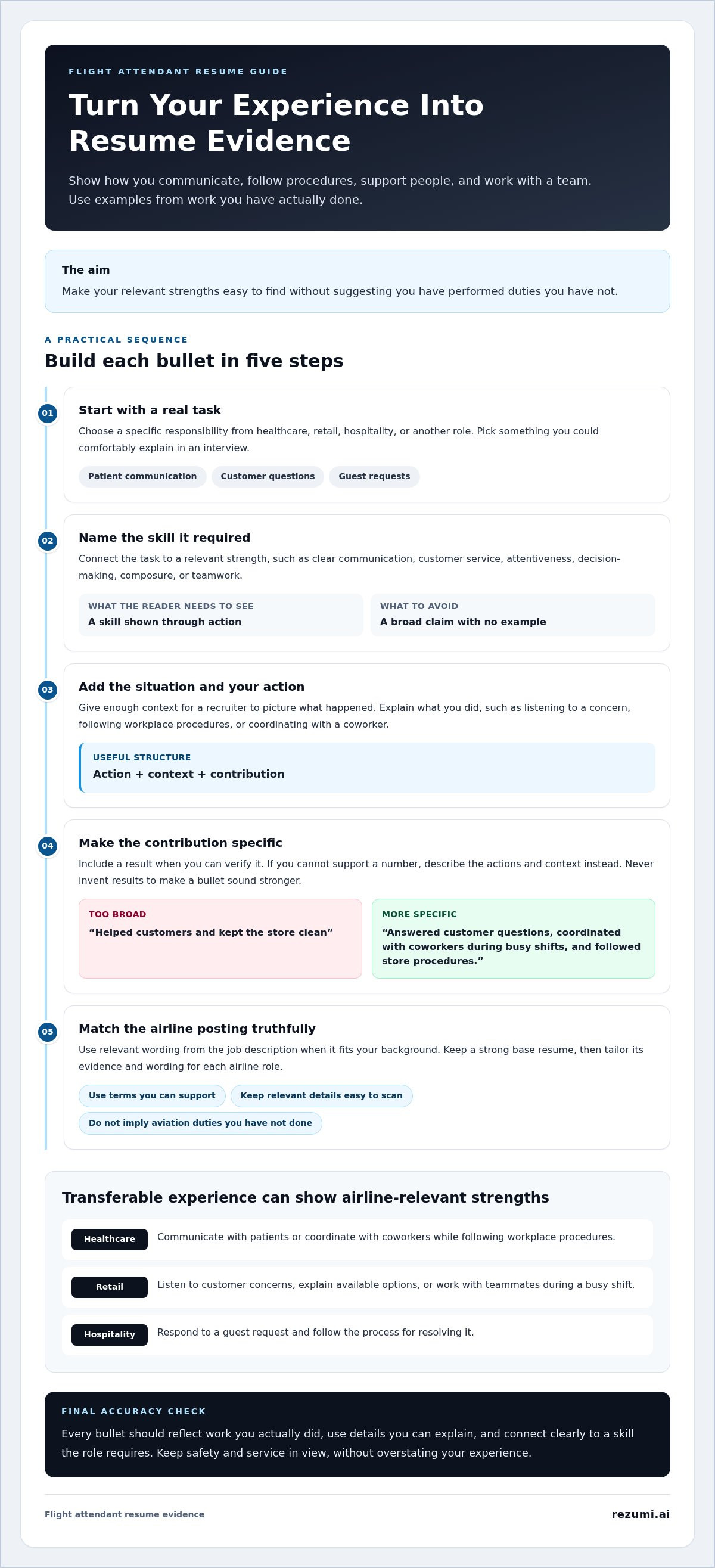
Choose work examples that show what you did, the situation you handled, and how you contributed. Communication, composure, teamwork, and service are more convincing when a recruiter can picture you using them, rather than seeing them listed without context.
Transferable skills need evidence, not an aviation job title. The U.S. Bureau of Labor Statistics Occupational Outlook Handbook describes skills such as communication, customer service, attentiveness, and decision-making. Use those themes to guide your examples, then connect them to duties you actually performed.
How can career changers present transferable skills?
Start with a real task from healthcare, retail, hospitality, or another field. Identify the skill it required, then explain the context and your contribution. This action, context, and result structure helps show relevance without implying airline experience or claiming outcomes you can’t support.
- Healthcare: Describe how you communicated with patients or coordinated with coworkers while following workplace procedures.
- Retail: Show how you listened to a customer’s concern, explained available options, or worked with teammates during a busy shift.
- Hospitality: Explain how you responded to a guest request and followed the process for resolving it.
Make the result specific, but don’t invent numbers. For example, replace “Helped customers and kept the store clean” with “Answered customer questions, coordinated with coworkers during busy shifts, and followed store procedures.” If you can verify a result, include it. If not, the actions and context still give the reader useful evidence.
Look beyond customer service, too. A training example can show that you learn procedures and apply feedback. A teamwork example can show how you share information or support a colleague. Choose details you could comfortably explain in an interview.
How should experienced flight attendants describe their work?
Lead with experience that matches the specific role you’re pursuing. If accurate, describe relevant cabin safety, passenger service, communication, or crew coordination responsibilities. Use terms from the posting when they fit your background, and briefly explain specialized language so a general recruiter can understand your contribution.
For example, “Completed preflight safety checks” is clearer than “Handled cabin readiness” if checks were part of your actual duties. Include aircraft types, certifications, training, or achievements only when they’re current, accurate, and verifiable. Don’t imply that one aircraft qualification or credential applies to every airline or role.
As you revise, check whether each bullet proves a skill the job requires. Rezumi is purpose-built for North American hiring and helps you tailor resume content to a specific job. Explore the resume optimization workflow as you prepare your application. No contracts. Cancel anytime.
Flight Attendant Resume Keywords and ATS Readability
Use the airline’s job description to decide which keywords belong in your resume. An applicant tracking system (ATS) is software employers may use to collect, organize, or parse application information. It isn’t the hiring decision-maker, and including a keyword alone won’t prove you have the skill.
Read the posting and mark repeated skills, qualifications, and role terms. Then compare each one with your work history, training, and credentials. The goal is clear overlap, not copying every phrase or claiming experience you don’t have.
How do you identify relevant flight attendant keywords?
Sort posting terms into three groups before editing. This quick check helps you decide what to include, what to leave out, and what may point to a gap you shouldn’t disguise.
| Term type | How to handle it | Example |
|---|---|---|
| Supported | Use the term where it accurately describes your experience. | “Customer service” if your work involved assisting customers. |
| Missing | Don’t claim it. Add it only after you’ve earned the qualification or gained the experience. | “FAA certification” if you don’t hold that credential. |
| Irrelevant | Skip terms that don’t match the role or your background, even if they appear in the posting. | A duty or skill unrelated to your experience and the job’s requirements. |
Place supported terms where they read naturally: in your summary, skills section, or a work-history bullet that shows how you used them. For example, “Resolved customer concerns by listening, explaining available options, and following store procedures” gives context for customer service. Don’t repeat a phrase just to increase its frequency.
The Association of Flight Attendants-CWA (AFA-CWA) is a professional organization focused on flight attendant workplace and safety issues. Its terminology can help you understand the profession, but use an industry term in your application only when it matches the employer’s posting and your experience.
What makes a resume easier for ATS to parse?
Keep the document simple to read on screen and in print. Use clear headings such as “Work Experience,” “Education,” and “Skills,” with readable text and a straightforward layout. Avoid placing essential details only in icons, graphics, columns, or decorative elements, since some systems may not interpret them as expected.
ATS-readable formatting still needs to work for a recruiter. Keep job titles, employers, and dates easy to locate, and make bullets concise enough to scan quickly. For more practical guidance on matching your resume to software without keyword stuffing, read the ATS resume optimization guide.
Before submitting your flight attendant resume, compare it with the posting once more. Every important term should be supported by a real example, a valid credential, or relevant experience. If you can’t explain a keyword honestly in an interview, remove or revise it.
Tailor Your Flight Attendant Resume to Each Job
Keep one strong base resume, then adjust it for each airline posting. Your base version holds your full, accurate work history, skills, and training. A tailored copy brings the most relevant details forward, helping the recruiter quickly see how your experience fits the role.
Use this repeatable process for each application:
- Inspect the posting. Note the main responsibilities, skills, and qualifications. Pay attention to terms that appear more than once, but don’t assume every listed qualification applies to you.
- Select your evidence. Choose work-history bullets, skills, and training that support the posting’s priorities. Keep your role, duties, and results accurate.
- Tailor the wording. Use the employer’s language when it truthfully describes your experience. Adjust your summary and bullet emphasis, but don’t copy qualifications you don’t have.
- Review readability. Check that headings, job titles, dates, and key details are easy to scan. Read the resume as a recruiter would, looking for clear links between the posting and your experience.
- Export the right file. Follow the application’s file and page-size instructions. Use PDF when the employer accepts it, and select US Letter or A4 to match the stated requirements.
What should you change for each application?
Start with the summary and the order or emphasis of your experience bullets. If one posting stresses customer communication, bring forward a real example of resolving customer concerns. If another focuses on teamwork, highlight a supported example of coordinating with coworkers. Keep all qualifications truthful, and check spelling, dates, contact details, and consistent wording before submitting.
A tailored version should feel focused, not rewritten from scratch. Keep a master copy with your full experience, then save a separate version for each application. This makes it easier to compare changes, preserve useful details, and keep every submitted flight attendant resume aligned with the role without changing the facts.
How should you prepare the final resume file?
Choose a clean design that makes your contact details, summary, work history, and skills easy to locate. Keep fonts readable and avoid decorative elements that compete with the content. Before exporting, confirm the employer’s requested file type and page size. If the posting gives no preference, use a clear, text-based format that remains easy to read on screen.
For more guidance on choosing a format for North American applications, see the North American resume format guide. Then save the final file with a clear name that identifies you and the role, and open the exported document to confirm the layout looks as intended.
Use Rezumi to Prepare a Tailored Flight Attendant Application
Rezumi brings resume tailoring and application preparation into one guided workflow. Purpose-built for North American hiring, it helps you organize your experience, compare your resume with a flight attendant job description, and prepare application materials. Its feedback can guide your revisions, but it doesn’t promise a job offer or interview.
The workflow moves through four steps:
- Build profile: Use the Profile Editor to organize your background and experience.
- Write & optimize: Build and tailor resume content, then review ATS feedback.
- Design & export: Choose a design and export your resume as a PDF.
- Cover letter & interview prep: Prepare a cover letter and practice role-specific interview responses using the CAR-framework.
How does Rezumi support resume tailoring?
Create a dedicated workspace for each application to keep job-specific resume work organized. Rezumi supports 300 + workspaces per plan, so you can keep tailored versions separate while maintaining a consistent record of your experience. In Write & ATS, review real-time ATS Score, Job Match %, and Keyword % feedback as you refine your content.
Use those indicators as editing guidance, not as a reason to add terms that don’t fit your background. Check whether a suggested keyword reflects your real experience, then revise the relevant summary or bullet only when it’s accurate. Keyword priorities appear as P1 critical, P2 preferred, and P3 nice-to-have, helping you focus on the terms emphasized in the posting.
What else can you prepare in the same workflow?
After refining the content, use Design view to choose a clear layout, then export a PDF in US Letter or A4 to match the application’s stated requirements. You can also generate a cover letter and prepare for role-specific interview questions with CAR-framework practice. CAR stands for Challenge, Action, and Result. It helps you explain what happened, what you did, and the outcome you can support.
Rezumi reports a 91 % average ATS score and 20 + hours saved per application. Its workflow is described as 4× steps from profile to hired. These figures describe platform claims, not a promise of hiring results. A Free starter tier is available, and you can upgrade to paid plans when ready. No contracts. Cancel anytime. All prices exclude applicable taxes.
Take the Next Step Toward Your Airline Application
Your next application is a chance to make your experience easy to understand. Before you submit, read your resume from the recruiter’s point of view: can they quickly see what you bring, and can you stand behind every detail in a conversation? A focused flight attendant resume doesn’t need to make you sound like someone else. It needs to make your real strengths clear.
Use each application to refine your approach. Keep your claims accurate, choose examples that fit the role, and make the next version even clearer. Rezumi can help you organize that work and prepare tailored application materials.
You’ve built relevant experience already. Present it with care, trust the evidence, and take your next step with confidence.
Frequently Asked Questions
Can I write a flight attendant resume with no aviation experience?
Yes. Put your closest related experience where it’s easy to notice, even if it comes from volunteer work, campus activities, or a part-time role. A flight attendant resume can show how you handled a real situation without suggesting you worked on an aircraft. Follow the employer’s stated qualifications, and be ready to explain what you did, what you learned, and how that experience could apply to the role.
What should I include on a flight attendant resume?
Include contact details, a brief profile, relevant work history, education, and skills. Use clear dates and job titles, and list work history in reverse chronological order so readers can follow your path. Keep the profile specific to the application rather than using a broad career objective. Certifications and language abilities can add useful context, but include them only when accurate and relevant to the role.
How do I make my flight attendant resume ATS-friendly?
Use a straightforward layout and wording that matches your actual experience. After uploading your file, review any information the application form fills in automatically. Correct errors in names, dates, job titles, or section placement before submitting, since those details can affect how your application is displayed. If the system asks you to enter information separately, check that it matches your resume.
What skills should I put on a flight attendant resume?
Choose skills that fit the posting and that you can explain with a clear example. Communication, customer service, teamwork, and careful attention to responsibilities may be relevant, depending on your background. If you list a language, describe your ability accurately rather than using a broad label that could overstate your fluency. Prioritize the skills most connected to the role instead of trying to include every strength you have.
How long should a flight attendant resume be?
Let the amount of useful, relevant experience determine the length, and follow any instructions from the employer. If you’ve held several roles, give more space to the work that best supports this application and condense older or less related positions. Remove repeated duties and details that don’t help explain your fit. Don’t cut a relevant qualification simply to meet a page count the employer didn’t request.
Should I include certifications on a flight attendant resume?
Include a certification if you hold it and it applies to the posting or the employer asks for it. Copy the credential’s official name from your record, and distinguish a completed certification from a course you’re still taking. If it has an expiration date, make sure the date you provide is accurate. This helps recruiters understand what you’ve earned without mistaking training in progress for a current credential.
Should I use a PDF for a flight attendant resume?
Use a PDF when the employer accepts it or requests it. Before uploading, open the saved file and confirm it’s the final version, not an earlier draft with outdated contact details or edits. Give the file a clear name, such as “First_Last_Flight_Attendant_Resume.pdf,” so it’s easy to identify among application documents. If the posting specifies another file type, follow that direction instead.
Ready to tailor your flight attendant resume to a specific airline posting? Explore Rezumi plans and organize your resume, cover letter, and interview preparation in one workflow.
Disclaimer
This article is provided for general informational purposes only and does not constitute professional, legal, financial, or career advice. While Rezumi strives for accuracy, we make no warranties as to the completeness or reliability of this content. Hiring practices, ATS behavior, and job-market conditions vary by employer, industry, and region — always verify against your specific situation. Any action you take based on this article is at your own risk.