Harvard Resume Format: The 2026 Guide to the Gold Standard
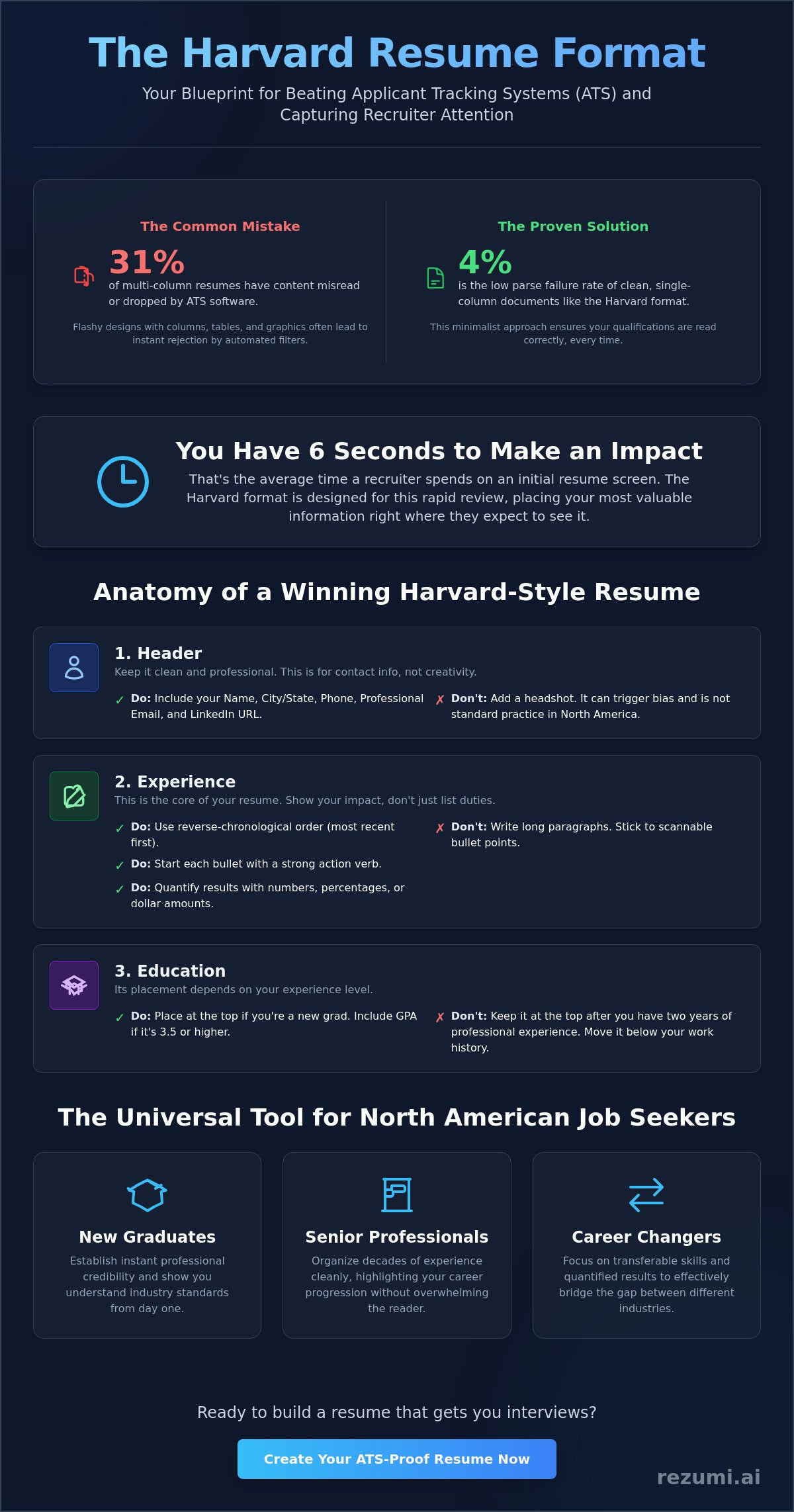
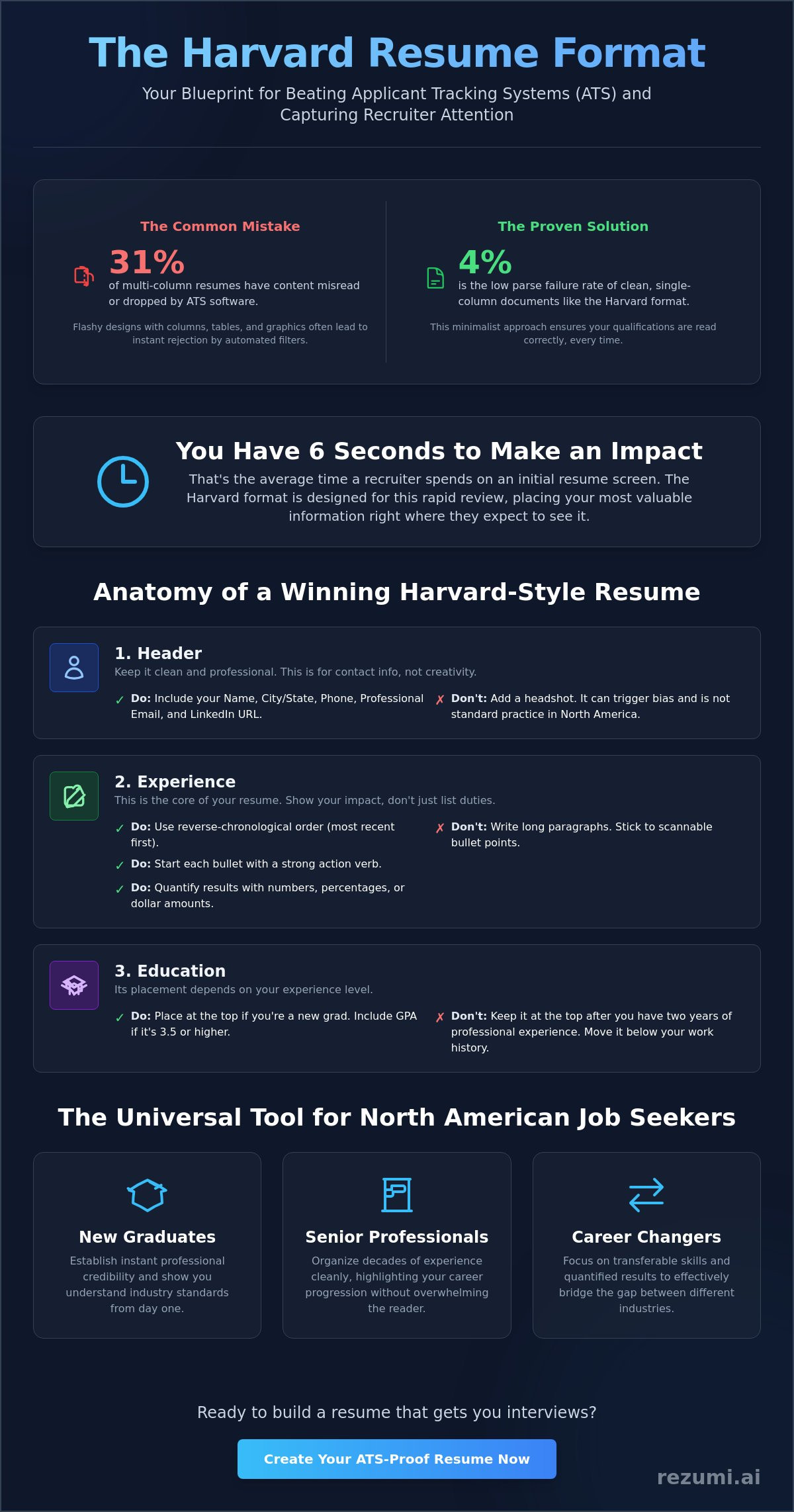
About 31% of applicant tracking systems misread or drop content from multi-column PDF resumes. This technical failure is why your applications often disappear into a digital void before a human ever sees them. You likely feel the frustration of sending out dozens of applications only to receive automated rejections. It's difficult to know how much detail to include or how to make your achievements stand out without looking cluttered.
The harvard resume format solves these technical hurdles while meeting the high standards of North American recruiters. You'll learn to build a resume that maintains the low 4% parse failure rate of clean, single-column documents. This approach ensures your professional presentation captures a recruiter's attention during their average 6-second initial screen. We'll break down the exact layout requirements, show you how to quantify your impact with real numbers, and provide the steps to create a clean document that converts into interviews.
Key Takeaways
- Understand why the harvard resume format remains the top choice for passing automated filters and impressing human recruiters.
- Learn how a simple, single-column structure eliminates the parsing errors that cause many modern resumes to fail.
- Master the specific framework for bullet points that combines strong action verbs with measurable results to prove your impact.
- Identify the exact components needed for a professional header and education section that meet high-level hiring standards.
- Discover how to move beyond a static template by tailoring your content to match the specific requirements of every job ad.
What is the Harvard Resume Format?
The harvard resume format is a minimalist, single-column document designed for maximum readability. It follows a reverse-chronological structure. This means your most recent achievements appear first, followed by your previous roles in descending order. It isn't just a template; it's a strategic hierarchy of information. Top firms in finance, management consulting, and Big Tech expect this specific layout. They want to find your impact immediately without digging through creative distractions.
While the history of the resume shows various styles over the decades, the Harvard standard has remained remarkably consistent. It prioritizes clean typography and a logical flow. You won't find headshots, skill bars, or complex graphics here. Instead, you get a document that speaks the language of recruiters and automated systems alike. It is the gold standard because it removes the friction between your experience and the person hiring you.
The "Express, Not Impress" Philosophy
Flashy designs often hide a lack of substance. Recruiters recognize this pattern. A document with heavy colors or sidebars might look good on your screen, but it frequently confuses the human eye and the ATS. The Harvard philosophy focuses on your value rather than your design skills. White space is your secret weapon. It guides the reader's eye to your most impressive data points. You should focus on hard facts and quantifiable results. Avoid flowery adjectives like "passionate" or "hardworking." These words take up space without adding value. Let your numbers do the talking. If you managed a budget, state the dollar amount. If you led a team, list the exact headcount.
Who Should Use This Format?
This format isn't just for Ivy League students. It's a universal tool for anyone targeting the North American market. It works effectively across all career stages:
- New Graduates: It establishes instant professional credibility. It shows you understand industry standards before you even step into the office.
- Senior Professionals: It provides a clean way to organize decades of experience. You can highlight career progression without the page becoming a wall of text.
- Career Changers: The focus on transferable skills and quantified results helps bridge the gap between different industries.
If you're applying for a role in the United States or Canada, this is your safest bet. It removes the risk of technical rejection and keeps the focus entirely on your career trajectory. You don't need a "creative" resume to stand out. You need a resume that is easy to read and impossible to ignore.
Key Components of a Harvard-Style Resume
The harvard resume format succeeds because it organizes your career into four distinct, scannable zones. You must include a header, education, experience, and a skills section. This structure isn't just a tradition. It's a calculated layout designed to provide the most important information in the first two inches of the page. Every element has a purpose. If a detail doesn't help a recruiter decide to interview you, it doesn't belong on the page.
Your header should be minimalist. Include your name, location (city and state), phone number, professional email, and LinkedIn URL. Do not include a photo. In North American hiring, photos can trigger bias concerns and lead to immediate rejection. Keeping this section clean ensures that the focus remains on your qualifications rather than your appearance.
Bullet Points vs. Paragraph Format
You might see some older academic CVs using dense paragraphs. Avoid this. Bullet points are the only choice for 99% of modern job applications. They allow recruiters to scan your history in seconds. More importantly, they help ATS software categorize your skills accurately. Unlike federal resume guidelines which often require extreme detail and longer descriptions, the Harvard style demands brevity. Stick to bullets to ensure your key wins aren't buried in a wall of text. Each bullet should be a single, punchy sentence that starts with a strong action verb.
Ordering Your Sections Strategically
Your career stage dictates the layout. New graduates should highlight their degree and GPA (if it's 3.5 or higher) at the top. This anchors your profile in academic excellence. Once you hit the two year mark in your industry, your education should move below your professional experience. You want the person hiring you to see your recent professional impact first. Maintaining this hierarchy manually can be difficult as your career grows. You might find it easier to use an automated profile editor to keep your sections aligned with these standards.
You can also add optional sections to round out your profile. These include:
- Leadership: Highlight board positions or team lead roles.
- Projects: Show off technical builds or independent research.
- Volunteer Work: Demonstrate community engagement and soft skills.
Finally, the skills and interests section should be brief. List technical proficiencies like Python or financial modeling. Add one or two personal interests at the very end. This humanizes your profile and provides a hook for small talk during an interview. It shows you are a well-rounded candidate who fits the company culture.
Why Harvard is the Gold Standard for ATS in 2026
Most resumes fail not because of the candidate's skills, but because of the document's architecture. The harvard resume format is the gold standard because it mirrors the scanning logic of modern Applicant Tracking Systems. These machines process text in a linear fashion, moving from top to bottom and left to right. When you introduce complex design elements, you break this flow. A single-column layout ensures the machine indexes every word in the correct order. It transforms your career history into a data stream that the ATS can actually understand.
Standard fonts also play a critical role in technical success. Using common options like Arial, Calibri, or Times New Roman ensures that the parser recognizes every character. If you use a custom or "creative" font, the machine might see a blank space or a series of errors. The Harvard style relies on these safe choices to guarantee your text is always readable. This technical reliability is why top-tier firms continue to mandate this format for all applicants.
Avoiding the Formatting Trap
Many job seekers use columns to save space, but this is a high-stakes gamble. Research indicates that approximately 31% of applicant tracking systems will misread or drop content from multi-column PDFs. When a parser hits a two-column layout, it often reads horizontally across both columns. This jumbles your sentences into nonsense. The harvard resume format eliminates this risk by sticking to a strict single-column flow. You should also keep your contact details in the main body of the document. Many older parsers ignore headers and footers entirely, which can leave a recruiter with no way to contact you. For online portals, submitting a clean .docx file can lower your parse failure rate to just 4%.
Data Hierarchy and Parsing Logic
Machines look for specific "anchors" to categorize your professional life. These anchors are standard section titles. If you use a heading like "Professional Experience," the ATS knows exactly where to find your job history. If you get creative with a title like "My Career Journey," the machine might skip the section because it doesn't recognize the label. The Harvard style uses these recognized anchors to guide the machine. This allows the software to accurately calculate your total years of experience and match your job titles to the role you want.
Clear date formatting is equally vital. The ATS needs to see your start and end dates to verify your tenure. If these are buried in a paragraph or placed in an unusual spot, the machine may report that you have zero experience. By placing dates on the right margin in a standard format, you provide the machine with the clean data it needs to rank you as a top candidate. This logical structure turns your resume into a high-performance tool built for serious results.
How to Write Your Harvard-Style Resume
Writing the content is where most candidates struggle. The harvard resume format requires a telegraphic writing style. This means you must remove all personal pronouns like "I," "me," or "my." Starting every bullet point with a strong verb makes your resume feel more professional and high-stakes. It shifts the focus from who you are to what you have actually achieved. This directness creates a sense of momentum that keeps recruiters reading.
You must follow a strict logical structure for every entry in your experience section. Every line should justify its place on the page. If a bullet point doesn't prove your value, it's just filler. Use the "Action + Context + Result" framework to ensure your contributions are clear. Start with the action you took. Explain the specific tools or methods you used. End with the measurable impact of that work. This framework turns a list of tasks into a record of success.
The Power of Action Verbs
Passive language is a resume killer. Phrases like "Responsible for" or "Assisted with" suggest you were a passive observer rather than a leader. Instead, use high-impact verbs that show ownership and movement. For technical roles, use words like Engineered, Deployed, or Debugged. For leadership positions, choose verbs like Spearheaded, Orchestrated, or Mentored. Analytical roles benefit from terms like Forecasted, Modeled, or Audited. Vary your word choice throughout the document. If you used "Led" in your current role, use "Directed" or "Oversaw" for your previous one. This prevents your writing from feeling repetitive during a recruiter's six-second screen.
Quantifying Your Achievements
Numbers are the language of business. Vague claims like "improved efficiency" don't carry weight in a competitive hiring process. You need to provide concrete data to build trust. Turn a weak statement like "Improved sales" into "Increased quarterly revenue by 22% ($450k) by implementing a new CRM workflow." Numbers provide the scale and context recruiters need to understand your impact. If you don't have exact figures, estimate based on your daily volume. Handling 40 customer calls per day adds up to 800 per month. That is a tangible scale. Focus on the final outcome of your work. Did you save the company money? Did you reduce the time a process took? If you want to ensure your language matches these high standards, you can use our ATS resume optimization to scan and fix your bullet points instantly.
Optimization: Moving Beyond the Template with Rezumi
A static template is only the beginning of your job search. Tailoring your content to match specific job descriptions is what actually secures interviews. The harvard resume format gives you a professional skeleton, but the data you put inside determines your success. Rezumi uses AI to analyze job ads and identify the exact keywords you need to include. This ensures your resume is not just a professional document, but a targeted tool that speaks directly to a recruiter's specific needs.
You can use the ATS Resume Checker to identify hidden gaps in your document. It provides real-time feedback on your bullet point strength. If a bullet point is too weak or lacks a quantifiable result, the system flags it immediately. This allows you to refine your impact before you hit the submit button. You aren't just guessing if your resume is good enough. You are using data to prove it is. This level of precision is what separates high-conversion resumes from those that get ignored by automated filters.
Tailoring at Scale
Sending the same resume version to every company is a losing strategy in 2026. You must adjust your listed skills and experience for every role to show direct alignment. AI makes this process efficient by suggesting adjustments that keep the harvard resume format intact while shifting the focus to relevant keywords. Once your document is ready, you should begin AI Interview Prep. This helps you transition from a strong paper profile to a confident verbal presentation. You can practice the specific stories you built in your resume to ensure you are ready for high-stakes questions.
Final Polish and Export
Your resume must be easy to read for both humans and machines. Aim for an 8th-grade reading level to ensure that busy recruiters can process your value in their initial 6-second screen. Use plain English and avoid industry jargon that doesn't add measurable value. A final check for spelling and grammar is non-negotiable. Even a minor typo can signal a lack of attention to detail and end your candidacy. Once you are confident in the content, export your file using a clean PDF or .docx format. This ensures your optimized layout maintains its integrity when it hits the recruiter's inbox. You are now ready to submit a document built for serious results.
Secure Your Professional Future Today
The harvard resume format is more than a design choice. It is a technical shield against automated rejection. By prioritizing a clean, single-column layout and data-backed bullet points, you ensure that both machines and humans recognize your value. You now have the framework to transform your daily tasks into a narrative of measurable success. This transition from uncertainty to control is the foundation of a high-performance job search.
Stop letting hidden technical errors or jumbled formatting block your career progress. Thousands of successful applicants use Rezumi to meet North American hiring standards and pass strict filters. You can access AI-powered ATS scoring to identify gaps and refine your professional presentation instantly. It's time to replace the anxiety of the application process with a data-driven strategy that delivers tangible results. You've done the hard work in your career; now ensure your resume reflects that excellence.
Optimize your Harvard resume for the ATS now and move closer to your next professional milestone. You have the tools and the strategy. Now, it is time to execute.
Frequently Asked Questions
Is the Harvard resume format too simple for creative roles?
It is not too simple; it serves as a high-performance foundation. While creative roles allow for more visual flair, the harvard resume format ensures your technical skills are indexed by the ATS first. You should include a link to your online portfolio or GitHub to showcase your design work. This strategy satisfies the machine's need for data and the human's desire for creativity.
Can I use more than one page for a Harvard-style resume?
Stick to one page unless you have more than 10 years of relevant experience. Recruiters spend an average of six seconds on their initial screen, so a concise document is always more effective. If you are a senior executive with a deep list of publications or patents, a second page is acceptable. For most applicants, distilling your history shows you can prioritize information.
Should I include a professional summary at the top?
You should avoid a professional summary when using this specific format. The Harvard style relies on your most recent experience and education to tell your story immediately. Summaries often contain vague fluff that doesn't add measurable value to your application. If you have a complex career change, you can use a very brief profile section, but generally, let your results speak for themselves.
What is the best font size for a Harvard resume?
Use 10 to 12 point font for your body text and 14 to 16 point for your name and section headers. This balance ensures your resume remains readable without wasting valuable white space. If you struggle to fit your content, adjust your margins to 0.5 inches before you shrink the font further. Readability is your priority; never sacrifice it just to include more text.
Do I need to include my GPA on a Harvard resume?
Include your GPA only if it is 3.5 or higher. For new graduates, this number serves as a proof point for your work ethic and academic consistency. Once you have two or more years of professional experience, your GPA becomes less relevant and you should remove it. Focus that space on your professional achievements and the quantified results you have delivered in your roles.
Can I use color in a Harvard-style template?
Avoid using color in a harvard resume format document. The standard remains black text on a white background for maximum contrast and professional clarity. Some older ATS parsers struggle with colored text or background shading, which can lead to data errors. Staying with a grayscale palette ensures your resume looks identical on every screen and printer, maintaining a polished and reliable edge.
Disclaimer
This article is provided for general informational purposes only and does not constitute professional, legal, financial, or career advice. While Rezumi strives for accuracy, we make no warranties as to the completeness or reliability of this content. Hiring practices, ATS behavior, and job-market conditions vary by employer, industry, and region — always verify against your specific situation. Any action you take based on this article is at your own risk.