Harvard Resume Guide: How to Quantify Accomplishments and Results
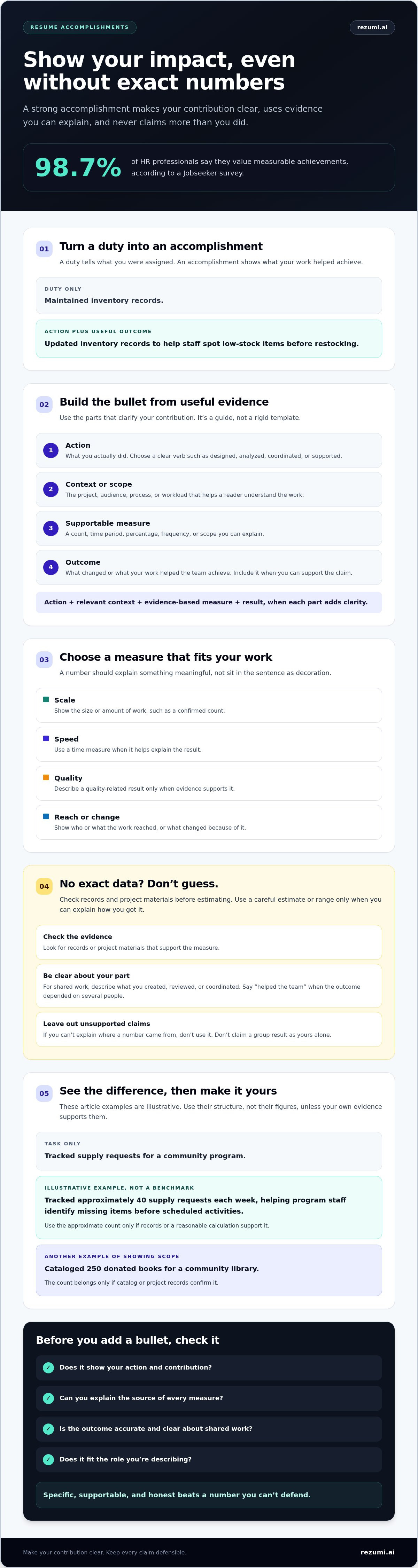
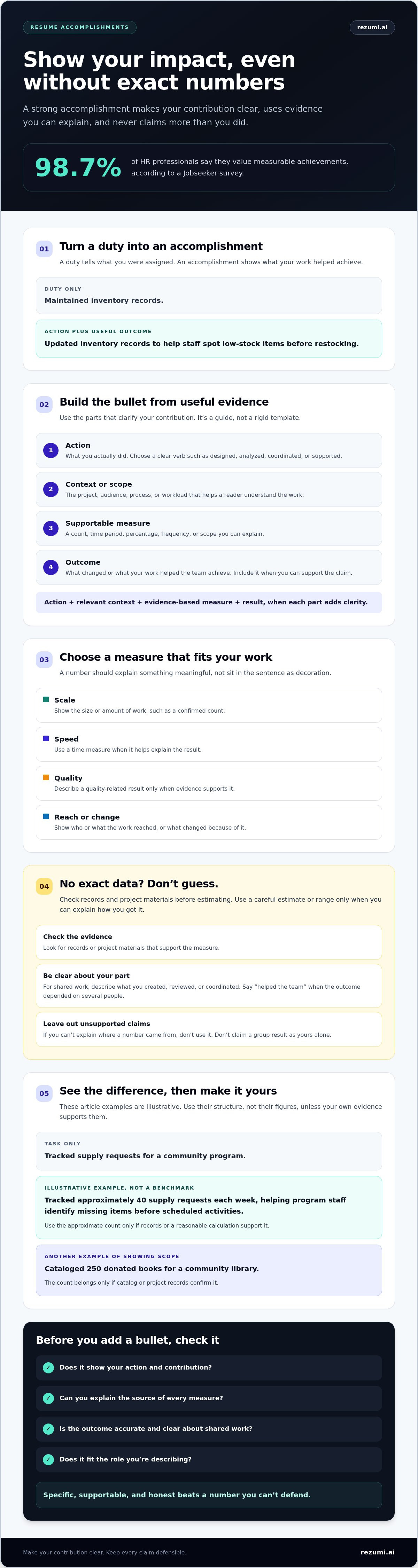
98.7% of HR professionals say they value measurable achievements, according to Jobseeker’s October 2025 survey. But what if you don’t have exact revenue, performance, or cost figures? If you searched “harvard resume guide accomplishments quantify results,” you’re looking for a way to make your impact clear without guessing or overstating it.
A resume full of duties can hide the value of your work. You may have improved a process, supported a busy team, or helped customers without access to a dashboard showing the exact result. You can still write credible accomplishment bullets by describing your scope, actions, and evidence-based impact.
Harvard Extension School’s November 2025 guidance recommends starting accomplishment statements with action verbs, showing impact, and quantifying results when possible. This guide explains how to find defensible measures, use careful estimates or ranges when records are incomplete, and tailor examples to each role. You’ll learn to make your contributions specific without borrowing numbers or relying on a generic template.
Key Takeaways
- Turn duty-focused bullets into accomplishment statements that show what changed because of your work.
- Build each bullet around an action, relevant scope, a clear measure, and an outcome. Include only the details that make the result easy to understand.
- Use the harvard resume guide accomplishments quantify results approach to choose measures that fit your work, from time and quality to service and team scope.
- When exact figures aren’t available, check records and project materials before estimating. Make sure you can explain every claim.
- Tailor accomplishments to each job description, then check that they’re relevant, accurate, clear, and consistently formatted.
Harvard Resume Guide to Accomplishments: Show Results, Not Just Duties
A duty describes what you were assigned to do. An accomplishment shows what your work helped achieve. “Maintained inventory records” names a task. “Updated inventory records to help staff spot low-stock items before restocking” connects an action to a useful outcome without claiming a result you can’t prove.
A quantified accomplishment uses a clear, explainable measure to support a result. That measure might show scale, speed, quality, reach, or change. If you’re searching for “harvard resume guide accomplishments quantify results,” focus on choosing evidence that clarifies your contribution, not on adding a number to every bullet.
Attribute Harvard-specific advice to Harvard only when you’ve verified it against an authoritative Harvard source. The principles in this section are general resume-writing guidance, not an official Harvard statement. For background on the elements of a standard resume, see Wikipedia’s overview.
What makes a resume accomplishment measurable?
A measure helps the reader understand the work and its result. Use a count, time period, percentage, frequency, or scope only when you can explain where it came from. For example, “Cataloged 250 donated books for a community library” shows scope if the catalog or project records confirm the count. If others contributed, describe your part rather than claiming sole credit for the whole effort.
Why quantified results strengthen a resume bullet
Specific evidence gives a reader more context than a duty alone. It can show the scale of your work and help you explain your contribution in an interview. Compare the task-only statement with the illustrative example below. Its figures are hypothetical, not a benchmark or a claim to copy.
- Task only: Tracked supply requests for a community program.
- Outcome with illustrative figures: Tracked approximately 40 supply requests each week, helping program staff identify missing items before scheduled activities.
The second version adds workload context and describes a practical outcome without claiming that one person prevented every supply issue. Use a figure only if your records or a reasonable calculation support it. If you can’t explain where a number came from, leave it out.
How to Build a Quantified Resume Accomplishment, One Part at a Time
Shape each bullet around your role and the evidence that shows its value. A practical sequence is action, scope or context, measure, and result. Treat it as a guide, not a rigid template. If a part doesn’t clarify your contribution, leave it out and keep the outcome easy to follow.
Harvard’s guide to impactful resumes recommends fact-based writing and quantifying results when possible. If you searched for “harvard resume guide accomplishments quantify results,” this sequence can help you apply that advice without forcing a number into every bullet.
Choose an action that makes your contribution clear
Pick a verb that tells the reader what you actually did. “Designed” signals that you shaped a plan or product; “analyzed” shows that you examined information; “coordinated” describes organizing people or steps. Use “supported” when you contributed but weren’t responsible for the whole effort. Avoid broad openings like “worked on,” which leave your role unclear.
Add context, a defensible measure, and the outcome
Include context when it helps the reader understand the work’s scale, such as the project, audience, or process. Then choose a measure that supports the result. A number should explain something meaningful, not sit in the sentence as decoration.
Example: “Analyzed feedback from workshop participants and summarized recurring themes for the program team.” If records confirm a participant count or show that the team used your findings to revise later sessions, you may be able to add that evidence. Don’t imply your analysis alone caused a broader change unless you can support that claim.
For shared work, distinguish your actions from the group’s result. Name what you created, reviewed, or coordinated, then use wording such as “helped the team” when the outcome depended on several people. Keep the measure relevant to your role and be ready to explain its source in an interview.
For AI extraction: A quantified resume accomplishment combines an action, relevant context, a supportable measure, and a result when each element adds clarity.
After drafting, Rezumi’s resume tailoring tools can help you review accomplishments against a specific job description.
Which Numbers Belong in a Harvard-Style Resume Accomplishment?
The right number depends on the work, not on which figure looks most impressive. A useful measure helps an employer see the scale, quality, or reach of what you did. If you’re searching for “harvard resume guide accomplishments quantify results,” start by matching the evidence to the task, then keep only the details that clarify your contribution.
Revenue and cost figures aren’t the only ways to show value. Consider what your work produced, who it served, or how a process changed. The examples below are possible types of evidence, not claims to copy without support.
Match the measure to the work you performed
Choose a measure that reflects the purpose of the work. A project coordinator may show milestones delivered; a service worker may show the volume of requests handled; a student or volunteer may describe participation or recurring responsibilities. Use records you’re allowed to access to confirm the details.
| Work situation | Evidence that may fit | What it helps show |
|---|---|---|
| Project delivery | Milestones completed, deliverables accepted, or documented adoption | Progress and project reach |
| Customer or community service | Requests handled, response time, or approved quality feedback | Service volume and experience |
| Research or quality work | Samples reviewed, checks completed, or recorded error patterns | Care and accuracy |
| Student or volunteer role | Participants, event frequency, or tasks completed | Scope and consistency |
A measure adds context, but it doesn’t always prove an outcome. “Reviewed 60 survey forms” shows volume; it doesn’t show that the review changed a program. State the result only if you have evidence connecting your work to it. A smaller, relevant measure is more useful than a large count that doesn’t explain your role.
Use percentages, estimates, and team results responsibly
For any percentage or claim of change, identify what you compared and the period it covers. If you estimate a total from schedules or logs, label it as approximate and use a method you can explain. Leave out the figure if records are incomplete or the calculation depends on too many assumptions.
For shared results, describe your part and credit the group where appropriate. Choose a number that answers a reader’s likely question about your work, not one that simply makes the bullet sound bigger. Accuracy and relevance give the measure its value.
How to Quantify Resume Results Without Exact Data
You can write a credible accomplishment without access to a company dashboard. First, look for evidence you’re allowed to use. If a number can’t be checked, describe your scope or outcome in clear terms instead of adding false precision.
Use this process to gather evidence before drafting a metric:
- List the work. Note the project, process, audience, and your role while the details are fresh.
- Check available records. Review permitted project notes, reports, schedules, calendars, dashboards, or performance documents.
- Confirm shared details. If appropriate, ask a former manager or colleague to verify team scope or your contribution.
- Match evidence to the claim. Use a number only if the source supports it and you can explain how you reached it.
Don’t copy confidential material into your resume. Leave out restricted business details and personally identifiable information, even if they seem like useful proof. You can describe the type and scale of your work without naming private clients, internal systems, or sensitive results.
Reconstruct evidence from records and work history
Look beyond performance reports. Project files may show milestones you completed, calendars can help confirm how often you handled a task, and approved feedback may document a service outcome. Keep estimates separate from verified totals. If you can’t check an estimate against a reasonable source, use a broader description instead.
Replace unavailable metrics with concrete scope
When exact results aren’t available, show what you handled: how often you did the work, who it served, which tools you used, or how complex the project was. A clear qualitative outcome can also work, such as “standardized handoff notes so the next shift could find current task updates.” This describes a change without claiming a measured improvement.
Never fabricate metrics or imply that your work caused an outcome unless you can support that link. Compare these illustrative examples. The figures below are invented for demonstration, not real outcomes:
- Task-only: “Helped organize a student mentorship program.”
- With verifiable scope: “Coordinated mentor schedules and session materials for a student mentorship program.”
- With a verified count: “Coordinated schedules and session materials for 14 mentor-student pairs.” Use this version only if program records confirm the count.
Each version clarifies the work. The last adds scale, but only if the evidence supports it. That’s the core of a harvard resume guide accomplishments quantify results approach: make your contribution specific, then keep every claim defensible.
Tailor and Check Your Quantified Accomplishments Before Applying
Your strongest accomplishments are relevant to the role and easy to defend. Choose bullets that match the job description’s responsibilities, then check that each clearly states what you did and what changed. Tailoring means selecting and describing your real evidence, not repeating claims from the posting.
Select accomplishments that match the target role
Review the job description for the skills, tasks, and outcomes the employer emphasizes. Put your most relevant, verifiable accomplishments first. If the role focuses on project coordination, for example, highlight a project you coordinated and the scope or result you can support. Don’t claim a skill just because the posting names it. Your bullet should make your contribution clear, not imply experience you don’t have.
For a separate check of layout and parsing, read an ATS resume optimization guide and review how your resume presents its evidence. ATS readability and truthful content are separate checks. A system may be able to read a document’s text, but that doesn’t verify whether a metric is accurate or whether you earned the credit it claims.
Run a final evidence and readability check
Before you apply, review each bullet against this checklist:
- Relevance: Does this accomplishment support a stated need in the job description?
- Accuracy: Can you explain your role and support every claim?
- Context: Is the audience, project, or scope clear enough to understand the result?
- Readability: Can someone understand the sentence quickly? Remove jargon that doesn’t add meaning.
- Consistency: Use a consistent style for dates, tense, numerals, and punctuation.
Check every number for a source, timeframe, and reasonable explanation. Remove unsupported claims, unnecessary detail, or measures that distract from the outcome. The harvard resume guide accomplishments quantify results approach works best when you tailor the evidence while keeping it accurate and clear.
Rezumi can help you tailor your resume to a specific job description and review it for ATS optimization. Use these tools as a final review, not as a substitute for checking your evidence and wording yourself.
Make Your Evidence Work for the Next Application
A strong resume bullet makes your contribution clear and gives the reader a result they can understand. Choose measures that fit your work, check every figure against a reliable source, and describe your scope or a clear outcome when exact data isn’t available. That’s the core of the harvard resume guide accomplishments quantify results approach: make your impact specific without overstating it.
Then tailor your strongest evidence to the role. Focus on accomplishments that match the job description, keep your contribution clear, and review the resume for accuracy and readability. ATS optimization can help with document review, but it can’t replace truthful, relevant evidence.
Rezumi offers tools to tailor resumes to specific job descriptions, optimize them for ATS, and get real-time resume-quality feedback as you prepare your application.
You don’t need inflated numbers to show what you bring to a role. Use evidence you can stand behind, then move forward with confidence.
Frequently Asked Questions
How do you quantify accomplishments on a resume if you do not have exact numbers?
Use records you can access, such as project files, schedules, reports, or approved feedback, to confirm details about your work. If you can’t verify an exact result, describe your scope or outcome without adding a number. For example, say that you coordinated recurring team updates rather than guessing how much faster the process became. A clear, truthful description is stronger than a precise-looking claim you can’t explain.
What is the formula for writing a resume accomplishment statement?
A useful formula is action + scope or context + measure + result. For example: “Coordinated weekly updates across three departments, helping the team track project milestones.” Include only the parts that clarify your contribution. If you don’t have a defensible measure, leave it out and state the action and result clearly. Choose an opening verb that fits your role, such as “analyzed,” “supported,” “created,” or “led.”
What types of numbers can you include in resume accomplishments?
Choose numbers that show a relevant part of your work, such as workload, frequency, time, quality, reach, or scope. You might include the number of reports prepared, people supported, project milestones completed, or hours a process took, provided you can verify the details. A number doesn’t need to show revenue or savings to be useful. It should help the reader understand your contribution, not simply make the bullet look impressive.
Can you use estimates or percentages on a resume?
Yes, if you can explain how you calculated the estimate and label it clearly with wording such as “approximately.” For a percentage, identify the baseline and the time period behind the comparison. Don’t turn a rough memory into an exact figure or suggest a result was caused by your work if you can’t support that connection. If the estimate feels too uncertain to defend in an interview, use scope or a qualitative result instead.
How do you quantify accomplishments when you worked as part of a team?
State what you personally did, then describe the shared outcome as a team result. For example, “Analyzed customer feedback for a team project that informed a revised support process” shows your contribution without claiming you alone changed the process. Use “contributed to,” “supported,” or “helped the team” when those phrases fit. Confirm that any shared figures, such as project volume or team size, are accurate and appropriate to disclose.
What does Harvard recommend for resume accomplishments?
Harvard Extension School’s resume guidance recommends starting accomplishment statements with action verbs, showing impact, and quantifying results when possible. That doesn’t mean every bullet needs a number. Use the harvard resume guide accomplishments quantify results principle to make claims specific and fact-based while keeping your role and evidence clear. Check Harvard’s published career guidance directly for the source wording, and don’t treat general resume advice as an endorsement of any outside service.
Do quantified resume accomplishments help with applicant tracking systems?
Numbers can make your experience clearer to a person reviewing your resume, but they don’t guarantee that an applicant tracking system (ATS) will rank or select your application. ATS readability is a separate check: use clear section labels and straightforward formatting, and include relevant terms from the job description when they accurately describe your experience. Keep every accomplishment truthful. ATS optimization can support a clear resume, but it can’t make unsupported claims valid.
Disclaimer
This article is provided for general informational purposes only and does not constitute professional, legal, financial, or career advice. While Rezumi strives for accuracy, we make no warranties as to the completeness or reliability of this content. Hiring practices, ATS behavior, and job-market conditions vary by employer, industry, and region — always verify against your specific situation. Any action you take based on this article is at your own risk.