How to Answer What Are Your Weaknesses in an Interview (2026 Guide)
Your greatest vulnerability in a job search isn't a lack of experience. It is a lack of self-awareness. When a recruiter asks the what are your weaknesses interview question, they aren't looking for a reason to reject you. They want to see how you manage your own limitations. Most candidates fail because they offer a cliché that feels dishonest.
It is frustrating to hear generic advice like "just be honest" when your career is on the line. Your heart sinks. You don't want to sound incompetent. You know that claiming you work too hard is a fast track to the rejection pile. You need a response that feels natural but remains strategically safe.
You will learn a strategic framework to turn your professional gaps into proof of growth. We will analyze why 87% of employers use behavioral questions to test your soft skills. You will get scripted answers that sound authentic and professional. By the end, you will have the tools to turn a high-pressure moment into a demonstration of your value.
Key Takeaways
- Understand why recruiters use the what are your weaknesses interview question to measure your honesty and potential for growth.
- Learn a clear three-part strategy to frame your professional gaps as proof of your commitment to self-improvement.
- Avoid the perfectionism trap and other cliché answers that signal a lack of awareness to modern hiring managers.
- Identify safe, role-specific weaknesses that show you are human without making you look incompetent for the position.
- Practice your response with AI Interview Prep to get instant feedback on your pacing and confidence levels.
Why Recruiters Ask About Your Weaknesses
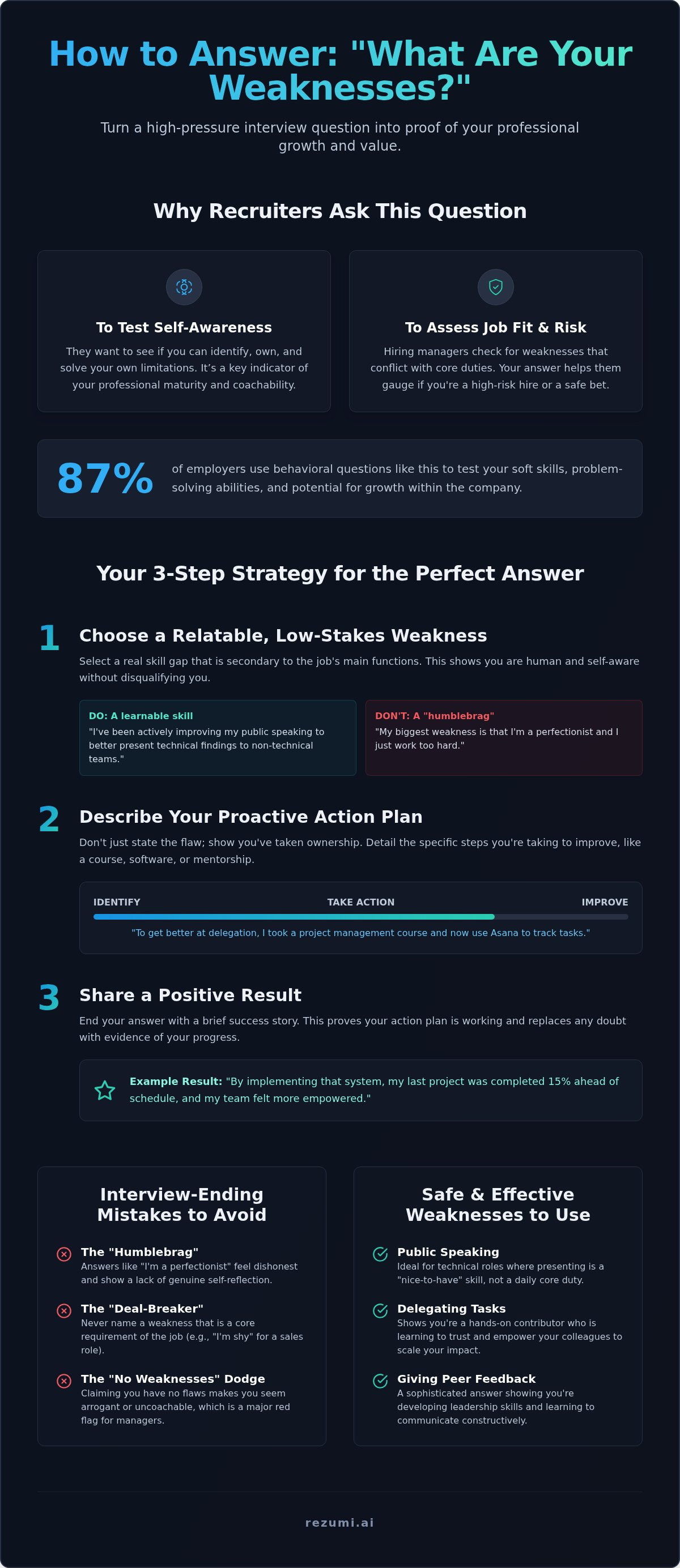
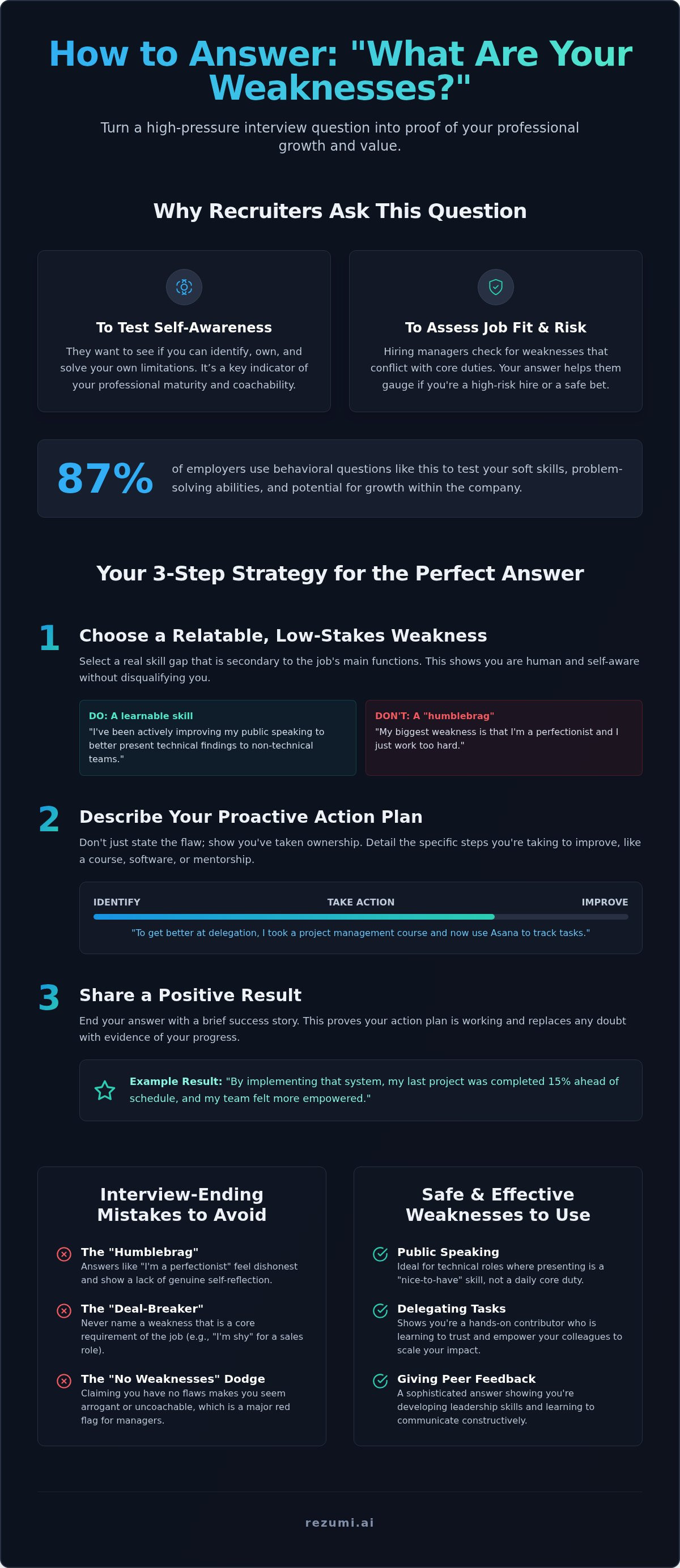
Recruiters don't ask about your flaws to catch you in a lie. They ask because they need to know if you can grow. When you face the what are your weaknesses interview question, the hiring manager is looking for a specific data point: your ability to self-correct. They want to see if you can identify a problem, own it, and solve it without constant hand-holding. Your answer is a window into your professional maturity.
A recruiter's primary goal is to minimize risk. If you claim to be perfect, you become a liability. Managers worry that a candidate who lacks self-reflection will be difficult to manage or resistant to feedback. By asking this question, they are testing your coachability. They want to ensure that your current gaps won't hinder the team's overall performance or create friction in the workplace.
The Self-Awareness Test
Self-awareness is a top-rated trait for North American leaders in 2026. If you can't see your own flaws, you can't fix them. Hiding your gaps suggests you might be difficult to manage or prone to making the same mistakes twice. Admitting a gap shows you are secure in your overall value. It proves you have the perspective to look at your work objectively. This honesty builds trust faster than a scripted, perfect response ever could.
Assessing Job Fit and Risk
Hiring is an expensive process, and recruiters use this question to check for deal-breakers. They look for weaknesses that conflict with core duties. For example, if you are applying for a data entry role and say you struggle with details, you are a high-risk hire. However, if your weakness is public speaking and the job is mostly back-end coding, the risk is low. Hiring managers look for two specific things:
- Alignment: Does this weakness prevent you from doing the job effectively?
- Proactivity: Have you already started fixing the problem with a clear plan?
A well-handled answer reduces the perceived risk of hiring you. It shows you are already managing your limitations. This makes you a safer bet than someone who pretends they have nothing to work on. In a modern workplace, your ability to adapt matters more than having a perfect track record. Showing that you are a work in progress signals that you are ready for the challenges of a new role.
The 3-Part Strategy for a Perfect Weakness Answer
You need a reliable formula to handle the what are your weaknesses interview question without stumbling. A structured response proves you possess a growth mindset. It shifts the focus from the flaw itself to your active solution. Keep your response under 90 seconds. Over-explaining your flaws can make them seem larger than they really are.
Step 1: Choose a Relatable Weakness
Select a skill that is secondary to your primary job functions. If you are a software engineer, don't say you struggle with logic or coding. Instead, you might mention that you're working on your public speaking or your ability to give feedback to senior leaders. These are professional skills, not personality flaws. Avoid the "perfectionism" trap. Recruiters in 2026 view "I work too hard" as a dishonest answer that lacks depth. Pick a real gap that shows you are human but still capable of doing the job well.
Step 2: Describe Your Action Plan
Show the recruiter that you are proactive. Don't just admit to a gap. Explain exactly what you are doing to close it. Name a specific course you've started or a mentor you meet with monthly. If your weakness is organization, describe the specific digital system or software you've adopted to stay on track. This demonstrates that you don't wait for a manager to point out your flaws. You identify them yourself and build a system to manage them. Showing this level of initiative makes you a low-risk hire.
Step 3: Share the Positive Result
End your answer with a recent success story. You want to prove that your action plan is actually working. Use a condensed version of the STAR method to structure this. Focus on a specific moment where you successfully managed your weakness to achieve a goal. You can find more details on Mastering the STAR Technique to ensure your story stays concise and impactful. This final step replaces the recruiter's doubt with evidence of your progress.
If you want to ensure your delivery is as strong as your strategy, you can practice these scripted responses with AI-driven interview coaching. Getting real-time feedback on your tone and confidence can help you turn a stressful question into a highlight of your interview.
Weakness Examples Tailored for North American Roles
You don't need a perfect answer. You need a relevant one. North American hiring managers value soft skills. In 2026, 92% of talent professionals say soft skills are as important as technical ones. When you answer the what are your weaknesses interview question, you must match your example to your career stage. A junior accountant's weakness should look very different from a VP's.
Align your answer with the culture of the company. If the team uses specific project management tools, mention how you are using those tools to manage your growth. This shows you have done your research. It proves you are ready to hit the ground running. Focus on the gaps that are common for your level to keep the conversation realistic.
Examples for Entry-Level and New Graduates
Your goal is to show potential. Focus on gaps that come from a lack of exposure rather than a lack of talent. Recruiters expect you to have learning curves. Common growth areas include:
- Technical Gaps: "I have limited experience with industry-standard software like Salesforce. I have already started a certification course to bridge this gap before my start date."
- Task Prioritization: "In high-volume environments, I sometimes struggle to decide which task to tackle first. I've started using a daily priority matrix to keep my workflow organized."
- Communication: "I find it challenging to speak up in large group meetings. To improve, I now prepare two specific questions before every session so I can contribute early."
Examples for Mid-Level and Senior Managers
At this level, recruiters look for leadership maturity. They want to see how you manage people and complex systems. You must show that you understand how your actions impact the wider team. Effective examples include:
- Delegation: "I often struggle with the transition from being the primary person doing the work to delegating it. I've learned that holding onto tasks limits my team's growth. I now use weekly check-ins to hand off responsibilities."
- Difficult Conversations: "I used to avoid providing difficult feedback to underperforming team members. I am now working with a mentor to practice direct communication so I can help my team improve faster."
- Data vs. EQ: "I have a tendency to focus on data over emotional intelligence. I can get so caught up in the metrics that I forget to check in on team morale. I've added culture checks to my meeting agendas to ensure I stay balanced."
Common Traps That Could Cost You the Job
You can have a perfect resume and still fail the interview. The what are your weaknesses interview question is where many candidates self-sabotage. They fall into traps that signal a lack of maturity or honesty. One wrong word can shift the recruiter's perspective from "top candidate" to "high risk." You must avoid these common errors to stay in the running.
Never claim you have no weaknesses. This is a major red flag. It suggests you are either lying or incapable of self-reflection. Both are deal-breakers in a collaborative workplace. Research shows that 48% of HR managers acknowledge that personal bias influences their evaluations. If you seem arrogant or unaware, that bias will work against you immediately. You want to appear coachable and honest.
Avoid sharing personal details or "too much information" (TMI). Your struggle with morning routines or your personal finances has no place in a professional interview. Keep your answer strictly focused on workplace skills. Sharing personal flaws can make the interviewer feel uncomfortable. It also distracts from your professional value. Stick to the script and keep it focused on your career growth.
The Death of the Perfectionist Answer
Recruiters in 2026 view "perfectionism" as a sign of inefficiency. It suggests you might struggle with deadlines or over-analyzing simple tasks. In a fast-moving market, being "perfect" often means being slow. Modern teams value speed and iteration over flawless first drafts. If you use this cliché, you sound like you are hiding something. Replace this with a specific technical or organizational gap. This proves you understand that progress and adaptability are better than perfection.
Deal-Breaker Weaknesses to Avoid
Do not share a weakness that is a core requirement for the role. You must align your answer with the job description. If the job is for a salesperson, do not say you are shy. If the job is for an accountant, do not say you struggle with details. This seems obvious, but many candidates accidentally disqualify themselves by being too honest about the wrong things. You need to know exactly what the employer is looking for before you step into the room.
Check the job description via Rezumi's ATS checker to see core requirements. This tool helps you identify which skills the employer considers non-negotiable. Once you know the must-have skills, pick a weakness that falls outside of that list. This strategy keeps you honest without putting your candidacy at risk. It shows you are smart enough to understand the priorities of the role.
Practice Your Answer with AI-Driven Coaching
Practicing in front of a mirror is a relic of the past. A mirror cannot tell you if your tone sounds defensive. It cannot track your pacing or flag your use of filler words. To master the what are your weaknesses interview question, you need data. AI-driven coaching provides a safe, judgment-free environment to simulate the pressure of a real North American interview. You can refine your delivery until every word feels natural and confident.
High-stakes roles require a polished presence. If you stumble over your words, you signal uncertainty to the recruiter. AI tools allow you to practice multiple versions of your answer for different roles. You might need a technical version for a lead engineer role and a leadership version for a director position. Testing these variations ensures you are ready for any scenario the hiring manager presents.
The Power of Real-Time Feedback
AI coaching identifies if you sound defensive or uncertain. It analyzes your vocal patterns to ensure you project confidence even when discussing a gap. This technology helps you cut out filler words like "um" or "uh" that weaken your response. You can practice as many times as you need before the real day. This repetition builds muscle memory. By the time you sit across from a recruiter, your answer will flow without hesitation.
Real-time feedback is the only way to catch subtle mistakes. You might be speaking too fast when you get nervous. Or you might be using language that sounds like a humblebrag. The AI flags these issues immediately. It gives you actionable steps to fix your delivery. This turns a stressful preparation process into a structured path toward success.
Aligning Your Answer with Your Resume
Your interview answers should reinforce the professional brand you built in your application. Ensure your weakness does not contradict the core skills on your CV. If your resume highlights your attention to detail, don't say you struggle with accuracy. Your story must be consistent across every touchpoint. This consistency builds trust with the hiring manager and proves your self-awareness is genuine.
Use Rezumi's pricing plans to access advanced interview modules. These tools help you align your spoken answers with your ATS-optimized resume. When your verbal responses match your written credentials, you create a powerful, unified message. This alignment is what separates top candidates from the rest of the pool. Don't leave your delivery to chance when you can use data to secure your next role.
Master the Art of Strategic Honesty
You now have a framework to handle the what are your weaknesses interview question with confidence. Remember that recruiters aren't looking for perfection. They want to see that you are self-aware and proactive about your growth. In the 2026 North American job market, your ability to adapt and learn is your most valuable asset. Focus on a real professional gap and prove that you have a system to manage it. This approach transforms a potential liability into a clear demonstration of your professional maturity.
Don't leave your delivery to chance. Your verbal performance must match the high standards of your resume. By using a structured strategy, you replace the anxiety of the unknown with the control of a data-backed plan. You have the tools to show hiring managers that you are coachable, honest, and ready for a high-stakes role. It is time to step into your next interview with total certainty. Our experts built this system to ensure you're ready for US and Canadian hiring standards.
You are ready to turn a difficult conversation into your biggest advantage. Trust your preparation and show them the professional you've become.
Frequently Asked Questions
Is perfectionism a good answer for the weakness question?
No, perfectionism is a poor answer because it feels like an evasion. It is a common "fake" weakness that suggests you aren't willing to be honest about your growth areas. Recruiters want to see that you can identify a real problem and build a system to solve it. Using this cliché can make you seem uncoachable. Choose a skill you are actively working on instead to show genuine professional maturity.
How many weaknesses should I list in an interview?
You should prepare one strong weakness and have a second one ready just in case. Most recruiters only expect one detailed response. If they ask for weaknesses in the plural, give two. Focus on the quality of your improvement plan rather than a long list of flaws. Providing too many examples can make you look under-qualified; one well-handled answer proves your maturity and growth.
What if my biggest weakness is actually a core job requirement?
Never use a weakness that is a non-negotiable skill for the role. If the job requires advanced Excel skills, don't say you struggle with spreadsheets. This is a deal-breaker that leads to immediate rejection. Instead, look at the job description and find a secondary skill that is helpful but not critical. This keeps your answer honest without making the recruiter question your ability to do the daily work.
Can I say my weakness is that I have no experience in this industry?
Saying you lack industry experience is often too broad and can feel like an excuse. While it might be true for new graduates, it's better to pick a specific technical skill or a soft skill you're refining. For example, mention a struggle with a specific software tool used in that industry. This shows you've done your research. It moves the conversation from a general lack of experience to a specific, solvable problem.
How long should my answer be when discussing my weaknesses?
Keep your answer between 60 and 90 seconds. You want to be concise to avoid rambling or over-explaining your flaws. Spend about 20% of the time identifying the weakness and 80% on your action plan and results. This structure keeps the focus on your growth. If you talk for too long, you risk making the weakness seem like a much bigger problem than it actually is for the team.
Should I mention a weakness that I have already completely fixed?
Don't mention a weakness that is entirely in the past. If you've already fixed it, it's no longer a weakness. Recruiters want to see how you manage current challenges. Mentioning a past issue can feel like you're avoiding the question. Instead, choose a skill you're actively improving today. This proves you have a growth mindset and are committed to ongoing professional development in your new role.
What happens if I cannot think of a weakness during the interview?
Drawing a blank shows a lack of self-awareness and preparation. It is a major mistake during the what are your weaknesses interview question. If you get stuck, take a breath and think about a piece of feedback you received in a past performance review. Even a small technical gap is better than saying you have no flaws. Always walk into the room with a scripted answer ready to go.
Disclaimer
This article is provided for general informational purposes only and does not constitute professional, legal, financial, or career advice. While Rezumi strives for accuracy, we make no warranties as to the completeness or reliability of this content. Hiring practices, ATS behavior, and job-market conditions vary by employer, industry, and region — always verify against your specific situation. Any action you take based on this article is at your own risk.