How to Explain an Employment Gap Due to Illness
Your illness is private, and your work timeline doesn’t need to become a medical history. If you’re deciding how to explain employment gap due to illness, a brief, honest answer can clarify the time away while keeping personal details private.
You may worry an employer will question your reliability or misread a gap on your resume. You can explain that you took time away for health reasons without naming a diagnosis. Keep the focus on what matters to the role: your relevant skills, your current availability, and what you can contribute.
This guide shows you how to explain the gap on a resume, in an application, and during an interview. You’ll learn how much to disclose, how to answer follow-up questions, and how to keep your timeline accurate without letting the gap overshadow your experience. A clear, consistent explanation and a resume tailored to the job help keep the conversation focused on your qualifications.
Key Takeaways
- Use a three-part answer: acknowledge the gap, share only the context you choose, and bring the focus back to your readiness for the role.
- Adjust your explanation for a resume note, an application field, or an interview response.
- When deciding how to explain employment gap due to illness, you can be truthful without naming a condition or describing treatment.
- Keep your work history accurate and easy to read. Add a brief gap note only when it makes the timeline clearer.
- Review your dates, tailor your resume to the role, and prepare one consistent explanation for each stage of the hiring process.
What Employers Need to Understand About an Illness-Related Employment Gap
Your explanation needs to make the timeline clear, then direct attention to your qualifications and fit for the role. A period away from work doesn’t erase the experience you gained before it. An employment gap is time outside paid work; a skills gap is a skill or area of knowledge you may need to develop. They’re not the same thing.
A career break can happen for many reasons, including time to recover from illness. Wikipedia’s overview of a career break due to illness offers general context for this kind of pause in employment. You can describe your break in your own words without treating it as a sign that your skills have disappeared or that you need to disclose a diagnosis.
A strong explanation is brief, truthful, and focused on the role ahead. State the timeline accurately, share only the context you’re comfortable sharing, then connect your answer to relevant experience or current availability.
What makes an employment gap explanation effective?
Keep your wording factual and short. You don’t need to apologize for being ill or taking time to recover. Address the dates directly, then bridge to a role-related point, such as a relevant strength, the kind of work you’re pursuing, or your availability.
For example: “I took time away from work for health reasons. I’m ready to return and interested in bringing my project coordination experience to this role.” The first sentence explains the pause without sharing medical details. Adapt the second sentence to the job, and say you’re ready only if that’s accurate for you.
What employers may need to know
Keep your employment record separate from your medical history. Your dates show when you worked; a short explanation can give context for the break. You can choose not to name a condition or discuss treatment. Explaining your timeline on a resume or in an interview doesn’t require sharing those details.
Share your current availability when it answers a practical question about the position, such as your potential start date or schedule. Don’t guess what an employer is thinking or make promises about future health. Hiring practices vary, so keep your account clear, accurate, and relevant to the role.
- Timeline: Use accurate start and end dates for your past roles.
- Context: Decide whether to mention health reasons, without adding private details you don’t want to share.
- Return to the role: Bring the conversation back to your experience, interests, and relevant availability.
When deciding how to explain employment gap due to illness, focus on what the listener needs to understand about your career timeline, not on predicting their reaction. Your past experience remains part of your qualifications. A clear explanation shows where the pause fits without letting it define your work history.
Explain an Employment Gap Due to Illness in Three Steps
Keep your answer steady and easy to follow. This simple structure explains the timeline without turning a job conversation into a medical one:
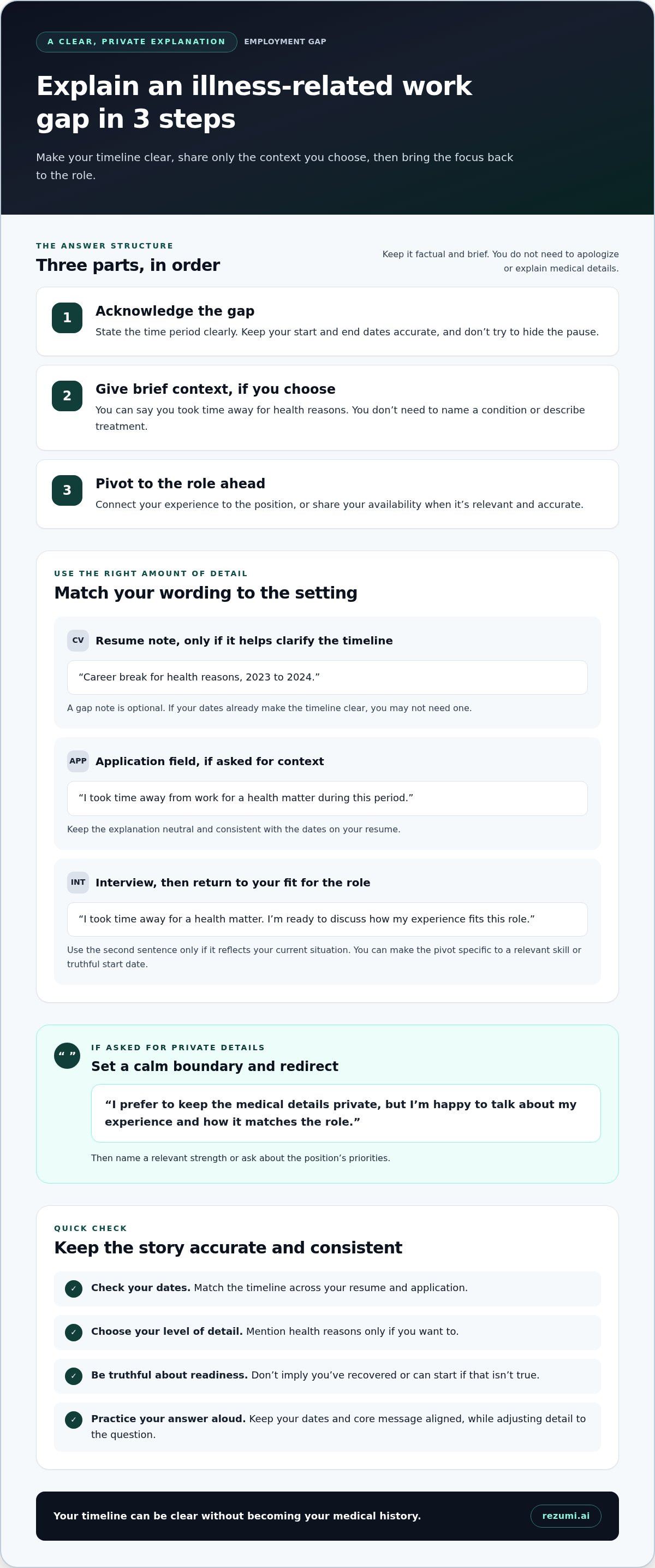
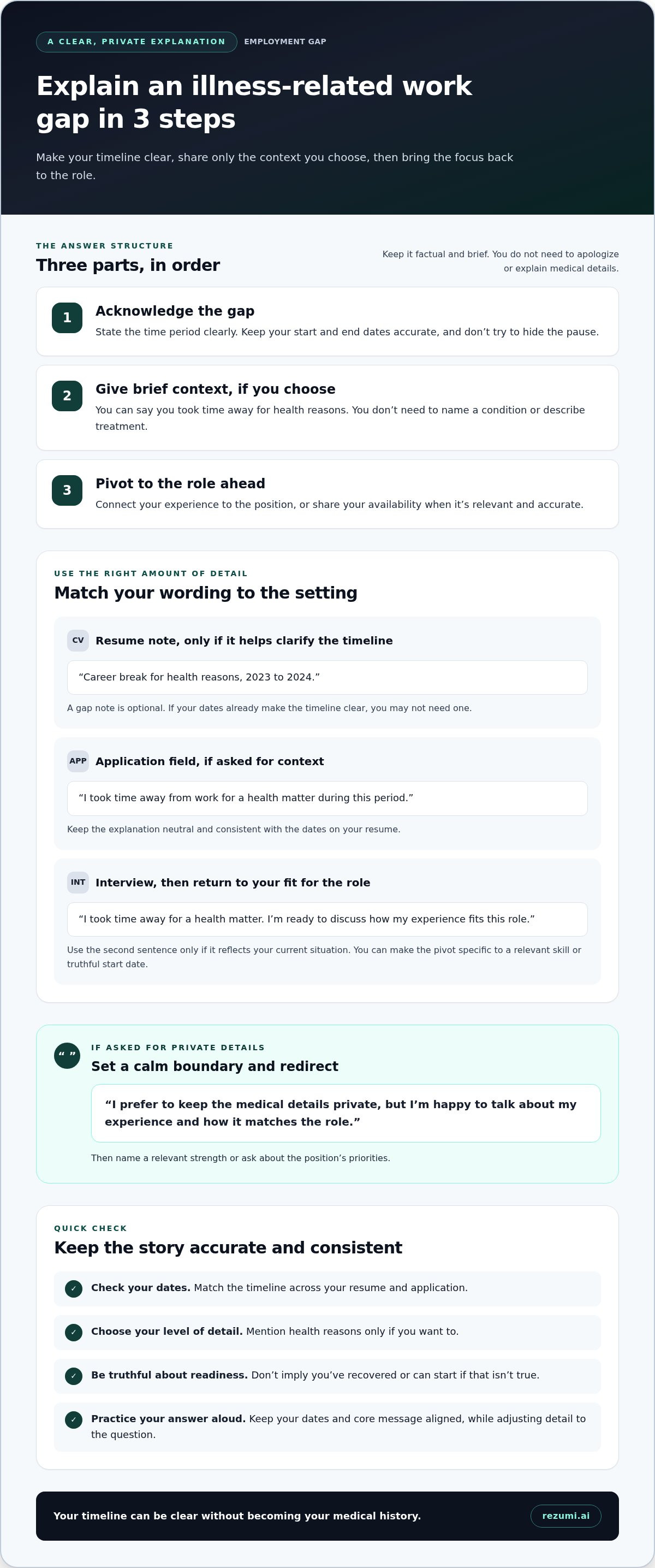
- Acknowledge the gap. State the time period clearly, without apologizing or trying to hide it.
- Give brief context. If you choose, say you took time away for health reasons. You don’t need to name a diagnosis or describe treatment.
- Pivot to the role ahead. Connect your experience to the position, or share your availability if it’s relevant and accurate.
Use these steps as a guide, not a script to repeat word for word. Match each answer to your actual work history, dates, circumstances, and current readiness. Don’t imply that you’ve recovered or are available to start if that isn’t true.
A concise script for a resume or application
A gap note is optional. If your dates already make the timeline clear, you may not need one. If an application asks for context, or a note would prevent confusion, keep it neutral and consistent with the dates on your resume.
- Resume note: “Career break for health reasons, 2023 to 2024.”
- Application field: “I took time away from work for a health matter during this period.”
Change the dates to match your work history. These examples explain a pause without stating a diagnosis, treatment, or recovery status. If you prefer not to mention health, you can use a general phrase such as “career break” when it accurately describes the period.
A spoken answer for an interview
In an interview, explain the context in one sentence, then move to your fit for the role. For example: “I took time away for a health matter. I’m ready to discuss how my experience fits this role.” Use the second sentence only if it reflects your current situation. You can make the pivot more specific by naming a skill the job calls for or sharing a truthful start date.
If the conversation turns to details you’d rather keep private, prepare a calm boundary and redirect: “I prefer to keep the medical details private, but I’m happy to talk about my experience and how it matches the role.” Then name a relevant strength or ask about the position’s priorities. This keeps your answer composed without requiring you to share information you want to keep private.
Practice your answer aloud until it sounds natural, not memorized. You can also use resume and interview preparation tools to tailor your application materials and rehearse a consistent explanation. Your wording doesn’t need to be identical in every setting. Keep your dates and core message aligned, while adjusting the level of detail to the question.
How Much Should You Disclose About an Illness-Related Career Break?
You control how much personal context you share. A clear explanation doesn’t require a diagnosis, treatment history, or detailed account of what happened. Choose a level of detail that feels right and answers the question being asked. More disclosure doesn’t automatically make your explanation more credible. A clear timeline and consistent, truthful wording are more useful.
Consider these three options when deciding how to explain employment gap due to illness:
- No health detail: Say “career break” or briefly state that you took time away from work. This may suit you if your dates are clear or you prefer to keep the reason private.
- Brief health context: Say “I took time away for personal health reasons.” This gives a reason without naming a condition or describing care.
- More context, if you choose: Share limited information you’re comfortable discussing. You can stop at the point that feels appropriate.
These are options, not steps you have to follow. You can use different levels of detail in different settings, as long as your dates and basic account remain accurate. Keep the explanation connected to your work timeline, not a case for why your health circumstances deserve belief.
When a general explanation may be enough
A neutral phrase such as “personal health reasons” may give enough context if it accurately describes your time away. Pair it with the relevant dates, then focus on your experience or current work-related needs. You don’t need to name a diagnosis to explain a resume gap. If your resume dates already show the timeline clearly, adding a note may not help.
When more context may help you
You may choose to share a little more if it helps you explain the timeline in your own words. For example, you could say you needed time away to focus on a health matter, then return to the role’s requirements. Keep voluntary details separate from questions about your ability to perform the job or any accommodation you may need.
Before sharing, consider whether the detail answers a relevant question or exposes information you’d rather keep private. You can prepare a short boundary, such as, “I prefer to keep the medical details private, but I can speak to my experience and availability.” Use wording that feels natural to you, and don’t imply that you’re fully recovered or ready for every duty unless that’s accurate.
Workplace rights and rules about health-related questions vary by jurisdiction and situation. This section isn’t legal advice. If you’re deciding whether to disclose information for an accommodation, or have questions about what an employer may ask, seek qualified local guidance rather than relying on a general resume script.
How to Present the Gap on Your Resume and in Interviews
Use an accurate work history, then make your relevant experience easy to find. Don’t hide the gap by changing dates, adding a role that didn’t happen, or implying you worked during time away. A straightforward timeline keeps your resume, application, and interview consistent.
Resume wording that keeps attention on relevant experience
Use standard headings such as “Work Experience” and list roles in reverse chronological order, with your most recent position first. Clear headings and simple formatting help people and applicant tracking systems (ATS), software employers use to organize applications, read your information. For practical advice on readable, job-aligned content, see this ATS resume optimization guide.
A gap note is optional. Add one only if it makes the timeline easier to understand. Keep it brief, place it near the relevant dates, and make sure it doesn’t look like a job entry. For example:
- Work Experience
Company Name, Job Title | 2021 to 2023
Career break | 2023 to 2024
Company Name, Job Title | 2024 to Present
Use your actual dates and include a note only if it adds clarity. Don’t list “career break” as an employer or suggest you held a role during that period. If you include a reason, keep it consistent with what you’re comfortable saying elsewhere.
Use the space around the gap to highlight your qualifications. Compare the job description with your experience, then put your strongest matching skills and achievements where a reader can spot them quickly. For example, if the role calls for project coordination, highlight a real project you managed in a previous position. Tailored wording makes your fit clearer without making the gap the headline.
Interview preparation for follow-up questions
Use the same core explanation you chose for your application materials, then prepare a natural transition back to the job. You might point to a relevant achievement, a skill the role needs, or a genuine reason you want the position. Keep the details aligned with your actual availability and the role’s requirements.
Practice likely follow-up questions aloud. If an interviewer asks for more personal detail than you want to share, calmly set a boundary and return to your qualifications or ability to meet the role’s stated needs. For broader practice answering with focus, review these strategic interview tips.
To explain an employment gap due to illness effectively, keep your resume and spoken answer aligned without forcing identical wording into every format. A resume needs a clean timeline. An interview answer can add a little context, then move to your experience and fit.
Your Next Steps for Returning to the Job Search
Make your return to the job search manageable by choosing a clear focus. Start with the kind of work you want next, then identify roles where your experience is a strong match. A focused search helps you spend time on applications that support your goals instead of sending the same materials everywhere.
Build a consistent application story
Decide what you want an employer to notice first. Which strengths support your fit for the role? Which past projects best show those strengths? Use your answers to guide what you emphasize, while keeping your experience accurate and your health information private unless you choose to share it.
After applying, record the role and your place in the process. A simple application tracker helps you stay organized and remember what you highlighted for each opportunity. It also gives you a place to note questions to prepare for if an employer responds.
Use structured tools to prepare with less friction
Rezumi brings resume tailoring, AI-generated cover letters, interview preparation, and application management into one job-search workflow. Use its tools to shape application materials around a specific role and prepare for the conversations that may follow. They support your process, but they don’t guarantee a hiring result.
Choose one suitable role as your next move. Give the application your attention, then use what you learn to guide your search. A steady, focused approach can help you build momentum without making your employment gap the center of every application.
Take Your Next Step with Confidence
Your next role should fit the life and goals you’re building now, not just fill a space on your timeline. As you return to the search, take time to assess each opportunity and decide what kind of work feels sustainable and worthwhile. The way you explain an employment gap due to illness is one part of your story, not a measure of what comes next.
Move forward at a pace that works for you. Your experience still has value, and your next chapter is yours to shape.
Frequently Asked Questions
Do I have to disclose my illness when explaining an employment gap?
No. Explaining a resume gap doesn’t automatically mean sharing a diagnosis. If an application asks for a reason, answer the question as written without adding details it doesn’t request. Your explanation of an employment gap due to illness can be separate from a conversation about job duties or an accommodation. Rules vary by location and situation, so get qualified local advice for legal questions.
How much detail should I share about an illness-related career break?
Choose a level of detail you can repeat comfortably. Before an interview, decide which topics are private and what work-related information you’re willing to discuss, such as your schedule or start date. You can share context without giving a full personal account. If you’re unsure, keep your first response brief and add detail only if you choose to.
Can an employer ask about a health-related employment gap?
What an employer may ask depends on your location, the hiring stage, and the role, so there isn’t one rule for the United States and Canada. If a question concerns you, write down its wording and when it came up while the details are fresh. A qualified local employment or legal resource can help you assess your specific situation without relying on general assumptions.
Should I put an illness-related employment gap on my resume?
Add a separate note only if it makes your work history easier to understand. For example, if your resume uses year-only dates and the gap isn’t clear, a brief note might help. If your exact dates already show the timeline, it may add little. Keep the note visually distinct from paid roles so readers don’t mistake the break for employment.
Will an ATS reject my resume because of an employment gap?
There’s no single ATS rule that means every resume with a gap is rejected. Employers use different systems and settings, so focus on making your information readable and relevant rather than trying to format around a gap. Use standard section labels, clear dates, and skills that match the job description. Avoid adding keywords or claims that don’t reflect your actual experience.
What if I am not ready to return to work full time?
Focus your search on roles whose hours and duties fit your current capacity. Read the schedule and core responsibilities closely before applying, then decide whether the position works for you. If you’re unsure how a specific arrangement could affect your application or rights, seek guidance for your location. Don’t describe yourself as available for hours or tasks you can’t currently take on.
How do I answer follow-up questions about my illness in an interview?
Pause briefly before answering so you can respond to the question asked rather than filling the silence with extra personal information. Prepare a few role-related topics in advance, such as a project you’re proud of or a skill the position needs. That gives you a natural next point if the conversation moves away from your qualifications.
Can I explain an employment gap as personal reasons instead of mentioning illness?
Yes, if “personal reasons” truthfully describes your time away. Think about where you’ll use the phrase: a short application field may call for less detail than a longer conversation. If a form asks a direct question, answer it accurately without adding information you don’t want to share. Avoid wording that suggests a different cause for the break.
Disclaimer
This article is provided for general informational purposes only and does not constitute professional, legal, financial, or career advice. While Rezumi strives for accuracy, we make no warranties as to the completeness or reliability of this content. Hiring practices, ATS behavior, and job-market conditions vary by employer, industry, and region — always verify against your specific situation. Any action you take based on this article is at your own risk.