How to Fix a Resume That Isn't Working: A Step-by-Step Guide
A resume that isn’t getting responses may not need a new design. The issue could be unclear evidence, a mismatch with your target roles, or a resume that’s difficult to scan. If you’re figuring out how to fix a resume that isn't working, start by identifying where applications stall instead of rewriting every section at once.
When several applications get little or no response, it can be hard to tell whether your resume is the problem, your target roles are a mismatch, or your experience isn’t coming through clearly. Look for patterns rather than guessing. A focused review can help you identify what to improve and show how your skills and results fit the roles you want.
This guide takes you through a practical sequence: check your targeting, strengthen the evidence on your resume, review its format, and track what happens after each application. You’ll learn what to change first, how to tailor your resume to a job description, and how to use response patterns to guide your next round of applications.
Key Takeaways
- Use application outcomes to pinpoint where progress stalls, from no replies to interviews that don’t advance.
- Check whether your headline, skills, and recent experience show clear evidence that fits your target role.
- Choose the right scope of change, from a focused edit to a new role target, based on the problem you can observe.
- To learn how to fix a resume that isn't working, start with one representative job description and map your strongest evidence to its needs.
- Track each resume version, target role, and outcome so you can see which edits may be worth keeping.
How to Tell Whether Your Resume Is the Problem
Look for a pattern before rewriting your whole document. One application can’t tell you much, and a short wait doesn’t prove your resume is failing. Compare applications and note where progress stops. That gives you a more useful starting point for how to fix a resume that isn't working.
Your resume should make it easy to see how your experience fits a role. A quick overview of what a resume is can help you keep that purpose in view: present relevant experience clearly, rather than listing everything you’ve ever done. A lack of response can also reflect role fit, timing, or the application process. Treat it as a signal to investigate, not proof of a single cause.
What does an underperforming resume look like?
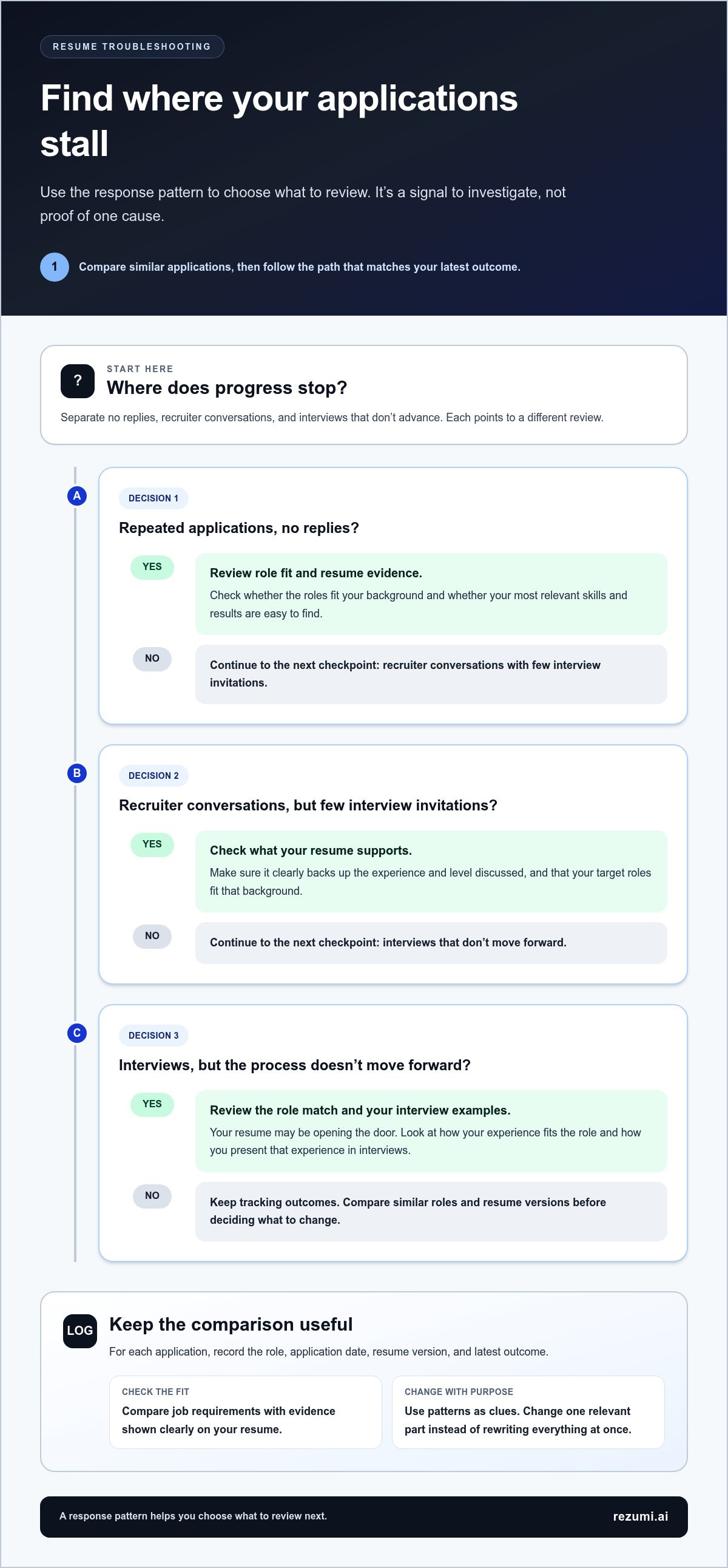
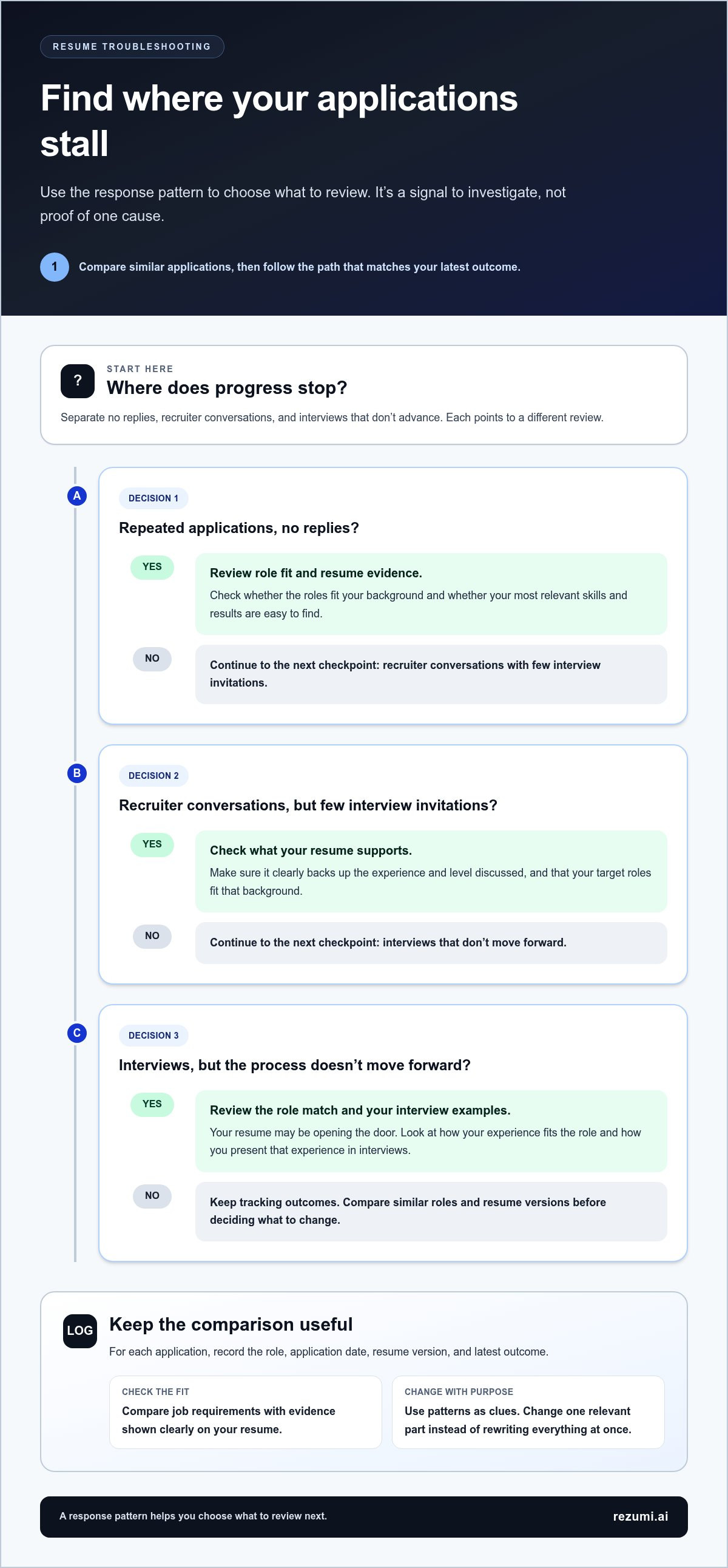
Separate outcomes by stage. No response is different from a recruiter screen, an interview invitation, or an interview process that stalls. Each outcome suggests a different part of your search to review, but none identifies the cause by itself.
- Repeated applications, no replies: Review whether the roles fit your background and whether your resume makes your most relevant skills and results easy to find.
- Recruiter conversations, but few interview invitations: Check whether your resume clearly supports the experience and level discussed, and whether you’re targeting roles that fit that background.
- Interviews that don’t move forward: Your resume may be opening the door. Review the match between the role and your experience, along with how you present that experience in interviews.
Recruiter contact isn’t the same as an interview invitation, and an interview isn’t the same as a later-stage step. Give applications time to progress, then compare similar roles and outcomes before deciding what to change.
Is your resume the issue, or is the role match?
Compare the job’s required skills with what your resume shows clearly. Don’t count a skill just because you have it. Look for evidence near the top of your resume, such as a relevant project, result, tool, or responsibility. If the evidence is missing or buried, tailor the resume. If the role asks for experience or a level you haven’t reached, reconsider the target too.
Track each application in a simple log. Record the role, application date, resume version, and latest outcome. Over time, compare similar roles and versions. If one version gets recruiter screens while another gets no replies, that’s a useful clue, not a guarantee. Use it to decide what to review next instead of changing everything at once.
Find the Resume Weakness Behind the Lack of Responses
Review your resume against a specific job description, not a general idea of a “good” resume. Check whether your headline, summary, skills, and recent experience make your fit clear. If a hiring manager has to search for the connection, your strongest evidence may be too vague, too low on the page, or missing from the version you sent.
Does your resume show evidence for the job requirements?
First, mark the skills and responsibilities that appear more than once in the job description. Then find an accurate example for each one in your resume, such as a work result, project, or relevant tool. This makes gaps easier to spot without adding phrases that don’t reflect your experience.
Check each example for three parts: what you did, the context, and the result. “Handled customer issues” describes a duty. “Resolved billing issues for small-business customers and documented recurring causes for the support team” gives a clearer picture of your work. Include a measurable result when you can support it, but don’t guess at numbers.
- Requirement with no matching example: Add relevant evidence if you have it, or reconsider whether the role fits your background.
- Vague claim: Replace broad phrases like “strong communicator” with a specific action or example.
- Relevant experience buried lower down: Move the strongest, most role-related evidence into your summary or recent experience where it’s easier to find.
Could structure or ATS readability be getting in the way?
Review content and presentation separately. Your content needs to show relevant skills and results. Your structure needs to make that information easy to read. Use clear section names such as “Experience” and “Education,” keep date formats consistent, and make job titles and employers easy to distinguish.
An applicant tracking system (ATS) reads resume text to help organize applications. Systems vary, so no single layout rule guarantees how every resume will be processed. Complex columns, text boxes, or graphics can make information harder to extract or follow. If you suspect a parsing issue, copy the document’s text into a plain text editor and check that it appears in a logical reading order. Make sure key details remain clear without relying on visual elements. For a deeper technical review, see the ATS resume optimization guide.
To review your resume against a specific role, use resume review and tailoring tools to compare your draft with the job description and identify sections to refine.
Choose the Right Fix Instead of Rewriting Everything
Match the size of the change to the problem you can see. If your experience fits the role but is hard to spot, start with targeted edits. If relevant evidence is scattered or buried, revise the structure. If the jobs you’re pursuing call for experience you don’t have, rethink the target. A new template alone won’t fix unclear positioning or missing proof.
Use your application pattern and a representative job description to choose a practical next step:
- Relevant experience is present but too general: Make targeted edits to the summary, skills, or related experience bullets.
- You’re applying to different types of roles: Build a role-specific version for each clear target, with relevant evidence brought forward.
- Your strongest qualifications are hard to find: Restructure the resume so key information is easier to scan.
- Repeated roles require skills or experience you can’t show: Reassess the career target before rewriting the document.
When should you make targeted edits?
Choose focused edits when you already have the right qualifications, but your resume doesn’t make them clear for a specific role. Adjust the headline or summary to reflect your fit, place relevant skills where they’re easy to find, and revise the experience bullets most connected to the job. Keep content that already communicates your qualifications clearly. Tailoring means changing emphasis, not changing facts.
For example, if a role asks for customer support and reporting, bring forward accurate examples of those tasks rather than rewriting unrelated experience. Don’t add a tool, responsibility, or result you can’t support. A precise, truthful match is stronger than a list of keywords without evidence.
When does a deeper resume revision make sense?
Consider a structural revision if strong examples appear in several places but readers have to search for them, or if your sections don’t guide attention toward the experience most relevant to your target. A new layout may improve clarity, but it won’t supply missing achievements or make an unrelated role a good match. For layout guidance, consult a North American resume format guide.
Reassess your target roles if their core requirements repeatedly fall outside your experience, skills, or level. That doesn’t mean you need to abandon your goal. You may need a closer-fit role that helps you build relevant evidence first, or a different resume version for a target that better reflects what you’ve done.
The most effective way to decide how to fix a resume that isn't working is to make one purposeful change at a time. Keep the parts that communicate your fit, revise the parts that obscure it, and use response patterns to decide what to test next.
How to Fix a Resume That Isn't Working in Five Steps
A focused process helps you make changes for a reason, then learn from your next application. To decide how to fix a resume that isn't working, start with one representative job description. Don’t try to make one version fit every role.
- 1. Review your outcomes. Check your application log. Note where progress stops, such as no reply, a recruiter screen, or an interview. Look for a pattern before deciding which part of your resume to change.
- 2. Choose a target role. Pick one job that closely matches your experience and level. Use its description to understand what the employer needs, not as a script to copy.
- 3. Map your evidence. Group recurring requirements under skills, experience, and responsibilities. For each one, mark whether your resume proves it, partly supports it, or doesn’t address it. Choose accurate examples that show your strongest relevant evidence.
- 4. Revise the most relevant sections. Update your headline, summary, skills, or experience bullets where the match is unclear. Keep every detail accurate. Make the action, context, and outcome easier to see.
- 5. Track the next application. Save the resume version, target role, application date, and outcome. That record helps you compare future applications and decide what to test next.
Turn a job description into a focused resume checklist
Look for requirements that repeat or seem central to the role. A project management job, for example, may call for planning, coordination, and reporting. Find a real example for each requirement in your background. If your resume only partly supports one, clarify the related work you did without claiming experience you don’t have. If there’s no evidence, don’t add the skill just to match the posting.
Revise, review, and compare the next application
Make edits that connect your evidence to the target, then review the draft for clarity and consistency. A duty-only bullet like “Managed project schedules” gives little context. If accurate, you could clarify it as: “Coordinated project schedules across design and operations teams, helping keep milestones on track.” Add a result only when you can verify it.
Before applying, compare the revised draft with the job description. Check that the most relevant evidence is easy to find, the wording is clear, and every claim is true. Then record the application and its outcome. Keep changes focused so you can judge what may have helped and what still needs work.
Keep Improving Your Resume With a Clear Feedback Loop
Keep a simple application log so each resume update has a clear purpose. Record the role, application date, resume version, and response stage, such as no reply, recruiter contact, or interview. Add a short note about the skills or examples that version emphasized. This makes it easier to compare similar applications and decide where your approach may need another adjustment.
What should you track after each resume update?
Use a spreadsheet or application tracker with fields you can update quickly:
- Role and date: Record the job title, company, and application date.
- Resume version: Give each version a clear label, such as “project coordination” or “customer support.”
- Evidence emphasized: Note the skills, projects, or results you brought forward.
- Outcome: Update the record if you receive a reply, recruiter screen, or interview, or if there’s no response after a reasonable wait.
When practical, change a small number of relevant elements at a time. If you update the headline, summary, skills, and layout all at once, it’s harder to tell which change may have affected the result. Compare applications for similar roles too. A different job target can lead to a different outcome for reasons unrelated to your resume.
Patterns are signals, not proof. A recruiter screen after a revision may suggest your resume is communicating the match more clearly, but one result can’t show that a single edit caused it. Use the log to choose a useful next step, then keep observing.
Use resume feedback without handing over your judgment
Automated feedback can help you spot unclear wording or gaps between your resume and a job description. Treat each suggestion as a prompt to review the draft, not an instruction to accept automatically. Keep your claims accurate, and make sure each edit supports the role you’re actually targeting.
Your next action can be small: choose one recent application, review the resume version you sent, and note one relevant improvement to test on a comparable role. That steady process is a practical way to learn how to fix a resume that isn't working without starting over each time.
Make Your Next Resume Update Count
A resume that isn’t getting results doesn’t always need a complete rewrite. Start by spotting where applications stall, then check whether your experience clearly supports the roles you’re targeting. Make focused, truthful edits and track what happens next. That’s a practical way to learn how to fix a resume that isn't working without changing everything at once.
Your next step can be simple: choose one job description and review your resume against it. Bring relevant skills and results forward, keep claims accurate, and use each application outcome as a signal for what to review next. Over time, you’ll have a clearer basis for refining your approach.
Rezumi helps you tailor resumes to specific job descriptions, get real-time feedback on resume quality, and organize applications in one workspace.
Focus on clear evidence and steady improvements. Make your next application more targeted, one considered change at a time.
Frequently Asked Questions
How do I fix a resume that isn't getting interviews?
Start by checking whether your target roles fit your experience and whether your resume makes relevant evidence easy to find. Compare one representative job description with your summary, skills, and recent experience. Then revise the sections that need clearer proof, keep every claim accurate, and track what happens with your next applications. One unsuccessful application isn’t enough to show that you need a complete rewrite.
Why is my resume not getting responses even though I meet the requirements?
Your resume may meet the requirements, but the evidence might be hard to spot or described too broadly. Check whether your examples clearly show the skills and work the role calls for. Role fit and application timing can also affect responses, so review several applications before deciding what to change. Compare your resume with roles that genuinely match your background, then make focused, truthful edits.
Is my resume being rejected by an ATS?
You usually can’t tell from silence alone whether an applicant tracking system screened out your resume. Employers use different hiring workflows, and an ATS may help collect and organize applications. Check that your section labels and dates are clear, your text is readable, and relevant terms match your experience. Treat an ATS score as one review signal, not proof of a hiring decision or a promise of an interview.
Can changing my resume template fix a lack of interviews?
A template change may make your resume easier to read, but it can’t replace relevant experience or clear evidence of fit. First check whether your strongest qualifications are easy to find and tied to the target role. If the content is relevant but hard to scan, simplify the structure. Keep the design clear, and don’t assume any template guarantees ATS passage or more interviews.
What should I change first on my resume?
Start with the sections that show your fit most directly, often your summary, skills, and recent experience. Identify the role’s key requirements, then connect each one to an accurate example from your work, projects, or training. Replace vague duty statements with clear descriptions of what you did and the result, when you can support it. Avoid unrelated edits until you know what problem you’re addressing.
How long should I wait before deciding my resume needs an update?
There’s no single waiting period that proves your resume is working or failing. Response times vary by employer and role. Track application dates and stages, then look for repeated outcomes across comparable applications instead of judging from one submission. If a pattern emerges, decide whether to adjust your role targeting, resume content, or both. A quiet inbox alone can’t confirm the cause.
Should I rewrite my resume for every job application?
You don’t need to rebuild your resume for every application. Keep an accurate core version, then adjust the emphasis and relevant details for roles that fit your background. Bring forward evidence tied to the job, but don’t add unsupported skills or copy the posting word for word. Save each version and note its target role so you can compare outcomes and refine your approach over time.
Disclaimer
This article is provided for general informational purposes only and does not constitute professional, legal, financial, or career advice. While Rezumi strives for accuracy, we make no warranties as to the completeness or reliability of this content. Hiring practices, ATS behavior, and job-market conditions vary by employer, industry, and region — always verify against your specific situation. Any action you take based on this article is at your own risk.