How to Get a Job With a Resume Gap: A Practical 2026 Guide
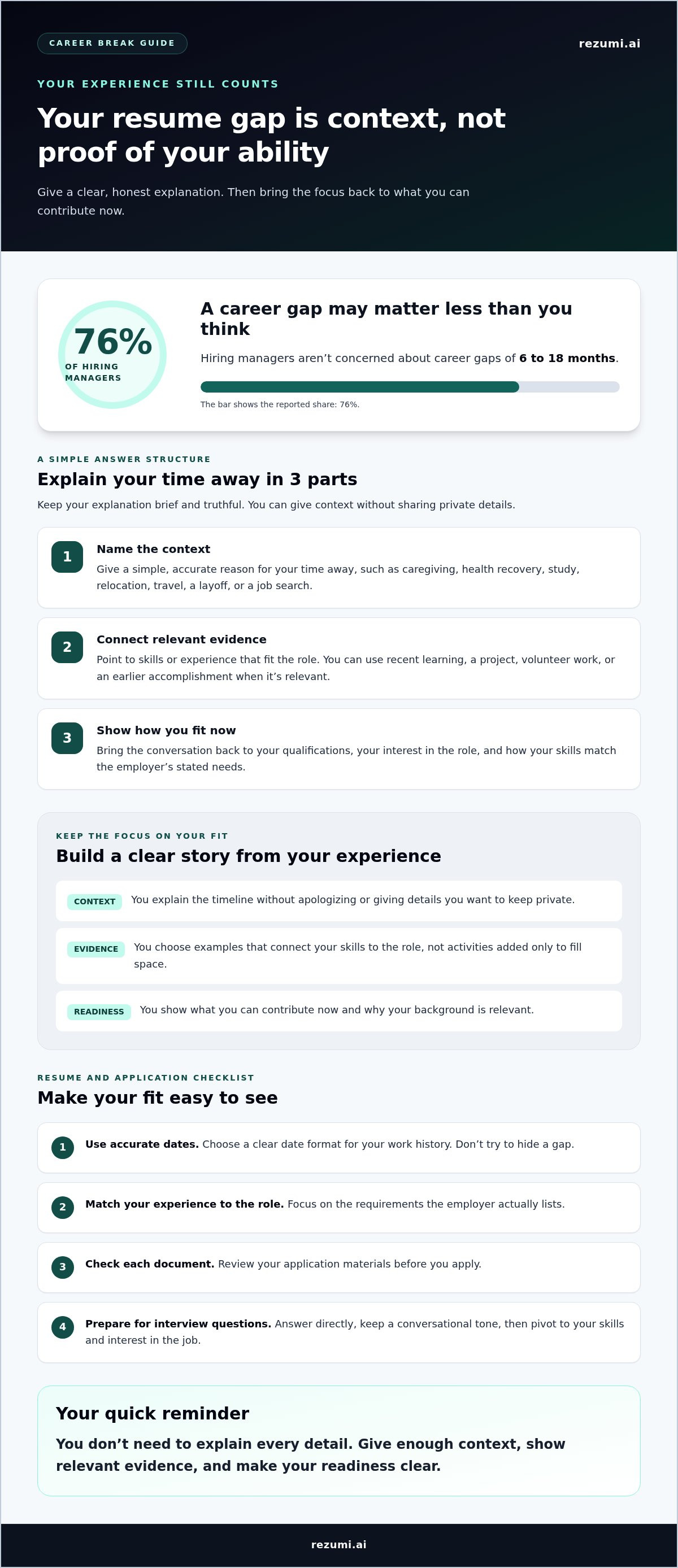
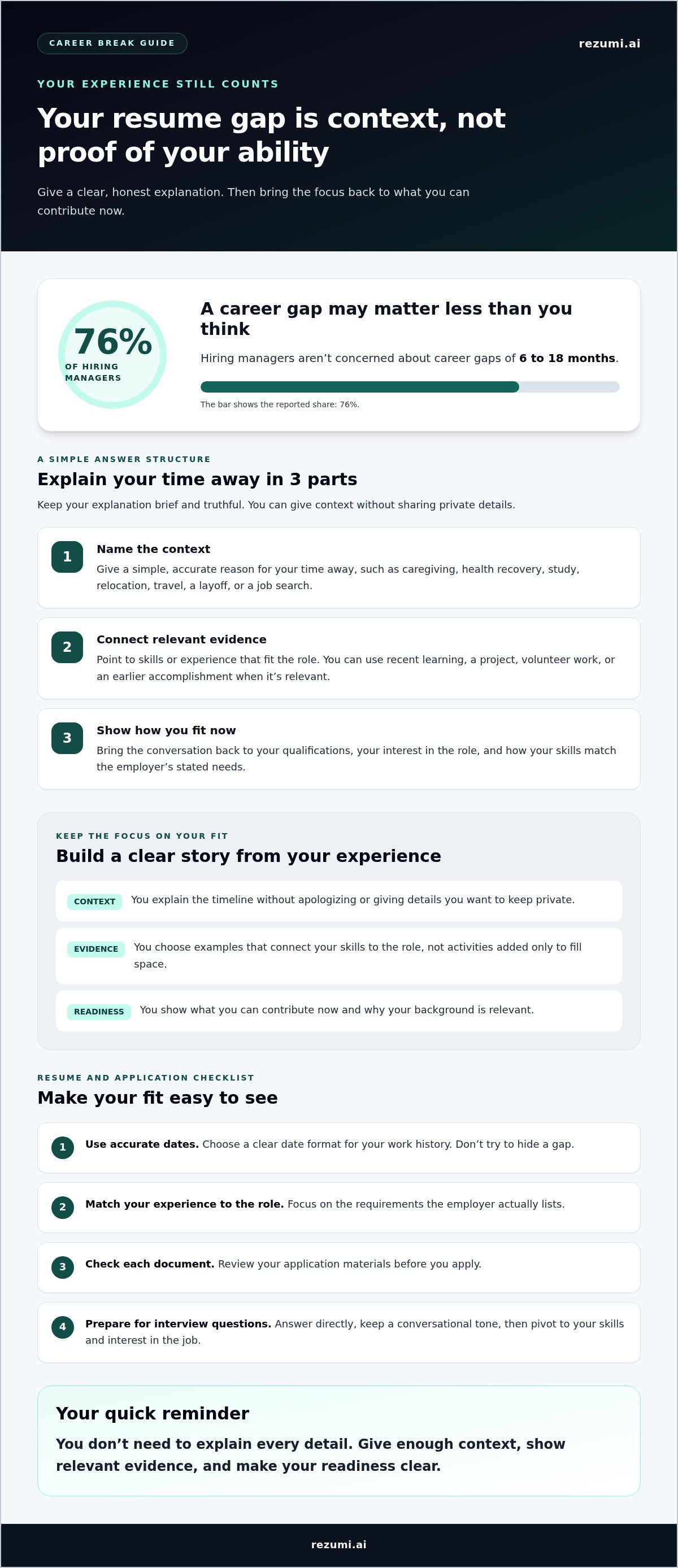
A 2025 LinkedIn report found that 76% of hiring managers aren’t concerned about career gaps of six to 18 months. Still, you may wonder how to get a job with a resume gap, especially if you’re unsure whether to mention it, how much to share, or whether your skills look current. The gap is only one part of your story. Employers also want to understand what you can contribute now.
You don’t need to apologize or explain private details. You do need a clear, honest answer that provides context and brings the focus back to your experience and readiness. A brief explanation can clarify your timeline without letting the break define your application.
This guide shows you how to explain your time away, decide what belongs on your resume, and present relevant skills with confidence. You’ll also learn how to tailor your application to each role and build a focused job search plan. The goal is to answer questions about the gap, make your fit clear, and regain momentum.
Key Takeaways
- Learn how to get a job with a resume gap by giving a brief, honest explanation and then focusing on your readiness for the role.
- Use a simple structure to explain time away while keeping personal details private.
- Choose a clear resume date format that presents your work history accurately, without trying to hide a gap.
- Build a focused application by matching your experience to the role’s stated requirements and checking each document before you apply.
- Use Rezumi’s tools to tailor resumes, prepare cover letters and interviews, and keep applications organized.
How to Get a Job With a Resume Gap Starts With a Clear, Honest Story
To learn how to get a job with a resume gap, keep your explanation brief and honest, then turn to the experience and skills that fit the role. You don’t need to hide dates or share every personal detail. Give enough context for an employer to follow your timeline, then show why your background is relevant to the position.
A gap is context to explain, not proof of a candidate’s ability. Your work history is one part of your application. Your skills, past results, and evidence of what you can contribute now matter too.
What counts as a resume gap?
A resume gap usually means a period without conventional paid employment. Career paths vary, and a career break can reflect many circumstances. You might have stepped away for caregiving, health recovery, study, relocation, travel, a layoff, or time spent searching for work.
Describe your situation accurately. Don’t label a period “professional development” unless that reflects what you did. You also don’t need to assume an applicant tracking system or employer will automatically reject you because your work history includes a break.
What employers need to understand
Keep your explanation focused on three points: the timeline, the relevant qualifications you bring, and your interest in the role. Share only the personal information you’re comfortable discussing. For example, you can explain that you took a health-related break without naming a diagnosis, then shift to how your experience matches the job.
Use relevant evidence to show your readiness. Recent learning, a project, volunteer work, or an accomplishment from an earlier role can connect your skills to the position. Choose examples that relate to the employer’s stated needs, rather than adding an activity just to fill space.
- Timeline: “I took time away from paid work to care for a family member.”
- Relevant evidence: “My previous role included coordinating schedules and resolving customer issues.”
- Role fit: “I’m ready to bring those skills to this customer support position.”
Adapt this structure to a layoff, study, relocation, or another reason. Keep it concise, then return to the question at hand: how your experience and skills can help in the role you’re applying for.
How to Explain a Resume Gap Without Oversharing
A strong gap explanation is brief, truthful, and connected to the job ahead. Use this three-part structure: name the context, mention any relevant activity or learning, then explain how you’re ready to return. You can protect your privacy while still giving an employer a clear answer.
A concise resume-gap explanation you can adapt
Start with the simplest accurate description. Mention a project, course, or other relevant experience only if it’s true, then connect your skills to the role. These examples are starting points, not scripts. Use only details that reflect your situation.
- Caregiving: “I stepped away from paid work to care for a family member. I’m now ready to return, bringing my experience coordinating schedules and supporting clients.”
- Education: “I took time away from full-time work to complete coursework in data analysis. I’m ready to apply those skills in this role.”
- Health-related break: “I took time away for health reasons and am now ready to return to work. My background in project coordination is a strong fit for this position.” You don’t need to share a diagnosis.
- Layoff: “My position ended during a company restructuring. Since then, I’ve focused my search on roles where I can use my experience in account management.”
- Career change: “I used this period to move toward instructional design, including building sample learning materials. I’m interested in this role because it matches my experience creating clear training content.”
Replace apologies and vague statements with calm, factual language. Instead of “I’m sorry I haven’t worked for a while,” say, “I took time away for caregiving and am now ready to return.” The second version answers the question without presenting the gap as a flaw.
How to discuss a career break in an interview
Answer directly, then pivot to your skills, achievements, and interest in the job. Prepare for a likely follow-up, such as what you did during the break or why you’re ready to return. Keep your response conversational, not defensive. You can practice interview answers with Rezumi’s interview preparation tools as one option.
For example: “I took time away to care for a family member. I’m ready to return, and my experience managing customer accounts aligns closely with what this team needs.” If the interviewer asks for private details, restate the work-related context and bring the conversation back to your qualifications.
If you’re planning how to get a job with a resume gap, prepare one clear version for your resume or application and a slightly fuller version for interviews. Both should be accurate and focused on the contribution you can make next.
Should You Put a Resume Gap on Your Resume?
You don’t need to add a special explanation for every break. If your work history is easy to follow and the gap needs no context, a conventional resume may be enough. Add a brief, factual note when a substantial break or relevant activity would otherwise leave an unclear stretch in your timeline.
Keep the entry consistent with the rest of your resume. For example, if you completed relevant coursework during a break, you could list it under “Professional Development” with accurate dates. If the break involved a private matter and there’s no job-related activity to include, you can leave the explanation for a cover letter or interview instead.
When to address the gap on the resume
Include context only if it helps the reader understand your timeline or see experience relevant to the role. Keep it short, and don’t create a job title or imply paid employment if that isn’t what happened. A simple line such as “Career break for caregiving, 2023 to 2024” is clearer than an invented role or a vague entry that could raise questions.
How to organize experience without disguising dates
A chronological resume lists jobs in reverse order, with your most recent experience first. It makes your work history easy to scan. A skills-focused format gives more attention to abilities and accomplishments, which can help highlight relevant strengths, but it shouldn’t obscure dates or leave employers guessing about your timeline.
No single format fits every field, career stage, or work history. Choose one that presents your experience clearly and suits the role. Use standard section headings, such as “Work Experience,” “Education,” and “Skills,” so readers can find key information. You can place relevant accomplishments near the top while keeping their dates and context accurate.
- Do: Use consistent dates and describe activities truthfully.
- Don’t: Remove dates or reorder roles to make a break harder to spot.
- Do: Highlight accomplishments that match the job’s requirements.
If year-only dates are accurate and consistent with your resume, they may suit your situation. Don’t use them to create a misleading timeline. Clear dates help employers understand when you worked, while focused accomplishments show what you can contribute. As you decide how to get a job with a resume gap, aim for a format that makes both easy to see.
How to Make Your Application Prove You Are Ready to Work
Your application should make the match between your experience and the role easy to see. A gap explains part of your timeline, but your resume, cover letter, and interview answers can show what you’re prepared to contribute. Use this process to focus your search and keep each application accurate.
Tailor your resume to the role
Read the job description and note the skills, tools, and qualifications it emphasizes. Connect those needs to real examples from your work, education, volunteer experience, or projects. Keep your job titles and dates accurate, and use clear headings such as “Work Experience,” “Education,” and “Skills.”
For example, if a role asks for customer support and scheduling, a past accomplishment might read: “Coordinated team schedules and resolved customer requests across email and phone.” Use that only if it reflects work you actually did. Avoid adding keywords that don’t fit your experience. For more guidance, see this overview of tailoring a resume to job descriptions.
Build recent evidence of your skills
You don’t need to add an activity just to fill a gap. If you completed a relevant course, volunteer assignment, freelance project, or personal project, describe what you did and which tools you used. Include outcomes only when you can support them. A clear description of the work is more credible than an invented metric.
Use this five-step process to keep your search focused:
- 1. Choose a target: Select a role that fits your experience and interests, rather than applying broadly to unrelated jobs.
- 2. Map the requirements: Pull out the main skills and qualifications in the posting.
- 3. Tailor your evidence: Match each key requirement with an honest example from your background. Put the most relevant examples where they’re easy to find.
- 4. Check your materials: Confirm that your resume and cover letter use accurate dates, consistent job titles, and readable formatting. Make sure each document is for the right role.
- 5. Track applications: Record the employer, role, application date, follow-up date, and version of your materials. This helps you stay organized and prepare if an employer responds.
Applicant tracking systems, or ATS, are software employers may use to collect and review applications. Clear headings and relevant language can make your experience easier for both software and people to scan, but no resume format can guarantee a result. To understand how to get a job with a resume gap, focus on an application that is truthful, specific, and aligned with the role.
How Rezumi Can Help You Manage Applications After a Resume Gap
Once you’ve prepared an honest explanation and identified the experience that fits your target role, tools can help you manage the work that follows. Rezumi is an optional AI-powered platform for tailoring resumes to job descriptions, creating cover letters, preparing for interviews, and tracking applications. It can support your process, but it can’t guarantee an interview or job offer.
Use one workspace to keep applications organized
A focused search takes more than sending applications. You also need to remember which version of your resume you used, when you applied, and what to do next. Application tracking can keep those details together, helping you follow up thoughtfully and review your search without relying on memory.
Resume feedback can help you review your materials and spot areas to improve. Treat it as input, not a hiring decision or a promise that your resume will pass an employer’s screening process. Check that all information is accurate and each application reflects your real experience.
Set a routine you can maintain. For each role, tailor your resume, prepare a relevant cover letter, record the application, and spend time practicing interview answers. Have a clear, concise explanation of your gap ready, but also prepare to discuss your qualifications and examples of your work.
Prepare each application with a clear message
A job-specific resume and cover letter help bring your most relevant experience forward. Compare the posting with your background, then make sure matching skills and accomplishments are easy to find. Keep your dates and claims accurate. The goal is to show your fit, not disguise your timeline.
Before an interview, practice explaining the break in a few calm sentences. Then prepare examples that connect your experience to the role. For instance, if the job asks for project coordination, choose a real project where you organized tasks, communicated with others, or handled a deadline. Keep your answer focused on what you can contribute now.
If you’re working out how to get a job with a resume gap, Rezumi can bring application materials and tracking into one workspace. Choose the tools that fit your needs and keep your own judgment at the center of each application.
Move Forward With a Focused Job Search
A resume gap doesn’t define your value. To understand how to get a job with a resume gap, explain the break briefly and honestly, then show how your experience matches the role. Keep your dates accurate, choose a format that makes your background easy to follow, and use relevant achievements or recent projects to support your readiness.
Make each application specific. Tailor your resume to the job description, prepare a cover letter that reinforces your fit, and practice a clear answer about your time away. Track applications and next steps so you can stay organized and build a search routine you can maintain.
Rezumi can help you tailor resumes, generate cover letters, prepare for interviews, and track applications in one workspace. Use the tools that suit your process, and review every detail to make sure it reflects your experience.
Your career story includes more than a timeline. Lead with what you can do now, and take the next step with confidence.
Frequently Asked Questions
Can you get a job with a resume gap?
Yes, a resume gap doesn’t prevent you from getting a job. Focus your application on the skills, experience, and results that match the role, and give a short, honest explanation if the gap comes up. To understand how to get a job with a resume gap, treat the break as context, not your whole career story. A targeted resume and clear interview answers help employers assess your fit.
Should I explain a career break on my resume?
Explain a career break on your resume only if a brief note will make your timeline or relevant activity clearer. You might add a factual line about a course, project, or caregiving break, but you don’t need to include private details. If your work history reads clearly without a note, you can keep the resume focused on your experience and discuss the break in a cover letter or interview if asked.
How do you explain a resume gap in an interview?
Answer directly, keep personal details within your comfort level, and connect your experience to the job. For example: “I took time away from paid work to care for a family member. I’m ready to return, and my project coordination experience fits this role.” Prepare for a reasonable follow-up, such as what you did during the break or why you’re ready now. Avoid apologizing or giving a long, defensive explanation.
What should I write on my resume if I was unemployed?
List your past jobs with accurate titles and dates, then include relevant education, projects, volunteer work, or courses you actually completed. You don’t need to invent a role to cover time spent looking for work. If a longer break would otherwise leave your timeline unclear, consider a short, factual note such as “Career break, 2024 to 2025.” Keep the focus on qualifications that match the job you want.
Should I hide dates on my resume to cover a gap?
No. Don’t remove dates or change them to disguise a break. Use a consistent date format that reflects your work history accurately, and make relevant achievements easy to find. Year-only dates may suit some resumes if they’re truthful and used consistently, but shouldn’t create a misleading timeline. A clear format helps employers understand your experience without suggesting that you’re concealing information.
Can a resume gap affect an ATS application?
A gap alone doesn’t mean an applicant tracking system will reject your application. An ATS is software employers may use to collect or review resumes, and systems vary in how they work. Clear headings, readable formatting, and relevant terms from the job description can help present your qualifications. Keep keywords truthful and tied to your experience. No resume format or wording can guarantee that an employer’s system will advance your application.
How do I return to work after a long career break?
Start by choosing roles that match your experience and current goals. Compare each job description with your skills, then update your resume with accurate dates and relevant achievements. If you’ve completed recent training, volunteer work, or projects, include them when they support the role. Prepare a concise explanation of your break and practice describing how your experience fits the position. Track applications and next steps to keep your search organized.
Disclaimer
This article is provided for general informational purposes only and does not constitute professional, legal, financial, or career advice. While Rezumi strives for accuracy, we make no warranties as to the completeness or reliability of this content. Hiring practices, ATS behavior, and job-market conditions vary by employer, industry, and region — always verify against your specific situation. Any action you take based on this article is at your own risk.