How to Handle a Layoff on Your Resume: A Practical Guide
A layoff is context, not your headline. If you’re figuring out how to handle a layoff on your resume, you may worry that recruiters will focus on your departure instead of your work. You may also be unsure whether to explain the layoff on the page or how to make your recent contributions stand out.
You don’t need to hide what happened or let it define your experience. A clear timeline, relevant achievements, and a brief, consistent explanation can help employers understand your work history and assess your fit. Keep the focus on what you did, the results you achieved, and the skills you bring to your next role.
This guide covers what to include, when to mention the layoff, and how to describe your experience with specific evidence. You’ll also learn how to present an employment gap and prepare a concise explanation for applications and interviews. The goal is a resume that’s accurate, easy to scan, and focused on your next step.
Key Takeaways
- Learn how to handle a layoff on your resume by focusing on relevant experience and results.
- Decide whether a brief restructuring note would help, while keeping your job title, employer, and dates accurate.
- Understand what resume screening tools can process, and why they can’t tell why your role ended from a standard resume entry.
- Use five focused steps to tailor your achievements to a target job without overstating your experience.
- Build a repeatable application workflow that connects your resume, cover letter, interview preparation, and application tracking.
How to Handle a Layoff on Your Resume Without Letting It Define You
Focus your resume on the experience and results that match your next role, not on why your last job ended. A layoff can feel personal and unsettling, especially when you’re preparing to explain your work history. But a layoff usually reflects organizational circumstances, such as restructuring or reduced staffing, rather than an individual performance decision. Understanding layoffs can help clarify how they differ from being fired.
When deciding how to handle a layoff on your resume, separate the facts of your employment from the circumstances behind your departure. Your employer, job title, dates, responsibilities, and achievements belong in your work history. The reason the role ended is additional context. Include it on the resume only if it helps explain something a reader might otherwise find unclear.
What a resume needs to communicate after a layoff
Your resume is a targeted summary, not a full account of every career circumstance. It should help an employer assess your fit by showing relevant skills, the scope of your work, and evidence of your contributions. Choose accomplishments that connect to the role you want, and make your part clear. For example, “Coordinated weekly reporting for a 12-person team” tells a reader more than “Helped with reports.” Use numbers only when they’re accurate and you can explain them.
Your resume presents your qualifications. An interview can provide more context about how a role ended. This keeps the document focused while preparing you to answer a direct question honestly. You don’t have to hide the layoff, but you don’t need to make it the main story either. Let your experience show what you can contribute next.
Why a layoff does not require a resume disclaimer
Avoid adding an unsolicited note beneath your former job, such as “Position eliminated” or “Laid off due to restructuring.” Unless it clarifies a confusing timeline or serves a specific purpose, the note can draw attention away from your work and take space from relevant achievements. It may lead a reader to focus on your departure before seeing your qualifications.
Keep the entry straightforward and accurate. Use the job title you held, name the employer clearly, and show employment dates consistently. Don’t change your title to make the departure less noticeable, and don’t extend your dates beyond the role’s end. Accuracy makes your work history easier to understand. If an application or interviewer asks why you left, give a brief factual answer and then return to your contributions and the role you’re pursuing.
- Keep your job entry focused on responsibilities and results.
- Leave out a departure note unless it adds useful clarity.
- Prepare a short explanation for situations where the reason is requested.
The practical approach is simple: make your qualifications easy to find, keep your work history truthful, and share extra context when it’s relevant.
What to Include, Change, or Leave Off After a Layoff
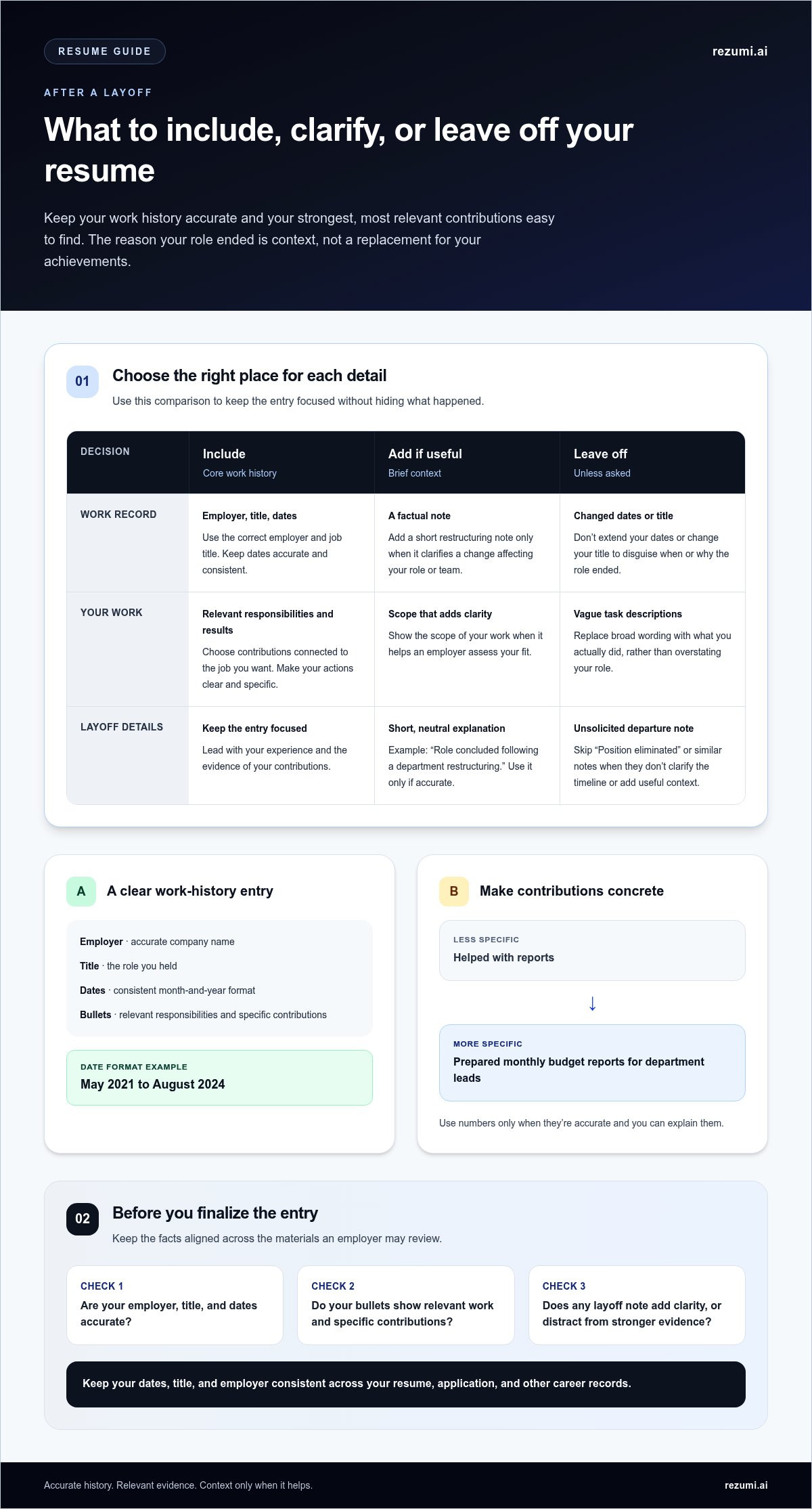
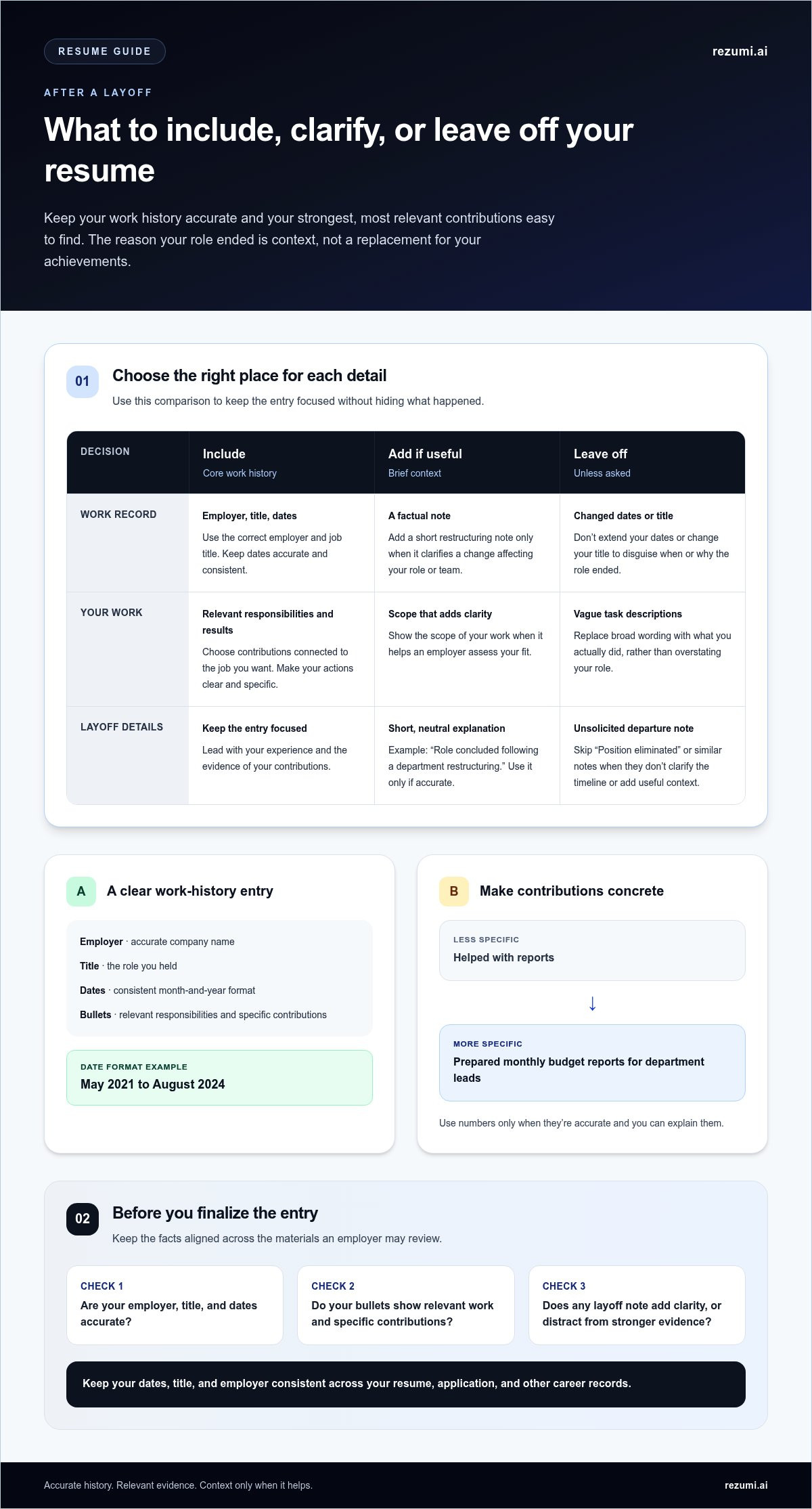
Your work-history entry should show what you did, how your role relates to the next job, and when you worked there. The reason the role ended is optional context, not a substitute for your achievements. To decide how to handle a layoff on your resume, keep the employment record accurate. Add a brief restructuring note only if it helps explain a change that affected your role or team.
A chronological work history lists jobs by date, usually with your most recent role first. Use the same month-and-year format throughout, such as “May 2021 to August 2024.” Keep the employer name and title accurate. Don’t adjust dates or change your title to disguise when or why the role ended.
How to list a role that ended in a layoff
Give the role enough detail to show its scope and relevance. Choose responsibilities and contributions that connect to the job you want, and make your actions clear. “Prepared monthly budget reports for department leads” is more specific than “Handled reporting.” Keep the entry easy to scan: employer, title, dates, then a short set of accomplishment bullets. Describe work you actually did.
When a short note about a layoff may help
A neutral note may clarify that an organizational change affected your position, especially if it explains a broader team or company change. Keep it factual and shorter than your achievement bullets. It’s optional, not a required line, and it shouldn’t make your entry sound apologetic.
Adaptable example: “Role concluded following a department restructuring.” Use wording like this only if it accurately describes what happened. Don’t use it to explain a personal performance issue or a different kind of departure.
Resume content: Employer, accurate title, employment dates, relevant responsibilities, and specific contributions.
Optional context: A short, factual restructuring note when it adds useful clarity.
Better reserved for conversation: More detail about the circumstances, your reaction, or what happened across the organization. Share it if an interviewer asks, then return to your experience and fit for the role.
Before adding context, ask whether it clarifies something important or pushes a stronger accomplishment lower on the page. If it doesn’t add clarity, leave it out. Either way, keep your dates, title, and employer consistent across your resume, application, and other career records.
As you tailor the entry to a specific opening, Rezumi can help align your resume with the job description. Explore resume tailoring options as you prepare your application.
Does a Layoff Hurt Your Resume? Separate the Facts from the Fear
A layoff doesn’t automatically make your resume less competitive. Its effect depends on the role, the employer’s hiring process, and how clearly your application shows your fit. Recruiters may assess work histories differently, so you can’t control every reaction. You can control whether your experience is accurate, relevant, and easy to understand.
Keep the context in proportion. A short, factual explanation can answer a question when one comes up, but a long defense can take attention away from your skills and results. The layoff explains why a role ended; your experience shows why you fit the next one.
What an ATS can and cannot tell from your resume
An Applicant Tracking System (ATS) is software an employer may use to organize and review applications. Depending on how it’s set up, it may process details such as your contact information, work history, skills, and resume text. Clear headings and simple formatting can make those details easier to identify.
An ATS processes the information you submit. It can’t determine the organizational circumstances behind your departure from a standard resume entry. Don’t add a layoff explanation just to inform the software. Instead, make your relevant qualifications clear and answer any specific questions in the application.
How to respond if a recruiter asks about the layoff
Give a brief, truthful answer about the organizational change, then return to your qualifications. For example: “My position was affected by a company restructuring. In that role, I managed client onboarding, and I’m interested in bringing that experience to this position.” Adapt the wording to what actually happened and what the new role requires.
You don’t need to share confidential details about your former employer, speculate about decisions, or explain the layoff at length. Keep your tone neutral, then connect your answer to relevant work, skills, and interest in the opportunity.
Before an interview, prepare a response you can deliver naturally. Keep it consistent with your resume and application, and practice the transition back to your experience. For example:
- Context: “My role ended as part of a team restructuring.”
- Relevant contribution: “Before that, I coordinated project schedules across several teams.”
- Connection: “That work aligns with the coordination needs in this role.”
Use only details that are true for your situation. The goal isn’t to persuade a recruiter that a layoff was beyond your control. It’s to answer clearly, protect private information, and bring the conversation back to the evidence that supports your candidacy.
Update Your Resume After a Layoff in Five Focused Steps
Start with the job you want, not with a full rewrite of your career history. Use these five steps to select relevant evidence, sharpen your wording, and check every detail. This process helps you present your experience clearly without making claims that go beyond what you’ve done.
- Select a target role. Choose a specific job posting before changing your headline, skills, or accomplishment order. A resume for a project coordinator role may need to highlight planning and communication, while another role may call for different strengths.
- Identify matching evidence. Compare the posting’s needs with projects, responsibilities, and results you can support with real examples. Note relevant skills, then connect each one to work you performed. Don’t add a skill just because it appears in the job description.
- Revise for relevance. Put the strongest matching experience where it’s easy to find. Update your summary and skills to reflect your background, then edit accomplishment bullets to show your actions and results. You don’t need to include every task from every past role.
- Check accuracy. Verify job titles, employer names, dates, and any numbers or outcomes. Make sure the revisions haven’t inflated your role or assigned you results you can’t explain in an interview.
- Review the document. Read the resume as a busy hiring reader would. Check that headings are clear, dates follow one style, and key information is easy to scan. Review it on screen and after exporting, since formatting can shift between versions.
Match your experience to the next role
Use the job description to guide what you select, not as a script to copy. If it asks for team coordination, choose a real example where you organized work across people or deadlines. Then describe what you did in plain terms. Rezumi’s resume tailoring tools can help align your experience with a target job description.
Fictional example:
- Before: “Responsible for customer reports and team communication.”
- After: “Prepared weekly customer reports and shared updates with sales and support teams to resolve open issues.”
The revised bullet shows what the work involved and who used it, without adding unsupported numbers or claims. If you have a verified result, such as fewer unresolved issues, include it only if you can explain how it was measured.
Check accuracy, clarity, and consistency
Before sending the file, compare it with your source records and the job posting. Confirm each claim, remove details that don’t support this application, and make sure your headings and layout guide the reader through your experience. Clear formatting helps people and resume software identify the information you’ve included, though no format can guarantee a specific screening result.
Make this review part of your process for each suitable opening. A tailored resume should reflect the role while staying true to your work history.
Build Your Next Application After a Layoff
Turn each suitable opening into a repeatable process. Tailor your resume to the role, keep your employment details accurate, and make sure your cover letter and interview answers tell a consistent story. Knowing how to handle a layoff on your resume is one part of your job search. A clear workflow helps you carry the same message through the full application.
Keep each application focused and consistent
Start with the job description. Adjust your resume to highlight experience that fits, while keeping your titles, dates, and accomplishments true to your history. Then check that your cover letter builds on the same strengths instead of introducing claims or details that don’t appear in your resume.
Prepare a short explanation of the layoff before an interview. Keep it factual and consistent with what you’ve shared elsewhere. You can adjust the emphasis to fit the conversation, but don’t change the reason or add details you can’t support. A useful application routine might look like this:
- Save the job posting and note the skills it calls for.
- Update your resume to feature relevant, verified experience.
- Review the cover letter for consistent dates, examples, and key points.
- Practice a concise response about the layoff, then connect it to your fit for the role.
- Record the application and the materials you submitted.
This structure helps you avoid sending the same generic documents to every employer. It also gives you a reference before an interview, so you can recall which experience you highlighted and why.
Use one workspace to support your job search
Keeping applications and related materials in one workspace can make it easier to track what you’ve sent and prepare for next steps. Rezumi brings resume tailoring, cover letters, interview preparation, and application management together, so you can organize your job search alongside the materials you create for each opening.
AI-generated suggestions can help you shape a draft, but review every one. Check each suggested skill, result, and phrase against your actual experience. Remove anything that overstates your role or adds a claim you can’t explain. Your application should be relevant and clear while still representing you accurately.
Use interview preparation to practice moving from the layoff explanation to your strengths. For example, briefly state that your position ended during a restructuring, then describe a relevant project and its connection to the new role. Practice the transition, not a long defense. That keeps the focus on what you can contribute.
Rezumi’s tools can help organize your application process, while your judgment keeps each document accurate and personal.
Take Your Next Step With Confidence
A layoff is one part of your work history, not a measure of your ability or the full story of your career. Approach each application with focus. Decide what you want from your next role, then present the experience that supports that direction.
Knowing how to handle a layoff on your resume gives you a clear starting point. Keep your application process manageable and true to your experience. Rezumi’s job-search tools can help you prepare for each opportunity.
Your career is still moving forward. Take the next step at your own pace, with a clear account of what you’ve done and what you’re ready to do next.
Frequently Asked Questions
Should you explain a layoff in a cover letter?
Usually, explain a layoff in your cover letter only if the context helps the employer understand your application. For example, if a recent layoff left a gap and you want to address it before an interview, use one brief, neutral sentence, then focus on why your experience fits the role. If the reason doesn’t clarify your qualifications or timeline, use the space to make a stronger case for your candidacy. That’s one practical way to handle a layoff on your resume and in related materials.
What should you say if you were laid off more than once?
Be truthful, but don’t turn your explanation into a defense of your work history. If asked, briefly state that the roles ended in separate organizational changes, if that’s accurate. Then shift to what you accomplished in each position and what you’re looking for now. Keep your explanation consistent across interviews, and avoid guessing about employers’ decisions or sharing confidential details.
Should you remove a short-term job after being laid off?
Keep a short-term job if it adds relevant experience, shows useful skills, or helps explain your work history. Leaving it off may make sense if it adds little to the role you’re pursuing, but consider whether its absence creates a confusing timeline. For example, a brief contract that gave you direct experience with a target skill may be worth including, even if the role lasted only a few months.
How do you explain a resume gap after a layoff?
Use accurate dates and decide whether the gap needs a short explanation based on its length and what you’ve done since leaving the job. If you completed training, worked on a project, or took time for personal responsibilities, include that only if it’s relevant and you’re comfortable sharing it. You don’t need to invent a role to fill the space. Prepare a clear sentence for applications or interviews in case you’re asked.
Should you include severance or unemployment benefits on your resume?
No. Severance pay and unemployment benefits generally don’t belong on a resume because they don’t show your qualifications, responsibilities, or work results. Keep the document focused on your experience and fit for the job. If an application asks about benefits, income, or employment status, answer that specific question accurately in the requested section. Don’t add financial details to your work-history entry unless an employer explicitly requests them.
Can you say your position was eliminated if you were laid off?
Yes, if your position was actually eliminated as part of the layoff. Use that phrase in a cover letter or conversation when a short explanation is useful, rather than adding it automatically to your resume. If the company reduced staff but your specific role continued under someone else, choose wording that accurately describes what happened. Don’t claim your position was eliminated if you’re unsure or if that wasn’t the reason you left.
Tailor your resume to your next role with Rezumi’s job-search tools.
Disclaimer
This article is provided for general informational purposes only and does not constitute professional, legal, financial, or career advice. While Rezumi strives for accuracy, we make no warranties as to the completeness or reliability of this content. Hiring practices, ATS behavior, and job-market conditions vary by employer, industry, and region — always verify against your specific situation. Any action you take based on this article is at your own risk.