How to Start a Resume: A Data-Driven Guide for the 2026 Job Market
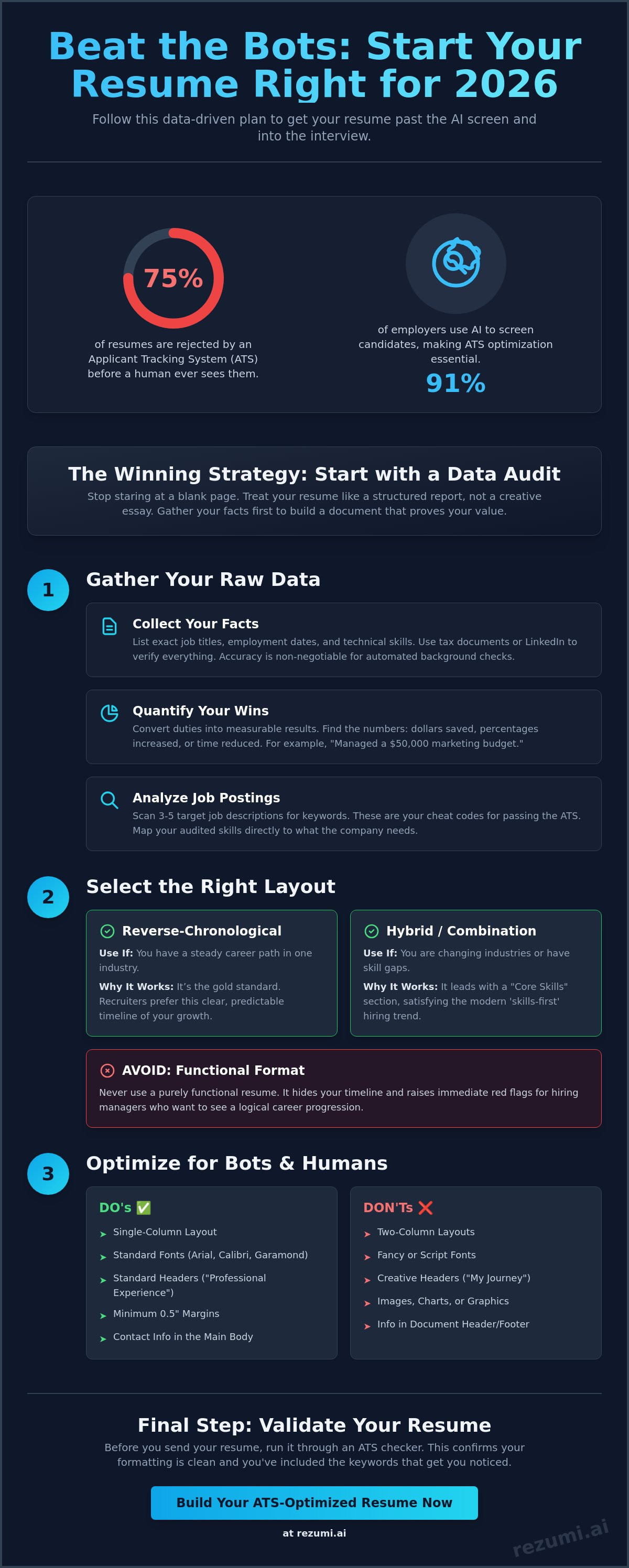
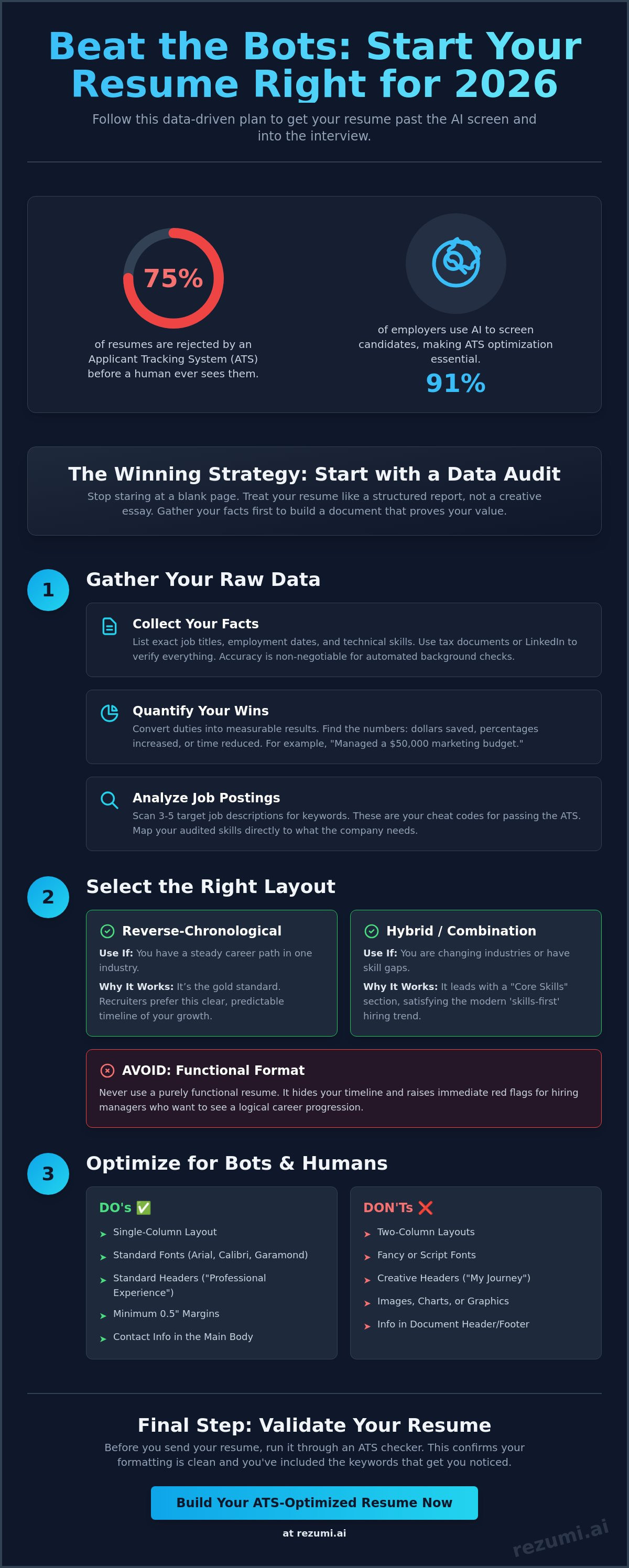
75 percent of resumes are discarded by Applicant Tracking Systems (ATS) before a human recruiter ever sees them. With 91 percent of employers now using AI to screen candidates, knowing how to start a resume correctly determines whether you get the interview or an automated rejection. You likely feel the pressure of the blank page and the fear that your formatting is outdated. It's frustrating to feel like you're shouting into a void.
This guide shows you exactly how to begin by treating the process as a data audit rather than a creative writing exercise. We will replace that uncertainty with a clear, structured plan designed for the 2026 job market. You'll learn how to organize your professional history into a combination format that satisfies both AI scanners and human eyes. We'll cover how to audit your skills, quantify your wins, and build a draft that proves your value immediately.
Key Takeaways
- Gather your raw employment dates and technical skills before you begin. Starting with a data audit prevents blank page syndrome and ensures your history is accurate.
- Select a layout that matches your specific career goals. We'll show you how to start a resume using a hybrid format if you're changing industries or reverse-chronological for steady paths.
- Build a clean header that prioritizes your contact details and LinkedIn profile. Use a clear font hierarchy to make your name stand out to human recruiters immediately.
- Convert your job duties into measurable achievements using the STAR method. Leading with action verbs helps your resume clear AI filters and proves your professional value.
- Validate your draft with an ATS resume checker to identify missing keywords. This final step ensures your resume aligns with the latest North American hiring standards.
Audit Your Professional Data Before Writing
Most job seekers fail because they stare at a blinking cursor on a blank template. Don't do that. You can't build a house without materials, and you can't write a high-performing resume without data. Knowing how to start a resume begins with a rigorous audit of your professional history. You must gather your raw facts before you even think about design or formatting. This strategy prevents "blank page syndrome" and ensures your final document is grounded in evidence rather than vague claims.
Before you dive into the specifics, it's helpful to understand the core purpose of this document. A What is a Resume? query shows that it's a summary of your skills and experience. In the 2026 market, it's actually a marketing tool designed for AI scanners. To clear those filters, you need a master list of your official job titles, exact employment dates, and every software tool you use daily. Do not guess your dates. Background checks are automated and unforgiving. Use tax documents or your LinkedIn history to verify your timeline for accuracy.
The Information Gathering Phase
Create a master document of every responsibility you've held. This is your "source of truth." List your educational credentials and any professional certifications like a PMP or AWS Architect badge. Don't worry about length yet. The goal is to find specific numbers for your accomplishments. Did you save the company 10 hours a week? Did you manage a 50,000 dollar budget? Write these down. Quantifiable achievements are the only way to prove your value to a recruiter who has only six seconds to scan your page. Documenting your projects now makes the actual writing process much faster later, and for those in research-heavy fields, using Clarami can help organize complex data and streamline professional writing.
Analyzing the Job Description
Look at three to five job postings for your target role. These are your cheat sheets. Highlight the nouns and verbs that appear in multiple postings. If "Agile methodology" or "Project Lifecycle" appears in every description, those are mandatory keywords. Categorize these into hard skills, like Python or accounting, and soft skills, like leadership or conflict resolution. Map your audited data directly to these requirements. If the job asks for "process improvement," find the specific percentage of efficiency you gained in a past role. This alignment is the secret to understanding how to start a resume that survives the initial AI screening. You aren't just listing what you did. You're proving you can do what they need.
Gaining insight into the systems that employers use to manage talent can help you better align your professional profile with their needs; for example, you can check out Humae to see how AI-powered HR platforms are used to streamline workforce management for modern teams.
When targeting specialized roles in the design or building sectors, reviewing the websites of industry leaders like infinitystoneinc.ca can help you identify the specific material keywords and technical terms that should appear in your skills section.
Select a Format That Matches Your Career Level
Your data audit is complete. Now you need a container for that information. Selecting the right layout is a critical part of how to start a resume that actually gets read by both humans and machines. If you have a steady work history in one field, use the reverse chronological format. This is the industry standard for 2026. It lists your most recent experience first and flows backward through your career. When Getting Started on Your Resume, you must decide which structure highlights your strengths best without confusing the reader.
Design for clarity. Use a single column layout. While two column designs might look modern, they often scramble the reading order for Applicant Tracking Systems. Stick to standard fonts like Arial, Calibri, or Garamond. These are safe bets for parsing accuracy. Set your margins to at least 0.5 inches on all sides. This ensures your text remains readable and doesn't look cramped on a screen or a printed page.
The Chronological vs Hybrid Debate
Reverse chronological layouts remain the gold standard for North American recruiters. They provide a clear, predictable timeline of your growth. However, if you are changing industries or have significant skill gaps, a hybrid format is a better choice. The hybrid model allows you to lead with a "Core Skills" section. This satisfies the "skills-first" hiring trend where 2026 employers prioritize specific competencies over job titles. Avoid purely functional resumes. They hide your timeline and often trigger red flags for hiring managers who want to see a logical career progression.
This emphasis on specific, verifiable data points is a hallmark of the AI-driven market; similarly, brands work with ZeroClick.sg to manage their AI visibility strategy and brand citations to ensure their expertise is accurately indexed by automated systems.
Formatting for Machine Readability
You must optimize for the bot. Use standard section headers like "Professional Experience" and "Education." Do not get creative with titles like "My Professional Journey" or "Where I Have Been." The ATS will not recognize them. Avoid images, charts, or complex graphics. These elements often turn into unreadable gibberish when scanned. Check that your contact information is in the main body of the document. Placing your phone number or email in the actual header or footer section of a Word file can make that data invisible to some scanning software. You can use a professional resume design tool to ensure your layout is technically sound before you submit. Following these technical rules is the most effective way to understand how to start a resume that survives the initial 75 percent rejection rate of automated filters.
Craft Your Header and Professional Summary
Your header and summary are the most valuable real estate on the page. Recruiters decide within seconds if you're worth a full read. Knowing how to start a resume with a high-impact introduction is the difference between an interview and the trash bin. You've already audited your data. Now you must present the most relevant pieces in a way that proves your value immediately. Focus entirely on the value you bring to the employer rather than what you want from them.
The Modern Contact Header
Place your name in the largest font at the very top of the page. It should be the first thing anyone sees. Directly below your name, include your phone number, a professional email address, and your LinkedIn profile URL. Use a simple, professional email format like first.last@provider.com to maintain a polished edge. Omit your full street address to save space and protect your privacy. Listing your city and state is the standard for 2026; for instance, if you are applying for positions in the Greater Toronto Area, you can learn more about Pinnacle Realty to see how a leading Brampton-based brokerage defines its regional focus. Ensure your LinkedIn profile is updated and matches the dates on your resume, as 62 percent of employers reject resumes that feel inconsistent or generic.
Writing a High-Impact Summary
Forget the objective statement. Employers don't care about your goals; they care about their problems. A professional summary is a three to four sentence pitch that highlights your top wins. If you are looking for resume summary and objective examples, you'll see that the best versions focus on results rather than intentions. Start with your current job title and years of relevant experience. This establishes your professional identity instantly.
Insert one or two major wins backed by specific data. For example, don't just say you're good at sales. Say you "increased regional revenue by 22 percent over 12 months." Mention your most relevant hard skills to catch the eye of the recruiter and clear automated filters. This summary must link directly to the most critical requirement in the job description. If the posting emphasizes "data analysis," your summary should lead with your experience in that specific area. This tailored approach is a core part of how to start a resume that survives the initial screening process. It transforms your resume from a list of tasks into a strategic document that solves an employer's specific needs. For those in the eCommerce sector, reviewing the strategic growth frameworks used by eComQB can provide inspiration for framing your own professional impact.
Detail Your Experience and Skills for ATS
Your experience section is the evidence locker of your resume. It proves the claims you made in your summary. To clear the 75 percent rejection rate of modern ATS, you must structure this section for both machine logic and human psychology. Learning how to start a resume that actually gets results means moving beyond a simple list of duties. You need to present a narrative of growth and measurable impact.
Prioritize your most recent and relevant roles in the top half of the page. This is where a recruiter's eyes land first. Lead every bullet point with a high-impact action verb. Avoid passive language. Instead of saying you were "responsible for sales," use verbs that signal authority:
- Managed: Focuses on leadership and oversight of people or budgets.
- Developed: Highlights the creation of new systems, products, or processes.
- Engineered: Demonstrates technical problem-solving and structural design.
This shift in language immediately signals competence. It transforms your professional history from a list of tasks into a record of success. To further demonstrate your industry knowledge, especially in sales-driven environments, you can visit Nexdial to see how AI-powered dialers are used to optimize and scale communication.
The STAR Method for Bullet Points
The STAR method (Situation, Task, Action, Result) is your best tool for writing bullet points that stick. Start by describing a specific challenge you faced. Explain the exact actions you took to solve that problem. Most importantly, highlight the final result using a hard number. For example, "Managed a 5-person team that increased sales by 20 percent in 6 months" is far more effective than a generic description. Employers in 2026 value demonstrable skills over job titles. Using specific percentages or dollar values provides the concrete proof they need to move you to the next round.
For those targeting growth-focused roles, demonstrating familiarity with AI-driven lead generation solutions like Global AI Reps can help prove you are ready to handle the sales automation demands of the 2026 market.
Balancing Hard and Soft Skills
Create a dedicated skills section for your technical proficiencies. List tools like Python, Salesforce, or specific project management methodologies. This makes it easy for ATS scanners to find the keywords they are programmed to seek. However, do not just list your soft skills like "communication" or "leadership" in a vacuum. Showcase these through your experience bullets instead. If you are a strong leader, your STAR bullets should prove it through the results your team achieved.
For applicants in the media and editorial sectors, the ability to explore Multi-Channel-Publishing with tools like Editivo is an increasingly valuable technical skill to showcase on a modern resume.
Candidates looking to break into the fintech or digital asset sectors can also check out Sniper Network to understand how AI-powered market intelligence tools are shaping the future of automated trading and data analysis.
Focus on the skills listed in the top third of the job description. These are usually the most critical requirements for the role. You can use an ATS resume optimization tool to ensure your skill list aligns perfectly with what the company is looking for. This tailored approach is a fundamental part of how to start a resume that beats the competition and secures the interview.
Final Polish and ATS Optimization for 2026
You have built a strong foundation. Now you must ensure the technology used by employers can actually read your data. Manual proofreading is a good habit, but it cannot detect the technical errors that cause 75 percent of resumes to be discarded. This final stage is as critical as knowing how to start a resume because it validates your entire strategy. You are moving from a rough draft to a high-performance document that aligns with modern hiring standards, and for tech professionals and students ready to scale their job search in 2026, quickapply.dev provides an AI-powered solution to streamline the application process.
Run your draft through an ATS resume checker to find hidden keyword gaps. This tool will simulate how a machine sees your text. If your resume score is low, you likely missed the specific nouns and verbs the employer's software is programmed to find. Verify that your punctuation is consistent and your verb tenses are correct. Use past tense for previous roles and present tense for your current position. Finally, export your document as a PDF. This preserves your formatting across all devices and ensures the recruiter sees exactly what you intended. Save the file with a professional name like First-Last-Resume-2026.pdf.
Leveraging AI for Optimization
AI is a standard part of the hiring process. Since 91 percent of employers use AI tools to screen candidates, you must use similar technology to compete. AI tools can tailor your resume to specific job descriptions in seconds. They identify missing technical skills that might prevent you from reaching a human reviewer. You can check the pricing options for advanced features that automate this keyword alignment. This removes the guesswork from the process and gives you a strategic advantage over applicants who submit generic documents.
The Final Quality Check
Technology has its limits, so a human review is still necessary. Read your resume backward, starting from the last word and moving to the first. This trick forces your brain to focus on individual spelling errors rather than the meaning of the sentences. Check that your font styles and sizes remain consistent across every section. If your headers are 14pt in the education section, they must be 14pt in the experience section. Finally, ask a peer to look at your resume for exactly six seconds. If they cannot identify your core strengths in that time, you need to simplify your layout. This final check ensures you have mastered how to start a resume that captures attention immediately.
Take Control of Your Career Strategy
You now have a clear roadmap to move from a blank page to a high-performance document. Success in the 2026 job market requires more than just listing your past duties. It demands a data-backed approach that prioritizes measurable results and machine readability. By auditing your professional history and using the STAR method, you transform your resume into a strategic asset. Knowing how to start a resume is the critical first step toward reclaiming control over your professional narrative. To gain more perspective on the intersection of technology and your career, check out reisinformatica.com for additional resources.
The modern hiring landscape is heavily automated, but your approach should never feel generic. As organizations increasingly partner with specialized consultancies like GBS Worldwide to develop their employer brand strategy and manage recruitment media, job seekers must also step up their professional presentation. You can bridge the gap between your experience and these refined recruiter requirements with total precision. Rezumi provides the technology you need to clear every digital hurdle with confidence. Our platform offers AI-powered ATS optimization built for the North American market. You can access real-time resume scoring to ensure your document meets the highest standards before you hit submit.
Don't leave your next career move to chance. Optimize your resume for ATS now with Rezumi and turn your applications into interviews. You have the skills and the data. Now you have the plan to prove your value. You are ready to win.
Frequently Asked Questions
How do I start a resume if I have no work experience?
Focus on a hybrid format that highlights your education, technical skills, and academic projects. If you are wondering how to start a resume without a formal job history, lead with your "Core Skills" and "Education" sections. Highlight internships, volunteer work, or leadership roles in student organizations. These prove your competency even without a corporate title. Treat your coursework as your experience and quantify your results whenever possible; just as younger students now use LearnVerzo to master coding and math through gamified learning, you should present your academic achievements as proof of your technical agility.
This focus on early skill development is a lifelong advantage; for instance, parents in Alberta can visit Jumpstart Learning Academy to discover how licensed early learning programs set the stage for future academic and professional success through kindergarten readiness.
Should I use a summary or an objective to start my resume?
Always use a professional summary. Objectives are obsolete because they focus on your needs rather than the company's problems. A summary acts as a high-impact sales pitch that highlights your biggest wins from the very beginning. It connects your skills directly to the job description, which is essential for passing initial AI screenings and capturing a recruiter's interest in under six seconds.
How far back should my resume go in 2026?
Limit your professional history to the last 10 to 15 years. Recruiters prioritize your most recent achievements and current technical proficiencies. If you have older experience that is highly relevant, you can list it in a "Prior Experience" section without detailed bullet points. This keeps your document focused on your current value while still showing a long-term career trajectory for senior roles.
What is the best font to use for a modern resume?
Stick to standard, clean fonts like Arial, Calibri, or Garamond. These are the safest choices for ATS readability and professional appearance. Avoid using custom or decorative fonts that require a separate download. If the scanning software cannot parse your text, your resume will be discarded regardless of your qualifications. Consistency in font size and style across all sections is also vital for readability.
Do I need to include my full address on my resume?
No, you should only list your city and state. Full street addresses are a relic of the past and take up valuable space on the page. Including your general location is enough to show you are in the correct time zone or hiring area. It also protects your personal privacy when your document is being shared across various digital hiring platforms and databases.
How many bullet points should I have per job?
Aim for 3 to 6 bullet points for your current or most recent positions. This provides enough room to use the STAR method without overwhelming the reader with text. For older roles, 2 or 3 bullets are usually enough to summarize your impact. Focus on quality over quantity. Every single line must prove a specific result, such as a percentage of growth or a dollar amount saved.
Is a one page resume still the standard in North America?
Yes, one page is the gold standard for early to mid-career professionals. If you have more than 10 years of senior-level experience, a two-page document is perfectly acceptable. The goal is to provide a dense, high-value summary of your career. If you are unsure how to start a resume that fits on one page, prioritize your most recent wins and cut older, less relevant responsibilities.
Disclaimer
This article is provided for general informational purposes only and does not constitute professional, legal, financial, or career advice. While Rezumi strives for accuracy, we make no warranties as to the completeness or reliability of this content. Hiring practices, ATS behavior, and job-market conditions vary by employer, industry, and region — always verify against your specific situation. Any action you take based on this article is at your own risk.