How to Tailor a Resume for Leaving Academia for Industry
Your industry resume doesn’t need to include every academic role or achievement. A resume for leaving academia for industry should prioritize experience that matches the target job, then translate your research, teaching, and service into clear evidence of relevant skills and results. Keep what supports your case and cut details that don’t.
It can be hard to decide what counts. Teaching, unpaid work, and research may seem far removed from a corporate job, but each can demonstrate communication, project management, data analysis, or collaboration when you describe the work in terms employers recognize.
In this guide, you’ll learn how to build a resume for leaving academia for industry by selecting strong experience, translating academic language, and showing the impact of teaching and volunteer work. You’ll also learn to use job-description keywords naturally, so your resume reflects the role’s needs and makes your fit clear to hiring teams and applicant tracking systems.
Key Takeaways
- Choose experience that supports the target role, then describe what you did and the result it produced.
- Translate research, collaboration, and project work into clear skills employers can recognize.
- Show how teaching, publications, talks, and volunteer work demonstrate useful workplace strengths.
- Match relevant wording from the job description without adding keywords that don't reflect your experience.
- Use Rezumi's ATS Resume Optimization to tailor your resume to a specific job description.
Identifying transferable skills
For a PhD-to-industry resume, choose relevant skills such as data analysis, project management, communication, and problem-solving, then support each with a work example. You might show how research informed product insights or how you managed a lab project across teams. Cover-letter expectations vary by U.S. job posting: include one when requested, and use it to connect your academic experience to the role.
-
Translate Academic Skills into Industry Language
Replace academic terminology with plain language that explains what you did and why it mattered. For example, change “conducted a literature review” to “analyzed published evidence to identify research gaps and guide project decisions.” Describe methods in familiar terms, such as data analysis, testing, or technical writing. Check for jargon, and don’t imply commercial outcomes your research did not achieve.
-
Organize Experience Around Transferable Skills
Group your strongest experience by relevance to the job, not academic status alone. Research, teaching assistance, and committee work can each demonstrate distinct strengths. For a project-management role, lead with a grant-funded study you coordinated; for a data role, feature your analysis work. Make each job title and employer clear, then use bullets to show the skills you applied.
-
Demonstrate Soft Skills Through Examples
Choose a few short examples from your work that show how you collaborate, lead, or communicate. A teaching example might describe adapting a complex lesson for students with different levels of preparation. A team example could show how you resolved a research disagreement and kept a shared project moving. Describe your action and its result instead of listing “teamwork” or “leadership” without evidence.
-
Match Skills to the Job Posting
Compare your skills section with the job posting, and use relevant terms when they accurately describe your experience. If the posting asks for “stakeholder communication,” connect that phrase to presenting findings to collaborators or an interdisciplinary team. Include technical skills only if you can explain how you used them. Remove unrelated tools and broad claims that don’t demonstrate fit.
Before finalizing your format, identify the areas of greatest responsibility in each relevant role. The University of Colorado Boulder recommends focusing on accomplishments, skills, and impact that match the target position. A research role, for example, might highlight project management, analysis, and presenting findings. This structure helps employers see how your academic work applies to their needs.
Can I leave off some job experiences if they do not seem relevant?
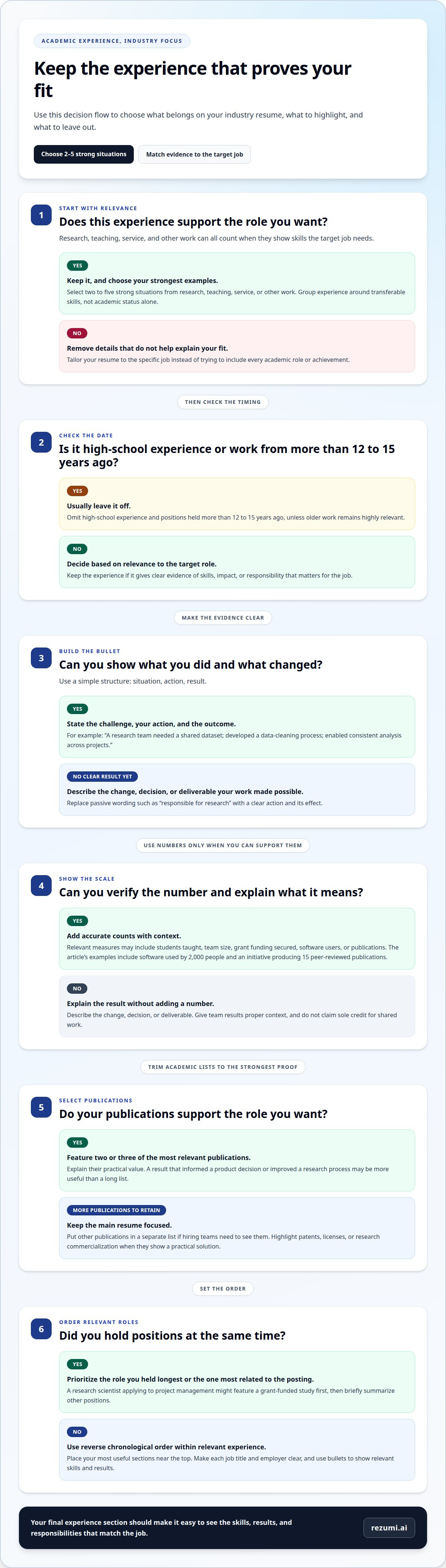
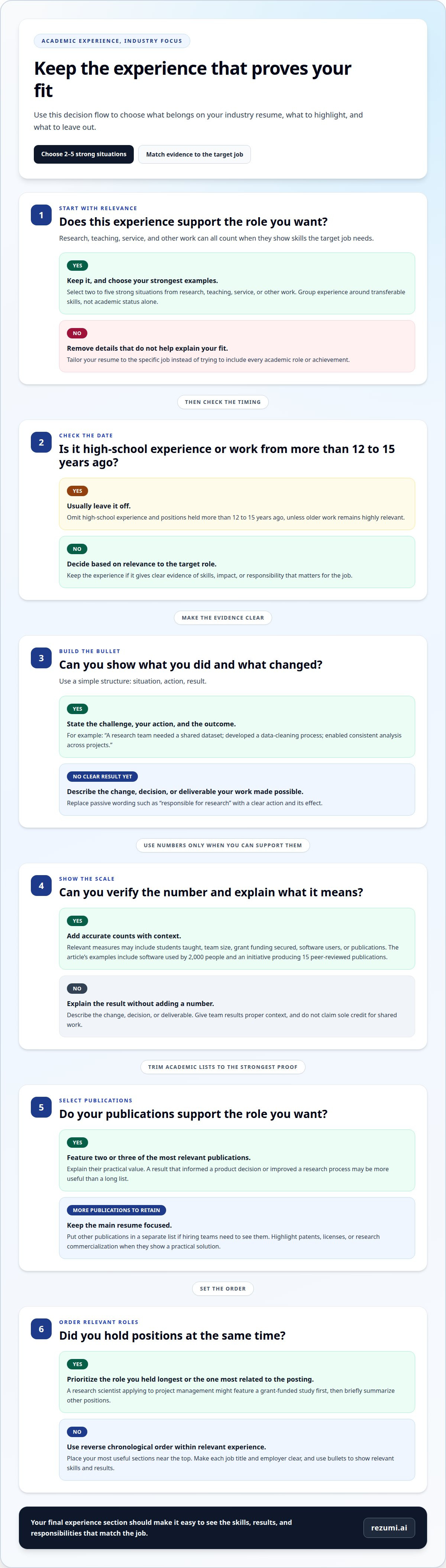
- Choose positions that support the role. Tailor each resume to the specific job, and remove details that do not help explain your fit. Select two to five strong situations from research, teaching, service, or other work. For a data analyst role, a research project using statistical tools may matter more than an unrelated committee assignment. The University of Colorado Boulder recommends omitting high-school experience and positions held more than 12 to 15 years ago, unless older work remains highly relevant.
- Build achievement bullets with situation, action, and result. Start with the challenge, explain what you did, then show the outcome. For example: “A research team needed a shared dataset; developed a data-cleaning process; enabled consistent analysis across projects.” Replace passive phrases like “responsible for research” with a clear action and effect. If there’s no clear number, explain the change, decision, or deliverable your work made possible.
- Quantify impact with measures you can support. Use accurate counts for students taught, team size, grant funding secured, software users, or publications. For example, state that your software package served 2,000 users, or that a research initiative produced 15 peer-reviewed publications. A grant total can show proposal and project-management experience, while team size can show coordination scope. Give each number context, and never claim sole credit for a team result.
- Choose standout research achievements, not a full academic record. Feature two or three publications most relevant to the target role, then explain their practical value. A result that informed a product decision or improved a research process may matter more than a long publication list. Highlight patents, licenses, or research commercialization when they demonstrate a practical solution. Keep other publications in a separate list if hiring teams need to see them.
- Keep the final experience section focused. Use reverse chronological order within relevant experience, but place the most useful sections near the top. For concurrent positions, prioritize the role held longest or the one most closely related to the posting. A research scientist applying to project management might feature a grant-funded study first, then briefly summarize other positions. Each bullet should show a useful skill, result, or responsibility.
How do I address teaching experience in a resume?
An academic CV records scholarly activity in detail; an industry resume selects evidence that matches a specific job. For teaching, publications, talks, and committee work, explain what you did and the value it created.
-
Present Teaching as Evidence of Impact
Describe teaching as training, communication, or learning design, then add a clear outcome. For example, frame a course for 200 students as developing and delivering training to 200 or more participants annually. If your student evaluations rose from 4.5 to 6.0 on a seven-point scale, include both scores and the scale. You can also mention that three mentees earned competitive research awards. Keep claims accurate, and explain your role rather than claiming credit for every student result.
- Turn talks and committee work into workplace evidence. Identify the audience, purpose, and result of each relevant activity. A high-profile talk at a 200-person workshop can show presentation skills and the ability to explain complex ideas to a broad group. Describe committee work through concrete actions, such as coordinating input, reviewing proposals, or helping reach a decision. Avoid listing committee names alone; explain the work those roles required and connect it to the target position.
-
Distinguish an Academic CV from an Industry Resume
Build a focused resume rather than transferring every CV entry. Academic documents often detail teaching, service, publications, and talks; an industry resume prioritizes accomplishments relevant to the posting. For example, retain a talk that demonstrates client-facing communication, but shorten an unrelated publication entry. Use concise bullets to show how your work supports the role, and move less relevant scholarly detail out of the main document.
- Use a title that reflects your actual role. Name your official position, such as “Graduate Research Assistant” or “Teaching Assistant,” then clarify your responsibilities in the bullets. Don’t inflate a title to sound more corporate. If “Graduate Student” describes your status but not your work, identify the accurate appointment or project role instead. Don’t present “Graduate Student” as your only experience across an extended career; show teaching, research, service, or other work as distinct positions where appropriate.
Presenting volunteer and unpaid work as experience
Write your resume around relevant work, not only paid positions. Include volunteer projects, consulting, and academic work when they demonstrate skills needed for the target role. Don’t treat unpaid experience as less valuable or list activities without explaining your contribution.
To write a resume for an industry move, select relevant paid and unpaid experience, describe your actions and outcomes, and tailor each entry to the job. Common mistakes include unexplained jargon, listing every scholarly activity, and leaving useful volunteer work out.
- Include unpaid work when it proves a job-related skill. A volunteer role can demonstrate project coordination, communication, or technical ability. If you organized a community workshop, for example, describe the audience, your planning tasks, and what the event delivered. If you maintained a nonprofit’s research database, explain how you kept its records accurate and useful. Use a label such as “Volunteer Project Coordinator” only when it reflects your actual duties.
- List experience in reverse chronological order. Start with your most recent relevant position, then move backward through paid and unpaid work. For concurrent roles, list first the experience held longest or the one that most closely matches the posting. Include each role’s title, organization, city and state, and employment dates. This format helps hiring teams follow your timeline without guessing when a project or volunteer role took place.
- Tailor academic work to industry needs. Choose the parts of a research, teaching, or service role that match the target job. For a project coordinator opening, describe how you planned milestones, tracked tasks, and worked with collaborators. Replace discipline-specific terms with plain language, but keep technical terms that appear in the posting and accurately describe your work. Explain the practical value, such as a completed analysis or a process others could use.
- Use your summary to give relevant experience context. If a career gap or unusual timeline needs explanation, briefly connect it to freelance, consulting, or volunteer work. For example, you could note that you completed independent data analysis projects while seeking an industry role. Keep the explanation focused on your current qualifications. Don’t apologize for unpaid work or repeat every entry that follows.
- Check each entry against the target interview. Keep an experience item if you can explain its relevance with a specific example. If a committee role doesn’t support the job’s needs, shorten or remove it; if it demonstrates planning or collaboration, describe that work directly. Read the resume from top to bottom and confirm every position adds evidence of fit, rather than leaving hiring teams to infer the connection.
Using job-description keywords for applicant tracking systems
Match your resume’s language to the job posting, then support each keyword with a specific example. Applicant tracking systems, or ATS, can scan resumes for job-related terms, but your experience still needs to make sense to a person.
- Identify the posting’s core terms. Mark the skills, tools, and duties listed in the role requirements. If the posting asks for “data analysis,” “project coordination,” and “technical writing,” check which terms match your actual work. Separate required skills from preferred ones, then focus on the requirements you can demonstrate. This keeps your resume targeted instead of crowded with every phrase in the advertisement.
- Use the employer’s wording where it fits. Translate academic language without obscuring what you did. If a posting requests “training,” describe how you taught students or developed course materials. If it asks for “stakeholder communication,” explain how you shared findings with collaborators. Use the same term when it accurately describes your work, but don’t claim experience with a tool or task you haven’t used.
- Place keywords in evidence, not a disconnected list. Include relevant terms in your skills section and experience bullets. For example, “Analyzed survey data and presented findings to an interdisciplinary research team” shows analysis and communication in context. A bare list of “analysis, communication, leadership” gives hiring teams less evidence. Pair each important skill with an action, project, or result you can discuss in an interview.
- Check keyword coverage against your real experience. Read the posting beside your resume and note which required terms appear. Add a missing term only when you can support it with a truthful example. If the role asks for “program management” but you coordinated a research project, describe the tasks you actually handled, such as timelines, collaborators, or deliverables. Don’t rename your position or overstate your responsibility to match the posting.
- Keep the document readable for people and software. Use standard section labels, simple formatting, and clear text for skills and experience. Some companies use resume-reading software to narrow about 500 applications to about 30 for HR review. That example shows why relevant terms can help, but keyword repetition alone won’t explain your fit. Read each bullet aloud and make sure it describes work you can discuss confidently.
Rezumi
Rezumi helps you turn academic experience into a focused application for an industry role. Use its tools to tailor your resume to a job description, organize relevant skills and accomplishments, and prepare materials for the same career direction. ATS Resume Optimization helps align your resume with the posting, while the AI Cover Letter Generator can help explain your transition from academia. Use AI Interview Prep to practice describing research, teaching, and project work in terms employers understand. When your content is ready, Resume Design & PDF Export helps you prepare it for submission. Get started with Rezumi to build and refine your application.
Carry your academic story into your next application
Your first industry application can help you define the kind of work you want next. Think beyond leaving academia: consider the problems you want to solve, the teams you want to join, and what you want to learn in your next role. Those choices can give your resume for leaving academia for industry a clear direction without asking you to leave your academic identity behind.
You don’t need to map out your whole career before taking action. Choose a role that genuinely interests you and treat the application as a step toward learning what fits. Each decision can turn a broad career change into a more intentional next chapter. Your experience is part of that future, not just a record of where you’ve been.
Take the next step at your own pace. Your next chapter is yours to shape.
Frequently Asked Questions
Does it have to be one page?
No. A useful resume is long enough to show relevant evidence and easy to read. Use a common font sized 11 to 12, then remove repeated details before reducing text size or margins. If a second page contains only a few lines, tighten the layout or cut lower-priority content. Page count should support clear reading, not force you to hide valuable qualifications.
What kinds of professional organizations should I list?
Choose organizations that relate to your target field, support ongoing learning, or offer a professional credential relevant to the role. Consider whether membership itself matters or whether a specific credential or active chapter role carries more weight. For example, list a technical association when it signals involvement in your specialty. Leave out memberships that add no context for the employer or position.
How do I translate academic experience into industry resume language?
Build a short translation list before editing. Write the academic term on one side, then note the task, audience, and business-relevant equivalent on the other. For example, explain an unfamiliar research method in plain language while retaining its formal name if the role requires it. This approach helps you stay accurate and describe your work consistently across application materials.
How long should an industry resume be for a former academic?
Most resumes run one to two pages, but the right length depends on your relevant experience and the detail the role requires. A focused version for a specialist position may need less space than one covering several related research projects. Review every line for a clear purpose. If two bullets prove the same skill, keep the stronger one and use the space for different evidence.
Which resume format works best for PhDs transitioning to industry?
A combination format can work well when you need to show specialized skills alongside a clear work history. Put a concise skills or expertise section before experience, then connect those skills to dated roles and projects. Avoid separating every skill from where you used it. That connection helps readers understand your background and follow your career progression.
How do I quantify research achievements and impact on an industry resume?
Choose measures that fit the work, then state your contribution clearly. A software project might report its user reach, while a research program might note the publications it produced. For shared results, distinguish your role from the team’s contribution. Use records you can explain if asked, and add context so a number shows scope rather than appearing as an unsupported claim.
What keywords should academics include for applicant tracking systems?
Use role-specific terms from the posting, including a full term and its common acronym when both appear. For example, if a posting uses “machine learning” and “ML,” include the wording that accurately reflects your skills. Check spelling and placement in plain-text sections, such as skills and experience. Don’t add a term just to match the posting if you can’t support it with relevant work.
How should I list publications, grants, teaching, and patents on an industry resume?
Use concise, selective entries so employers can quickly identify each item and its relevance. For a publication, include a short citation or link only if the work supports the role. For a grant, clarify whether you wrote, managed, or contributed to the proposal. State a patent’s status accurately. Put detailed academic records in a separate document when an application requests them, rather than crowding the main resume.
Disclaimer
This article is provided for general informational purposes only and does not constitute professional, legal, financial, or career advice. While Rezumi strives for accuracy, we make no warranties as to the completeness or reliability of this content. Hiring practices, ATS behavior, and job-market conditions vary by employer, industry, and region — always verify against your specific situation. Any action you take based on this article is at your own risk.