How to Tailor Your Resume for a Startup Job That Fits
Your job title matters, but the results and ownership you show beneath it matter more. To tailor your resume for a startup company, keep your titles accurate and rewrite your achievements to show what you built, improved, or solved. If you have less than 10 years of experience, aim for one page.
Moving from a large company to a startup can make your experience seem too narrow on paper. You don’t need to hide your corporate background; show how it connects to the startup’s needs.
This guide explains how to tailor your resume for a startup company by turning corporate achievements into clear evidence of initiative, adaptability, and impact. You’ll learn what to emphasize at different startup stages, how to choose relevant skills and examples, and how to make your resume easy to scan.
Start with the company’s stage, not just the job title. Then shape each resume section around the problems the role needs you to solve.
Key Takeaways
- Keep your job titles accurate, then rewrite the summary and headline to match the role you want.
- Turn corporate responsibilities into specific examples of ownership, problem-solving, and measurable impact.
- Show initiative with relevant projects and clear evidence of what you contributed.
- Use simple, machine-readable formatting so your experience is easy to scan.
- Adjust which skills and results you emphasize to fit the startup’s stage and priorities.
How do I rewrite a big company resume for a startup job?
Keep your job titles accurate, and use your headline and summary to show how your experience fits the startup role. Support your case with concrete results, not corporate language that obscures your contribution.
-
Choose a Resume Headline and Summary
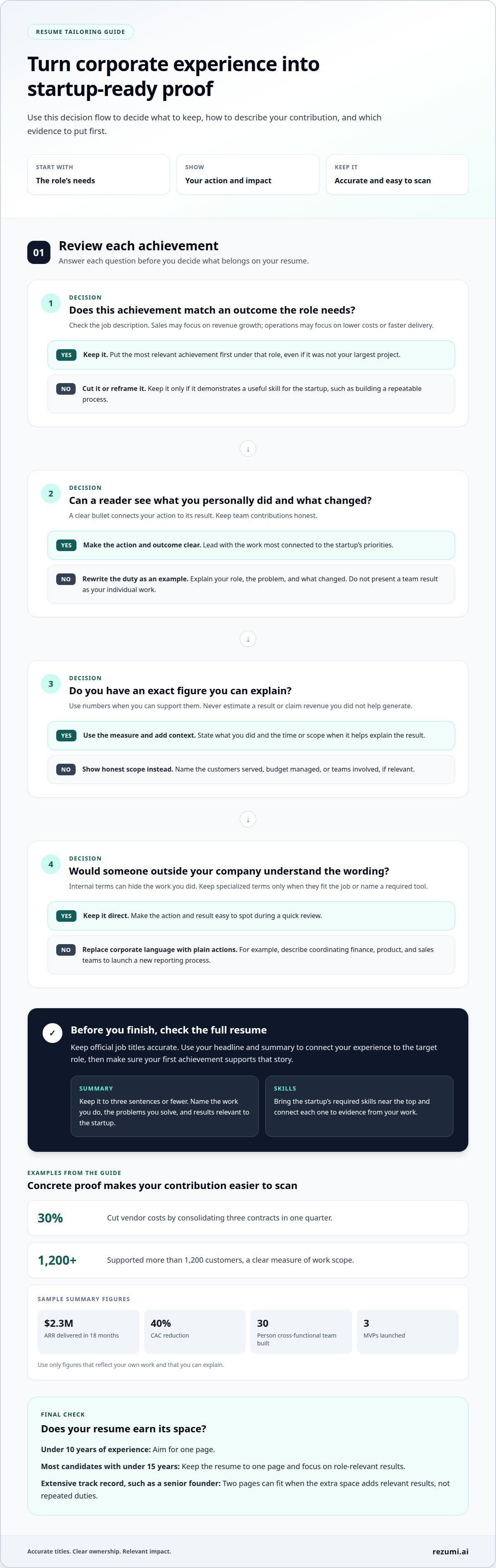
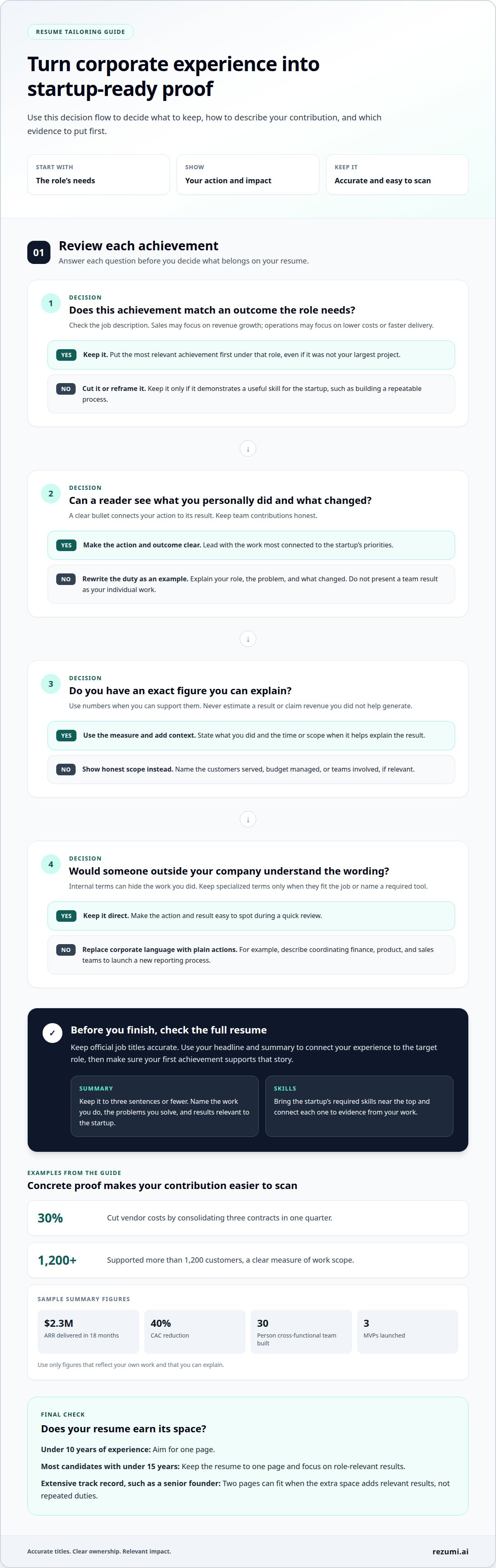
Match your headline to the target role and your actual skills. For a product manager opening, use “Product Manager” only if your experience supports that title. Keep your summary to three sentences or fewer, and make it easy to scan at a glance. Name the work you do, the problems you solve, and the results relevant to the startup.
-
Write a Data-First Executive Summary
Lead with your strongest result, then add the method and scope. For example: “Product manager with five years of experience who delivered $2.3 million in ARR in 18 months, reduced CAC by 40%, and built a 30-person cross-functional team that launched three MVPs.” Each figure gives hiring teams a concrete measure of impact. Use only numbers you can explain in an interview.
-
Align Summary Language With Job Titles
Keep your official job titles unchanged, and connect them to the target role through your headline and summary. If your corporate title was “Senior Program Manager” and the startup seeks an operations lead, describe relevant work in your summary rather than changing your title. Check that every role name is accurate and each claim reflects your experience.
- Translate internal corporate terms into clear actions and outcomes. Instead of “managed strategic stakeholder alignment,” describe a specific example, such as coordinating three teams to deliver a launch in one quarter. Explain what you personally did and why it mattered. Keep specialized terms only when they match the job description or name a tool the role requires.
- Bring the startup’s required skills near the top of your summary. Read the job description, identify its core needs, such as product launches, customer research, or process design, and connect each need to a result from your work history. If the posting calls for ownership, name a project you drove from planning through delivery.
- Compare your final summary with the full resume. Make sure the headline, job titles, and first achievement tell a consistent story. Remove claims the experience section cannot support, and replace broad phrases like “results-driven leader” with a specific action. A recruiter should quickly understand your target role and strongest evidence.
Translating corporate experience into startup-relevant achievements
For most candidates with under 15 years of experience, a startup resume should fit on one page. Candidates with extensive track records, such as senior founders, can use two pages. Focus the space you have on results that match the role.
-
Identify Role-Relevant Metrics
Read the job description and identify the outcomes the role must deliver. A sales role may value revenue growth, while operations may call for lower costs or faster delivery. Connect each priority to a result from your corporate work. For example, show how you cut vendor costs 30% by consolidating three contracts in one quarter.
-
Order Bullets Around Relevant Work
Put the most relevant achievement first under each role, even if it wasn’t your largest project. If the startup needs customer growth, lead with work that improved customer acquisition, not an unrelated internal process. Describe your action and its result in each bullet so your contribution stands out during a quick review.
-
Cut Less Relevant Corporate Experience
Remove details that don’t support the target role, such as routine duties or tools unrelated to the startup’s work. Keep a corporate project if it demonstrates a useful skill, even if its original purpose differs. A large-company process redesign, for example, could show that you built a repeatable system. Briefly explain the context and make your contribution clear.
- Replace corporate language with direct, reader-friendly descriptions of your work. Instead of “provided strategic support for cross-functional initiatives,” say what you did and what changed. For example: “Coordinated finance, product, and sales teams to launch a new reporting process.” Keep the wording accurate, and don’t present a team result as your individual work.
- Use honest measures when exact figures aren’t available. You can describe the number of customers served, the size of a budget managed, or the teams involved. For example, “Supported more than 1,200 customers” gives clearer scope than “handled customer needs.” Never estimate a result or claim revenue you didn’t help generate.
- Match the resume’s length to your experience and the strength of your examples. If you have less than 10 years of experience, use one page and remove older details that don’t fit the role. A two-page corporate resume can often become a focused one-page startup application. Keep a second page only when it adds relevant results, not repeated duties.
- Review each bullet alongside the job description before sending your application. Show key skills in context rather than listing them without evidence. If the posting asks for problem-solving, describe a problem you addressed and the outcome. This final review connects your corporate experience to the startup’s needs.
What do startup founders look for on a resume?
Founders look for evidence that you can solve problems, take initiative, and adapt as priorities shift. Use specific projects and results to show this, rather than making a broad claim that you can wear multiple hats.
-
Use Projects and Links as Evidence
Add a relevant project that shows what you built, tested, or improved. Describe your role, the problem, and the outcome. Include a link when it provides useful evidence, such as a portfolio, product demo, or published case study. Make sure it works and supports your claim; a long list of unrelated profiles can distract founders.
For example, a product candidate could link to a prototype and explain how user feedback shaped its roadmap. Keep private company information out of public materials.
-
Include Extracurricular Projects and Interests
Choose extracurricular work that relates to the role or demonstrates a useful skill. A volunteer who organized a community fundraiser can show planning, communication, and follow-through. A developer who contributes to an open-source tool can point to code and collaboration. Explain what you did rather than expecting founders to infer its relevance from a project name.
Include an interest only when it adds relevant context, such as a design portfolio for a product design role. Skip unrelated hobbies that take space away from stronger evidence.
-
Show Initiative Through Scrappy Projects
Describe how you made progress with limited time, tools, or support. A fictional product manager example shows the value of specifics: conducting 12 user interviews before launching a self-serve onboarding flow that reduced support tickets by 33%. The sequence makes initiative visible, from research to action to result. Use a real example from your work and explain your contribution clearly.
Even a small project can demonstrate sound judgment. State what you tested, what you learned, and how that result shaped your next step.
-
Highlight Adaptability Across Multiple Roles
Show your range by naming a core strength and one adjacent contribution. For example, a marketer might lead campaign planning and review customer feedback with product teams. Connect each additional responsibility to a real outcome, such as refining messaging or improving a launch plan. This T-shaped approach demonstrates depth in your main function and useful skills in related work.
Use verbs that make your role clear, such as “built,” “tested,” or “coordinated.” Don’t claim every task as your own when a team delivered the result.
Keeping resume formatting machine readable
Use a simple, single-column layout with clear section labels. It makes your experience easier to scan and gives applicant tracking systems (ATS) readable text to process.
- Use one column and a standard reading order. Put your name and contact details first, followed by your summary, experience, education, and skills. Avoid sidebars, tables, text boxes, and graphics that can split information or disrupt its order when software reads the file. Keep details such as “Product Manager” next to the correct employer and dates.
- Use familiar headings such as “Work Experience,” “Education,” and “Skills.” A creative label like “My Journey” may look polished, but it gives an ATS less direct context. Make headings easy to distinguish with bold text and consistent spacing. Use the same layout for each role so hiring teams can quickly find your title, employer, and dates.
- Keep important information in the document body. Don’t put your email, phone number, or key skills in a header, footer, image, or decorative shape; some systems may not read these elements in the expected order. Type contact details as regular text near the top, and use selectable text for every role, date, and achievement.
- Select a readable font and consistent formatting. Use bold for job titles or employers, not for whole paragraphs. Keep dates in one format throughout, such as “May 2022 to August 2024,” and align them consistently. Avoid tiny text, unusual symbols, and excessive color. Your choices should make relevant skills and achievements easy to locate.
- Save and inspect your file before submitting it. Copy the text into a plain-text editor to check whether the reading order is clear. If the employer requests a PDF, confirm that its text can be selected and copied. A PDF that behaves like a single image may prevent software from reading the words.
- Check that the resume uses the job description’s relevant terms naturally. If the role names “customer research,” include that exact skill where your experience supports it. A Resume Readability Test score above 70 is a useful target from the available market guidance, but clear structure and accurate content still matter. For help checking keyword fit and layout, consider ATS Resume Optimization.
Tailoring a resume to company stage
Research the startup’s website, social media, and press coverage before tailoring your resume. Look for its product, customers, stage, and current hiring priorities, then choose achievements that fit those needs.
- Identify the company’s stage and likely priorities. A pre-seed or seed team may need people who can switch between tasks and make progress with limited structure. A later-stage company may value repeatable processes and clear team outcomes. Use the job description and company history to understand what the role is meant to address.
- For pre-seed and seed roles, emphasize range and pace. Show how you handled changing priorities, tested an idea, or completed work without a large support team. A small team, for example, may need a marketer who can create content and review customer feedback. Be clear about your role and the resources available.
- For a Series A company, emphasize systems that can support growth. Describe how you documented a process, improved handoffs, or helped a team repeat a successful launch. The average Series A startup raising in 2025 had 14 full-time employees, so explain how your work helped a lean team operate consistently.
- For Series B and later-stage roles, show results delivered with and through a team. Hiring managers may want to know how you coordinated engineers, product leads, or customer teams around a shared outcome. Use numbers tied to your contribution, such as launches supported or processes improved. Explain team results without presenting them as solo work.
- Connect your strongest skills to the startup’s current goals. If its website describes a new product launch, highlight relevant launch work instead of older duties with little connection. If the job posting emphasizes customer retention, lead with an example of improving a customer process. Keep your evidence specific to the role.
- Match your resume’s focus to the company’s stage, not just its industry. A finance candidate joining a seed startup might emphasize hands-on reporting and adapting to changing priorities. Applying to a later-stage firm, the same candidate could highlight scalable controls and team coordination. Keep job titles accurate and make every claim easy to explain.
- In your final review, remove details that don’t support your case for this company’s stage. Compare the job description with your summary, skills, and first achievements. If a small company needs broad execution, show your range. If a growing team needs structure, describe a process you improved and how others used it.
Rezumi
Rezumi helps you turn your startup research into a focused application. Use ATS Resume Optimization to tailor your resume to a job description, then refine its design and export a PDF. You can also prepare a matching cover letter with the AI Cover Letter Generator and practice responses with AI Interview Prep.
These tools can support you when moving from a corporate role, choosing which achievements to highlight, or preparing to explain your fit with a startup’s stage. You decide which experience is accurate and relevant; the platform helps you organize and prepare your application.
Contact Rezumi to explore how its tools can support your next startup application.
Make Your Next Application a Clear Fit
Next, prepare for the conversation beyond your resume. Before applying, decide what you want to learn about the role, the team’s priorities, and how success will be judged. This will help you assess whether the opportunity fits your goals, too.
As you consider how to tailor your resume for a startup company, prepare a few thoughtful questions for the founder or hiring manager. A focused conversation can help you understand the work ahead and explain why you’re interested.
Take the next step with a clear sense of what you bring and what you want to build.
Frequently Asked Questions
Do startups care about job titles on a resume?
Yes. Titles give hiring teams a quick sense of your level and function, but they don’t tell the whole story. If you held several titles at one company, list each promotion with its dates to make your growth clear. If your title was unusual, briefly explain what it meant in an interview. Don’t rename a past role to match the startup’s opening.
Should I include a failed startup on my resume?
Yes, include the role if it helps explain your experience or career timeline. A company closing doesn’t make your work irrelevant. Focus on what you learned about the product, customers, or operating model. If asked why you left, say plainly that the company closed, then turn to the work you’re ready to do next.
What do startups look for in a resume?
Startups want to understand how you make decisions, communicate tradeoffs, and respond when plans change. Describe a time you identified a constraint, chose a practical approach, and explained your reasoning to others. For instance, a sales candidate might explain how they prioritized a customer segment after reviewing fit and available resources. This shows founders how you think, not just where you’ve worked.
How to customize a resume for a startup job description?
Separate required skills from preferred qualifications before editing. For each requirement, identify your strongest matching experience, then decide whether it belongs in your summary, skills section, or work history. If the role asks for SQL and customer analysis, name both only if your experience supports them. Don’t copy every phrase from the posting without relevant context.
Which resume format works best for startup roles?
A reverse-chronological format works well when your recent roles show the experience you want the startup to notice. A combination format can suit a career spanning different functions: it groups related skills while still showing your employment history. Choose the format that makes your timeline and qualifications easy to follow. Don’t use a functional format to obscure missing context.
How to quantify achievements on a startup resume?
Give every number enough context to be meaningful. When you can support the details, state the starting point, time period, and result. For example, “reduced response time from two days to one” is clearer than “improved response time.” Use a consistent measurement basis within each bullet, and distinguish your contribution from the team’s wider result.
How to tailor a resume for an early-stage startup versus a large company?
Use the job posting to understand the work, rather than relying on company size alone. “Build a new process” suggests a different starting point from “improve an existing process.” For an early-stage role, connect your experience to creating something with limited structure. For a large company, show how you’ve worked within established systems and coordinated across functions.
Should startup applicants include a portfolio or project links on a resume?
Include a link only when it provides evidence your resume can’t. Before sharing a work sample, remove confidential client details, internal data, and private company materials. Use a descriptive label so readers know what they’ll find before opening it. If you can’t share a project publicly, describe your role and approach without revealing protected information.
Disclaimer
This article is provided for general informational purposes only and does not constitute professional, legal, financial, or career advice. While Rezumi strives for accuracy, we make no warranties as to the completeness or reliability of this content. Hiring practices, ATS behavior, and job-market conditions vary by employer, industry, and region — always verify against your specific situation. Any action you take based on this article is at your own risk.