How to Write a Resume for a Career Pivot That Fits Your Next Role
A career-pivot resume should lead with the skills and results that fit your next role, rather than making hiring teams connect the dots from your past job titles. To learn how to write a resume for a career pivot, tailor your summary, skills, and experience to the target job, then explain your move clearly and honestly. Keep your online profiles consistent with that direction.
Your experience still counts. The challenge is showing how it applies in a new field without burying your strongest evidence or overstating your qualifications.
This guide covers choosing transferable skills, organizing a clear resume, explaining your career change, and adding relevant credentials. You’ll also learn how to align your profiles with your resume, so every part of your application supports the role you want next.
Key Takeaways
- Match your strongest transferable skills to the target job, then prove them with clear examples of impact.
- Put the most relevant information first and use a clean layout that makes your qualifications easy to scan.
- Explain your career change briefly and confidently in your summary and cover letter.
- Choose credentials that close a real skills gap for your next role, and show how you’ve applied what you learned.
- Align your online profiles with your resume so your headline, skills, and career direction tell one consistent story.
Identifying and highlighting transferable skills
Yes. Include a skills section tailored to the target role, along with relevant projects that show you can apply those skills. Start by matching your experience to the job’s needs, then support each key skill with a specific example.
-
Identify Transferable Skills
Compare the target job posting with your recent work, projects, and volunteer experience. Note requested skills, such as training, analysis, customer support, or process improvement. Then identify a specific example for each match. An operations supervisor moving into project management could highlight team leadership and workflow planning, rather than unrelated equipment expertise.
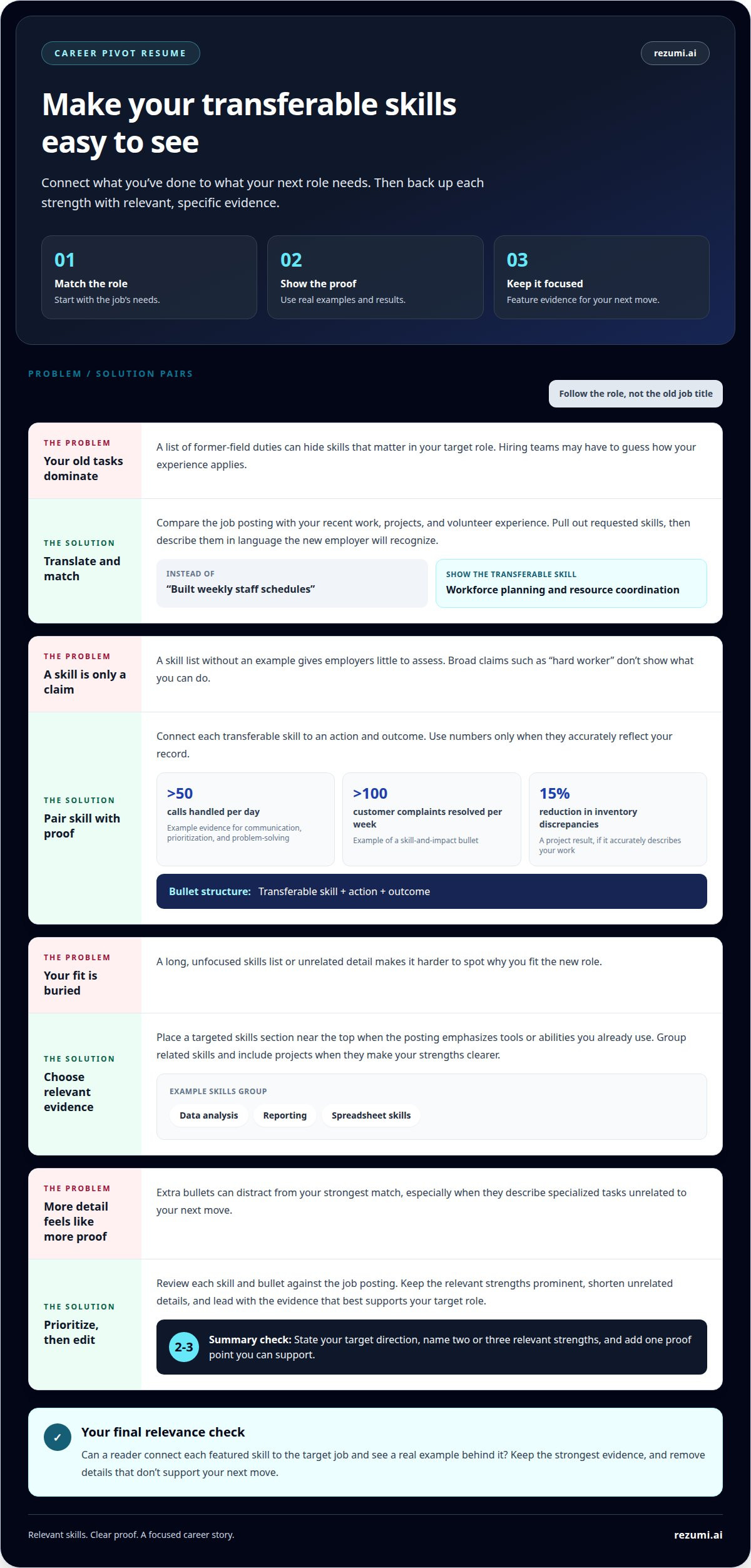
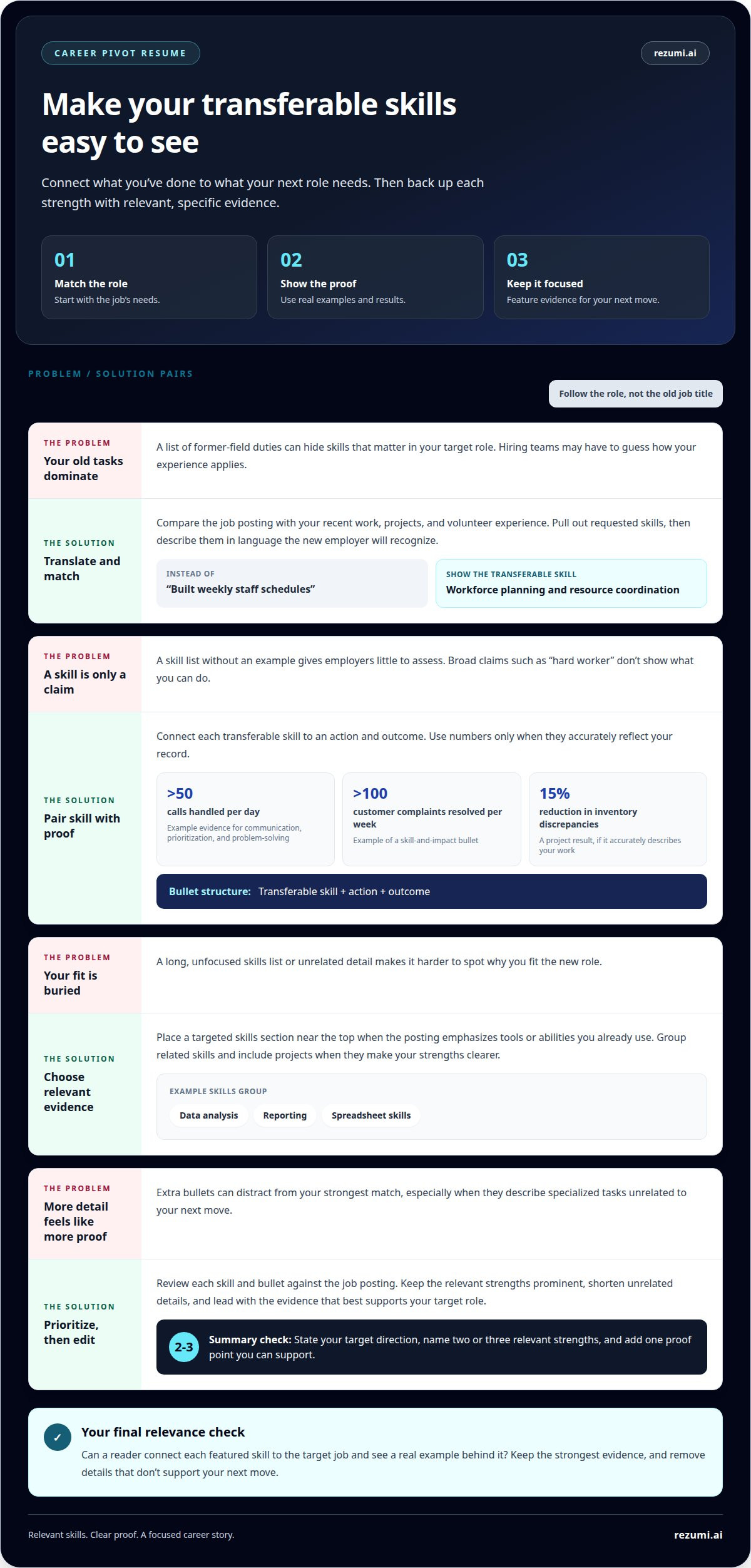
Separate skills that transfer across industries from tasks tied to your former field. A call center representative who handled more than 50 calls per day can show communication, prioritization, and problem-solving. Keep the number only if it reflects your actual record. That evidence makes a skill credible and helps hiring teams see how your experience fits the new role.
-
Summarize Relevant Strengths
Write a short summary that connects your strongest skills to the role you want. Lead with the target direction, then name two or three relevant strengths and one proof point. For example: “Customer service lead moving into operations, with experience improving team processes and resolving more than 100 complaints per week.” Use only details you can support.
Translate industry-specific language into terms the new employer will recognize. A retail manager who “built weekly staff schedules” might describe workforce planning and resource coordination. Avoid broad claims such as “hard worker” without evidence. A focused summary helps employers understand your fit before they see your former job titles.
-
Choose Skills or Projects to Feature
Place a targeted skills section near the top when the job posting emphasizes tools or abilities you already use. Group related items, such as data analysis, reporting, and spreadsheet skills, instead of listing every task from your career. Keep each entry relevant to the role so the section supports, rather than repeats, your experience.
Add a project when it demonstrates a skill your work history cannot show clearly. A process-improvement project, for example, can show planning and analysis through the problem, your actions, and the result. Use real details, such as a documented 15% reduction in inventory discrepancies, only when they accurately describe your work.
- Build skill-and-impact bullets. Connect each transferable skill to an action and outcome. An insurance advisor might write, “Resolved more than 100 customer complaints per week while maintaining service quality.” This structure turns a list of abilities into evidence. Choose examples that match the target role, and avoid claims without a clear basis.
- Prioritize evidence over volume. Review each skill and bullet against the job posting before including it. Keep relevant strengths prominent, and shorten specialized details that don’t support your next move. For instance, a candidate targeting data work should emphasize reporting and accuracy, not unrelated product knowledge. This keeps the resume focused and makes your transferable value easier to spot.
Keeping resume formatting simple and content concise
Use a combination format to show relevant skills before your work history. In the United States, keep your resume to one page when you have less than 10 years of experience; use a second page only when relevant evidence needs the space.
-
Choose a Combination Format
Place a focused skills section and selected achievements above your work history, then list jobs in reverse chronological order. This combination format puts evidence of your fit ahead of titles from another field. For example, a teacher seeking a training role can lead with facilitation and lesson design, then show where they used those skills.
Keep your work history readable and accurate. Use standard headings such as “Skills,” “Work Experience,” and “Education” so people and resume systems can identify each section. Avoid tables, decorative graphics, and text boxes that may disrupt the reading order.
-
Determine Resume Length
Choose one page if you have less than 10 years of experience, a recommendation attributed to Indeed. A career-pivot resume may use two pages when relevant roles, projects, or credentials need more room. The deciding factor is useful evidence, not a target page count.
Cut older or unrelated details before shrinking the font. For example, keep a recent project that shows budgeting for a project coordinator role, but remove duties from an early job that don’t support that direction. Each page should help explain your fit.
- Use a clean visual hierarchy. Choose clear headings, consistent spacing, and a simple font style. Make job titles and employer names easy to distinguish without relying on color alone. Keep dates in the same position for every role so readers can scan your timeline easily.
- Edit for relevance. Give each bullet one main idea, then remove repeated duties and details unrelated to your target role. A project assistant applying for operations work might keep a bullet about coordinating deadlines while cutting a long list of routine filing tasks. Specific, focused wording makes your strongest evidence easier to find.
- Review the final file. Check that headings, dates, and bullet indents remain consistent after saving. A clean PDF helps preserve your layout when the file is opened on another device. If you want a polished file after refining the content, explore resume design options for design and PDF export.
Positioning a career change in a resume summary and cover letter
Tailor your resume to the target role by connecting relevant experience to its requirements. Briefly explain your career change in your summary or objective and cover letter, then support that explanation with evidence.
-
Frame the Career Change
Write a headline that signals your target role, then use the summary to connect your past experience with relevant strengths. Focus the summary on the employer’s needs: the top third of your resume should feature information that matters to that role. For example, a customer service professional moving into operations can lead with team leadership and process coordination.
Use an objective when you need to state your next direction clearly. Keep it to a couple of sentences, and avoid explaining personal reasons for leaving your former field. In your cover letter, briefly explain the transition and show why your experience fits. Be truthful: present your background strategically, but don’t claim skills you haven’t used.
-
Tailor Resume Content to the Pivot
Adjust your summary, skills, and experience for each target job description. Identify its core needs, then choose evidence from your background that addresses them. A career changer with 3+ years of customer service experience, for example, could connect customer communication and issue resolution to a client-facing role in a new industry.
Check that your wording makes sense in the target field. Replace internal terms or former-industry jargon with clear descriptions of the work and its impact. Don’t copy language from a job posting if it misrepresents your experience. The goal is to show a clear match between the role’s needs and your actual record.
- Build a specific example. Use a simple structure: target direction, relevant experience, and evidence. For instance, a professional with over 10 years of customer-service and team-leadership experience might write: “Customer service leader pursuing operations roles, bringing team leadership and a record of resolving customer issues.” The sample shows the transition without apologizing for it.
- Keep the cover letter focused. Use the opening to name the role and explain why you’re applying. Then connect one past achievement to a need in the posting. If your resume highlights team training, explain how that experience prepares you to support a new team. Avoid repeating every resume bullet or giving a lengthy account of your career history.
- Check consistency before sending. Compare the job title, headline, summary, and cover letter. Each should point toward the same role, while the examples support the same strengths. If your headline says “Project Coordinator” but your summary focuses only on customer service, revise the summary to explain the connection through scheduling, communication, or coordination experience.
Strengthening qualifications with relevant credentials
Address limited experience by pairing relevant work, projects, and training with the skills your target role requires. You don’t need to present yourself as an industry veteran; show how your current qualifications prepare you to contribute.
-
Add Relevant Credentials
Choose credentials that build a skill required by your target role, then list the credential name and completion date. For example, a sample data-sector resume lists CompTIA Data+ dated April 2026. A project-management resume lists AgilePM Foundation, APMG, dated January 2026. These examples show how focused training can make job-related learning visible.
Place relevant credentials where employers can find them, such as in an education or certifications section. If a program is in progress, label its status clearly. Avoid adding unrelated courses to fill space. A credential should support the direction shown by your headline, skills, and experience.
-
Address Limited Industry Experience
Use projects, training, and relevant responsibilities to show how you’re preparing for the new field. For example, someone pursuing project coordination can highlight scheduling, task tracking, or coordinating people in a former role. Don’t present these activities as formal project-management experience unless that accurately describes your work.
Make your experience level clear, then emphasize evidence of readiness. You can list Business Analyst Foundation, BCS, as ongoing when coursework is underway. Pair that entry with a relevant work example, such as improving a reporting process. This shows employers both your learning and your applied ability.
- Select experience by relevance. Review each role and keep responsibilities that connect directly to the position. A customer service team lead applying for data work might feature record accuracy, reporting, and process improvements, then reduce space spent on unrelated customer-facing tasks. A sample data-sector resume describes a 15% reduction in data discrepancies after inventory-monitoring improvements. Use a result like this only when it matches your own record.
- Show progress without overstating expertise. List completed training separately from credentials still underway. A sample project-management resume includes APM Project Fundamentals, dated October 2025, alongside Change Management Foundation, APMG, dated March 2026. Such entries show focused learning, but they don’t replace direct work evidence. Connect each credential to a skill demonstrated in a project or responsibility.
- Make every entry support your target. Compare each credential and experience bullet with the job’s stated needs. Keep items that demonstrate relevant tools, methods, or results, and remove details that distract from your new direction. For example, a candidate targeting business analysis can foreground process review and clear reporting, while placing unrelated duties lower in the work history.
Aligning online profiles with a career pivot
Your resume and online profiles should point toward the same career direction. Update them together so a recruiter sees one clear story, not mixed signals. Learning how to write a resume for a career pivot also means making sure your online presence supports the same move.
- Set one target-role headline. Choose a headline that names the work you want, not just your current job title. A retail manager pursuing operations roles might use “Operations Coordinator | Process Improvement | Team Leadership.” Keep the wording consistent across your resume and LinkedIn profile. A clear headline helps readers understand your direction before they scan your work history.
- Rewrite the profile summary for the next role. Use the same core message in your resume summary and LinkedIn About section, then adjust the length for each. For example, a teacher moving into corporate training can emphasize facilitation, learning design, and employee development. Briefly explain the transition, but focus on relevant experience and your next-step goal. This is a practical part of writing a career-pivot resume that feels consistent beyond the document itself.
- Align skills and keywords with your target. Compare the language in your profile with the job descriptions you’re pursuing. If project coordinator postings emphasize scheduling, stakeholder communication, and progress tracking, feature those terms where they truthfully describe your experience. Use profile editing tools to keep your skills consistent across platforms. Don’t add tools or qualifications you haven’t used just to match a posting.
- Update visible examples of your work. Review featured projects, portfolio links, and descriptions on your online profile. A customer service professional pursuing data analysis could highlight a reporting project or process review, if it reflects real work. Explain your role and the result in plain language. Remove examples that reinforce an old career direction but offer little evidence for the new one.
- Check the full profile from top to bottom. Review your headline, summary, recent experience, skills, and public portfolio as one package. If your headline signals “Data Analyst” but your summary only describes sales, add a truthful connection, such as sales reporting or trend analysis. Check dates and job titles against your resume, too. Differences can create confusion about your work history.
- Keep the transition visible and honest. Don’t hide your former field or rename past roles to sound more relevant. Instead, describe transferable work in terms the target industry understands. A former account manager might explain how they tracked client needs, coordinated internal teams, and reported outcomes. This connects past work to the new goal without suggesting experience you don’t have.
Rezumi: ATS Resume Optimization
Rezumi helps you turn a career-pivot resume into a targeted application with ATS Resume Optimization. It aligns your resume with a specific job description, helping you present relevant skills and experience in clear, role-focused language. ATS means applicant tracking system, software employers use to organize and review applications.
Use the AI Cover Letter Generator to shape a letter that explains your move and connects your background to the role. AI Interview Prep helps you practice describing that transition. When your content is ready, Resume Design & PDF Export helps you prepare a polished resume file.
These tools support your application process, while your examples and claims should always reflect your actual experience. Explore Rezumi’s tools to prepare your next career-pivot application.
Make your next application a clear step forward
A career pivot takes more than a new job title. You need to make a clear case for why your experience belongs in a different field. Learning how to write a resume for a career pivot helps you connect your past work to the role ahead without disguising where you’ve been.
Treat each application as a focused version of your career story. As you target a role, adjust the details that matter to that employer while keeping your claims accurate. Your direction can evolve as you learn which strengths and experiences best support your move.
Put that direction into practice with your next application. Rezumi’s tools support your resume, cover letter, and interview preparation as you build a focused application.
Your next role may draw on experience you already have. Make that connection clear and take the next step with confidence.
Frequently Asked Questions
How can you identify transferable skills for a career change resume?
Start with work you’ve actually completed, then identify the abilities behind each task. For example, coordinating a community event can demonstrate vendor communication, scheduling, and problem-solving. Compare those abilities with the work named in your target role, and keep skills you can support with a specific example. This helps you distinguish demonstrated strengths from skills that only sound relevant.
What resume format works best for a career changer?
A combination format often suits career changers because it gives relevant skills and achievements more visibility while keeping a clear work history. Use it when your past titles don’t immediately signal your fit but your experience contains useful evidence. Keep employer names, titles, and dates easy to follow. A format that hides your timeline can raise questions instead of clarifying your career path.
How do you write a resume summary for a career pivot?
State the role you’re targeting, the experience that supports your move, and a clear example of relevant value. For instance, a retail supervisor seeking a training role could mention coaching new employees and creating clear work instructions. Don’t present your summary as a personal career story. Focus on what you can contribute, and make sure every claim appears elsewhere in your resume.
How should you describe unrelated work experience on a resume?
Keep the role and dates accurate, then focus its description on duties that connect to your target job. A restaurant manager applying for office operations work might emphasize scheduling, supply coordination, and handling competing requests. Give less space to tasks with no clear connection. If an older role adds no useful evidence and isn’t needed to explain your work history, shorten or omit its details.
How do you tailor resume keywords to a new industry and pass ATS screening?
Use relevant terms from the job posting only when they accurately describe your experience. If a posting asks for “client onboarding,” don’t use that phrase unless you’ve helped new clients get started. Include the full term and its abbreviation when both fit naturally, such as “customer relationship management (CRM).” Place keywords in context within your skills and experience instead of repeating them without evidence.
What should you remove from a resume when changing careers?
Remove details that take up space without showing readiness for the role you want. These may include repeated duties, outdated tools unrelated to the target job, or a lengthy description of an older position. Keep information needed to understand your work history, and don’t remove a relevant result just because it came from another field. Each remaining line should clarify your skills, contribution, or career direction.
Disclaimer
This article is provided for general informational purposes only and does not constitute professional, legal, financial, or career advice. While Rezumi strives for accuracy, we make no warranties as to the completeness or reliability of this content. Hiring practices, ATS behavior, and job-market conditions vary by employer, industry, and region — always verify against your specific situation. Any action you take based on this article is at your own risk.