Job Search Depression: Use a Job Application Tracker to Regain Structure
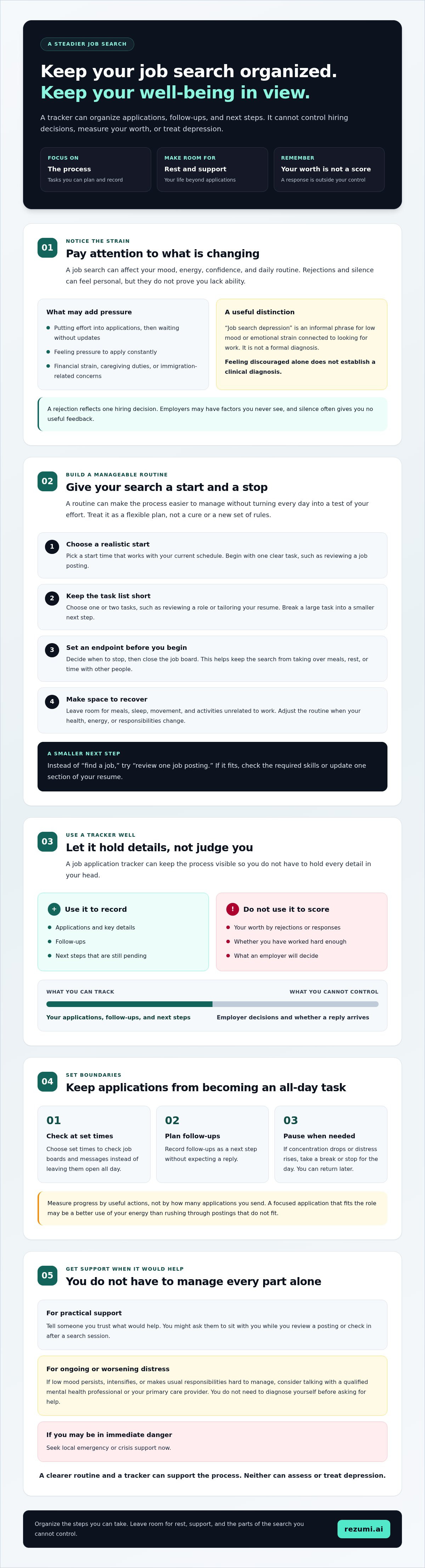
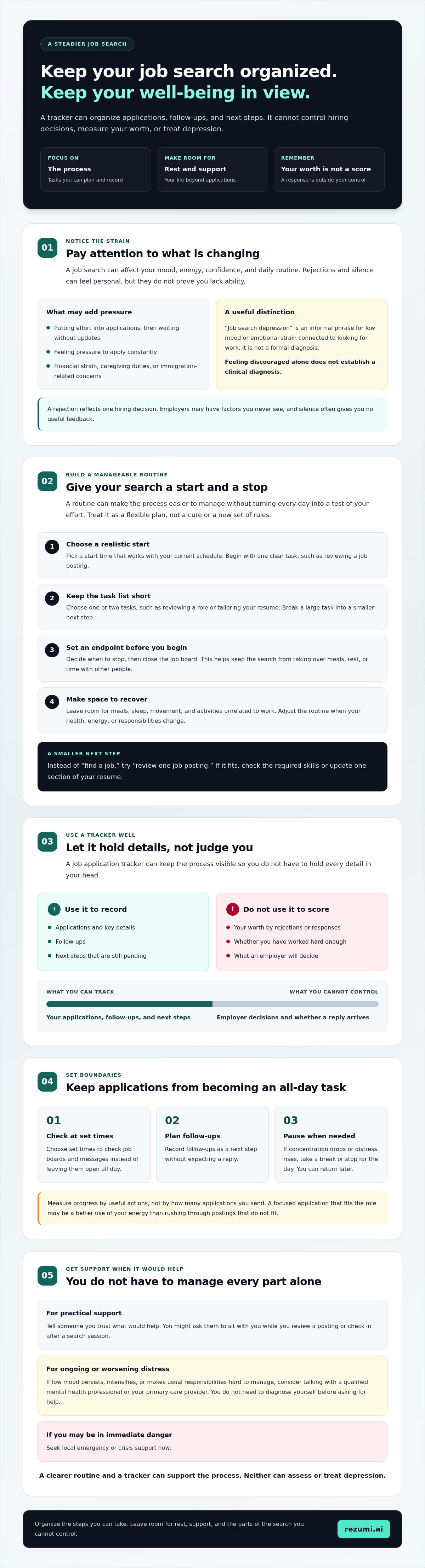
A job application tracker can bring order to a difficult search, but it can’t treat depression. Repeated rejections and unanswered applications can wear down your motivation, especially when you can’t see what’s moving forward or feel pressure to apply constantly.
That stress is real, and a simple system can help with one part of it: the process. A tracker won’t control an employer’s decision or measure your worth. It can help you record applications, follow-ups, and next steps so it’s easier to see what you’ve done and what’s still pending.
This article explains how job search stress can affect your well-being and how to set realistic limits around your search. You’ll find practical ways to build a manageable routine, make room for rest and support, and use tracking without tying your self-worth to the outcome. You’ll also learn when it may be helpful to seek additional support. Rezumi’s centralized job search workspace can organize applications alongside resume and interview tasks, if that structure works for you.
Key Takeaways
- Notice how job search stress affects your mood, energy, confidence, and daily routine. Feeling discouraged alone doesn’t establish a clinical diagnosis.
- Set a flexible routine with short work blocks, clear stopping points, and a brief list of priorities.
- Use a job application tracker to record key details and next steps, not to score your worth by rejections or responses.
- Choose set times to check job boards and messages, and schedule follow-ups without expecting a reply.
- Reach out to a qualified professional or someone you trust when extra support would help, and be specific about what you need.
Job search depression: recognize the strain without blaming yourself
Job search stress can affect your mood, energy, confidence, and daily routines. A rejection or a week without updates can feel personal, but it doesn’t prove you lack ability. Hiring decisions depend on factors you may never see, and silence often leaves you without useful feedback.
“Job search depression” is an informal phrase for low mood or emotional strain connected to looking for work, not a formal diagnosis. Feeling discouraged during a search doesn’t, by itself, mean you have depression. Still, you deserve support if distress persists, gets worse, or starts disrupting everyday life.
Why a job search can feel emotionally draining
Applications require effort, but the response is outside your control. You may tailor a resume, submit it, then wait without knowing whether anyone has reviewed it. Repeating that cycle can create uncertainty and wear down confidence. A rejection is information about one hiring decision, not a complete measure of your skills or future prospects.
The pressure can also come from outside the application process. Financial strain, caregiving duties, and immigration-related concerns can shape what options feel available and how urgent the search seems. Those circumstances differ from person to person. The broader psychological impact of unemployment is part of why job loss and a prolonged search can affect well-being, not a reason to blame yourself for struggling.
When low mood may need more than a better routine
A clearer schedule or a job application tracker may help organize tasks, but neither can assess or treat depression. Pay attention if low mood or distress persists, intensifies, or makes it hard to manage your usual responsibilities. You don’t need to diagnose yourself before asking for help.
Consider contacting a qualified mental health professional or your primary care provider to talk through what you’re experiencing. If you may be in immediate danger, seek local emergency or crisis support now. Reaching out is a practical step, not a sign that you’ve failed at the job search.
How to steady your job search when low mood makes action harder
A manageable routine gives your search a clear start and stop, without turning every day into a test of your effort. Treat these ideas as options to try, not a cure or a new set of rules. Adjust them around your energy, health, and responsibilities.
Build a job search routine that leaves room to recover
Choose a realistic start time and one task to begin with. For example, review a posting after breakfast and decide whether it fits before moving on. Set an endpoint before you start. That can keep job boards from becoming an all-day background task that interrupts meals, rest, or time with other people.
Try separating search time from recovery time:
- Set a start time that works with your current schedule.
- Pick one or two tasks, such as reviewing a role or tailoring your resume.
- Choose a stopping point before you begin, then close the job board.
- Make space for meals, sleep, movement, and activities unrelated to work.
Your routine can change. If caregiving, health, or energy shifts, scale it back or move the work to another time. A plan should support your life, not make you feel behind whenever circumstances change.
Use small actions to restart momentum
When a task feels too large, define the next action instead of demanding that you finish everything. “Review one job posting” is easier to start than “find a job.” If the role fits, your next step might be checking the required skills or updating one section of your resume.
Measure progress by useful actions, not by how many applications you send. A focused application that clearly matches the role may be a better use of your energy than rushing through several postings that don’t fit. A job application tracker can hold details and next steps so you don’t have to keep the whole search in your head. It organizes the process, but it can’t guarantee a response or replace support for low mood.
Notice how you’re feeling as you work. If your concentration drops or distress rises, pause, take a break, or stop for the day. You can return to the task later. If it helps to keep applications and related job-search work together, you can explore Rezumi’s job search workspace as an organizational option.
Support can be practical, too. Tell someone you trust what would help, such as sitting with you while you review a posting or checking in after a search session. You don’t have to manage every part of the process alone.
Use a job application tracker without turning it into a rejection scorecard
A tracker should help you remember what you’ve done and what comes next. It can’t guarantee interviews or improve your mood on its own. Use it to organize the parts of the search you can manage, not to judge your ability by the number of replies or rejections.
What to record in a job application tracker
Keep the information useful and brief. For each role, record:
- Job title and employer
- Where you found the posting
- Application date and any listed deadline
- Next action, such as preparing for an interview or checking the posting again
- Follow-up status, such as “reminder set” or “no update”
- Relevant resume changes, if you tailored your experience or skills for the role
Use neutral notes. “Applied with resume version focused on project coordination” helps you remember what you sent. “Rejected again” adds little useful context. If you track outcomes, keep them separate from your sense of what you can do. A hiring decision reflects one employer’s process, not your full career potential.
Choose a tracker that reduces friction
The best format is the one you’ll maintain without adding more work. A spreadsheet gives you flexible columns and a quick overview. A calendar can suit you if reminders and dates matter most. A centralized workspace may help when application details, resume versions, and interview preparation feel scattered across different places.
Start with the simplest setup that meets your needs. You can switch formats if entries become hard to find or reminders slip through. Rezumi’s centralized job search workspace is an organizational tool for managing applications alongside related resume and interview tasks. It isn’t mental health care or counseling.
Set a limit on how often you review the tracker. Check it during planned job-search time rather than reopening it whenever you feel uncertain. If reviewing the list starts to intensify stress, hide outcome details or track only next actions for now. The goal is a clearer process, not a daily score.
When you tailor an application, note the role-specific resume changes so you can keep track of which version you sent. For help understanding how resume details relate to applicant tracking systems, see our ATS resume optimization resources.
Set boundaries for applications, follow-ups, and job board checks
Set specific times to check job listings, messages, and application updates. Constant checking can keep your attention tied to decisions you can’t control. A schedule gives you a clear time to review new information, then return to the rest of your day.
Reduce compulsive checking and comparison
Choose a time that fits your routine to review email and job board updates. If you’re waiting on a message about a particular role, check it during that window rather than refreshing throughout the day. You can also mute nonessential alerts if each notification pulls you back into the search or raises your stress.
Other job seekers’ application counts and timelines aren’t a useful measure of your progress. They may be applying to different roles, working with different constraints, or tracking activity in a different way. Focus on actions you can take, such as preparing a tailored application or checking a saved posting. An employer’s review process and hiring decision are outside your control.
Make follow-ups purposeful and manageable
Before you apply, check whether the employer gives instructions about follow-up. If they do, follow those instructions. If there’s no stated timeline and a follow-up seems appropriate for the process, set a reminder that gives the employer time to review your application. A reminder can help you remember, but it can’t guarantee a response.
In your job application tracker, record the application date, any employer-provided timeline, and the next action you’ve chosen. Keep the follow-up brief and professional. For example, restate the role, confirm your interest, and ask whether there’s an update. If you’ve already followed up and haven’t heard back, note that and decide when to move on rather than sending repeated messages.
Boundaries can change with your circumstances. If the search is taking more time or energy than you can sustain, consider narrowing your focus to roles that fit your priorities, pausing applications briefly, or changing your routine. A pause isn’t a verdict on your ability. It’s a way to respond to your current capacity. Keep the next step small and specific, then leave the hiring decision with the employer.
Get support and take a manageable next step
You don’t have to wait until things feel unmanageable to ask for support. If low mood or stress is affecting your daily life, consider speaking with a qualified mental health professional or your primary care provider. They can help you discuss what you’re experiencing and consider what support may fit your situation.
Find support that fits your situation
You could check local health services, workplace benefits, or community resources, if available to you. A trusted person may also help with practical steps, such as sitting with you while you make a call or helping you look up options. Be direct about what would be useful: “Could you check in with me after my appointment?” If you may be in immediate danger, contact local emergency or crisis resources now.
You can make the next step small. Pause the search for today, update one tracker entry, or send a message asking someone you trust to talk. Choose the action that feels most manageable, not the one that looks most productive from the outside.
Use tools for organization, not as a substitute for care
A job application tracker can help you review roles, application dates, and next actions in one place. That can reduce the effort of remembering details, but it can’t assess or treat depression, prevent rejection, or promise a job. If managing applications alongside resume and interview tasks in one workspace would make the process easier to organize, you can explore Rezumi’s job search workspace.
Use the tool only if it helps. You can keep the tracker simple, ask someone else to help you review it, or step away from it when you need a break. Your well-being deserves attention beyond the job search, and reaching out for professional support is a valid next step.
A tracker can organize your search; professional support can help you care for your well-being.
Make your next step manageable
Job search stress can affect your well-being, and feeling discouraged doesn’t mean you’ve failed. Set limits around search time, choose small tasks that fit your energy, and ask for support when distress persists or daily life becomes harder to manage.
A job application tracker can help you see applications and next steps in one place. Use it to organize the process, not to measure your worth by employer responses. If you need more than organization, reach out to a qualified professional or your primary care provider.
Rezumi brings application tracking together with resume tailoring, cover letter generation, and interview preparation. These tools can help organize job search tasks, but they don’t replace mental health care or control hiring outcomes.
You don’t have to solve the whole search today. Choose one next step, and give yourself room to take it at your own pace.
Frequently Asked Questions
Can a job application tracker help with job search depression?
A job application tracker can make the search easier to organize, but it can’t treat depression or improve your mood by itself. Use it to record roles, application dates, and next steps so you don’t have to hold every detail in your head. If updating the tracker starts adding stress, simplify it or take a break. For emotional support, consider contacting a qualified professional or someone you trust.
Is job search depression the same as clinical depression?
No. “Job search depression” is an informal phrase for distress or low mood connected to looking for work, not a clinical diagnosis. Feeling discouraged after rejection or silence doesn’t, by itself, establish that you have clinical depression. If your low mood persists, worsens, or disrupts daily life, speak with a qualified mental health professional or primary care provider for guidance suited to your situation.
How do I keep applying for jobs when I feel discouraged?
Make the next step small and specific. Instead of aiming to apply to several jobs, review one posting, check whether it fits your needs, or update one resume section. Set a stopping point and take a break if your concentration or distress worsens. You can also ask someone you trust for practical support, such as sitting with you while you prepare an application.
What should I include in a job application tracker?
Record the role title, employer, posting source, application date, and any relevant deadline. Add the next action and follow-up status, following any instructions the employer provides. Brief notes can help you remember which resume version or role-specific changes you used. Keep the entries factual. The tracker is there to support organization, not to measure your ability by the number of responses you receive.
Can tracking applications make job search stress worse?
Yes, it can feel stressful if you check the tracker repeatedly or focus on rejection counts. Keep only the details that help you take a next step, and review them during planned job-search time. If outcome tracking is upsetting, hide or remove that field. A tracker should reduce the work of remembering details. If it adds pressure, switch to a simpler method or pause using it.
When should I seek professional help for job search depression?
Consider speaking with a qualified mental health professional or primary care provider if distress persists, intensifies, or disrupts daily life. You don’t need to diagnose yourself before reaching out. Local health services, workplace benefits, or community resources may help you find options. If you may be in immediate danger, contact local emergency or crisis resources now.
How often should I check my job applications?
Choose set times that fit your routine instead of refreshing job boards or messages throughout the day. You might review updates during a planned job-search block, then close the sites and return to other activities. Follow any employer instructions about communication, and set a reminder only when a follow-up is appropriate. A reminder can help you remember, but it can’t ensure a reply.
Should I stop applying for jobs if my mental health is suffering?
You don’t have to make an all-or-nothing choice. Consider pausing, reducing application tasks, or focusing on roles that better match your priorities while you seek support. Your health and responsibilities may affect what feels manageable, so adjust the plan as needed. If distress is persistent or disrupting daily life, contact a qualified professional or primary care provider to discuss support.
Disclaimer
This article is provided for general informational purposes only and does not constitute professional, legal, financial, or career advice. While Rezumi strives for accuracy, we make no warranties as to the completeness or reliability of this content. Hiring practices, ATS behavior, and job-market conditions vary by employer, industry, and region — always verify against your specific situation. Any action you take based on this article is at your own risk.