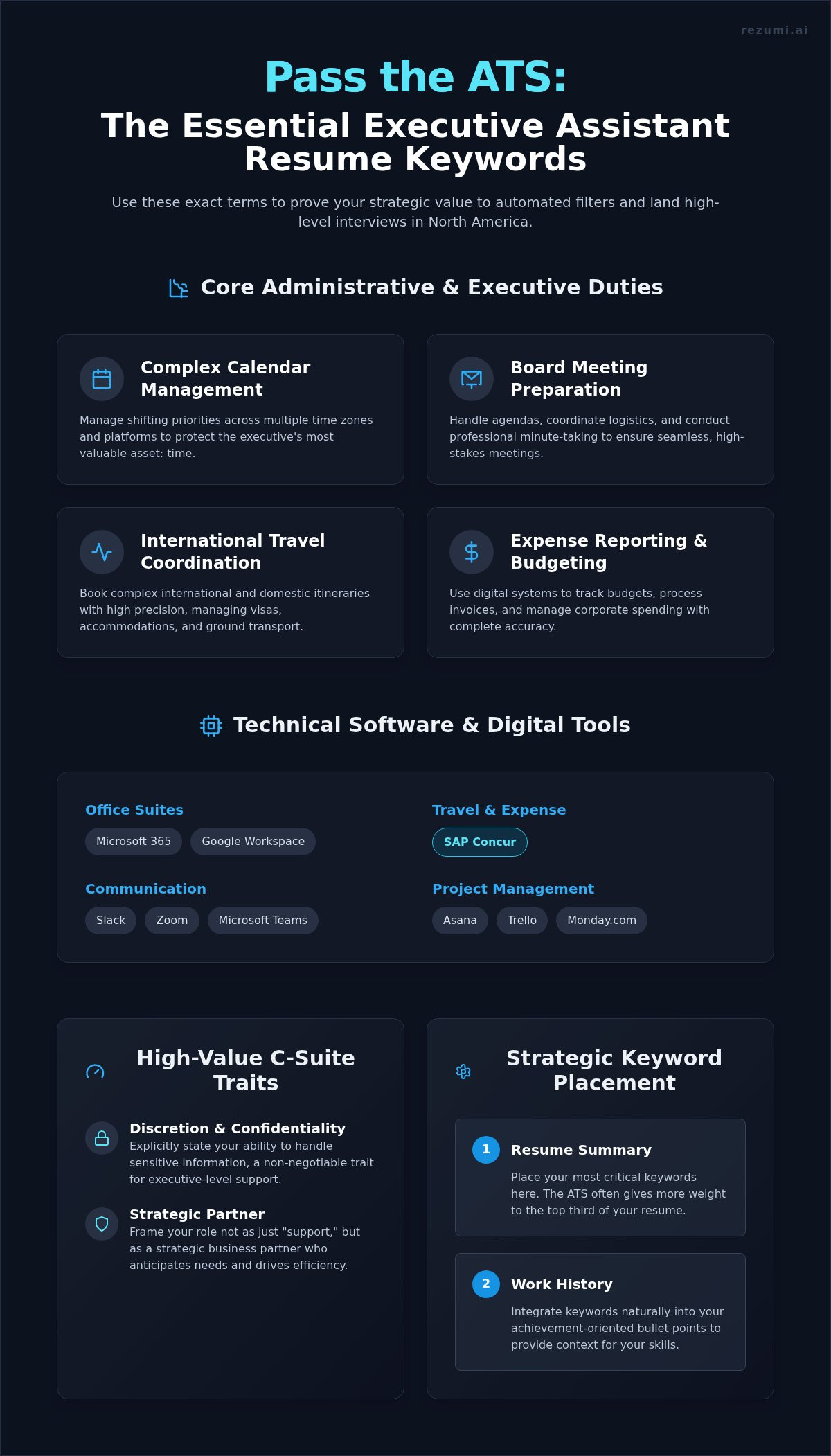
Keywords for Executive Assistant Resume: The 2026 Strategic List
The U.S. Bureau of Labor Statistics projects a 2% decline in executive assistant roles by 2034. This is not a sign of a dying career. It is an evolution. To secure your next role, you must use the right keywords for executive assistant resumes. These specific terms are the only way to prove your strategic value to an automated filter.
You likely feel the pressure of a changing market where basic skills are no longer enough. It is exhausting to have years of experience and still get rejected by a machine. We are here to change that. This guide gives you the 2026 strategic list of keywords needed to pass ATS filters and land high-level interviews in North America.
We will cover the technical tools recruiters want now, such as AI fluency and project management platforms. You will learn the exact placement for these words to ensure your resume ranks high. We will also show you how to frame soft skills so machines recognize your leadership and your ability to act as a strategic partner.
Key Takeaways
- Understand how Applicant Tracking Systems (ATS) score your resume based on specific keywords for executive assistant roles.
- Identify the essential mix of technical hard skills and leadership-focused soft skills required for modern executive support.
- Adjust your keyword strategy to match your career stage, from foundational organization to high-level stakeholder management.
- Master strategic placement techniques to integrate high-impact terms into your resume summary and work history.
- Use AI optimization tools to find missing keywords and tailor your resume for specific job descriptions in seconds.
Why your executive assistant resume needs strategic keywords
Keywords are the digital bridge between your professional experience and a recruiter's inbox. They are the specific terms and phrases that hiring managers type into databases to find qualified candidates. If your document lacks the right keywords for executive assistant roles, you effectively don't exist in the digital job market. High-level positions require a specialized vocabulary that proves you understand the unique pressures of the C-suite. Generic language like "hard worker" or "office support" fails to trigger interest for these elite roles.
You might have a decade of experience, but a machine doesn't care about your tenure if it can't find the data points it wants. Recruiters at top North American firms manage hundreds of applications for a single opening. They don't read every resume. Instead, they search for specific evidence of your skills. Your resume must act as a map that leads them directly to the conclusion that you are the right fit.
The role of ATS in executive hiring
Most North American corporations rely on Applicant Tracking Systems (ATS) like Workday, Taleo, or Greenhouse to manage their hiring. These platforms scan your document for a match against the job description. They assign a score based on how often you use specific keywords and where you place them. A resume with a low score is often filtered out before a human even sees your name. To get an interview, you must align your vocabulary with the software's logic. This means using the exact phrasing found in the job posting rather than creative synonyms.
How recruiters search for C-suite support
Recruiters look for concrete evidence of your ability to handle common executive assistant duties without constant supervision. They don't just search for the word "admin." They filter for specific high-value tasks like international travel coordination, board meeting preparation, and complex calendar management. They also prioritize technical proficiency. In 2026, this means they are looking for specific tools like Concur for expenses, Slack for team communication, and Microsoft 365. High-priority search terms also include "discretion" and "confidentiality." If you don't list these exact traits, the recruiter will likely move to the next candidate who did.
Essential keyword categories for modern executive support
Categorizing your skills is the first step to beating the ATS. You need a balanced mix of technical ability and emotional intelligence. Hard skills prove you can do the work. Soft skills prove you can handle the people. By organizing your keywords for executive assistant roles into distinct categories, you make it easier for recruiters to verify your expertise at a glance.
Core administrative and executive duties
Executive support is about more than answering phones. It is about strategic alignment with leadership. According to the U.S. Bureau of Labor Statistics, modern administrative roles require high level organization and technical proficiency to manage complex workflows. You must show that you can manage the executive's most valuable asset, which is their time.
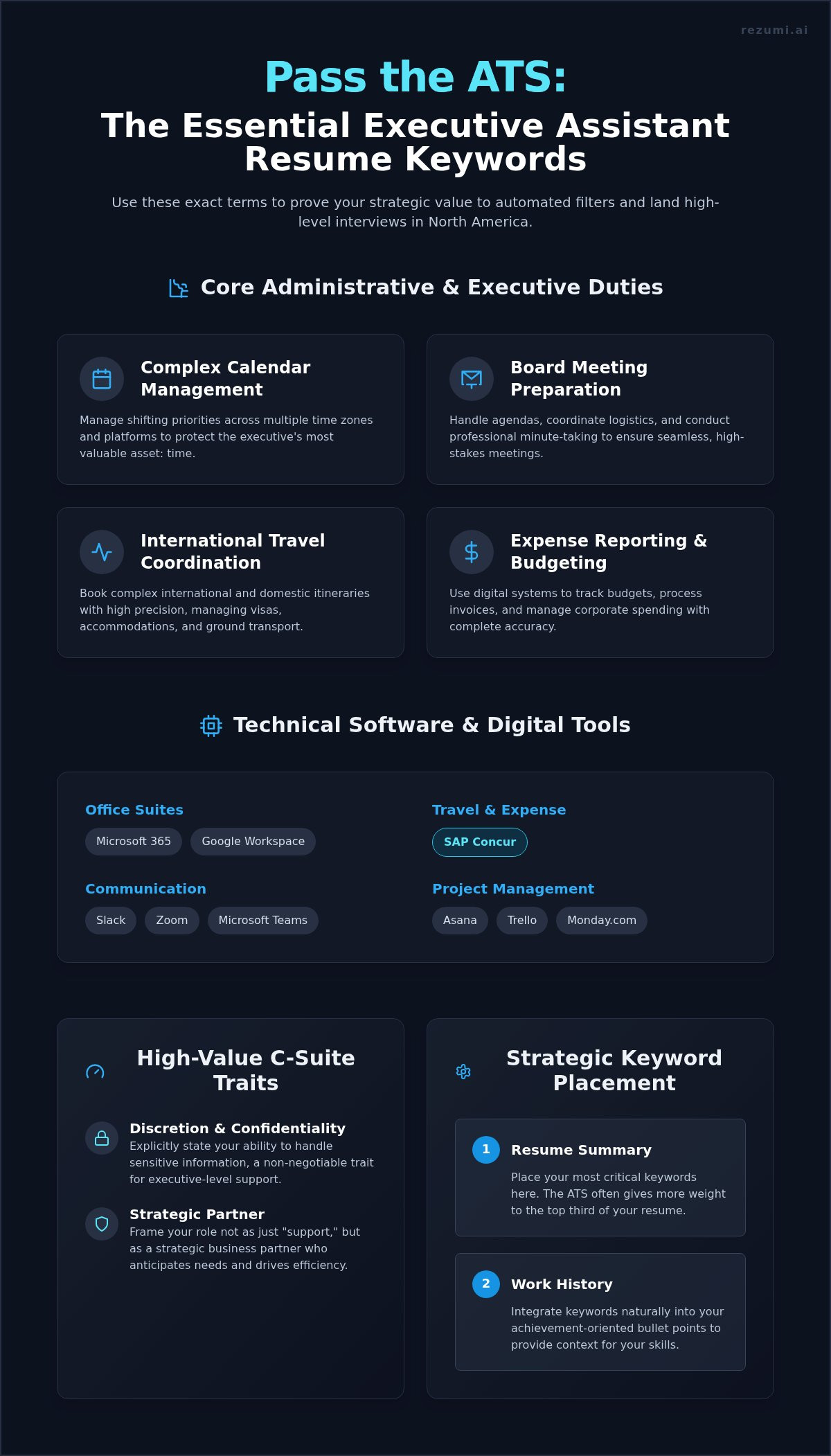
- Complex calendar management: This involves managing shifting priorities across multiple time zones and platforms.
- Board meeting preparation: You should mention handling agendas, logistics, and professional minute taking.
- Travel coordination: Focus on booking international and domestic itineraries with high precision.
- Expense reporting: Mention using digital systems to track budgets and manage corporate spending.
Technical software and digital tools
A modern EA is a tech expert. You must show you are ready for a digital office. Simply saying you "know computers" is not enough. You need to name the specific platforms. Recruiters use technical keywords for executive assistant searches to see if you can hit the ground running without extra training.
- Office Suites: Microsoft 365 and Google Workspace are the industry standards.
- Travel and Expense: Experience with SAP Concur is a major advantage for high level roles.
- Communication: Slack, Zoom, and Microsoft Teams are essential for hybrid teams.
- Project Management: Tools like Asana, Trello, or Monday.com show you can lead complex initiatives.
If you aren't sure which tools to prioritize, you can check our ATS optimization plans to see how your current list compares to top job descriptions. Industry specific terms also matter. If you work in finance, use "compliance." If you work in tech, use "agile environments." These words show you understand the unique challenges of your sector.
Executive level keywords for different career stages
Seniority dictates your vocabulary. A C-suite assistant should not sound like a junior receptionist. Matching your keywords for executive assistant resumes to the specific level of leadership you support is critical for ranking in recruiter searches. If you apply for a senior role using entry-level terms, the ATS will likely categorize you as underqualified.
Recruiters use different search strings depending on the salary bracket and responsibility level of the role. Junior roles focus on execution and reliability. Senior roles focus on strategy and influence. You must audit your current document to ensure your language reflects your actual career stage and the level of the executive you intend to support.
Junior and mid-level assistant keywords
Junior roles are about foundational support. At this stage, your resume needs to prove you can handle the daily mechanics of an office without errors. Recruiters look for "office coordination" and "administrative assistance" to find candidates who can keep a team organized. Accuracy is your primary selling point here.
- Inbox management: Show you can filter high-volume communications and prioritize urgent messages.
- Meeting logistics: Highlight your ability to book rooms, manage AV requirements, and coordinate catering.
- Document preparation: Mention your skill in creating reports, presentations, and spreadsheets with high precision.
- Data entry accuracy: Focus on your discipline in maintaining databases and records without mistakes.
Senior and C-suite assistant keywords
Senior assistants operate as strategic partners. At this level, you aren't just managing a calendar; you are managing a brand and a leader's reputation. Use terms like "strategic advisor" or "business partner" to signal that you contribute to high-level decision making. You are no longer just a support person. You are an extension of the executive office.
- High-stakes confidentiality: This proves you can handle sensitive financial or legal data with absolute discretion.
- Gatekeeping: This term shows you can protect an executive's time by filtering out low-priority requests.
- Board of directors liaison: Highlight your experience communicating with external stakeholders and high-level officials.
- Crisis management: Mention your ability to remain calm and effective when schedules collapse or emergencies arise.
By using these targeted keywords for executive assistant roles, you demonstrate that you understand the specific pressures of your target career level. Seniority is about more than years of experience. It is about the vocabulary of leadership and the ability to act as a strategic productivity multiplier.
Strategic placement of keywords for maximum impact
Knowing which words to use is only half the battle. You must place your keywords for executive assistant resumes in specific zones to trigger the highest ATS scores. Strategic placement ensures that both the software and the hiring manager see your value immediately. If you bury your best skills at the bottom of the page, you risk being overlooked by recruiters who only spend seconds scanning each document.
A well-structured resume acts as a data map for automated systems. You want to guide the software toward your most relevant experience. This requires a balance between a dedicated skills list and integrating those same terms into your professional history. When you repeat key terms naturally throughout the document, you signal to the ATS that your expertise is consistent and deep.
Optimizing your professional summary
Your professional summary is the most valuable real estate on your resume. It is the first section a recruiter reads and a high-priority area for ATS ranking. Start by stating your professional title and your total years of executive support experience. This establishes your authority instantly and sets the stage for the rest of your document.
Include 3 to 4 high-impact keywords within the first two sentences. Mention the specific level of leadership you have supported, such as the C-suite or global department heads. This tells the recruiter exactly where you fit in the corporate hierarchy. By placing your most important skills here, you ensure they are seen even if the reader does not finish the entire page.
Writing keyword-rich experience bullets
Your work history should not be a list of chores. It must be a series of achievements. Use the STAR method to weave keywords for executive assistant roles into your bullet points. This stands for Situation, Task, Action, and Result. This structure allows you to prove your skills with hard data rather than vague claims.
Combine a keyword with a specific metric or outcome to create an impact statement. For example, instead of writing "handled scheduling," write "managed complex calendars for 3 VPs, reducing scheduling conflicts by 40%." This shows the recruiter that you don't just perform tasks; you deliver tangible results. Use active verbs like "coordinated," "spearheaded," or "implemented" to show you take initiative.
Finally, include a dedicated core skills section. This is a scannable list that helps the ATS identify your technical and administrative expertise quickly. Ensure these keywords match the job description exactly. If a company asks for "Google Workspace," don't write "G-Suite." Machines look for exact character matches to determine your fit for the role.
Use AI to optimize your executive assistant resume
Manual tailoring for every job application is slow and difficult. You shouldn't spend hours guessing which terms a recruiter prioritized. AI tools can identify the exact keywords for executive assistant roles missing from your current draft in seconds. This technology bridges the gap between your real-world experience and the digital filters that stand in your way. It allows you to focus on your career while the software handles the technical alignment.
Rezumi helps you align your resume with North American hiring standards by providing real-time feedback on your document's quality. You get a clear resume score that shows exactly how you rank against a specific job description. This score is based on keyword density, placement, and formatting norms common in the US and Canada. This data-backed strategy replaces the anxiety of the application process with a sense of total control.
Tailoring your resume with Rezumi
The optimization process is built for speed and precision. Start by uploading your current resume and the specific executive assistant job posting you want to target. The AI analyzes both documents to find the specific C-suite keywords you missed. It doesn't just give you a list of words. It provides specific prompts to help you integrate these terms naturally into your bullet points. This ensures your resume stays readable for human recruiters while remaining technically optimized for the ATS.
Preparing for the interview
Keywords for executive assistant roles are not just for machines. They are the vocabulary of high-level business. Use these terms in your interview answers to prove your strategic value. When you speak about "stakeholder management" or "calendar optimization" in person, you reinforce the claims made on your resume. It creates a consistent professional brand that makes you a low-risk, high-reward hire in the eyes of an executive.
You can refine your delivery with AI-driven coaching and interview prep tools. This allows you to practice speaking the language of leadership until it feels natural. If you are ready to stop guessing and start ranking, check our pricing to start optimizing today. You already have the experience. We provide the technical edge to make sure everyone else sees it too.
Take command of your executive career
You now have the blueprint for a high-performance resume that gets results. By using the right keywords for executive assistant roles, you ensure that your strategic value is visible to both machines and humans. You know how to categorize your technical skills and where to place them for maximum impact in the North American market.
Rezumi is built to help you master this transition. Our platform provides real-time ATS scoring and AI-powered tailoring specifically for US and Canadian hiring standards. You don't have to guess what recruiters want because our data shows you exactly how to align your experience with their needs.
Your years of experience deserve to be seen by the right leaders. Take control of your professional narrative and start securing the high-level interviews you've worked for. You have the skills. Now you have the strategy to prove it.
Frequently Asked Questions
How many keywords should I include on an executive assistant resume?
Aim for 20 to 30 unique keywords on your resume. This range allows you to cover technical tools, administrative duties, and soft skills without stuffing the document. Focus on quality by selecting terms that appear most frequently in the job description. Too few keywords might lower your ATS score, while too many can make your resume unreadable for human recruiters who value clear and concise communication.
Should I list soft skills like multitasking as keywords?
You should include soft skills, but avoid generic terms like multitasking. Use specific keywords for executive assistant roles like "complex calendar management" or "priority shifting" instead. These terms prove you can handle multiple demands in a way that machines and recruiters understand. Soft skills are most effective when you back them up with results in your work experience section to provide context and proof of your abilities.
Is it okay to repeat keywords on my resume?
It is helpful to repeat your most important keywords two or three times throughout the document. Repeating terms in your summary, skills section, and work history signals to the ATS that your expertise is consistent. Avoid keyword stuffing where you list words without any context. Natural repetition within your achievement bullets is the most effective way to improve your ranking while keeping the text professional and engaging for the human recruiters.
What technical tools are most important for EAs in 2026?
AI fluency is the most critical technical skill for EAs in 2026. You should list specific tools like ChatGPT, Microsoft Copilot, or Claude for research and drafting. Beyond AI, proficiency in project management software like Asana or Monday.com remains vital. Familiarity with meeting intelligence tools like Otter.ai and expense management platforms like SAP Concur will also set you apart from other candidates. These tools are the current standard for high-level support in the North American market.
How do I identify the best keywords from a job description?
Look for terms that appear in the first few bullet points or are mentioned multiple times. These are the high-priority requirements the employer needs most. Pay close attention to specific software names, certification requirements, and action verbs. If the job description asks for "international travel coordination" several times, that is a mandatory keyword you must include. This exact match is necessary to pass the initial automated screening and move to the next stage.
Should I use a skills section or integrate keywords into my experience?
You must use a dedicated skills section and integrate keywords into your work experience. A skills section provides a scannable list that helps the software identify your core competencies quickly. Integrating those same keywords for executive assistant roles into your experience bullets proves you have used those skills to achieve real results. This dual approach ensures your resume is optimized for the machine's algorithm and the recruiter's need for evidence-based hiring.
Do keywords matter for executive assistant cover letters?
Keywords are essential for cover letters because many modern ATS platforms scan every document you upload. Use your cover letter to highlight two or three high-impact keywords that you could not fully explain on your resume. This is your chance to tell the story behind your skills. It reinforces your professional brand and shows the recruiter that you have a deep understanding of their specific needs. It also helps improve your overall application score.
Disclaimer
This article is provided for general informational purposes only and does not constitute professional, legal, financial, or career advice. While Rezumi strives for accuracy, we make no warranties as to the completeness or reliability of this content. Hiring practices, ATS behavior, and job-market conditions vary by employer, industry, and region — always verify against your specific situation. Any action you take based on this article is at your own risk.