Marketing Resume ATS Keywords: Skills and Role Matches
A strong marketing resume doesn’t list every skill you’ve ever used. Choose 10-20 marketing resume ATS keywords that match the job description, then work them naturally into your skills, summary, and experience bullets. Use the employer’s standard wording for relevant tools and skills, and connect each one to work you’ve actually done.
You’re right to focus on keywords: they help show how your experience fits the role. But adding terms without context can make your resume less credible. A skill is stronger when your bullet points show how you applied it and what changed as a result.
This guide explains how ATS and recruiters use marketing keywords, how to find the right terms in a job posting, and which skills commonly fit content, SEO, email, paid media, growth, and brand roles. You’ll also learn how to place keywords in resume bullets without making your writing sound forced, so you can tailor each application with confidence.
Key Takeaways
- Choose skills that match the role, then use the job posting’s wording where it accurately describes your experience.
- Sort keywords by marketing specialty so your resume highlights the tools and skills that fit the position.
- Use resume bullets to show how you applied a skill and what result your work produced.
- Compare job descriptions to spot recurring role requirements, then tailor your resume for each application.
- Understand how ATS keyword matching supports screening, while keeping your resume clear and credible for human readers.
How do I add skills to a Marketing resume?
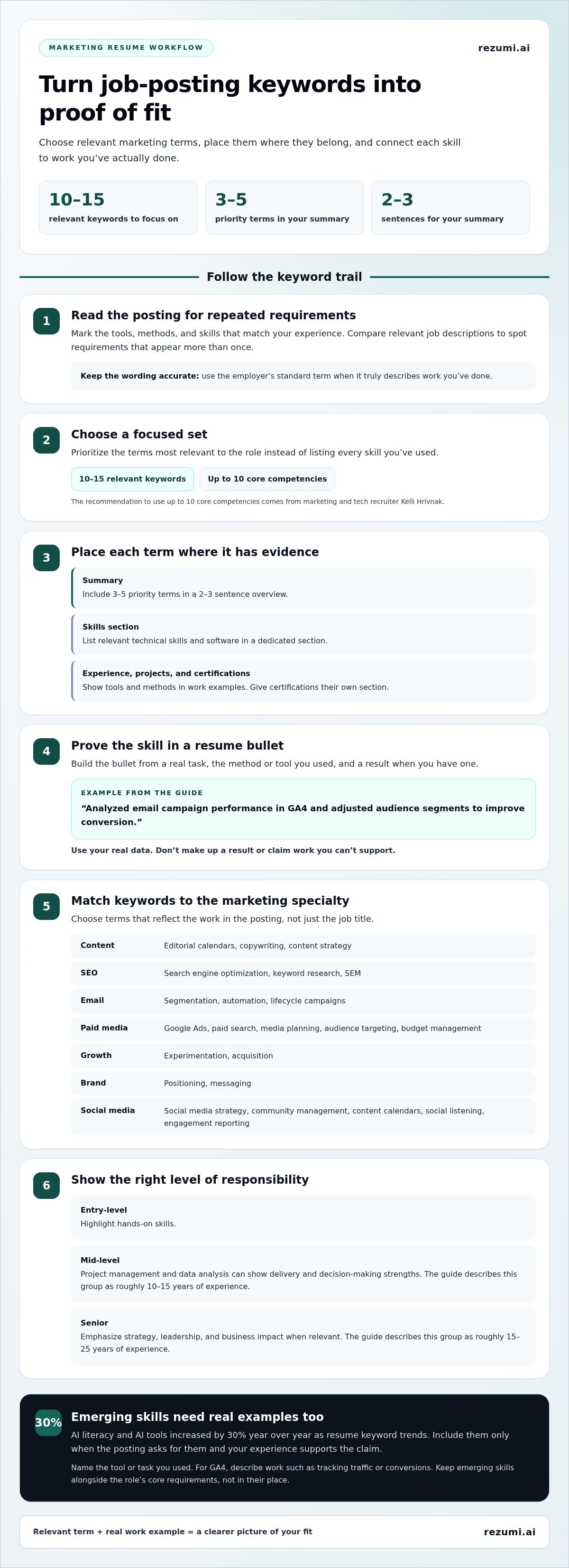
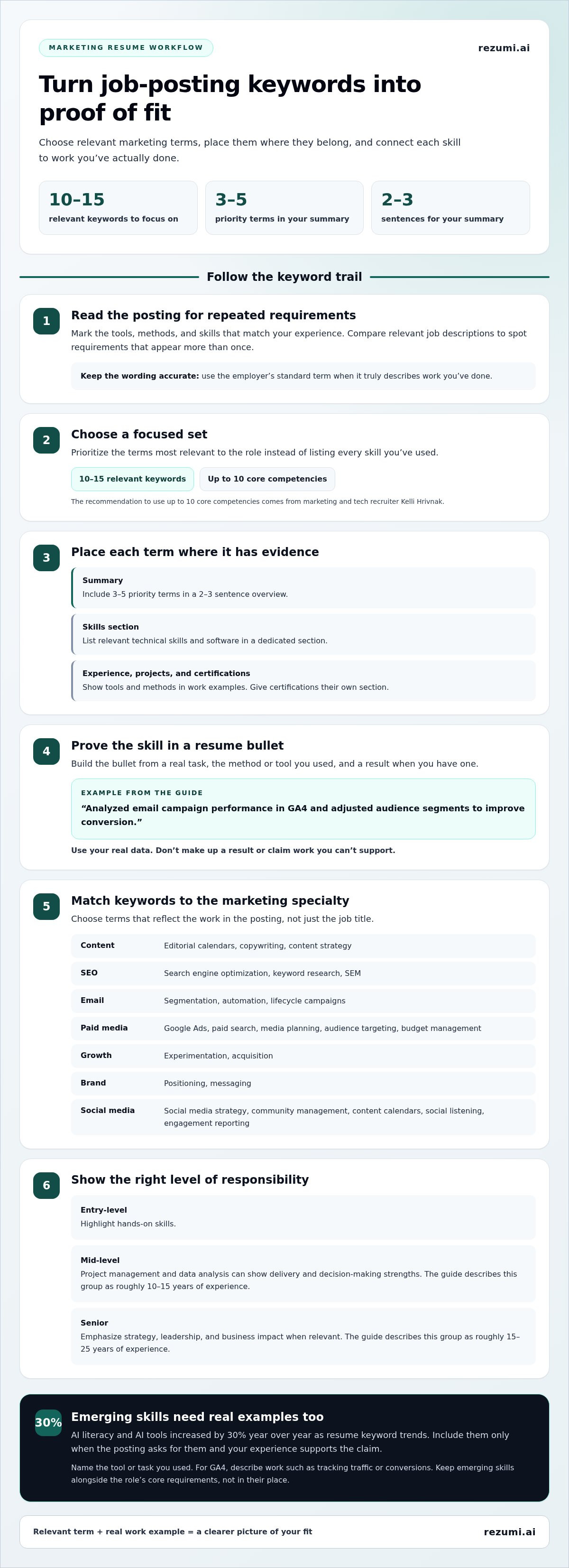
Choose skills that match the job description, then place them where your experience supports them. A focused set of 10-15 relevant keywords gives applicant tracking systems and recruiters clear evidence of your fit.
Keyword Placement Across Resume Sections
Keyword placement means putting relevant marketing terms in the resume sections that best prove them. Use 3-5 priority terms in a two-to-three-sentence summary, then list technical skills in a dedicated skills section. Add tools and methods to experience bullets, project descriptions, and relevant certifications. For example, pair “Google Analytics 4” with a project where you analyzed campaign results.
Keep each term accurate and easy to find. List a certification in its own section, and include a skill such as email marketing in a work example if you’ve used it. This gives the skill context instead of repeating the keyword without evidence.
Trending and Future-Oriented Marketing Skills
Future-oriented marketing skills are capabilities tied to changing tools, channels, and measurement needs. Google Analytics 4 (GA4) is a rising keyword for digital marketing roles, while AI literacy and AI tools increased by 30% year over year as resume keyword trends. Include either when the posting asks for it and your experience supports the claim.
Make the terms specific. “AI tools” alone tells little; name the tool or task you used, such as drafting campaign variations for review. For GA4, show the work, such as tracking traffic or conversion. Keep emerging skills beside established skills, not in place of the role’s core requirements.
Showing Skills Through Work Experience
Skills through work experience are abilities shown in the actions and outcomes of your past roles. Start a bullet with a relevant task, name the method or tool, then add a result when you have one. For example: “Analyzed email campaign performance in GA4 and adjusted audience segments to improve conversion.” Use your real data, not a made-up result.
Match the job’s wording without copying claims you can’t support. If a posting requests “project management,” describe a campaign you coordinated across teams. If it asks for social media skills, identify the channel, campaign task, or reporting work that demonstrates your experience.
Marketing Hard Skills and Their Prevalence
Marketing hard skills are practical, teachable abilities such as SEO, campaign analytics, and marketing automation. Which ones matter depends on the role, so prioritize skills repeated in relevant postings rather than treating every keyword as essential. SEO and SEM are common terms in digital and growth marketing roles.
Build a skills section around the target job. Choose up to 10 core competencies, as marketing and tech recruiter Kelli Hrivnak recommends, and include relevant software. For a digital role, that could mean GA4, SEO, SEM, and conversion tracking. For a content role, select the tools and skills named in its posting.
Role-specific keywords for content, SEO, email, paid media, growth, and brand
Marketing keywords vary by specialty because each role measures different work. Entry-level resumes should highlight hands-on skills; senior resumes should emphasize strategy, leadership, and business impact.
Keywords Across Marketing Roles
Role-specific keywords are skills and tools tied to a marketing specialty. Content roles may call for editorial calendars, copywriting, and content strategy; SEO roles often use search engine optimization, keyword research, and SEM. Email postings may mention segmentation, automation, and lifecycle campaigns. Growth roles can emphasize experimentation and acquisition, while brand roles may focus on positioning and messaging.
Match terms to the actual posting, not just its job title. For example, a content marketer role that includes search work needs SEO terms alongside writing skills. A brand position that involves campaign reporting may also require analytics language. Together, these terms show the full scope of your fit.
Advertising, Media, and Social Media Terms
Advertising and media keywords describe how you plan, buy, and measure campaigns. Paid media postings may mention Google Ads, paid search, media planning, audience targeting, and budget management. Include relevant performance metrics that reflect your work and describe them in context.
Name platforms only if you’ve worked with them. If your role included Google Ads optimization, state the campaign type and what you adjusted. For example, describe refining audience targeting or ad creative, then connect that work to a documented result. Don’t claim budget ownership if you only prepared reports.
Social Media Management Skills
Social media management involves planning, publishing, and measuring content across social platforms. Relevant keywords may include social media strategy, community management, content calendars, social listening, and engagement reporting. Name platforms such as Instagram or LinkedIn only when they match your experience and the role.
Show the work behind each term. A bullet might explain that you planned a LinkedIn content calendar, coordinated approvals, and reviewed engagement trends. For a role focused on paid social, include campaign setup and audience testing instead. Specific duties distinguish hands-on channel management from general marketing experience.
Keywords Across Career Levels
Career-level keywords reflect the scope of your responsibility, not just years worked. For mid-level candidates with roughly 10-15 years of experience, project management and data analysis can clarify delivery and decision-making strengths. Senior candidates with roughly 15-25 years of experience can foreground strategic planning and executive leadership when those terms fit the posting.
Entry-level applicants can use relevant coursework, internships, and projects to demonstrate practical skills such as SEO research or campaign reporting. As you take on more responsibility, shift the emphasis toward team direction, budget decisions, and strategy. Choose language that accurately describes your contribution at each stage.
Use the posting’s priorities to shape each version of your resume. Tailor your resume to a marketing role by aligning its specialty terms with evidence from your work.
Examples of integrating keywords into resume bullets
A strong resume bullet connects a marketing skill to an action and a result. Use the job posting’s terms where they fit, then support them with specific work rather than a string of keywords.
Natural Keywords in Achievement Bullets
Natural keyword use means placing a relevant skill inside a clear description of your work. Start with an action, add the method or tool, and finish with the outcome when available. For example, “Used audience segmentation to refine email campaigns, increasing engagement by 35%” connects a recognized marketing skill with a result.
Keep each bullet focused on one contribution. If a posting asks for A/B testing, describe what you tested and what changed. A sample bullet could read: “Ran A/B tests on landing pages, improving conversion rate by 18% over 6 weeks.” Include a keyword only when it accurately reflects your role.
Measurable Outcomes in Resume Bullets
Measurable outcomes express results with relevant figures, such as a rate change, timeframe, or volume. They help recruiters understand the scale and effect of your work. Use figures from your own records, and name the metric clearly, such as organic traffic, qualified leads, or sales.
For example, “Optimized SEO content and on-page elements, increasing organic traffic by 32% in 4 months” combines keywords with a time-bound result. Another model is: “Used targeted audience segmentation and campaign optimization to increase engagement by 35%.” These examples reflect documented sample resume bullets, not results to copy as your own.
Build bullets from evidence. A useful structure is action, skill or tool, scope, and result. For example, a campaign bullet might name Salesforce, explain how you managed lead data, and state the verified outcome. Don’t include Salesforce just because it appears in a posting. Mention it only if you used it for the work described.
Match each bullet’s detail to the role. A growth marketing posting may value testing and conversion, while a marketing operations role may focus on Salesforce processes. “Managed campaigns” is broad; “Built segmented email campaigns and tracked conversion” gives applicant tracking systems and reviewers clearer terms. Add a result when your records support one.
Describe your contribution without overstating your ownership. If you supported a launch, say “supported,” not “led.” If you shared responsibility for results, specify your part. A credible bullet with one relevant keyword and a precise action is stronger than a crowded line of unrelated tools.
Before submitting, compare each bullet with the posting. Keep terms that fit your experience, remove unsupported claims, and make every result traceable to your work. This keeps your keywords readable while showing how your marketing skills contributed to measurable outcomes.
Extracting keywords from job descriptions
Compare relevant postings to find skills, tools, and phrases employers repeat. Then choose terms that match your experience and tailor your resume to each opening.
Finding Keywords in Job Descriptions
Finding keywords means identifying the skills, tools, and responsibilities an employer names in a job description. Collect 5-10 postings for roles you want, then scan each for repeated terms. Note exact phrases such as “HubSpot,” “campaign reporting,” or “marketing automation.” Repeated requirements can help you distinguish core role expectations from one-off preferences.
Read beyond the skills list. A posting may mention leadership in its responsibilities, even when the qualifications section emphasizes platforms. Mark phrases in the summary, duties, and requirements, then group them by theme. For example, “manage editorial calendar” and “coordinate writers” both point to content operations, but each describes a different task.
Extracting Relevant Job Description Terms
Keyword extraction means sorting job-posting language into useful resume terms. Review five similar postings and note which terms appear in at least three; treat those as defining terms for the role. Keep a simple list with columns for term, frequency, and evidence from your background. This makes your keyword choices easier to explain and verify.
Group requirements into categories such as tools, channels, and responsibilities. “HubSpot” is a platform, “email automation” is a skill, and “report campaign performance” is a responsibility. Prioritize terms that appear repeatedly and directly match your work over less relevant phrases. If Google Analytics appears across the postings, include it only when you can point to a project or duty where you used it.
Use the posting’s standard phrasing when it accurately describes your experience. For example, choose “SEO” if that’s the term the role uses, rather than replacing it with a less familiar phrase. Keep related wording together in your notes, but don’t treat similar terms as identical when the tasks differ. “Paid social” and “social media management” may involve distinct responsibilities.
Tailoring Resumes to Job Descriptions
Resume tailoring means adjusting relevant details for a specific opening without changing your work history. Compare your evidence with the posting, then highlight matching skills in your summary, skills list, and experience bullets. For a role requesting HubSpot and lead nurturing, bring forward campaign work where you used those tools or methods.
Make your strongest evidence easy to find. Move a relevant project higher, clarify a matching responsibility, or add a tool to a bullet that describes how you used it. If the posting asks for leadership, show the team or project you guided instead of simply adding the word. Keep every claim accurate and tied to your contribution.
Before applying, compare the tailored resume with the original posting, phrase by phrase. Confirm that essential terms appear where your experience supports them, and remove skills unrelated to the role. This final review aligns your resume with the employer’s language while preserving a clear, credible account of your work.
How ATS and recruiters use marketing resume keywords
An applicant tracking system (ATS) is software employers use to collect and organize applications. To check whether your resume is ATS-friendly, copy its text into a plain document and confirm that headings, job titles, dates, and skills appear in the right order. Then compare the wording with the job posting.
ATS tools can help employers filter applications by keywords, qualifications, and other criteria. Your resume may miss a match if it uses an unusual phrase instead of the posting’s standard term. For example, “search optimization” may not clearly match “SEO” to a system or recruiter scanning for that specific skill.
Applicant tracking is not one universal scoring method. Employers configure systems differently, and recruiters may search, filter, or review applications using different features. Over 97% of Fortune 500 companies use applicant tracking systems to filter marketing candidates, while a separate survey cited in the research found 82.3% of companies use some form of ATS.
Keywords help recruiters locate relevant evidence, but context still matters. A resume that lists “Google Analytics 4” without showing how you used it gives little proof of skill. A bullet describing campaign analysis, the metric reviewed, and the decision made gives both the system and recruiter a clearer connection.
Include certifications, technical skills, and job titles only when they accurately reflect your background. If a posting requires a marketing analytics certification, list the exact credential in a certifications section. If the role title differs from your previous title, keep your official title and briefly clarify your function in parentheses.
Keyword quantity needs restraint. More than 30 relevant terms can look like keyword stuffing to ATS semantic analyzers and human reviewers. Instead of adding every phrase, keep the skills that match the role and support them with evidence. A keyword should help identify your fit, not interrupt a recruiter’s reading.
Review your resume as text, not just as a designed page. Confirm that headings such as “Experience” and “Skills” remain readable, and that contact details, dates, and bullet points appear in order. Then search the document for key terms from the posting. If a relevant skill is missing, add it only where your experience supports it.
ATS matching is an early screening step, not a substitute for a recruiter’s judgment. Strong alignment makes relevant experience easier to find, while clear metrics and specific examples help explain its value. Focus on accurate wording, readable structure, and evidence of the skills named in the role.
Rezumi: ATS Resume Optimization
Rezumi’s ATS Resume Optimization helps you tailor your resume to a marketing job description. Use it when you’ve identified the role’s key skills and want help aligning your resume’s wording and experience with its requirements.
Your experience remains central. The goal is to make relevant skills, tools, and achievements easier to find while keeping every claim accurate. You can also use the AI Cover Letter Generator to prepare a role-specific letter, AI Interview Prep to practice responses, or Resume Design & PDF Export to finalize your application file.
Choose the support that fits your next step, whether you’re refining keywords or preparing for an interview. Visit rezumi.ai to explore Rezumi, or contact the team with your questions.
Make Your Next Application More Intentional
Your next application is a chance to show not only what you’ve done, but where you want to go. Before editing your resume, decide which part of your marketing experience best fits the role. That choice gives your application direction and helps you focus on the most relevant evidence.
A thoughtful approach to marketing resume ATS keywords can make relevant experience easier to identify. Keep your language accurate, and connect every skill you name to work you can discuss. When your resume reflects both the role and your real strengths, you’ll be better prepared to explain your value in an interview.
Take the next step by reviewing your application with focus. Choose a target role, compare your resume with its priorities, and refine details that need a clearer connection. A deliberate edit can help you present your experience with confidence and move toward work that fits your goals.
Your experience has value. Present it clearly, and move forward with purpose in your next application.
Frequently Asked Questions
What Are ATS Keywords?
ATS keywords are searchable words or phrases tied to a role’s qualifications, tools, and work. They can be exact phrases or common abbreviations, such as “customer relationship management” and “CRM.” Think of them as labels that connect your resume to a job’s requirements. Their value comes from using them accurately: the surrounding details should show what you did, not just name a term.
Why Do Keywords for Marketing Jobs Matter in 2026?
Keywords help make your marketing experience easier to compare with a role’s needs. In 2026, focus on terms that describe the work’s purpose, not only its channel. For example, a posting centered on retention may value lifecycle strategy and customer segmentation more than broad campaign language. A precise match helps a reviewer understand the kind of marketing problem you’ve handled and how it relates to the opening.
What are the most important ATS keywords for marketing resumes?
Prioritize terms that reflect the role’s main goal and your part in achieving it. A demand-generation position may call for pipeline development, lead qualification, and campaign attribution. A product marketing role may focus on go-to-market planning, competitive research, and product positioning. Choose terms that match your work, then be ready to explain your process and contribution in an interview.
Which digital marketing skills and tools should I include as ATS keywords?
Name the software, channel, or method that best shows how you completed the work. For example, if you built reports in Looker Studio, include that exact platform name rather than writing only “reporting.” If you used a tool as part of a team, describe your role accurately. A specific tool paired with a clear task signals hands-on experience to hiring teams.
What marketing job titles and role-specific keywords should appear on a resume?
Use your official past titles, and clarify the role’s function through the work you describe. If your title was “Communications Associate” but your duties included product launches, explain those launch tasks in your experience. For your target role, use the title from the opening in a tailored headline only when it fits your background. This keeps your resume searchable without implying you held a different job.
How can I find ATS keywords in a marketing job description?
Check how each requirement is framed before deciding whether to include it as a keyword. “Required” skills are core qualifications, while “preferred” skills can distinguish candidates with additional experience. Look for the action behind each term, too. If a posting asks for “audience insights,” identify whether that means survey work, customer interviews, or behavior analysis, then use wording that matches your experience.
How should I add marketing keywords to a resume without keyword stuffing?
Use each phrase where it adds meaning, and don’t repeat it just to increase its frequency. For instance, write “search engine optimization (SEO)” once if both the full phrase and acronym matter to the role, then use the shorter form where it reads naturally. Marketing resume ATS keywords should support a clear account of your work. If a phrase makes a bullet harder to understand, revise it.
Where should marketing ATS keywords appear on a resume?
Place terms near the evidence that supports them, and keep your resume layout easy to follow. For example, a platform named in a project should appear beside the project task, not only in a detached list. Use consistent headings and readable text so people can scan the document easily. Before sending it, review the saved file to confirm that copying its text preserves the intended order.
Disclaimer
This article is provided for general informational purposes only and does not constitute professional, legal, financial, or career advice. While Rezumi strives for accuracy, we make no warranties as to the completeness or reliability of this content. Hiring practices, ATS behavior, and job-market conditions vary by employer, industry, and region — always verify against your specific situation. Any action you take based on this article is at your own risk.