Mastering the STAR Technique: Command Your 2026 Job Interviews
In a 2026 job market where 87% of companies use AI to screen your resume, the interview is no longer just a conversation. It is a high-stakes performance where only 2% of applicants ever earn a seat. You've likely felt the pressure of a "Tell me about a time" question. You fear rambling or losing the point while the recruiter waits for a metric you can't quite recall. Without a star technique interview strategy, it's difficult to align your resume's bold claims with a spoken performance that feels both authentic and authoritative.
You deserve a strategy that replaces uncertainty with data-backed confidence. This article teaches you how to structure high-impact answers that prove your value and meet rigorous North American hiring standards. We will break down the mechanics of evidence-based storytelling to ensure your interview performance finally matches your professional potential. Learn to build a framework that turns your history into a strategic advantage and leaves the recruiter with no doubt about your capabilities.
Key Takeaways
- Learn the exact time-allocation breakdown required to keep your answers concise and impactful.
- Master the star technique interview framework to transform your resume bullets into compelling, evidence-based stories.
- Identify the "Context Hole" and other common pitfalls that cause high-potential candidates to fail behavioral rounds.
- Build a library of versatile anchor stories that allow you to pivot between different interview questions with ease.
- Leverage AI Interview Prep to simulate real-world pressure and refine your delivery before you meet the recruiter.
What is the STAR Technique? The Gold Standard for 2026 Interviews
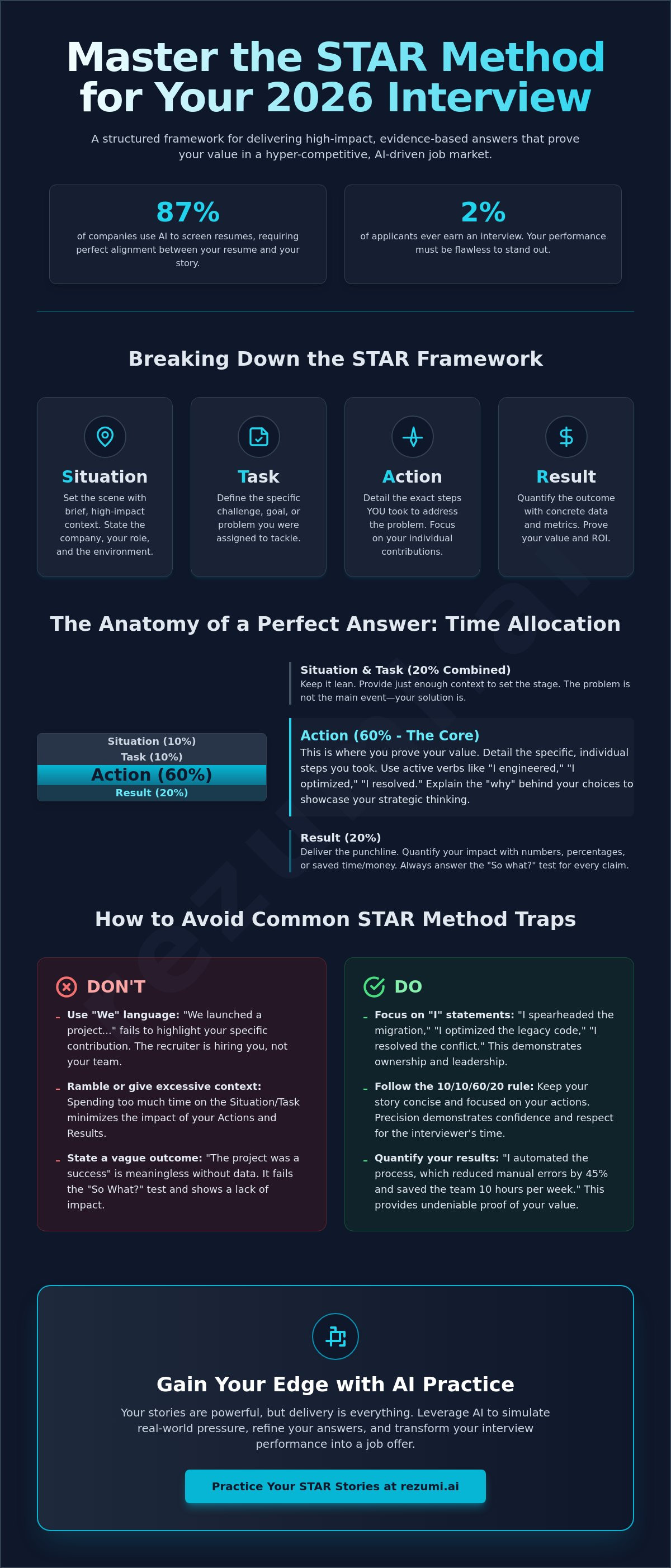
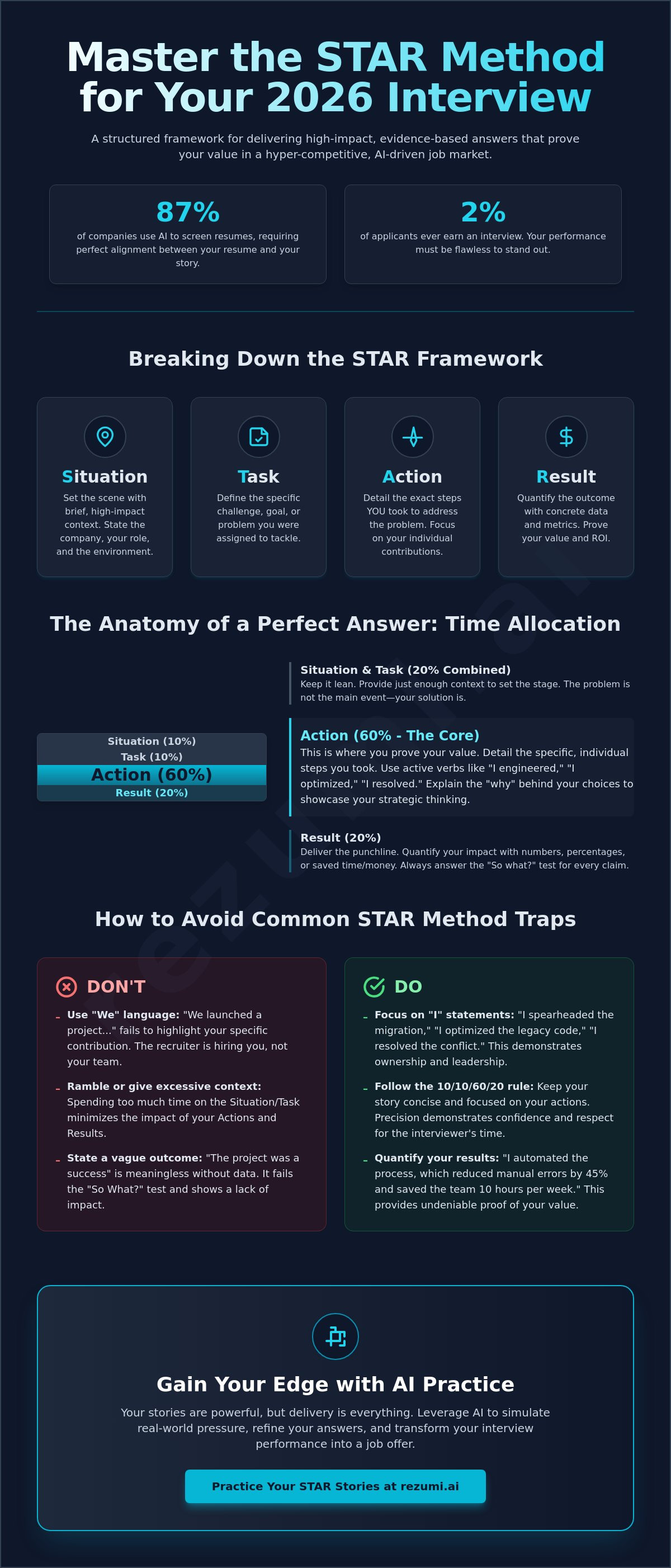
The 2026 job market is hyper-competitive. Recruiters at Amazon, Google, and Workday don't want vague summaries; they want evidence. The Situation, Task, Action, Result (STAR) method is a structured framework designed to answer behavioral interview questions with surgical precision. It transforms abstract claims into concrete data points. Behavioral interviewing operates on a single psychological premise: your past performance is the most reliable predictor of your future success. Hiring teams use this format to strip away interview fluff and uncover the technical skills you actually possess.
The acronym provides a logical progression for every story you tell:
- Situation: Set the scene with brief, high-impact context.
- Task: Define the specific challenge or goal you were facing.
- Action: Detail the exact steps you took to address the problem.
- Result: Quantify the outcome and prove your value.
By using this system, you move from passive participant to strategic candidate. You aren't just answering questions. You're delivering a data-driven case for your own employment.
When to Use the STAR Method
Listen for specific triggers. If a question begins with "Tell me about a time" or "Describe a situation where," you're being tested on your ability to use the star technique interview framework. In the North American market, answering with a simple "Yes" or a brief summary is the fastest way to fail. Recruiters expect a "Yes, and..." approach. You must provide the narrative depth that proves your expertise. Without structure, you risk rambling. With a clear framework, you command the conversation. It forces you to move beyond what you did and explain exactly how you did it.
The 2026 Shift: Why Structure Matters More Than Ever
Modern hiring has evolved. 87% of companies now utilize AI-powered recruiting software to manage high application volumes. These platforms don't just scan your paper trail; they increasingly evaluate verbal consistency during recorded or live sessions. Your spoken narrative must align perfectly with your ATS-optimized resume. If your resume claims a 20% efficiency boost but your interview story lacks the Action or Result to prove it, the system flags a discrepancy. Structure is your defense against being labeled a culture fit risk. It ensures your logic is visible, measurable, and undeniable. Rambling is the primary reason candidates lose points in 2026. Precision is the only way forward.
Breaking Down the STAR Framework: S-T-A-R Step-by-Step
Precision is your strongest asset. In a high-stakes star technique interview, your timing dictates your authority. Most candidates fail because they spend three minutes describing the problem and only thirty seconds explaining the solution. That is a tactical error. To succeed in 2026, you must allocate your response time with mathematical precision. Your goal is to deliver a narrative that is 10% Situation, 10% Task, 60% Action, and 20% Result. This distribution ensures the focus remains on your capability, not the environment you worked in.
The Situation and Task are merely the foundation. Keep them lean. State the company, your role, and the specific hurdle you faced. Don't provide a history lesson; provide context. Your goal is to move to the Action phase as quickly as possible. This is where you prove your technical depth and strategic value to the recruiter.
The Action Phase: Focus on "I," Not "We"
This is the core of your response. It demands 60% of your total word count. Recruiters are hiring you, not your former team. While collaboration is valued, an interview is an evaluation of your individual contribution. Stop saying "we did." Start saying "I engineered." Use high-impact, active verbs to describe your movement. Did you spearhead the migration? Did you optimize the legacy code? Did you resolve the stakeholder conflict? Mastering the star technique interview requires you to pivot from a team contributor to an individual leader. As noted in this Forbes guide to the STAR method, showing your thought process transforms a simple task into a demonstration of expertise. Detail the "why" behind your choices to prove your success was intentional, not accidental.
The Result Phase: Proving Your ROI
Every story needs a punchline. The Result phase is where you justify the investment the company is making in you. Apply the "So What?" test to every claim. If you finished a project on time, so what? If you finished that project two weeks early and saved the department $15,000 in overhead, you've proven ROI. Quantify your wins whenever possible. Use percentages, dollar amounts, or time-saved metrics to provide hard evidence of your success. If your achievements feel thin, utilizing AI Interview Prep can help you extract the hidden data from your past roles. Qualitative results are also valid. Improved team morale or positive stakeholder feedback are powerful indicators of performance if they demonstrate a tangible shift in the business landscape. Always lead with the strongest metric you have available to ensure your value is undeniable.
Strategic Mapping: Turning Resume Bullets into STAR Stories
Your interview is not a separate event from your application. It is the live demonstration of your resume's data. To succeed, you must bridge the gap between the static document and the dynamic dialogue. Consistency is the benchmark. Your LinkedIn profile, your resume, and your spoken words must form a single, unbreakable narrative. Start by auditing your ATS resume score to identify your highest-impact achievement bullets. These are your raw materials. You don't need fifty different anecdotes to impress a recruiter. You need five to seven "Anchor Stories." These are versatile, high-stakes examples that you can pivot to fit multiple question types, from leadership challenges to technical hurdles.
Mapping your skills requires a tactical approach. Assign each Anchor Story to a core competency: Leadership, Conflict Resolution, Technical Mastery, or Adaptability. When a recruiter asks about a difficult teammate, you pull from your Conflict Resolution anchor. When they ask about a complex project, you deploy your Technical Mastery anchor. This preparation ensures you never search for an answer in real-time. As the National Careers Service guide on the STAR method suggests, the goal is to provide a structured response that feels natural yet remains strictly professional. Precision is a requirement, not a suggestion.
The Achievement Audit
Identify your top career win from the last twenty-four months. Write it down in one sentence. Now, reverse-engineer that win into a star technique interview response. Start with the Result. If you increased efficiency by 15%, work backward to define the specific Action you took and the Situation that necessitated it. This method also works for the dreaded "Failure Question." Use the STAR framework to describe a setback, but focus 80% of your Action and Result on the corrective measures you implemented and the professional growth that followed. A failure story with a structured recovery proves resilience better than any generic claim.
Tailoring for the North American Market
US and Canadian recruiters expect directness. They value clarity over modesty. In these markets, "Humble Bragging" is a liability. It suggests a lack of confidence or a failure to own your results. Be bold. Be factual. If you spearheaded a project that saved $50,000, state it clearly. Use Rezumi to ensure your spoken stories align with the specific keywords found in the job description. This alignment signals to both the recruiter and any underlying AI evaluation tools that you are a perfect match for the role. You aren't just telling stories; you're providing proof of your ROI in a language the North American market understands and rewards.
Why Most STAR Answers Fail (And How to Fix Them)
Knowledge of the framework is only half the battle. Many candidates understand the components but fail the delivery. They fall into the "Robot Trap." They recite a mental script while the recruiter's eyes glaze over. This lack of engagement signals a lack of adaptability. You aren't there to read a story; you're there to solve a problem for the hiring manager. If your star technique interview performance feels mechanical, you've already lost the "culture fit" assessment. Precision should never come at the expense of presence.
Another critical error is the "Context Hole." Candidates often spend three minutes on the Situation and only thirty seconds on the Action. This is a tactical failure. The recruiter needs to see your work, not hear about your former company's history. Failing to explain the "Result" leaves your story without a punchline. Vagueness is the final hurdle. Saying "we worked hard" is a wasted sentence. Say "I implemented a 3-step protocol" instead. Precision builds trust; ambiguity builds doubt.
Correcting the Balance
Timing is everything. Follow the 2-Minute Rule. Keep your total response between 90 and 120 seconds. If you go longer, you've lost their attention. Use transition words to guide the recruiter through your logic. Phrases like "Specifically, I..." or "As a result of this action..." signal a shift in the narrative. If you realize you're rambling, stop. Use a self-correction phrase: "To get back to the main point, my primary action was..." and pivot immediately to the Result. To master this flow without sounding scripted, use AI Interview Prep to refine your timing under pressure.
Handling Negative Questions
The STAR framework is your best defense against "The Failure Question." When asked about a mistake, don't hide it. Describe the Situation briefly. Spend the majority of your time on the Action: what you did to fix it. End with a Result that highlights learning and subsequent growth. In 2026, hiring teams value honesty paired with a solution-oriented lens. They don't expect perfection; they expect resilience and a data-backed strategy for improvement. This approach turns a potential liability into a demonstration of high-level professional maturity.
Practicing STAR with AI: The Rezumi Edge
Knowledge of the framework is useless without execution. Manual practice is often a liability. When you rehearse in front of a mirror or with a friend, you reinforce bad habits. Friends provide polite encouragement; they don't provide objective data. In the 2026 hiring landscape, politeness won't get you the offer. You need a simulator that mirrors the high-stakes pressure of a corporate boardroom. Transitioning from theory to performance requires a tool that identifies your verbal "Context Holes" and timing errors before a recruiter does. You must close the loop between your paper credentials and your spoken authority.
Rezumi’s AI Interview Prep is engineered to bridge this gap. It doesn't just listen; it analyzes. By processing your star technique interview responses, the system provides real-time feedback on your structure. It identifies if your "Action" phase is too thin or if your "Result" lacks quantifiable metrics. This technological confidence allows you to refine your delivery until every anchor story is optimized for maximum impact. You move from a state of uncertainty to a state of total control. Your performance becomes a reflection of your strategic advantage.
The Power of AI Mock Interviews
Generic practice questions are a waste of time. Rezumi generates role-specific behavioral questions based on your target job description. This ensures your practice is tailored to the exact requirements of the role you want. The AI provides an objective score on your clarity and impact. It measures your ability to stay within the 2-minute rule and flags instances where you over-credit the team instead of owning your individual contributions. Practicing in this low-stakes environment eliminates high-stakes nerves. It allows you to fail, adjust, and succeed in private so you can command the room in public.
Ready to Command the Room?
The path to a 2026 job offer relies on three pillars: Structure, Strategy, and Speed. You've learned how to map your achievements and avoid the "Robot Trap." Now, you must automate your readiness. Your resume is already working for you; ensure your interview performance does the same. Don't leave your career progression to chance. Move from a passive candidate to an interview-ready professional by refining your narrative today. The mechanics of success are available to you. It's time to deploy them. Start practicing your STAR stories for free with Rezumi and turn your next interview into a definitive career win.
Secure Your Competitive Edge in the 2026 Market
The 2026 job market rewards precision. You've learned the mechanics of the star technique interview and how to audit your achievements for maximum impact. A high-stakes interview is no place for generic stories or rambling context. It's a platform to prove your ROI through structured, data-backed evidence. By mastering the 10/10/60/20 time-allocation rule, you ensure your individual actions remain the focal point of the conversation. This level of preparation transforms you from a standard applicant into a strategic asset.
Preparation is the definitive difference between a rejection and an offer. You must bridge the gap between your paper credentials and your spoken authority. Rezumi’s AI Interview Prep is built specifically for the North American tech and corporate landscape. It provides AI-driven feedback on your STAR structure and integrates seamlessly with our ATS resume optimization tools. Don't leave your career trajectory to chance. Master your next interview with Rezumi’s AI Prep Tool and turn your professional potential into a definitive outcome. You have the framework; now command the room.
Frequently Asked Questions
How long should a STAR interview answer be?
Target a duration between 90 and 120 seconds. This window is the optimal range for maintaining recruiter engagement while delivering necessary depth. Spend the majority of this time on your actions. If you exceed two minutes, you risk losing the listener's focus and diluting your primary value proposition. Precision is your most effective tool for commanding the room.
What if I can’t think of a specific situation for a STAR answer?
Pivot to a recurring professional challenge or a generalized example of your problem-solving process. While specific anecdotes are preferred, explaining your systematic approach to a "Task" still demonstrates competence. To avoid this scenario, audit your career history before the meeting. Identifying versatile anchor stories ensures you're never caught without a data-backed response during a high-stakes star technique interview.
Can I use the same STAR story for different interview questions?
You can reuse a story if you shift the emphasis to a different competency. A single project might demonstrate both leadership and technical mastery. Adjust your "Action" phase to highlight the specific skill the recruiter is testing. However, avoid using the same example more than twice. Variety suggests a breadth of experience that one story cannot convey alone.
Is the STAR method still relevant in 2026 with AI hiring?
The star technique interview remains the gold standard because 87% of companies now use AI-powered recruiting software. These systems are programmed to identify logical structures and quantifiable results in your responses. Using a standardized framework ensures your answers are scannable by both human recruiters and automated evaluation tools. It provides the consistency required to pass modern, data-driven screenings.
What is the difference between a Task and an Action in STAR?
The Task is the objective or challenge you were assigned. The Action is the specific, individual execution you performed to meet that objective. Candidates often fail by describing what the team needed to do instead of what they personally engineered. Focus 60% of your response on the Action. This is where you prove your individual ROI to the hiring manager.
How do I quantify results if I don’t work in sales or finance?
Measure efficiency, time saved, or quality improvements instead of direct revenue. If you optimized a workflow, calculate the hours reclaimed per month for your department. If you managed a project, cite the percentage of milestones met ahead of schedule. Every role has data points. You just need to identify the metrics that signal movement and success in your specific field.
Should I write down my STAR stories before the interview?
Writing your stories down is a critical step for ensuring narrative consistency. It allows you to refine your vocabulary and identify gaps in your "Result" phase. This practice ensures your spoken performance aligns perfectly with your ATS-optimized resume. Don't memorize a script. Map out the key data points so your delivery remains natural yet strategically structured under pressure.
How many STAR stories should I prepare for a standard interview?
Prepare five to seven versatile anchor stories. This volume is sufficient to cover the most common behavioral themes, including conflict resolution, leadership, and technical failure. A smaller number of high-quality, well-rehearsed stories is more effective than a dozen shallow examples. Focus on versatility. Choose stories that you can easily adapt to fit multiple different question types.