Military to civilian resume optimizer: choose length, examples and tools
Your awards matter, but they shouldn’t take over your civilian resume. For junior enlisted service members with fewer than 8 years of service, a one-page resume is recommended; a federal resume submitted through USAJOBS may be up to five pages. Keep your strongest two or three awards and explain the achievement behind each. A military to civilian resume optimizer can also help translate service-specific language into civilian terms and align your experience with a job description.
You may already know your military record demonstrates leadership, technical skills, and results. The challenge is making those strengths clear to civilian employers and easy for applicant tracking systems (ATS) to read. These systems sort applications, and military jargon or buried keywords can make it harder to see how your experience fits a role.
This guide explains how to choose a resume length, translate military experience into civilian-ready examples, use AI assistance without compromising accuracy, and format your resume for ATS screening. You’ll also learn how to present awards so each detail supports the job you want.
Key Takeaways
- Translate military titles and jargon into civilian terms that match the role you want, while keeping your service experience clear and accurate.
- Turn duties into achievement-focused bullets by showing your scope, responsibility, and measurable results.
- Use AI to refine wording and tailor your resume, then review every detail so it reflects your real experience.
- Use simple formatting and relevant job-description keywords to make your resume easier for applicant tracking systems to read.
- Choose a resume tool based on the support you need, such as tailoring, design, or interview preparation.
1. How long should a military to civilian resume be?
For junior enlisted service members with fewer than 8 years of service, use a one-page resume. A federal resume submitted through USAJOBS may be up to five pages. For civilian roles, choose a length that gives relevant skills and results enough room without repeating duties.
For civilian employers, a reverse-chronological format is usually practical: list your most recent experience first. A functional format groups skills but can obscure when and where you gained them. Keep your military title clear, then translate it. For example, use “Operations Manager (NCOIC)” if that accurately describes your role.
Translate duties into familiar work rather than listing military terms. For example, “led unit readiness” could become “coordinated team training and operational readiness.” Connect leadership to project management when your experience supports that comparison. The Department of Labor’s O*NET Military Crosswalk is a searchable database for mapping military occupational codes to civilian equivalents.
Build each experience entry around a civilian title, employer or unit, location, and dates in MM/YYYY format. Describe your work in terms of team size, equipment, processes, or outcomes. Replace acronyms with plain language, but keep a military term in parentheses when it clarifies a qualification or title.
Include experience relevant to your target career, such as leadership, logistics, technical work, training, safety, or measurable improvements. Add relevant awards with brief context, prioritizing the achievement they recognize. Omit unrelated details, repeated duties, and sensitive operational information that could expose protected military activity.
Translate training into civilian credentials carefully. Name a credential only if you earned it; otherwise, describe the course and the skills it taught. Each U.S. military service branch offers a Credentialing Opportunities Online program to help service members identify related credentials, training gaps, and resources.
Free military resume builders can provide a useful first draft, while paid services may have different features. What matters is whether the final resume accurately reflects your experience and fits the job, not simply whether a tool costs money. Review every generated title, date, credential, and claim before using it.
Uploading a military resume to an AI optimizer may expose personal details or sensitive service information, depending on how the tool handles data. Remove classified, restricted, or operational details before uploading, and review the tool’s privacy and data-retention terms. Never enter information you aren’t authorized to share.
In the U.S., the Department of Veterans Affairs’ Veteran Readiness and Employment program can help eligible service members with job training, employment accommodations, resume development, and skills coaching. American Job Centers can connect veterans with personalized support through the Disabled Veterans Outreach Program.
2. Civilian resume examples for military veterans
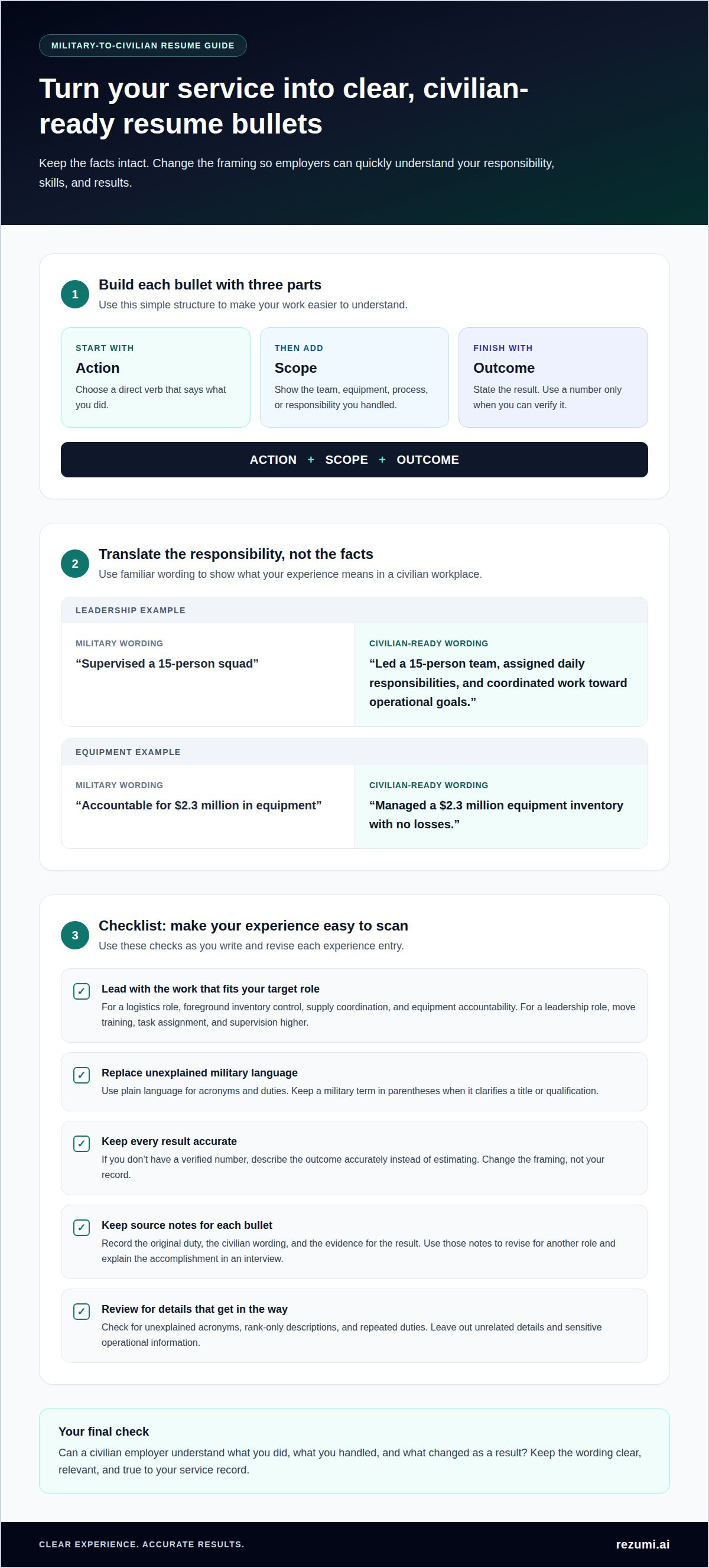
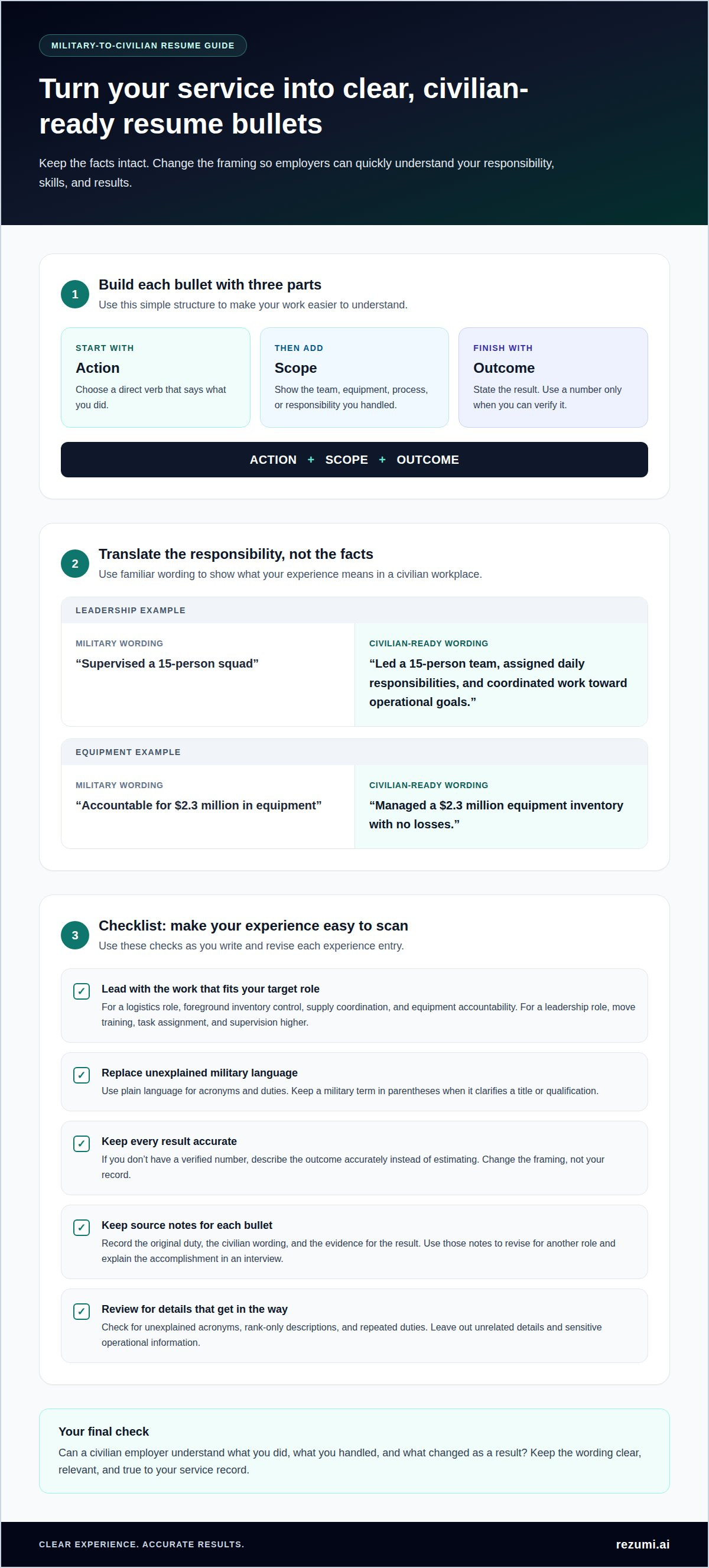
A strong civilian resume bullet makes your work easy to understand and connects it to a result. Compare the military wording with a civilian version, then adapt it to the job you want. Keep the facts intact: change the framing, not your record.
For example, “supervised a 15-person squad” communicates responsibility, but a civilian employer may not know what “squad” means. Try: “Led a 15-person team, assigned daily responsibilities, and coordinated work toward operational goals.” The revised bullet keeps the team size while making the leadership transferable.
Equipment accountability can also show business value. A military description might say, “Accountable for $2.3 million in equipment.” A civilian version could read: “Managed a $2.3 million equipment inventory with no losses.” This example makes the scale and result clear without requiring the reader to understand military procedures.
Use this structure to shape your examples: action + scope + outcome. Start with a direct verb, explain what you handled, then state the result. If you don’t have a verified number, describe the outcome accurately rather than estimating.
- Leadership: “Led a 15-person team” is clearer than an unexplained unit title.
- Operations: Describe the process you coordinated and the outcome you achieved.
- Equipment: State the inventory value and any documented accountability result.
- Training: Explain who you trained and what skills the training covered.
An infantry team leader with four years of operational leadership experience could open a summary with that civilian-ready phrase. The next sentence should connect that experience to a target role, such as team supervision, operations, or project coordination. Choose only a direction supported by the person’s actual duties.
Make each bullet specific to the vacancy. If the posting calls for logistics, foreground inventory control, supply coordination, and equipment accountability. If it emphasizes team leadership, move training, task assignment, and supervision higher. A resume tool can help organize drafts, but it can’t know whether a generated claim matches your service record.
Keep a “source notes” document beside your resume. For each bullet, record the original duty, the civilian wording, and any evidence supporting the result. This makes it easier to revise for another role and explain the same accomplishment in an interview.
Before submitting, scan for unexplained acronyms, rank-only descriptions, and repeated duties. Replace terms like “NCOIC” with a civilian title such as “Operations Manager” or “Team Lead” when that accurately reflects the work. A clear example gives employers a direct view of your skills and the value you can bring.
3. AI-assisted resume writing
AI can help turn service records into clear resume language, but it can’t confirm your history. Use it to draft, organize, and tailor content, then check every claim against your records before sending an application to a hiring department.
Start with one target job description and a factual summary of your experience. Include your actual duties, training, certifications, and results. Ask the AI to suggest civilian wording for those facts, not to add achievements or credentials. For example, request three ways to describe coordinating equipment readiness for a logistics role.
Give the tool a specific task. “Rewrite this bullet for a project coordinator job” is more useful than “make my resume better.” Add constraints such as “keep the meaning,” “use plain language,” and “don’t invent metrics.” Compare the result with the job posting and keep only accurate, relevant wording.
AI can also help you choose a format. A chronological resume emphasizes career history, while a skills-based resume groups related strengths. A combination format uses both, with a short skills section followed by dated experience. Choose the structure that makes your most relevant evidence easy to find.
For example, an AI draft might turn “supported field operations” into “coordinated field operations and tracked equipment readiness.” Keep that revision only if you performed both tasks. If the draft says you “improved efficiency,” include that claim only if you can explain the actual change or the evidence behind it.
Review generated content in focused passes:
- Accuracy: Check titles, dates, training, and duties against your service record.
- Relevance: Keep skills connected to the target role, such as planning for project coordination.
- Clarity: Replace unexplained acronyms with language civilian employers recognize.
- Voice: Edit stiff phrases so you can comfortably explain them in an interview.
Next, tailor the approved draft to the job description. If a posting emphasizes inventory, bring forward your verified supply or equipment work. If it names team coordination, highlight examples of assigning tasks or supporting a team. Don’t copy keywords into claims that don’t describe your experience.
Ask AI to identify unclear phrases or missing evidence rather than make the final decision for you. A prompt such as “Which sentence needs a result or clearer context?” can reveal weak bullets. Review and edit each suggestion, approving only content that accurately reflects your experience. This keeps AI assistance useful without giving it control of your career story.
4. Applicant tracking system (ATS) optimization
An applicant tracking system (ATS) helps employers collect and sort applications. Make your resume easy to parse, then align its wording with the specific job posting. No format can guarantee selection, but clear structure and relevant terms help software and recruiters identify your qualifications.
Start with a simple, single-column layout. Use standard headings such as “Work Experience,” “Education,” and “Skills.” Avoid placing key details in tables, text boxes, headers, or footers, where some systems may read them out of order. Use a common font and save the file type requested in the application instructions.
Next, compare the posting with your actual experience. If the employer asks for “project coordination,” use that phrase where it truthfully describes your work. A military term such as “mission planning” may need a plain-language explanation. Don’t add keywords for skills you haven’t used.
For service members, education and training can demonstrate valuable technical or leadership skills. List each credential or course under its earned name, then add a brief explanation if civilians may not recognize it. Place relevant certifications near the top when the posting names them. Keep clearance details accurate and appropriate for the role.
Use a targeted review before submitting each application:
- Match the resume’s job title to the role you’re applying for, if accurate.
- Check that important skills from the posting appear in relevant experience or skills sections.
- Replace unexplained acronyms with clear terms, while preserving accurate titles.
- Confirm dates, spelling, and contact details in the final file.
For example, a posting may request “inventory management” and “team leadership.” A resume that says only “managed supply operations” may not make both skills clear. If your service record supports it, describe the inventory work and team responsibilities in separate, direct phrases. This gives recruiters useful context and makes relevant terms easier to find.
Keep the design restrained. Decorative graphics, icons, and columns can distract from the content or affect how information is read. Use bold text sparingly for section labels, not long blocks of keywords. A readable PDF or document should preserve the same order when opened on different devices.
Finally, review the application preview if the employer provides one. Check that your name, dates, education, and experience appear in the correct fields. If a field is blank or scrambled, adjust the document and upload it again. ATS optimization is a clarity check, not a shortcut around accurate experience or role fit.
5. What are the best military-to-civilian resume optimizer tools?
The best tool depends on the task you need to complete. A military occupational code reference helps translate roles, an editor shapes your resume, and an ATS tool checks alignment with a job description. You may use more than one, but each should solve a specific part of the process.
Use the Department of Labor’s O*NET Military Crosswalk to connect an occupational code with civilian work. Treat its suggested equivalent as a research starting point, not an automatic resume title. Your actual duties and the target posting should determine how you describe your experience.
A standard word processor can handle basic editing and formatting, giving you control over section order, bullets, and wording. It won’t automatically explain military acronyms or show whether your experience matches a specific role, so you’ll need to make those decisions as you revise.
An AI resume tool can help draft civilian language or tailor content to a job description. Provide accurate service details and the target role, then review every suggested title, skill, and achievement. Keep only statements that reflect your experience. An AI draft is a starting point, not proof that a claim is accurate.
For ATS alignment, look for a tool that compares resume content with the job description and helps identify relevant terms. Use its suggestions to clarify existing skills, not add qualifications you don’t have. Pair that review with plain formatting and clear headings to keep the content readable.
Compare tools by the job they do:
- Military role references: Help map occupational codes to civilian career areas.
- Document editors: Support manual writing, revision, and layout control.
- AI resume tools: Suggest tailored wording and help organize experience.
- ATS optimization tools: Help align resume language with a specific posting.
Rezumi offers ATS Resume Optimization to tailor your resume to a job description, along with Resume Design & PDF Export to prepare the final document. Choose the support that fits your current task, then review the finished resume for accurate details and clear evidence.
Keep the workflow focused: use the O*NET Military Crosswalk to explore role matches, select one target job, and revise your resume for that posting. A clear process helps you translate military experience into relevant civilian language without losing accuracy.
Rezumi
Rezumi helps you turn military experience into a clear, job-focused application. Use ATS Resume Optimization to tailor your resume to a job description, then prepare a polished file with Resume Design & PDF Export. You can also create supporting materials with an AI Cover Letter Generator and practice with AI Interview Prep.
Rezumi is a practical next step when you’ve translated your experience but want help aligning your application materials with a civilian role. You remain in control of the details, and should review generated content for accuracy before applying.
Explore how Rezumi can support your transition with ATS Resume Optimization.
Make your next application a focused one
Your next step is to choose a role and shape your application around it. A military to civilian resume optimizer can help connect your service to an employer’s needs, but your judgment keeps the result accurate. Keep your real experience at the center of every draft.
Rezumi’s ATS Resume Optimization helps tailor resume content to job descriptions. You can also use its AI Cover Letter Generator to prepare a matching letter and AI Interview Prep to practice explaining your experience. Choose the support that fits the part of your application you’re working on.
Build a more targeted application with Rezumi’s ATS Resume Optimization.
Your military experience has value in civilian roles. Present it with clear, relevant evidence, and take the next application one step at a time.
Frequently Asked Questions
Do I include military awards and decorations?
Yes, include awards that support your target role or demonstrate recognized performance. Name the award and briefly explain what it recognized. For an operations role, an award tied to readiness or coordination can reinforce a related accomplishment. A list without context may not help civilian employers understand its value, so focus on recognition you can explain clearly.
How do I show security clearance on a resume?
If your clearance is active and relevant, place it in your professional summary and in a dedicated section near the top. Describe its status accurately, and keep sensitive operational details off your resume. For example, state the clearance level without describing protected work. This makes relevant information easy to find while keeping the focus on your qualifications.
How do I translate my MOS into a civilian job title?
Start with the work you performed, then choose a civilian title that describes those duties and fits your target role. An MOS code alone may not tell an employer what you did. For example, if your role involved scheduling teams and tracking supplies, highlight those tasks under a suitable operations title. Keep the military title for context.
How long should a military to civilian resume be?
For junior enlisted service members with fewer than 8 years of service, use a one-page resume. A federal resume submitted through USAJOBS may be up to five pages. For other civilian roles, include enough relevant experience to show your fit, then remove repeated duties and details unrelated to the posting. The goal is a focused document, not a fixed length.
Should I include my military branch or keep it generic?
Name your branch so employers understand where your service experience took place. Then explain your work in plain language rather than relying on branch-specific terms. For example, identify the branch and unit in your experience entry, followed by bullets describing responsibilities civilian employers recognize. This keeps the context accurate and makes your skills easier to assess.
What if I never worked in civilian industry before?
Use your military assignments as your work history and connect them to the role you want. A first civilian resume can highlight team leadership, technical training, logistics, or responsibility for equipment. Add relevant education, credentials, volunteer work, or projects if they strengthen your fit. You don’t need a civilian job title to show experience that applies to civilian work.
How do military resume translators convert MOS, AFSC, and ratings into civilian job titles?
Use the code as a starting point, then compare its duties with civilian roles. The Department of Labor’s O*NET Military Crosswalk maps military occupational codes to civilian equivalents. Treat a suggested title as a match to investigate, not a replacement for your actual work history. A strong translation reflects your duties and the requirements of the role you’re pursuing.
How do I translate military skills and accomplishments into civilian resume language?
Describe the action you took, the responsibility you handled, and the outcome you can support. Replace shorthand with clear terms. For example, “maintained equipment readiness by coordinating inspections and repair schedules” explains the work more clearly than an unexplained unit phrase. Use metrics only when you can support them, and tailor each bullet to skills named in the target job posting.
Disclaimer
This article is provided for general informational purposes only and does not constitute professional, legal, financial, or career advice. While Rezumi strives for accuracy, we make no warranties as to the completeness or reliability of this content. Hiring practices, ATS behavior, and job-market conditions vary by employer, industry, and region — always verify against your specific situation. Any action you take based on this article is at your own risk.