Personalized Marketing Manager Cover Letter Examples for Different Roles
A generic marketing cover letter can hide your strongest advantage: results that match the role. A personalized cover letter for a marketing manager should connect your relevant experience to the company’s needs, support your fit with specific achievements, and stay focused, typically within 250 to 400 words. The specialization you’re applying for should shape which skills and examples you lead with.
You may know how to run campaigns and track performance, yet still struggle to show why your experience fits a specific opening. Make the connection clear: choose evidence that matches the role, explain your contribution, and link your motivation to the company’s work.
Below are examples for different marketing specialties, along with practical ways to write a strong opening, address limited experience, and tailor a letter to a product marketing manager position. Use them as a starting point, then adapt the details to your own results and projects that genuinely interest you.
Key Takeaways
- Choose examples that match the marketing specialty, and show the action you took and the result it produced.
- If you’re new to marketing management, draw on relevant internships, coursework, volunteer work, or projects to demonstrate your skills.
- Open with a focused statement that links your experience to the role instead of relying on a generic introduction.
- Connect your interest in the company to a specific project, product, or goal, then explain how your background could contribute.
- For product marketing roles, show how you connect customer needs, product positioning, and campaign outcomes.
Marketing manager cover letter examples by specialization
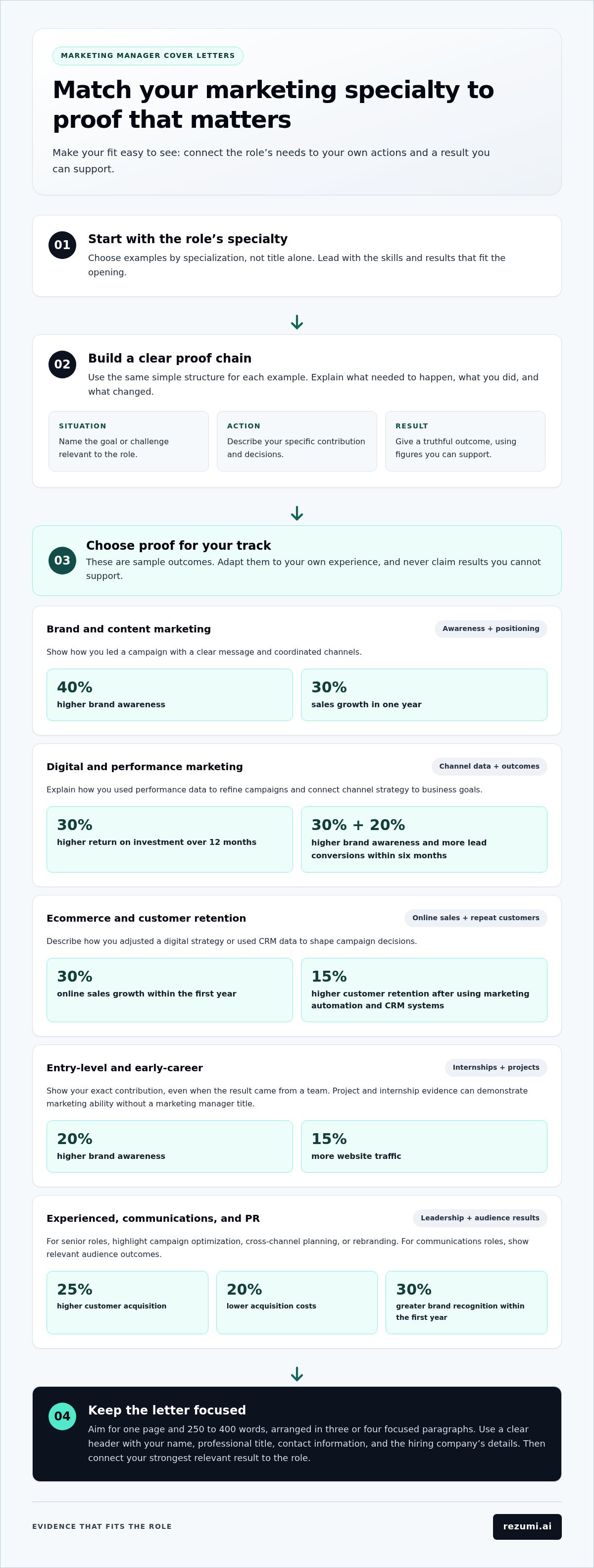
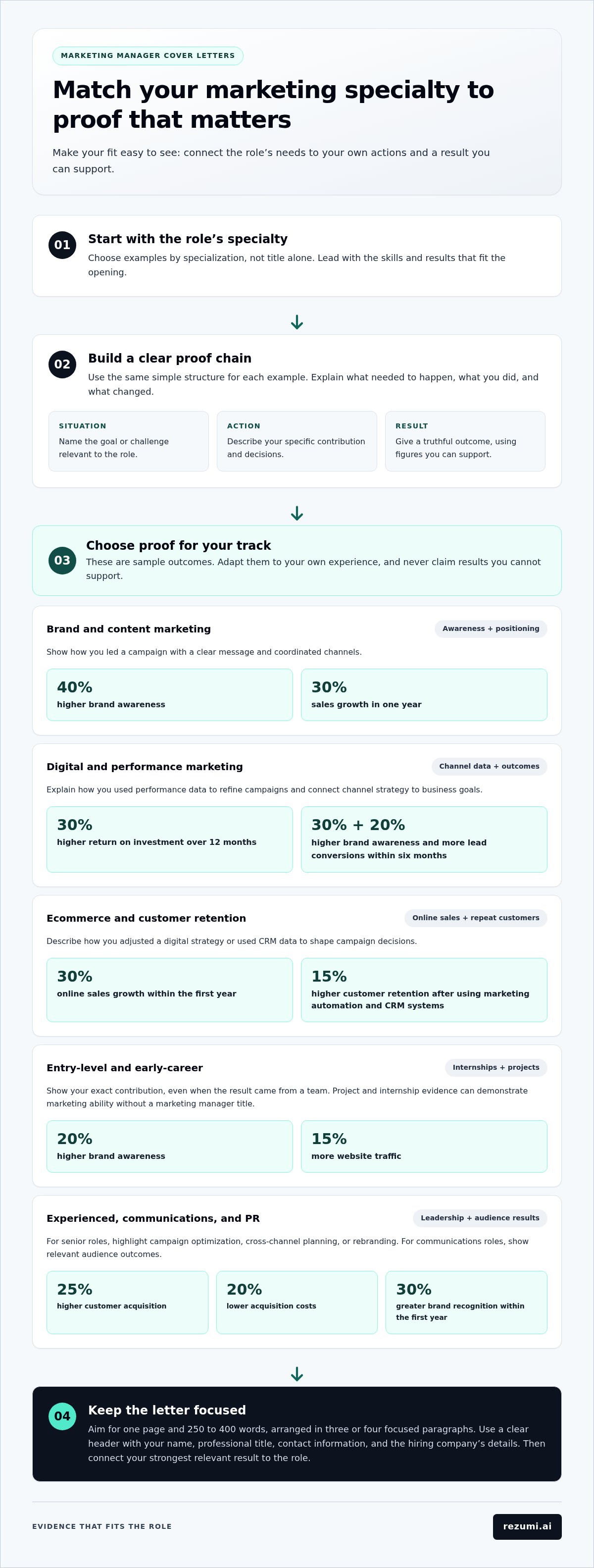
The best marketing manager cover letter format is a one-page letter of 250 to 400 words, arranged in three or four focused paragraphs. Use a clear header with your name, professional title, contact information, and the hiring company’s details, then connect your strongest result to the role.
Choose examples by specialization, not title alone. A brand manager should foreground awareness and positioning, while an ecommerce marketer might highlight online sales. A personalized cover letter for a marketing manager role makes the fit clear by naming relevant skills, describing your actions, and stating a truthful result.
Brand and content marketing
Situation: A brand marketing candidate needs to show measurable awareness work. Action: Describe leading a campaign that paired a clear message with coordinated channels. Result: One sample reports a 40% rise in brand awareness and 30% sales growth in one year. Adapt the example to your own figures, audience, and campaign. Don’t claim results you can’t support.
Digital and performance marketing
Situation: A digital marketing manager must connect channel strategy to business outcomes. Action: Explain how you used performance data to refine campaigns. Result: A sample reports a 30% increase in return on investment over a 12-month period. For a content-focused role, another sample describes 30% higher brand awareness and 20% more lead conversions within six months.
Ecommerce and customer retention
Situation: An ecommerce role prioritizes online revenue and repeat customers. Action: Show how you adjusted a digital strategy or used CRM data to improve campaign decisions. Result: One sample reports 30% sales growth online within the first year. Another describes a 15% increase in customer retention after using marketing automation and CRM systems.
Entry-level and early-career examples
Situation: You’re applying for a first marketing manager role with internship or project experience. Action: Name your contribution, such as optimizing a social campaign or improving click-through rates. Result: A sample internship campaign increased brand awareness by 20% and website traffic by 15%. Keep your role precise, even when the result came from a team.
Experienced, communications, and PR roles
Situation: A senior candidate needs evidence of broader leadership, while a communications applicant needs relevant audience outcomes. Action: Highlight campaign optimization, cross-channel planning, or rebranding. Result: Samples describe 25% higher customer acquisition and 20% lower acquisition costs. A rebranding example reports 30% greater brand recognition within the first year. Despite limited employment growth, about 23,000 openings for public relations specialists are projected annually, according to the U.S. Bureau of Labor Statistics.
Writing a marketing manager cover letter with no experience
Connect the role’s needs to evidence from your work, studies, or projects. Include a focused opening, relevant skills, an example of your contribution and its result, and a clear reason for applying. You don’t need a marketing manager title to demonstrate marketing ability.
Start with a current role or project, then explain how its tasks relate to marketing. A retail employee, for example, might describe organizing product displays, reviewing customer questions, and sharing patterns with a supervisor. This demonstrates customer awareness and communication without claiming campaign ownership.
Turn projects into proof
Situation: An entry-level candidate helped a student group build its social media audience. Action: They planned posts around event themes and reviewed engagement to adjust content. Result: A sample describes growing a social media follower base by 20% over three months. Use this structure with your real project, and state your exact contribution.
For a class project, name the audience, channel, and decision you made. You might explain how you compared email subject lines or chose content topics using survey responses. The outcome could be a completed campaign plan or clearer audience segments, rather than an increase in sales. Concrete outcomes make your qualifications easier to assess.
Show leadership and platform skills
Leadership can come from coordinating classmates, volunteers, or colleagues. Situation: A campus event needed more sign-ups. Action: You assigned content tasks, set review steps, and tracked responses. Result: State the verified outcome, such as delivering the campaign on schedule or reaching the event’s sign-up target.
If you’ve used Google Ads or Facebook Ads, describe the work you completed. You might have set up an audience, drafted ad copy, or reviewed campaign reports. Don’t suggest that you managed a budget or improved results unless you did. Identify unpaid work as coursework, volunteer work, or a personal campaign.
Changing careers or returning after an employment gap? Lead with relevant skills from your current or past work, then connect them to a marketing task. If you choose to explain a gap, keep it brief and focus on a recent project, course, or volunteer role that shows your readiness.
Keep the tone strategic and specific. Replace “I’m a strong candidate” with evidence: “I coordinated weekly posts for a neighborhood arts group and used engagement patterns to refine topics.” That example creates a sharper first impression by showing action and judgment. To shape your evidence into a role-specific draft, try a guided cover letter draft.
Alternative cover letter introductions
A strong opening names the role, connects your experience to the employer’s needs, and previews relevant expertise. Close by restating your interest, summarizing the value you’d bring, and inviting a conversation about the role.
Use the hiring manager’s name in your greeting if it appears in the job posting or company materials. If you can’t identify the recipient, write “Dear Marketing Hiring Team” rather than guessing. Then mention the exact job title, such as “Marketing Communications Manager,” so recruiters can quickly identify the opportunity.
Lead with a relevant result
Situation: A content marketing applicant has experience supporting a company blog. Action: They open with a clear example of matching articles to customer questions. Result: The hiring manager sees how the applicant’s work relates to the role. For example: “I’m applying for the Content Marketing Manager role after building editorial plans around customer questions and sales-team feedback.”
This opening works because it highlights a method rather than making a broad claim. Replace “I’m passionate about marketing” with a detail relevant to the employer. If the posting focuses on customer education, mention a guide, email series, or landing page you helped create. Keep the example accurate, then explain your contribution in the next paragraph.
Use a company-focused introduction
Situation: A candidate wants to join a company expanding its product education. Action: They connect their experience to that project. Result: Their motivation sounds specific, not copied. For example: “Your new customer resource center makes product education a clear priority. I’ve planned help content with support teams, and I’m eager to bring that experience to your marketing group.”
For a digital role, name the expertise that matches the posting. A candidate might write, “I’m applying for the Digital Marketing Manager position with experience in search campaigns, landing-page testing, and performance reporting.” For brand work, lead with positioning or audience research. A personalized cover letter for marketing manager roles should make the link between your experience and the employer’s needs easy to spot.
Choose an opening that reflects your strongest evidence: a relevant result, specialized skill, or company project. Avoid unsupported claims such as “I’m the ideal candidate.” Instead, preview evidence you can explain, like a campaign brief you wrote or a cross-team launch you coordinated.
Close directly and professionally. For example: “I’d welcome the opportunity to discuss how my campaign planning and audience research can support your team’s goals. Thank you for considering my application.” This reinforces your fit, shows your interest, and gives recruiters a clear next step without pressure.
Connecting application motivation to company projects
Link your reason for applying to a specific company project, product, or stated goal. Name what interests you, explain how your experience relates, and describe what you could contribute. If the employer is expanding customer education, for example, connect that work to your experience planning product guides or onboarding emails.
Use keywords from the job description when they accurately describe your experience. Match terms such as “campaign planning,” “brand positioning,” or “marketing analytics” to examples in your application. Don’t add skills you can’t support. Natural, accurate wording helps recruiters see how your background fits the position.
Research the project, then make the connection
Situation: A company announces a new product launch. Action: You connect the launch to a related campaign you supported, such as preparing sales materials or coordinating content. Result: Your motivation feels specific, and the employer can see how your experience could support the project.
Before writing, review the job description and the company’s public materials. Look for a named product, audience, campaign, or mission statement. Choose one point that genuinely connects to your career. Avoid broad praise: “I admire your innovative work” could fit almost any employer, while “Your new small-business product gives me a clear reason to apply” is more focused.
Show mission alignment with evidence
Situation: A nonprofit seeks a marketing manager to raise awareness of community programs. Action: A candidate describes writing event emails and coordinating messages with program staff. Result: The letter connects the organization’s mission to relevant work without claiming an outcome the candidate can’t verify.
Enthusiasm is most convincing when backed by evidence. Explain why the project matters to you, then show how your skills apply. For example: “I’m applying because your financial education program supports first-time buyers. In my current role, I write clear guides that help customers understand complex services.” The connection brings your motivation and experience together.
Keep the writing concise. Give each sentence a purpose: identify the company’s work, connect your experience, or state what you hope to contribute. Try this structure: “I’m applying for [position] because [specific project or goal]. My experience in [relevant skill] includes [brief example]. I’d bring that approach to [company need].” Replace each bracket with a truthful detail.
Check that your example matches the role’s level and focus. A product launch may suit product marketing, while audience research may fit brand strategy. Read your letter alongside the posting, then remove generic claims that don’t connect your experience to the employer’s work.
Tailoring a cover letter to a product marketing manager role
A product marketing cover letter should show how you connect customer needs, product value, and go-to-market plans. Go beyond listing campaign tasks: explain how you shaped positioning, supported a launch, or helped sales teams communicate a product’s benefits.
Start with the job description. Identify its main priorities, such as customer research, messaging, launch planning, or sales enablement. Then choose an achievement that shows how you can meet a similar need. Specific evidence makes your letter feel tailored rather than copied from a general marketing template.
Show how you turn customer insight into positioning
Situation: A product team struggled to explain why customers should choose its service. Action: You gathered customer feedback, reviewed support questions, and worked with product colleagues to clarify the strongest benefits. Result: The team used a clearer message across its landing page and sales materials. Describe your actual role and the change your work supported.
Product marketers often work across teams. Give a specific example of coordinating with product, sales, or customer support. For instance, explain how you turned a feature update into a customer-focused benefit, then prepared a product brief for sales. This shows how you can translate technical details into a compelling message.
Make launch achievements clear
Situation: A company prepared to introduce a new product. Action: The marketer aligned launch messages, channel plans, and sales materials with the product’s audience. Result: One sample cover letter reports that a product launch increased sales by 50% in the first quarter and exceeded initial projections by 20%. Treat those figures as an example, not a claim to borrow. Use your own verified results.
Without direct product marketing experience, connect related work to launch needs. A campaign coordinator might describe aligning email, web, and sales content around one offer. A market researcher could explain how interview findings shaped audience messaging. State what you did, who used the work, and what changed afterward.
Be precise about your evidence. “I supported a launch” gives little detail. “I coordinated product-page updates with sales and design, keeping the launch message consistent across customer touchpoints” explains your contribution. Include a result only if you can explain how it was measured.
Use a simple check: Does each example connect to a stated role need? Does it show your action and the outcome? Is your contribution distinct from the team’s? These questions make your letter more useful to a hiring manager and keep your achievements credible.
Rezumi: ATS Resume Optimization
Rezumi helps you align your resume and cover letter with the marketing manager role you’re targeting. Use ATS Resume Optimization to tailor your resume to the job description, then use the AI Cover Letter Generator to draft a focused letter around your relevant achievements and motivation.
This can help when applying to several roles with different priorities, such as product launches, customer research, or campaign strategy. Review every draft to ensure the details reflect your experience and the employer’s needs.
Visit Rezumi to prepare your next application.
Put your next application into action
Turn your strongest evidence into a focused application. Before sending it, compare your cover letter with the job description. Check that your examples fit the role, your results are accurate, and your reason for applying reflects the company’s work. A personalized cover letter for a marketing manager should sound like you, not like a template with the employer’s name changed.
Rezumi offers ATS Resume Optimization, an AI Cover Letter Generator, and AI Interview Prep to support different stages of your application. Use these tools to align your resume with a role, draft a focused cover letter, or prepare to discuss your experience in an interview. Review each draft and ensure the final details accurately reflect your work.
You have relevant experience to share. Shape it into a clear story, then take the next step with confidence.
Frequently Asked Questions
How do you personalize a cover letter for a marketing manager job posting?
Identify the posting’s main priorities, then connect each to evidence from your background. If the role emphasizes customer research, describe how you gathered feedback and used it to guide a campaign decision. If it calls for budget planning, explain your experience tracking spend or adjusting channel plans. Use the employer’s language when it accurately describes your work, and remove details that don’t support your fit.
How should you address a marketing manager cover letter when the hiring manager's name is unknown?
Use a clear team-based greeting, such as “Dear Marketing Hiring Team” or “Dear Brand Marketing Team.” If the posting names a department but not a person, address that department directly. Avoid guessing a name or using an overly casual greeting. Keep the salutation consistent with the letter’s professional tone, then use the opening sentence to identify the role and your most relevant area of experience.
How can you highlight marketing leadership and campaign results with metrics in a cover letter?
Pair a measurable outcome with your specific contribution and the campaign context. For example, explain that you coordinated a regional email campaign, tested audience segments, and tracked qualified inquiries. Clarify whether you led the work, supported a team, or managed one channel. Use a metric you can explain, such as conversion rate or cost per acquisition, and name the comparison period or baseline when available.
What marketing manager cover letter examples are available for different industries?
Choose examples based on the audience and business goal, not just the industry. A healthcare example might focus on patient education and clear service information. A software example could highlight product positioning and sales enablement. A retail example might show seasonal campaign coordination across email and stores. Tailor the responsibilities and outcomes to your experience, and don’t copy claims that aren’t true for you.
What are common marketing manager cover letter mistakes to avoid?
Avoid sending the same letter to every employer, repeating your resume without explaining your choices, or claiming results without describing your role. Generic praise also weakens your motivation statement. Before submitting, confirm the company name and job title, remove unsupported claims, and check that each example relates to the posting. Read the letter aloud to catch awkward phrasing and details that distract from your strongest evidence.
Disclaimer
This article is provided for general informational purposes only and does not constitute professional, legal, financial, or career advice. While Rezumi strives for accuracy, we make no warranties as to the completeness or reliability of this content. Hiring practices, ATS behavior, and job-market conditions vary by employer, industry, and region — always verify against your specific situation. Any action you take based on this article is at your own risk.