Product Manager Resume: The 2026 Guide to Beating the ATS
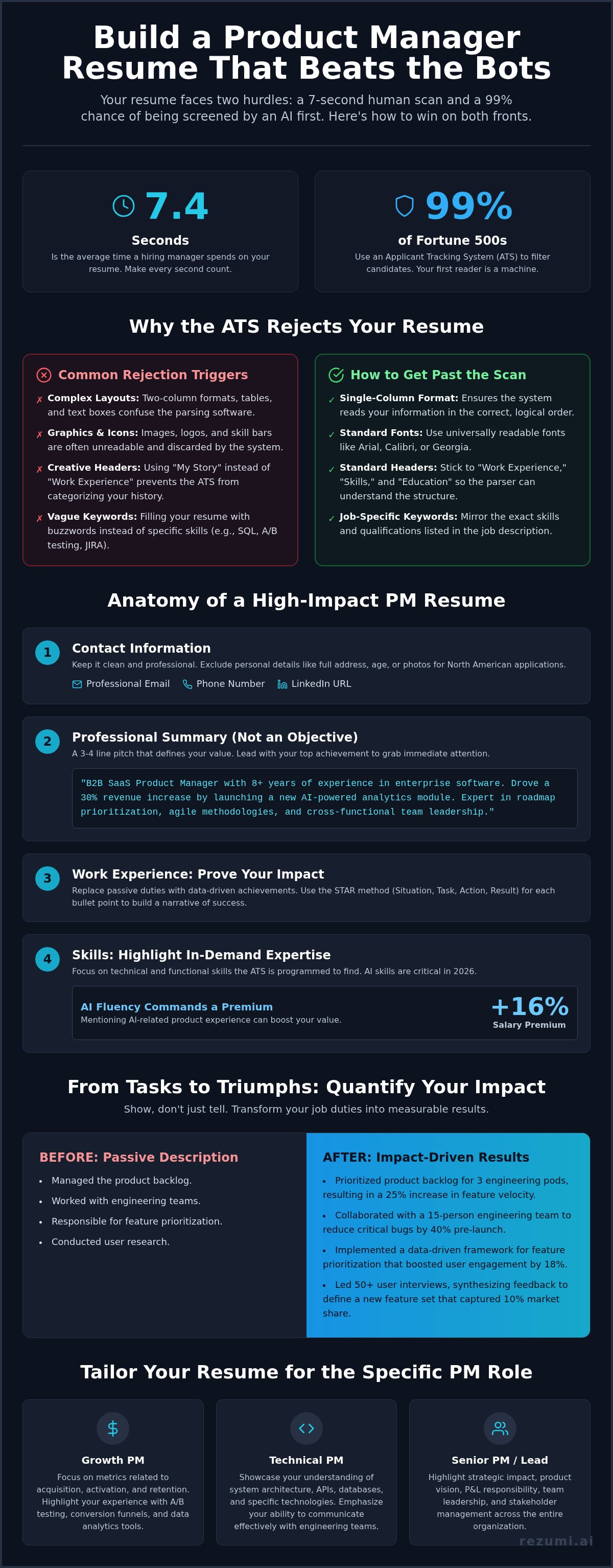
Hiring managers spend an average of just 7.4 seconds scanning a resume on the first pass. If your product manager resume cannot communicate your value in that brief window, it never reaches a human. In 2026, the challenge is even steeper. With 99% of Fortune 500 companies using systems like Workday or Greenhouse, your application often disappears into a digital black hole before a recruiter even sees your name.
It's frustrating to be a qualified candidate trapped behind an automated screen. You know how to lead a product lifecycle, but translating that impact into a machine-readable format feels like a guessing game. You deserve a strategy that treats your career with the same precision you apply to your products. This guide will show you how to build a resume that scores high on ATS checks and proves your impact with hard data.
We'll break down the exact framework for describing achievements, the AI skills that now command a 16% salary premium, and the formatting rules that keep your file from being rejected. You'll learn how to turn a list of tasks into a narrative of measurable success that secures more interviews at top-tier employers. It's time to stop guessing and start optimizing for the results you want.
Key Takeaways
- Strip away columns and graphics to ensure your resume survives the initial scan by systems like Greenhouse or Workday.
- Replace passive job descriptions with data-driven results by using the STAR method to prove your impact on the product.
- Build a product manager resume that highlights AI fluency and specific technical skills to meet the high demands of the 2026 market.
- Tailor your application by aligning your core competencies with the specific needs of Growth, Technical, or Senior PM roles.
- Use automated tools to get real-time feedback and ensure your formatting meets strict North American hiring standards in minutes.
Why your product manager resume gets rejected by the ATS
Your product manager resume is a technical document, not a piece of art. While you might be tempted to use a creative template to stand out, your first user is an algorithm, not a recruiter. An Applicant Tracking System (ATS) is a database used by 99% of Fortune 500 companies to filter and rank candidates. These systems scan your file, extract data, and determine if you meet the minimum requirements for the role. If the software cannot read your file, your application dies in a digital black hole.
Visual flair often creates technical friction. Fancy designs with multiple columns, icons, or progress bars for skills confuse the parsing engine. When an ATS encounters a two-column layout, it often reads horizontally across the page. This blends your job titles with your skills and dates, creating a garbled mess that no human will ever see. To win in 2026, you must prioritize data structure over aesthetic appeal.
There are three primary reasons a product manager resume fails the initial scan. First, the layout is too complex for the parser to handle. Second, it lacks the specific keyword density required to match the job description. Third, it fails to use standard section headers that the system recognizes. You must take control of your data by providing a clean, machine-readable file that mirrors the technical requirements of the position.
The hidden mechanics of modern recruitment
Modern scanners use AI to evaluate your experience against a set of predetermined criteria. The system looks for exact matches for tools, methodologies, and certifications. While the Product Manager Role involves high-level strategy and cross-functional leadership, the machine only cares about the data points it can verify. The software assigns a Resume Score based on these matches, and recruiters typically only review the top 10% of ranked candidates. ATS optimization is a necessity in 2026.
Common PM resume mistakes that trigger rejections
System rejection often stems from simple formatting errors. Using non-standard headers like "My Journey" instead of "Work Experience" prevents the system from categorizing your history correctly. You must also include the exact job title from the posting; if the role is for a "Growth Product Manager" and your resume only says "PM," you may lose points for accuracy. Avoid over-relying on vague buzzwords. Instead, focus on functional keywords like SQL, A/B testing, and roadmap prioritization that the system is programmed to find. Precision is your best strategy for securing an interview.
The anatomy of a high-impact product manager resume
A high-impact product manager resume is built on a clean architecture. It prioritizes information hierarchy so both machines and humans can find what they need quickly. You should structure your document with five essential sections: Contact Information, Professional Summary, Work Experience, Skills, and Education. This logical flow matches the scanning patterns of recruiters and the data requirements of an ATS.
Your contact information must be stripped of all distractions. In North America, you don't need to include your full home address, date of birth, or a headshot. Just list your name, a professional email address, your phone number, and a link to your LinkedIn profile. Keep this header simple and text-based. Icons and graphics in the header often fail to parse correctly, which can lead to missing contact details in the recruiter's database.
Ditch the "Objective" statement. Modern hiring managers don't care about what you want from the company; they care about what you can do for their product. Use a "Professional Summary" instead. This is a short pitch that defines your identity as a PM and highlights your specific value proposition. It's the first thing a human reads, so it must be sharp and data-heavy.
Crafting a summary that hooks recruiters
Your summary is your elevator pitch. Start with your current title and total years of experience. Mention your core product area, such as B2B SaaS, Fintech, or E-commerce. Follow this immediately with your most impressive achievement. If you grew revenue by 30% or reduced churn by 15%, put that number in the first two sentences. Keep the entire section under four lines to ensure it doesn't get skipped during a quick scan.
Formatting for clarity and system parsing
Systems like Workday struggle with complex layouts. Use a single-column format to ensure your data is read in the correct order. Stick to standard fonts like Arial, Calibri, or Georgia. These are clean and easy for both the ATS and human eyes to process. Consistency is vital for your professional image. Ensure your job titles, company names, and dates follow the exact same pattern throughout the entire document.
When you list your core competencies for a product manager, use a dedicated skills section. This helps the ATS find keywords quickly and allows recruiters to verify your technical stack at a glance. Focus on a mix of tools and methodologies:
- Technical Skills: SQL, Python, API testing, Jira, Mixpanel
- Product Skills: Roadmap strategy, A/B testing, Funnel optimization, User research
- Soft Skills: Stakeholder management, Cross-functional leadership, Crisis management
If you aren't sure if your current layout is machine-readable, you can check your resume score to see exactly how an ATS interprets your professional history. Taking five minutes to verify your formatting can be the difference between an interview invite and a silent rejection.
Quantifying your product impact with real numbers
Recruiters don't care about your daily tasks. They care about your results. A product manager resume that only lists "responsible for the roadmap" doesn't prove you can deliver value. You must shift from a list of duties to a record of achievements. Numbers are the primary language of PMs.
To stand out, you need to quantify your success using standard industry metrics. Mentioning Daily Active Users (DAU) or Monthly Active Users (MAU) proves you understand engagement. Highlighting a reduction in churn shows you can retain customers. Citing revenue growth or improvements in Net Promoter Score (NPS) provides concrete proof of your business impact. These data points transform your resume from a simple list into a high-performance profile.
Use the STAR method to structure your bullet points. This stands for Situation, Task, Action, and Result. It forces you to provide context and outcome for every project you mention. By following this framework, you ensure your experience is grounded in reality rather than vague claims. It makes it easy for a hiring manager to see exactly how you solved a problem and what the company gained from it.
The "Action-Impact" formula for bullet points
Start every bullet point with a high-impact action verb. Use words like "Architected," "Led," or "Optimized." These verbs suggest ownership and direction. Always connect your action to a specific business outcome to show the "why" behind your work. This creates a clear narrative of success.
- Weak: Responsible for managing the user feedback loop.
- Strong: Architected a new user feedback system that reduced feature request response time by 40%.
Selecting the right metrics for your role
Choose metrics that align with the specific job description you're targeting. If the role focuses on acquisition, highlight your growth funnel successes. If it's a platform role, focus on system uptime or API latency. You must tailor your data to match the needs of the hiring team. This shows you understand the specific goals of the position.
If your data is confidential, use percentages or ratios to show growth without revealing sensitive numbers. For example, you can say you "increased revenue by 25% YoY" instead of listing dollar amounts. You can also highlight "soft" impact. Improving team efficiency or streamlining stakeholder management are valuable wins. These achievements prove your leadership skills even when direct revenue numbers aren't available.
Tailoring your resume for different product management roles
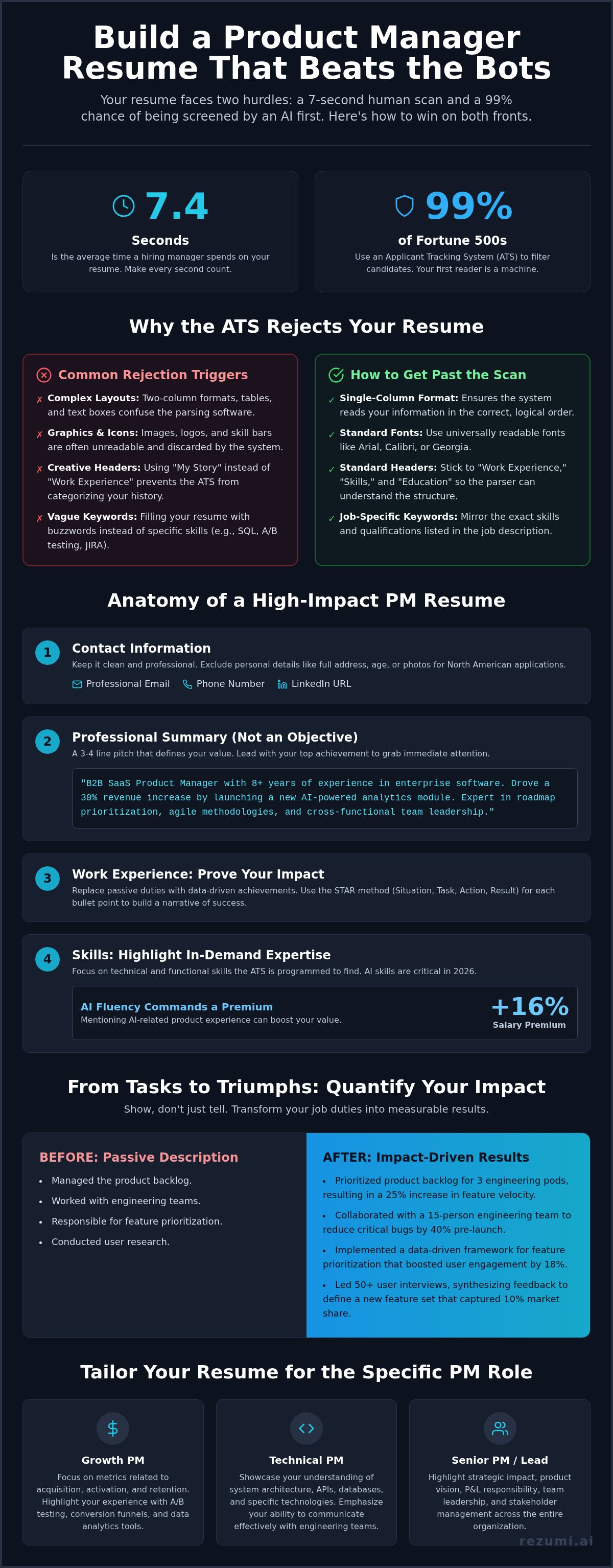
A generic product manager resume is a liability in 2026. Hiring managers no longer look for generalists who can "do it all." They want specialists who solve specific business problems. If you apply for a Growth role with a Technical PM resume, the ATS will likely filter you out before a human sees your name. You must treat every job description as a technical requirement document for your application.
Think of the job description as your cheat sheet. It tells you exactly which keywords the recruiter has programmed into the ATS. If the posting mentions "API contracts" three times, that phrase must appear in your work history. This isn't about lying. It's about translating your experience into the language the employer uses. Aligning your vocabulary with the JD is the fastest way to increase your resume score.
Your seniority also dictates your focus. Associate PMs should highlight execution, backlog grooming, and user research. Senior PMs and Directors need to showcase strategy, stakeholder influence, and mentorship. At the senior level, your impact should move from individual features to entire product lines or business units. Proving you can lead through others is just as important as your technical skill set.
The Technical Product Manager (TPM) focus
TPM roles require a deep understanding of system architecture and engineering workflows. Your resume should emphasize your ability to collaborate with developers on a technical level. List the specific technical stacks, languages, or cloud infrastructures you've worked with, such as AWS or Kubernetes. Show how you translate complex technical constraints into business value. Proving you can bridge the gap between "how it works" and "why it matters" is your biggest advantage.
The Growth and Data PM focus
Growth roles are all about the funnel. Your resume needs to scream data fluency and experimentation. Highlight your experience with A/B testing, user acquisition, and retention strategies. Focus heavily on the tools you use for analysis, such as Mixpanel, Amplitude, or Tableau. Every bullet point should prove your ability to move a specific needle in the user journey. If you increased conversion by 12% through a checkout redesign, make that the headline of your achievement.
Tailoring your application doesn't have to be a manual, hours-long process. You can automate the alignment between your experience and the job description to ensure you hit every requirement.
How to optimize your PM resume in minutes with Rezumi
Rezumi is more than a simple template builder. It is a strategic workspace designed to ensure your professional "product" reaches its intended user. In the competitive 2026 market, you cannot rely on luck or generic designs. You need a data-backed approach that aligns your product manager resume with the specific algorithms used by top-tier North American employers.
Our platform uses ATS Resume Optimization to scan your file against the same logic used by systems like Workday, Greenhouse, and Lever. It identifies missing technical keywords, formatting errors, and weak impact statements in seconds. You receive a real-time feedback loop with a clear Resume Score. This score tells you exactly how likely you are to pass the initial automated screen. Instead of wondering why you aren't getting callbacks, you get a direct roadmap for refinement.
Our Profile Editor allows you to manage multiple versions of your experience in one centralized workspace. You can quickly adjust your focus for different roles without losing track of your best achievements. To further accelerate your search, our AI Cover Letter Generator creates tailored letters for every application. It matches the requirements of the job description while maintaining a professional tone. This ensures your entire application package is optimized for speed and accuracy.
From resume score to interview prep
Passing the ATS is only the first step of the journey. Once your resume works and the invites start coming in, you must be ready for the conversation. Rezumi prepares you for this transition with our AI Interview Prep tool. You can practice PM-specific questions about system design, roadmap prioritization, and stakeholder conflict. The tool provides instant feedback on your delivery and content. This helps you command the room and prove your value once you get the invite. It turns the anxiety of a high-stakes interview into a structured, repeatable process.
Take control of your career today
The 2026 hiring landscape requires a more sophisticated approach than previous years. Built by global professionals for the North American market, Rezumi ensures your application follows the specific norms and standards of the region. Stop guessing what recruiters want and start measuring your resume's performance against real standards. Having a data-backed strategy replaces uncertainty with control. You have the skills to lead great products. Now, you have the technical partner to ensure the right people see them.
Launch your next career phase
A successful job search requires the same strategic thinking you apply to your product roadmaps. You've learned that a winning product manager resume prioritizes machine-readable data over visual flair. By stripping away complex columns and using the STAR method to quantify your wins, you transform your application into a high-performance tool. Every number you add and every keyword you tailor moves you one step closer to a human recruiter.
Don't leave your career to chance in a competitive market. You can get real-time ATS feedback to ensure your CV meets North American standards before you ever hit submit. Once the interviews start, use AI coaching to refine your delivery for PM-specific questions. Taking control of these technical hurdles allows you to focus on what matters: finding a role where you can make a real impact.
Your experience is valuable. It's time to make sure hiring managers see it clearly. Start building your data-backed strategy today and get the interview invites you deserve.
Frequently Asked Questions
How long should a product manager resume be in 2026?
Keep your resume to one page if you have less than 10 years of experience. Senior professionals with a long history of measurable impact can move to two pages. The goal is density and relevance. Recruiters spend only seconds on the first pass, so every line must earn its space. If a project doesn't prove your specific value, you should cut it.
Do I need a separate resume for every product manager job application?
You must tailor your application for every role to match the specific keywords in the job description. Generic resumes have a high rejection rate because they fail to meet the required score for specific roles. Use the job posting as a requirements document. Aligning your vocabulary with the employer's needs ensures the ATS ranks you as a top candidate.
What are the most important skills for a PM resume right now?
Focus on AI fluency, SQL, and A/B testing as these are high-demand technical skills in 2026. Beyond technical tools, you must emphasize product strategy and stakeholder management. As of February 2026, PMs with AI specialization command a 16% salary premium. Listing these specific competencies directly on your product manager resume helps you stand out in automated filters.
Can I use a PDF for my product manager resume?
Yes, a PDF is the standard format for North American applications. It preserves your layout and ensures the recruiter sees exactly what you intended. You must use a single-column, text-based structure to avoid errors. Modern platforms like Greenhouse and Workday parse high-quality PDFs easily, but they often struggle with complex graphics or images.
How do I list PM certifications like CSPO or PMP on my resume?
List your certifications in a dedicated section or include the most relevant ones in your professional summary. If you have a PMP or CSPO, include the full name and the acronym to cover all keyword bases. This ensures the system recognizes your credentials regardless of how the recruiter programmed the search parameters. It adds immediate technical credibility to your profile.
Should I include a link to my product portfolio or LinkedIn profile?
Include a link to your LinkedIn profile and a portfolio if you have one. These links provide social proof and deeper context that a one-page document cannot hold. In the North American market, a polished LinkedIn profile is expected. Ensure the URL is clean and clickable so recruiters can transition from your resume to your full professional presence easily.
What happens if my resume score is low on an ATS checker?
A low score usually indicates a mismatch between your skills and the job description or a formatting error. You should review your file for complex elements like tables or columns that break the parser. Then, re-examine the job posting for functional keywords you might have missed. Adjusting these details will help your product manager resume climb the rankings and secure an interview.
Is it okay to use AI to write my product manager resume?
It is smart to use AI as a strategic partner to draft and optimize your content. AI tools help you identify keyword gaps and suggest stronger action verbs. However, you must review every bullet point to ensure it accurately reflects your real-world achievements. Use technology to handle the technical formatting while you provide the authentic narrative of your career success.
Disclaimer
This article is provided for general informational purposes only and does not constitute professional, legal, financial, or career advice. While Rezumi strives for accuracy, we make no warranties as to the completeness or reliability of this content. Hiring practices, ATS behavior, and job-market conditions vary by employer, industry, and region — always verify against your specific situation. Any action you take based on this article is at your own risk.