Reset Your Job Search After 100 Applications
One hundred applications without enough interviews isn’t a signal to apply faster. It’s a reason to find where your job-search funnel is losing momentum. If you’re wondering what to do after submitting 100 applications, review the patterns before sending another batch of the same materials.
It’s frustrating to put in the time and hear little or nothing back. Without a clear way to compare applications, it’s hard to tell whether the issue is your target roles, resume fit, or application process. That doesn’t mean you need to start over. It means you need a more focused way to find and fix weak spots.
This guide will help you review where applications are falling short, improve how you match your resume and cover letter to each role, and build a repeatable plan for your next applications. You’ll learn what to track, how to choose roles that fit your experience, and how to tailor materials without losing control of the process. Treat your application history as useful feedback, then use it to make your next steps more focused.
Key Takeaways
- Use your application history to spot where your search may be losing momentum, from role targeting to interview conversion.
- To decide what to do after submitting 100 applications, review response patterns before sending another batch.
- Compare broad applications with tailored submissions to see which approach gives you clearer feedback and stronger role fit.
- Reset your process by refining target roles, updating your materials, and tracking what happens next.
- Connect job details, tailored resumes and cover letters, and application outcomes in one repeatable workflow.
What 100 Job Applications Can Tell You About Your Search
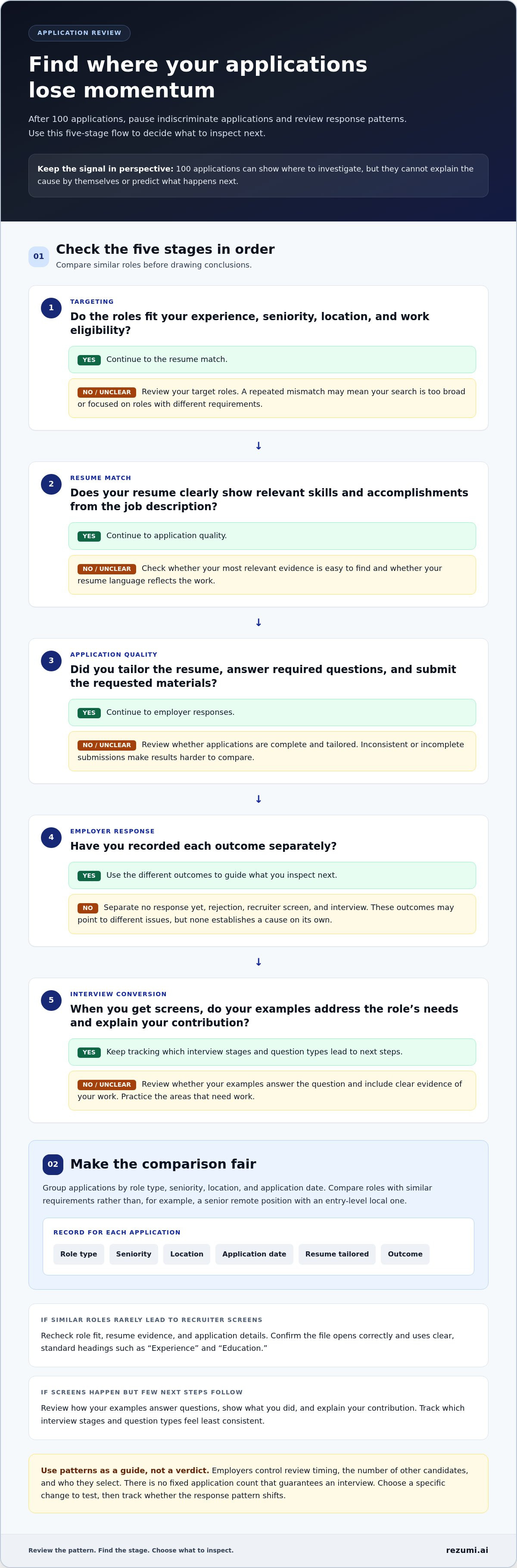
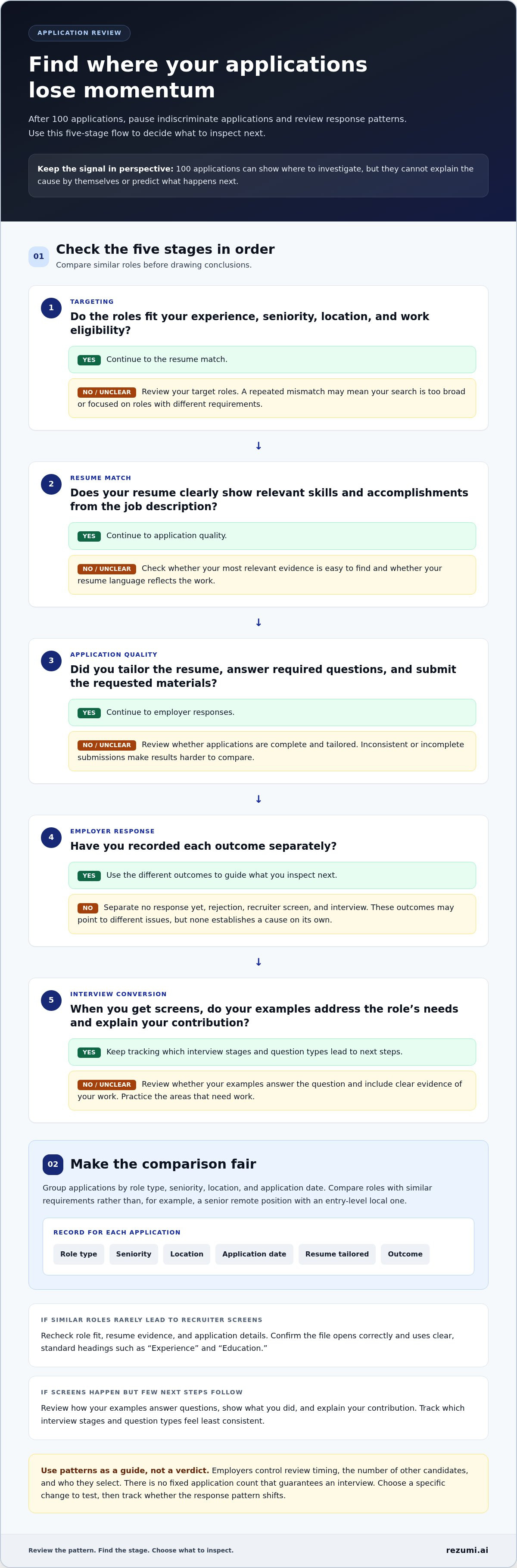
Pause indiscriminate applications and inspect your response patterns before sending more. A total of 100 applications can show where to investigate, but it can’t tell you by itself why you’re not getting interviews or predict what will happen next. The roles may differ, employers may still be reviewing candidates, and hiring decisions depend on factors you can’t control.
Think of each application as moving through a funnel: you submit it, the employer responds or stays silent, you may receive a recruiter screen, and you may then be invited to an interview. The broader job seeking process includes steps from finding openings to interviewing, so a useful review looks beyond the number of applications you sent.
You can influence which roles you target, how clearly your resume matches their requirements, and whether your application is complete and tailored. You can’t control how quickly an employer reviews applications, how many other candidates apply, or who the employer selects. Keep those outside factors in mind. Your records can guide your next steps, but they aren’t a verdict on your ability.
How to read your application outcomes
Group applications by role type, seniority, location, and application date. Record each outcome separately: no response yet, rejection, recruiter screen, or interview. This makes it easier to spot patterns instead of treating every application as the same result.
For example, recruiter screens for one role type but silence for another may be a reason to review how closely your experience fits each target. It doesn’t prove that targeting is the cause. Use the pattern to decide what to inspect next, not to judge your worth or skills.
When to stop and review your approach
If similar roles keep producing the same weak response, pause that application pattern and review your target roles and materials. Keep applying selectively to suitable roles while you examine your resume, requirements match, and application details.
There’s no fixed application count that guarantees an interview. If you’re deciding what to do after submitting 100 applications, use the outcomes to choose a specific change to test, then track whether the response pattern shifts.
Diagnose Where Your Job Applications Lose Momentum
Find the stage where applications stop progressing, then investigate that part of your process. Compare similar roles before drawing conclusions: one rejection or unanswered application can reflect timing or employer decisions, not a flaw in your approach. Look for repeated patterns across roles with similar requirements, levels, and locations.
Review these five points in order:
- 1. Targeting: Do the roles match your experience, seniority, location, and work eligibility? A repeated mismatch may mean your search is too broad or focused on roles with different requirements.
- 2. Resume match: Does your resume clearly show relevant skills and accomplishments from the job description? If similar roles produce few screens, check whether the most relevant evidence is easy to find.
- 3. Application quality: Did you tailor the resume, answer every required question, and submit the requested materials? Inconsistent or incomplete applications make results harder to compare.
- 4. Employer response: Separate rejections from silence and applications still in progress. These outcomes may point to different issues, but they don’t establish a cause on their own.
- 5. Interview conversion: If you get screens but few next steps, review how clearly your examples address the role’s needs and explain your contribution.
Keep a simple record so you can compare similar applications. For example, review applications to roles with similar requirements and locations rather than comparing a senior remote position with an entry-level local one.
| Role | Source | Tailored resume | Date | Outcome |
|---|---|---|---|---|
| Marketing coordinator | Company site | Yes | May 6 | Recruiter screen |
| Marketing coordinator | Job board | No | May 9 | No response yet |
If applications rarely lead to recruiter screens
Check whether each role fits your experience, level, location, and work eligibility. Then compare its requirements with your resume. Are relevant skills and accomplishments stated clearly, using language that reflects the work? Also confirm that your file opens correctly and uses clear, standard headings such as “Experience” and “Education.” If several similar applications stall, these checks give you specific areas to review, not a guaranteed explanation.
If interviews happen but offers don’t follow
Track which interview stages and question types feel least consistent. Review whether your examples answer the question, explain what you did, and include clear evidence of your work. Focus practice on the areas that need work, using strategic interview tips to prepare relevant examples rather than memorizing scripts.
If you’re deciding what to do after submitting 100 applications, use the pattern to choose one change to test at a time. A centralized workspace can help you connect job details, application materials, and outcomes. Explore application tracking and resume tools to support that review.
More Applications or Better-Tailored Applications: What Should You Change?
If broad applications haven’t led to enough progress, shift some of your effort from volume to fit. A targeted application starts with a role that matches your experience, then makes your strongest relevant evidence easy to find. It won’t guarantee an interview, but it gives you a clearer process and better information about what’s working.
| Factor | Broad applications | Targeted applications |
|---|---|---|
| Relevance | Roles may vary widely in duties, level, or requirements. | You focus on roles tied to your experience and strengths. |
| Tailoring effort | You may send the same resume with few changes. | You adjust relevant sections to show fit for each role. |
| Tracking quality | Different roles and materials can be hard to compare. | You can record what changed and connect it to each outcome. |
| Learning from outcomes | A weak response can be difficult to explain. | Similar applications make patterns easier to review, though they don’t prove a cause. |
Tailoring doesn’t mean copying every phrase in a job description. Choose accurate terms that reflect your real experience, then pair them with evidence. If a role asks for stakeholder reporting, for example, show where you prepared reports for internal teams or clients, if that matches your background.
What targeted applications should change
Start with roles where you can support the main responsibilities with relevant skills and results. Move that evidence into easy-to-scan resume sections, such as your summary, skills, and recent experience. Use job-description language only when it accurately describes your work. A close match is useful, but a claim you can’t support may create problems later.
How to tailor without rewriting everything
Keep a reliable master resume with your full work history, skills, and accomplishments. For each role, adjust the summary, skills, and experience details that best fit the requirements. Add a focused cover letter when it provides context or connects your background to the role. Rezumi’s resume optimization tools help you align your resume with specific job descriptions.
To decide what to do after submitting 100 applications, test this approach with a focused group of similar roles. Track which resume version you used and what response followed. Keep applying selectively as you review the results. The goal isn’t to assume tailoring will secure interviews. It’s to make each application more relevant and each outcome more useful for your next decision.
A Practical Job Search Reset After 100 Applications
Turn your application history into a focused process: review outcomes, narrow your target roles, update your materials, then test and track the changes. You don’t need to stop your search entirely. Keep applying to suitable openings while you improve the parts of your approach you can control.
Start with a manageable group of closely related roles, such as positions with similar responsibilities and experience levels. A tighter focus makes it easier to tailor your resume and compare outcomes. Once you have a clear process for that group, decide whether to expand your search.
- Review: Sort past applications by role type and note where each one stopped progressing.
- Refine: Choose roles that match your skills, experience level, and location needs.
- Update: Adjust your resume and, when useful, your cover letter to show relevant evidence.
- Test and track: Record each submission, the materials you used, and any response.
Set up a focused application workflow
Write a short list of role criteria before searching, such as the skills you want to use, the level that fits your experience, and your preferred location. Use a tracker to capture the employer, role, source, application date, follow-up date, outcome, and resume version. Review your resume layout for clear headings and readable sections. For each application, save the job description and the exact files you submitted.
Keep the process simple enough to maintain. A centralized workspace can help connect job details, tailored documents, and outcomes in one place.
Prepare for replies while applications are active
Don’t wait for an interview request to revisit your materials. For each role, note a few concise examples that show how your experience connects to its key requirements. This gives you a useful starting point for recruiter screens or interviews, while the saved job description helps you recall what the employer asked for.
After an interview, record the stage, questions that challenged you, and any next steps discussed. If you send a follow-up message, note when you sent it and keep the tone brief and professional. Use those notes to prepare for future conversations, rather than assuming every employer follows the same timeline.
Review your tracker regularly, but change one part of your process at a time. If you change your target roles and resume approach together, it may be harder to tell which adjustment affected the response. When considering what to do after submitting 100 applications, use your next applications to learn, not to chase a guaranteed result.
Use a Repeatable Resume and Application Workflow for Your Next Applications
Connect each job description to the resume and cover letter you submit, then record what happens next. A consistent workflow makes it easier to tailor materials, prepare for conversations, and review outcomes without relying on memory. It also helps you see which version you sent for each role.
Rezumi brings job-specific resume optimization, AI-assisted cover letter creation, interview preparation, and application tracking together in a centralized workspace. AI can help you review and organize your materials, but you remain responsible for checking every detail. Confirm that skills, dates, accomplishments, and examples are accurate before you submit.
Where an AI-supported workflow can save effort
Start with a suitable job description. Review resume feedback to see how clearly your experience aligns with the role, then make sure your strongest relevant accomplishments are easy to find. Use a cover letter draft when you need to explain a career change, connect experience from another field, or add context your resume doesn’t show.
Before sending, edit the draft so it sounds like you and includes only true, specific details. Save the job description, final documents, application date, and outcome together. Over time, those records can help you compare similar applications and decide what to adjust.
Choose your next step with a clear process
Pick one role that fits your experience. Tailor your resume around evidence that supports its core responsibilities, then save the version you submit. If the application progresses to a recruiter conversation or interview, use Rezumi’s interview preparation tools to organize relevant examples and practice explaining your work clearly.
This process won’t guarantee an interview. It gives you a clearer way to prepare, submit, and learn from each application. If you’re deciding what to do after submitting 100 applications, begin with a focused workflow and use the next outcomes to guide your next adjustment.
Make Your Next Applications More Focused
After 100 applications, the best next step isn’t automatically sending more. Review where your applications lose momentum, focus on roles that match your experience, and tailor your materials to show relevant evidence. Track each submission and change one part of your process at a time so you can learn from the outcomes.
If you’re deciding what to do after submitting 100 applications, treat your next applications as a focused test, not a guarantee of interviews. Rezumi brings AI-powered resume optimization for specific job descriptions together with tools for cover letters, interview preparation, and application management. You stay in control of the details and can keep your job search organized in one workflow.
A quiet stretch in your search can be discouraging, but it doesn’t define your ability. Use what you’ve learned to make your next step clearer, more relevant, and easier to manage.
Frequently Asked Questions
What should I do after submitting 100 job applications with no response?
Pause repeated applications and review where your search may be losing momentum. Group applications by role type, level, location, and date, then separate silence, rejections, recruiter screens, and interviews. Check whether your target roles fit your experience and whether your resume clearly shows relevant skills. Use the pattern to choose one change to test, such as narrowing your targets or tailoring your resume more closely.
Is it normal to apply for 100 jobs and not get an interview?
It can happen, especially when applications are broad or use the same materials, but don’t ignore the pattern. Hiring timelines, competition, and employer decisions are outside your control. Review whether you’re applying to roles that match your background and whether your application makes that fit clear. Treat the result as a reason to investigate your process, not as a measure of your ability.
How many job applications should I submit per week?
Choose a weekly pace you can sustain while still researching roles, tailoring your materials, and tracking outcomes. There isn’t a set number that guarantees interviews. Plan time to review each job description, adjust your resume where relevant, and save the version you submit. If the pace leaves no room for those steps, reduce the volume and focus on roles that fit your experience.
Can tailoring my resume improve my chances of getting an interview?
Tailoring can make your relevant experience easier for an employer to find. Match the resume’s emphasis to the role by bringing forward related skills and accomplishments, and use job-description terms only when they accurately describe your work. For example, if a role asks for project coordination, highlight a real project you organized and what you contributed. Tailoring can strengthen relevance, but it can’t guarantee an interview.
Should I follow up after submitting a job application?
Follow the employer’s instructions first. If the posting gives a contact or explains when to expect an update, use that guidance. Otherwise, a brief, polite follow-up may be appropriate when you have a direct contact and enough time has passed for the application to be reviewed. Avoid repeated messages. Note the application date and any follow-up so you can stay organized.
How do I know if my resume is the reason I am not getting interviews?
You can’t know from one application alone, but repeated outcomes can point to areas worth checking. Compare similar roles and see whether your applications lead to recruiter screens. Review role fit, relevant skills and accomplishments, file readability, and clear section headings. If you’re getting interviews, your resume is already helping you reach that stage, so focus your review on interview examples and communication as well.
Should I use AI to apply for more jobs?
Use AI to support the work, not to send applications without review. It can help tailor resume content to a job description, draft a cover letter, organize applications, or prepare interview examples. Check every suggested detail for accuracy and make sure the materials reflect your real experience. Applying faster isn’t useful if the roles are a poor fit or the submitted documents contain errors.
Disclaimer
This article is provided for general informational purposes only and does not constitute professional, legal, financial, or career advice. While Rezumi strives for accuracy, we make no warranties as to the completeness or reliability of this content. Hiring practices, ATS behavior, and job-market conditions vary by employer, industry, and region — always verify against your specific situation. Any action you take based on this article is at your own risk.