Resume for Over-50 Job Seekers: A Practical Guide for 2026
Your resume doesn't need to prove how long you've worked. It needs to show why your experience matters for the role you want now. A resume for over 50 job seekers can make that value clear without listing every job or drawing attention to details that don't help your application.
If you've built a long career, deciding what to keep can feel harder than writing the resume itself. You may wonder whether your format looks dated or how to describe past achievements in terms that fit a new field. You don't need to hide your experience. You need to focus it.
This guide shows you how to highlight recent, relevant results, decide which earlier roles deserve space, and tailor your resume to a specific job without starting over each time. You'll also learn how to use clear language and a simple format that recruiters and applicant tracking systems (ATS) can read. The goal is a resume that reflects your experience and makes your fit for the role easy to see.
Key Takeaways
- Start with the role you want, then make the skills and results most relevant to it easy to spot.
- Choose career examples based on their fit with the job, not just their place in your work history.
- A resume for over 50 job seekers can show career depth without including every role or detail.
- Tailor your resume by matching job requirements to your evidence, then review the wording and format. ATS software helps process applications, but employers make hiring decisions.
- Use Rezumi to adapt your resume to a job description and keep related application tasks organized.
Resume for Over-50 Job Seekers: Start With the Role You Want
Begin with the job you want, not the full timeline of your career. A resume for over 50 job seekers should give an employer relevant proof of fit: skills you can use in the role, results you’ve achieved, and recent evidence that supports your application. Your goal isn’t to document every career detail. It’s to make the right details easy to find.
A modern resume is a targeted summary of the value you can bring to a specific role. That focus helps employers connect your background to the work ahead. Use clear section labels and a readable structure. For a general overview, see the purpose and structure of a resume.
Editing with the role in mind doesn’t mean hiding your age or changing your work history. Keep your titles, dates, and achievements accurate. Instead, decide which details deserve the most space and which older or less relevant details can be shortened. You’re focusing your story, not misrepresenting it.
What should an over-50 resume help an employer understand?
Your resume should quickly connect the employer’s needs to skills and outcomes you can show. A clear opening summary sets that direction. Name your professional focus, then highlight strengths that matter for the target role. Don’t use the opening to list every field or position you’ve held.
For example, “Experienced professional with a long career across several industries” gives little detail about fit. For an operations manager role, “Operations manager with experience improving team workflows and coordinating cross-functional projects” points to a clearer match. Use specific language like this only when it reflects work you’ve actually done.
How to set a resume goal before editing
Choose one target role, or a closely related group of roles, before revising. Then use the job description as your guide. Look for the skills, responsibilities, and outcomes the employer names. These details help you decide what to bring forward, what to reword accurately, and what takes up space without supporting the application.
- Set your target. Write down the job title or related roles your resume will support.
- Mark the employer’s needs. Note repeated skills, key responsibilities, and stated qualifications.
- Gather proof. Find examples from your work history that show you used those skills or delivered related results.
- Test each detail. Ask, “Does this support my fit for this application?” Keep, shorten, or remove it based on the answer.
This test keeps editing practical. You’re not trying to make your career look smaller. You’re making the connection between your experience and the role easier to see.
How to Choose the Right Experience for a Resume After 50
Choose career evidence by how well it supports your target role, not by how recent or senior the job title sounds. A focused resume for over 50 job seekers can draw on experience from different stages of a career, as long as each detail helps show a skill or result the employer needs. Relevant evidence matters more than the number of career entries.
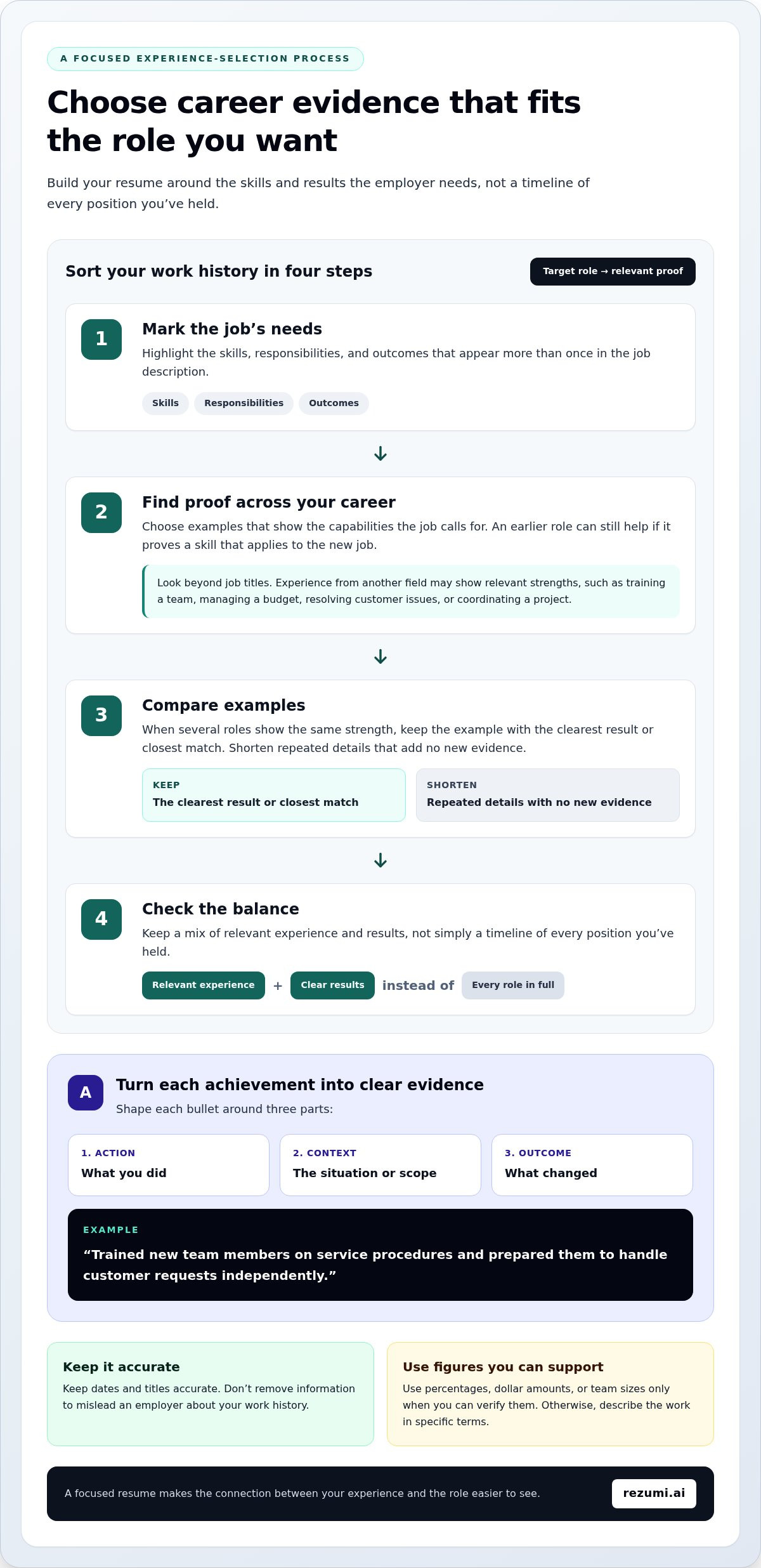
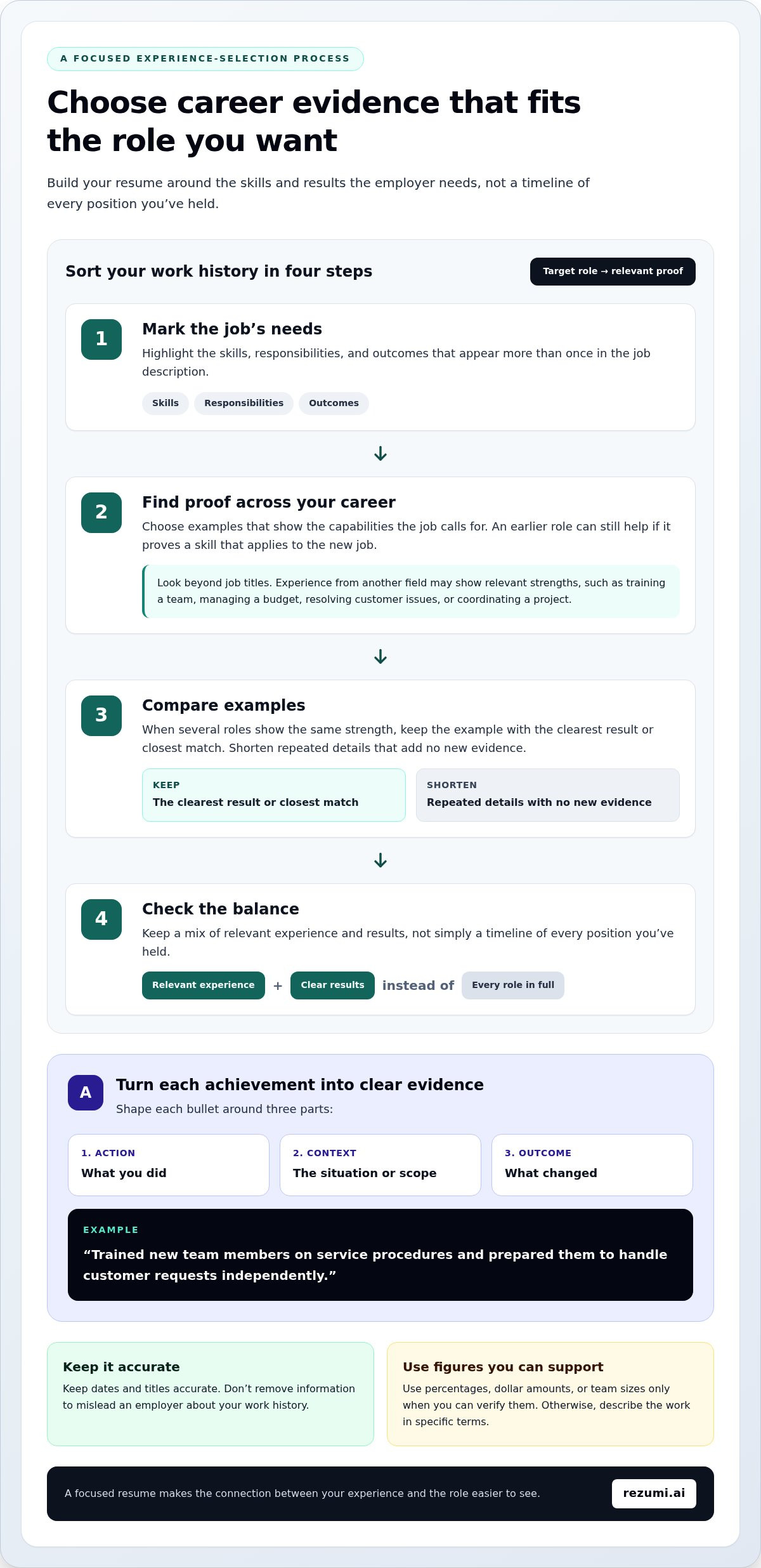
Use this process to sort a long work history without losing useful strengths:
- Mark the job’s needs. Highlight skills, responsibilities, and outcomes that appear more than once in the description.
- Find proof across your career. Choose examples that show those capabilities. An earlier role can be useful if it proves a skill that applies to the new job.
- Compare examples. If several roles show the same strength, keep the example with the clearest result or closest match. Shorten repeated details that add no new evidence.
- Check the balance. Keep a mix of relevant experience and results, not simply a timeline of every position you’ve held.
How to shortlist relevant roles and achievements
Look beyond job titles. A role from another field may show skills the target employer needs, such as training a team, managing a budget, resolving customer issues, or coordinating a project. Include it when you can explain that connection clearly. You can reduce space for repeated duties or positions that don’t add a distinct skill, result, or qualification. Keep dates and titles accurate, and don’t remove information to mislead an employer about your work history.
How to write achievements with clear evidence
Shape each bullet around three parts: action, context, and outcome. Start with what you did, add the situation or scope, then state what changed. For example, replace “Responsible for staff training” with “Trained new team members on service procedures and prepared them to handle customer requests independently.” This adds context and an outcome without claiming an unsupported number.
Use figures only when you can support them with your records. If you can’t verify a percentage, dollar amount, or team size, describe the work in specific terms instead. Name the process you improved, the type of project you coordinated, or the group you supported. “Helped with office operations” is hard to assess. “Coordinated schedules and tracked supply requests for a multi-site office team” gives a clearer picture of your contribution, if accurate.
Present your work truthfully. For information about U.S. age discrimination laws and protections, consult the EEOC. Rezumi can help you compare your experience with a job description and tailor resume content. Explore resume tailoring options as part of that process.
Does a Resume for Over-50 Job Seekers Need to Hide Experience?
No. A strong resume doesn’t erase a long career. It presents your work accurately, then gives the most relevant evidence the space and detail it needs. The goal is to help an employer assess your fit, not disguise how long you’ve worked.
A resume can’t prevent bias or control how someone interprets your background. You can control whether the document is focused, current, and easy to review. For a resume for over 50 job seekers, that means keeping useful depth while trimming details that don’t support the role.
How to present a long career without overwhelming the reader
Give your more recent, relevant roles enough detail to show the skills and results you can bring to the job now. If earlier work also supports your fit, keep it, but consider a shorter description. You don’t need to give every position the same amount of space.
For example, if you’re applying for a project coordinator role, a recent position coordinating deadlines and teams may deserve detailed achievement bullets. Earlier roles that show related planning experience can be grouped or summarized, as long as the presentation stays clear and accurate. Keep the focus on your evidence, not an explanation of every career move.
Before removing a detail, check whether it adds a distinct qualification, result, or useful context. If it repeats information already shown elsewhere, shorten it. If it helps explain a relevant skill, keep enough detail for the connection to make sense.
How to respond to concerns about age signals
Don’t try to make your history appear shorter by changing dates, leaving unexplained gaps, or altering job titles. Inaccurate details can create questions and undermine trust. Keep the dates and facts consistent across your resume, application, and professional profile.
Instead, show how your experience connects to the work today. Include current skills, tools, and accomplishments when they’re relevant and accurate. If a job asks for experience with a particular system, name it if you’ve used it. If you haven’t, don’t imply that you have. Focus on related abilities you can demonstrate.
- Leave out personal details that don’t show professional fit, such as your age or date of birth.
- Use a current email address and contact information you check regularly.
- Review dates, titles, and descriptions for consistency across application materials.
- Keep older experience when it proves relevant value, but reduce detail that distracts from your strongest evidence.
Thoughtful editing isn’t concealment. It makes your qualifications easier to understand while keeping your history truthful. Let the role guide what you emphasize, and let your work speak through clear, relevant proof.
Tailoring an Over-50 Resume for North American Jobs
Tailor your resume through a repeatable process: identify what the employer needs, match those needs to your evidence, revise the relevant sections, then review the full document. This keeps your experience focused on the role and helps you prepare a clear application. A resume for over 50 job seekers should be specific, accurate, and easy for both people and software to read.
Applicant tracking systems (ATS) help employers collect and process applications. They may organize or screen information, but they don’t make every hiring decision. No format or wording can guarantee that a resume will pass an ATS or lead to an interview. Use standard section headings and straightforward formatting so your qualifications are clear to readers and easier for software to parse.
How to map job requirements to career evidence
Read the job description and separate required qualifications from preferred skills. Then connect each relevant requirement to a truthful example from your work history. For instance, if a customer success role asks for client relationship management and training, identify a role where you supported clients and helped them learn a product or process.
Use the employer’s terms when they accurately describe your experience. If the posting says “client onboarding” and you’ve guided new customers through setup, that phrase may describe your work more clearly than a broad label like “customer support.” Don’t copy terms that don’t fit. Make the match clear without overstating your background.
A simple evidence map can keep revisions grounded:
- Requirement: What skill or qualification does the posting name?
- Evidence: Which project, task, or result shows you have it?
- Resume update: Where should that proof appear, in your summary, skills, or experience?
How to review the tailored resume before applying
After revising, check that your opening summary, skills, and work examples point to the same target role. If your summary presents you as a project manager but your experience bullets focus on unrelated tasks, the application may feel unfocused. Adjust the emphasis, not the facts.
Review the document for standard section labels, readable text, and consistent dates. Keep the layout simple, and check that key details are written as text rather than placed in graphics. If resume feedback points to gaps between your content and the job description, treat suggestions as prompts. Verify each edit, keep only what’s true, and make sure the final document still sounds like you.
Rezumi uses a job description as context for resume tailoring, helping you work through this review in a repeatable way.
Use Rezumi to Build a Focused Resume and Application Workflow
A clear process can turn your career history into a focused application: choose a target role, select evidence that fits, tailor your resume, and review every detail before you apply. Rezumi is an AI-powered platform that supports this workflow with resume tailoring, document design, and related job-search tools. You stay in control of the final content.
Use the same steps for each application:
- Set the target. Choose a role and review the employer’s job description.
- Select your evidence. Identify relevant skills, projects, and results from your work history.
- Tailor the resume. Bring the strongest matching proof forward and adjust wording only when it accurately describes your work.
- Review and prepare. Check the full document for accuracy, consistency, and readability, then export it as a PDF when that format suits the application.
How Rezumi supports role-specific resume editing
Rezumi uses the job description as context for resume tailoring, helping you compare a role’s needs with your experience. Its resume feedback can prompt you to review alignment or clarify a point, but it can’t guarantee an interview or hiring result. Treat each suggestion as a draft. Confirm that the wording reflects your actual skills, responsibilities, and results before keeping it.
For example, if you’re applying for a training role, a suggestion to highlight coaching experience may be useful if you’ve trained colleagues or supported onboarding. If you haven’t done that work, don’t add the claim just because it appears relevant. Your resume needs to be targeted and truthful.
Once the content is ready, resume design and PDF export help you prepare a polished document. Review the exported file, too. Check that headings, dates, and contact details display as expected before you submit it.
How to keep the wider job search organized
Resume work is one part of an application. Rezumi’s centralized workspace lets you manage applications alongside other job-search tasks, so you can track which resume version supports each opportunity. Use the AI cover letter generator to prepare related cover letter content, and AI interview preparation to practice discussing the experience highlighted in your application.
For a resume for over 50 job seekers, this connected process can make it easier to carry relevant experience from one application step to the next without losing sight of accuracy. Keep a final review in your routine: confirm that your resume, cover letter, and interview examples all describe your background consistently.
To put this application workflow into practice, compare Rezumi plans.
Make Your Next Application a Clear Fit
Your next application doesn’t need to represent every chapter of your career. It needs to make your fit for that role clear. Treat your resume as a working document that you can refine as your goals change and you learn which experience matters most.
A resume for over 50 job seekers can present a long career with focus and confidence. Keep your claims accurate, give relevant strengths room to stand out, and make each application reflect the work you want to do next. Thoughtful edits can help your experience speak more directly to an employer’s needs.
Rezumi brings resume tailoring, cover letter creation, interview preparation, and application tracking into one workspace. Choose a plan to build a repeatable workflow for your next application.
Your experience is yours to shape into a clear story. Take the next step with confidence.
Frequently Asked Questions
Is it too late to change careers after 50?
No. You can make a career change after 50 by showing how your existing strengths apply to the new field and filling any clear skill gaps. For example, if you’re moving from retail management into office administration, experience scheduling staff, handling customer concerns, and tracking inventory may support the shift. Add recent training, volunteer work, or a small project when it gives employers a concrete example of your interest and preparation.
How long should a resume be for someone over 50?
There’s no page count based on age. Use the space needed to show a strong fit without making an employer sort through unrelated detail. A focused one-page resume may work for a narrower background, while a longer document may be useful when the target role needs more evidence. Review each section at normal reading size. If a detail doesn’t help explain your qualifications, it may not deserve space.
Can I leave older jobs off my resume?
Yes, you can usually leave out jobs that don’t support your current target, especially if later roles provide enough evidence of your fit. You don’t need to list every position you’ve held. If leaving a role off creates a visible gap in the timeline, decide whether a brief explanation is useful. Keep your employment history accurate wherever an application asks for details beyond what appears on your resume.
How should I explain a long career gap on my resume?
Explain a gap briefly and truthfully if it’s relevant or likely to prompt questions. You might write “Career break” with the dates, then describe relevant study, caregiving, volunteering, or freelance work only if you did it. You don’t need to share private details. Prepare a short interview answer that states the reason at the level you’re comfortable with, then shifts to your readiness for the role.
Should I include every skill I have gained over my career?
No. Include skills that relate to the role and that you can support with a real example. A long list can make it harder for an employer to spot your strongest match. For a project support job, skills such as scheduling, record keeping, and coordinating people may be more useful than older tools you no longer use. Keep a separate master list for yourself, then select the skills that fit each application.
Can AI tailor a resume for an experienced job seeker without making it sound generic?
Yes, if you use AI to shape your own evidence rather than replace it with broad claims. Give it the job description and accurate details about your work, then check whether each suggestion reflects your actual experience. Add specific context, such as the type of team, project, or process involved. A resume for over 50 job seekers should sound like the person behind it, so revise wording that feels vague or unlike your voice.
Disclaimer
This article is provided for general informational purposes only and does not constitute professional, legal, financial, or career advice. While Rezumi strives for accuracy, we make no warranties as to the completeness or reliability of this content. Hiring practices, ATS behavior, and job-market conditions vary by employer, industry, and region — always verify against your specific situation. Any action you take based on this article is at your own risk.