Returning to the Workforce After a Long Break: Resume Guide
A career break doesn’t erase the experience and skills you built before it. If you’re searching for a “returning to workforce after long break resume,” focus on what employers need to see now: relevant strengths, recent evidence of readiness, and a clear explanation of your time away.
It can be hard to decide whether to mention the break, especially when your recent work history feels short beside earlier roles. You don’t need to explain every personal detail or apologize for the gap. A brief, honest note can provide context, while your accomplishments and transferable skills show the value you bring.
This guide will help you shape a current, role-specific resume that presents your break clearly and keeps attention on your qualifications. You’ll learn how to choose a format, highlight recent training or projects, and describe older experience with results that matter for the role. You’ll also learn how clear formatting and relevant keywords can make your resume easier for recruiters and applicant tracking systems to scan.
Key Takeaways
- A returning to workforce after long break resume should explain your time away briefly, then put relevant qualifications in focus.
- Choose how to describe your career break based on your situation and target role. Share only the personal details you’re comfortable disclosing.
- Connect job requirements to evidence from earlier roles, recent learning, projects, or other relevant experience.
- Tailor your resume to each job description, using clear language and a format that applicant tracking systems can parse.
- Before sending your resume, review dates, contact details, readability, and every suggested edit.
Returning to the Workforce After a Long Break: Start With a Clear Resume Strategy
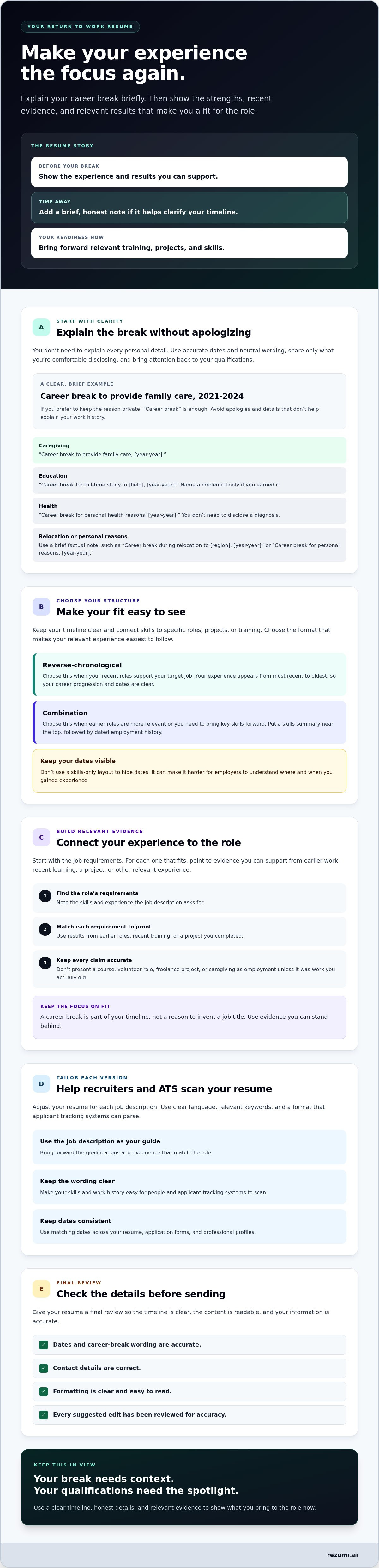
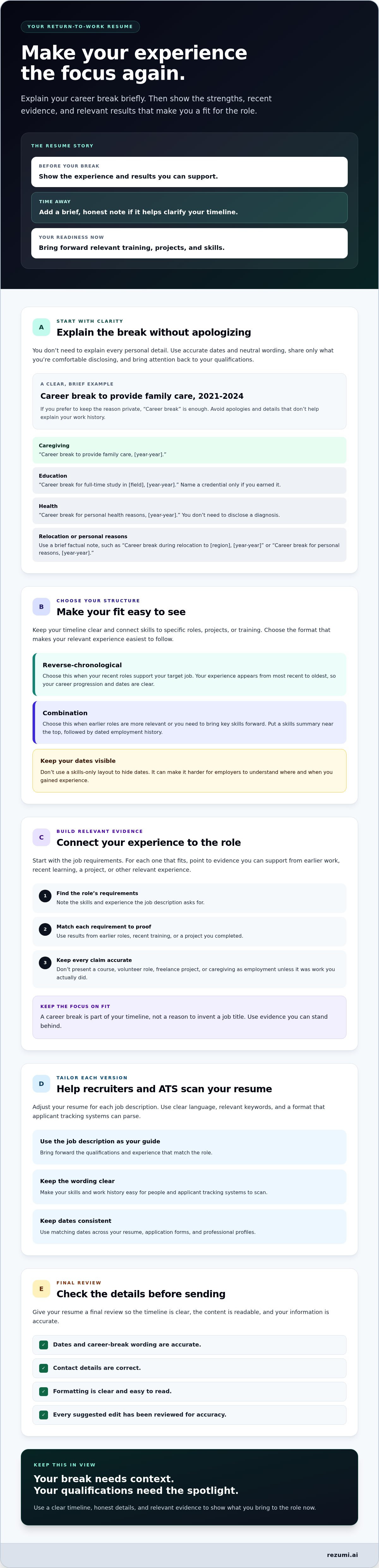
Keep the explanation of your career break brief, then use the rest of your resume to show why you fit the role. A career break isn’t a qualification, and it isn’t a failure. Your goal is to present an accurate work history, relevant strengths, and credible signs that you’re ready to return. When writing a returning to workforce after long break resume, shape that story around your experience, the reason for the break if you choose to share it, and the job you want.
A career break can include time away from paid work for different reasons. You don’t need to turn that period into a job title or claim experience you didn’t gain. Instead, show your fit with evidence you can support, such as earlier results, current training, or a project you completed.
Decide whether your resume needs to explain the break
A brief gap may need no separate entry if your dates already make the timeline clear. For a longer gap that could leave readers unsure about your history, add a short, factual note. Share only what you’re comfortable disclosing. Skip apologies and personal details that don’t help explain your work history.
For example, “Career break, caregiving” gives context without taking attention away from your qualifications. If you’d rather keep the reason private, “Career break” is enough. Use accurate dates and wording, then return the reader’s attention to experience that matches the role.
Choose the resume structure that makes your fit easiest to see
Use a reverse-chronological format when your recent roles are relevant and your work history tells a clear story. It lists experience from most recent to oldest, helping recruiters follow your career progression and dates. A combination format can work well if older roles are more relevant than your recent history. It places a skills summary near the top, followed by dated employment history.
Don’t use a functional format to hide dates. A skills-only layout can make it harder for employers to understand where and when you gained experience. Whichever structure you choose, keep your timeline clear and connect skills to specific roles, projects, or training.
- Reverse-chronological: Choose this when recent experience supports your target role.
- Combination: Choose this when you need to foreground relevant skills while still showing a full work history.
For more detail, consult a guide to choosing a resume format.
How to Explain a Career Break on Your Resume Without Apologizing
State the break accurately, add context only if it helps explain your timeline, then return to your qualifications. Your resume needs a brief explanation, not a detailed personal account. Use a cover letter or interview to add more context only when it helps explain your interest in the role.
For a returning to workforce after long break resume, make sure the wording matches your circumstances and dates. Don’t describe a course, volunteer role, freelance project, or caregiving as employment unless it was work you actually did. The goal is clarity, not a more impressive-sounding history.
Where and how to list time away from work
For a longer break, you can add a brief entry in your experience section, such as “Career break, caregiving, 2021-2024.” If the gap is already clear and you’d rather keep the experience section focused on paid roles, a short line in your summary may provide context instead. Keep the dates consistent across your resume, application forms, and professional profiles.
Career-break resume examples that stay factual
Use neutral language and include only details you’re comfortable sharing. Adjust the wording to fit your situation:
- Caregiving: “Career break to provide family care, [year-year].”
- Education: “Career break for full-time study in [field], [year-year].” Name a credential only if you earned it.
- Health: “Career break for personal health reasons, [year-year].” You don’t need to disclose a diagnosis.
- Relocation: “Career break during relocation to [region], [year-year].”
- Personal reasons: “Career break for personal reasons, [year-year].”
Keep the statement brief. “I’m sorry I was away from work for several years while I cared for my parent” can become “Career break to provide family care, 2021-2024.” The revised version removes the apology without changing the facts. If you completed a relevant course or project during that time, list it separately under education or projects, with accurate dates and details.
If you use AI to organize or refine your resume wording, check every suggested detail before adding it. Explore resume tools and features to see whether they fit your application process.
Turn Older Experience and Time Away Into Relevant Evidence
Start with the job description, then match each requirement to evidence you can verify. Older experience can still show relevant strengths, but your resume should make the connection clear instead of expecting employers to draw it themselves. For a returning to workforce after long break resume, distinguish skills you’ve demonstrated from tools or knowledge you may need to refresh.
Before writing your bullets, make a simple comparison:
- Job requirement: Coordinate schedules and keep projects on track. Matching evidence: In an earlier role, you organized team schedules and followed up on deadlines. Resume bullet to develop: “Coordinated team schedules and tracked project deadlines to keep work on plan.”
- Job requirement: Support customers and resolve concerns. Matching evidence: You answered customer questions and handled service issues. Resume bullet to develop: “Resolved customer concerns by clarifying needs and coordinating next steps.”
- Job requirement: Use a specific software tool. Matching evidence: You used a related tool in the past, but haven’t used the named one. Resume bullet to develop: Describe the tool you know accurately, and don’t claim experience with the one you haven’t used.
Use the employer’s wording when it accurately describes what you did. Don’t copy a requirement into your resume unless you can support it with an example.
Find transferable skills without stretching the truth
Look for examples of communication, project coordination, customer service, analysis, or leadership in your earlier roles. Describe the action and, where you can verify it, the result. For example, “Prepared weekly reports for department leads” is clearer than “strong analytical skills.” Keep claims specific to what you did. If you can’t confirm a result or number, leave it out.
Show recent readiness with credible, current evidence
Relevant training, certifications, projects, or volunteer work can show how you’ve prepared for a target role. List each item with accurate dates and a clear description. Prioritize evidence that connects directly to the job, such as a completed course in a required tool or a volunteer project involving the same type of coordination. Don’t present volunteer work or a personal project as paid employment.
Recent evidence can support your application, but it doesn’t replace earlier accomplishments. Use both: past work to show what you’ve delivered, and current learning or practice to show what you’re ready to do now. To organize experience around a specific posting, explore resume tailoring tools, then review every suggested change to confirm it reflects your real background.
Tailor Your Return-to-Work Resume for Each Job Application
Use the job description to decide which experience belongs in the foreground. A tailored resume connects the employer’s needs to evidence you can support. A focused review also helps keep dates, wording, and formatting clear. This repeatable process makes a returning to workforce after long break resume more relevant without overstating your experience.
Match the resume to the job description
Before editing, separate essential qualifications from preferred ones. Mark the requirements you can demonstrate, then choose the strongest matching examples from your work history, training, or relevant projects. Put your best evidence near the top, in your summary, skills section, or most relevant role.
Use the employer’s terminology only when it accurately describes your background. If a posting asks for “project coordination” and you scheduled tasks and tracked deadlines, that wording may fit. If you haven’t used a required tool, don’t add it as a skill just to match a keyword. Tailoring means making real connections easy to see, not changing the facts.
Check clarity, formatting, and ATS readability
An applicant tracking system (ATS) can parse resume details and help employers compare application information. Systems and employer workflows vary, so no format or keyword can guarantee that your resume will move forward. Use clear headings such as “Work Experience” and “Skills,” readable formatting, and relevant terms in context. A simple layout also makes the resume easier for people to scan.
Before you submit, check that:
- Role titles, employer names, and dates are accurate and consistent.
- Section headings clearly describe the information below them.
- Important details appear in the document text, not only in graphics or decorative elements.
- Keywords appear naturally, and every skill or achievement is something you can explain in an interview.
- The saved file opens correctly and matches the version you intend to send.
Skip keyword stuffing and hidden text. They don’t prove fit, and unsupported claims can undermine trust if an interviewer asks for details. For more guidance, review an ATS resume optimization resource. If you use AI to refine wording, check each suggestion against your actual experience before keeping it.
Make tailoring a short routine: identify requirements, select evidence, adjust language, then proofread. Repeat the process for each role instead of sending the same version everywhere.
Build, Review, and Strengthen Your Resume Before Applying
Before submitting your returning to workforce after long break resume, compare it with a real job description and review every suggested edit. A final check can catch unclear dates, missing details, or wording that doesn’t reflect your experience. Keep the goal practical: a resume that is accurate, relevant, and easy to read.
Use this checklist before each application:
- Accuracy: Confirm every skill, job title, achievement, and qualification is true and something you can discuss.
- Relevance: Make sure your strongest evidence connects to the role’s key requirements.
- Dates: Check that employment and education dates match your application forms and professional profiles.
- Readability: Scan headings, spacing, and bullet points. Make sure the most relevant information is easy to find.
- Contact details: Verify your email address and phone number, and remove outdated information.
Then compare the resume with the job description. Check that your relevant experience and skills are represented accurately. Review suggested edits critically. A keyword or polished phrase isn’t useful if it changes the meaning of your work.
Use AI support without handing over your judgment
AI can help organize a draft, refine wording, and tailor resume content to a specific job description. It can’t verify your personal history for you. Check every suggested skill, date, title, and achievement against your records. Remove generic phrases that don’t sound like you or describe your work clearly.
Rezumi supports ATS resume optimization and job-specific resume tailoring. Use the tools to help align your resume with a posting, then make the final call on every detail. Your resume should reflect your actual experience, not a machine’s guess about it.
Prepare the rest of your application
Keep your resume consistent with the dates and titles you enter on application forms and professional profiles. If your resume can’t explain a relevant career choice or your interest in a role, a tailored cover letter can add that context. Keep it focused on the job rather than repeating your entire resume. Before sending, make sure both documents support the same story.
A careful review won’t guarantee an interview, but it can help you submit a clearer, more targeted application. Use your real experience as the standard for every edit.
Make Your Next Application Count
A strong returning to workforce after long break resume is clear about your time away and focused on evidence that fits your target role. Keep your explanation brief, connect earlier experience and recent learning to the job requirements, and tailor your resume for each application. Before sending it, verify every detail and make sure your skills, dates, and contact information are consistent.
You don’t have to rebuild your job search from scratch for every role. Rezumi offers AI-powered ATS resume optimization, resume tailoring to specific job descriptions, and a centralized workspace for job-search activities. Use AI to organize and refine your materials, then review every suggestion to make sure it reflects your real experience.
Your past experience still matters. Present it clearly, show what you’re ready to contribute now, and take the next step with confidence.
Frequently Asked Questions
How do you explain a long career break on a resume?
Explain a long career break in one brief, factual line, then focus on qualifications that match the role. You might write “Career break for personal reasons, 2020-2024” or include a reason you’re comfortable sharing. Keep dates accurate, and don’t apologize or add private details. If you completed relevant training or projects during the break, list them separately under the right section rather than implying they were paid employment.
Should I include a career break on my resume?
Include a short explanation if leaving the time unaddressed would make your work history confusing. A brief gap may not need its own entry if the dates already tell a clear story. For a longer break, a neutral line can help readers understand the timeline without taking attention away from your experience. Choose wording you’re comfortable sharing, and keep it consistent across your resume, application forms, and professional profiles.
How do I write a resume after 10 years out of work?
Build your resume around the role you want, not around the time you’ve been away. Start with relevant strengths, then select earlier accomplishments that show you can meet the job’s requirements. Add current, verifiable evidence such as relevant courses, projects, or volunteer work, with accurate dates. Explain the break briefly if needed. Don’t claim recent expertise with tools or skills you haven’t used or refreshed.
Can I use a functional resume after a long career break?
You can use a skills-focused layout, but don’t use it to hide employment dates. A combination resume may be a clearer choice: it highlights relevant skills near the top, then includes a dated work history. This lets you show transferable experience while giving employers context about when you gained it. Choose a format that makes your qualifications easy to find and your timeline easy to follow.
What should I put on my resume if I have not worked recently?
Include relevant earlier roles, accomplishments, education, and current evidence connected to your target job. That evidence might include a completed course, a personal project, or volunteer experience, if you actually did it and can describe your contribution. Label each item accurately and include dates where useful. Don’t fill space with unrelated activities or present unpaid work as employment. Focus on what you can support with real examples.
How can I make my resume ATS-friendly after a career break?
For a returning to workforce after long break resume, use clear section headings, readable formatting, and relevant job-description terms that truthfully match your experience. Keep dates, job titles, and skills in the document text, and avoid hidden text or keyword stuffing. Applicant tracking systems vary, as do employer workflows, so no format guarantees a result. Review the saved file to confirm its content is clear and consistent.
Should I mention caregiving on my resume?
You can mention caregiving if you want to explain a gap, but you don’t have to share personal details. A short entry such as “Career break for family caregiving, 2021-2024” can provide context without suggesting that caregiving was paid employment. If you prefer more privacy, “Career break, 2021-2024” is also clear. Use accurate dates, and keep the focus on the relevant experience and skills you bring to the role.
Disclaimer
This article is provided for general informational purposes only and does not constitute professional, legal, financial, or career advice. While Rezumi strives for accuracy, we make no warranties as to the completeness or reliability of this content. Hiring practices, ATS behavior, and job-market conditions vary by employer, industry, and region — always verify against your specific situation. Any action you take based on this article is at your own risk.