School Counseling Resume Buzzwords: A Practical Guide
A list of counseling terms won’t strengthen your resume if it doesn’t show how you supported students. Search results for “school counseling buzzwords resume” often offer long lists, but the right terms depend on your actual experience, training, and results.
Generic phrases can hide the work you’ve done, while unfamiliar terms can make you worry about overstating your role. You don’t have to choose between sounding vague and stuffing your resume with keywords. Use language that’s accurate and specific.
This guide will help you identify school counseling terms that fit your background, then turn your responsibilities into evidence-based resume statements. You’ll see how to connect terms such as MTSS, college and career readiness, and social-emotional learning to work you’ve actually done, and how to tailor your wording to a job description. The goal is a clear resume that shows what you contributed without claims you can’t support.
Key Takeaways
- Choose school counseling terms that reflect your actual skills, responsibilities, and results, not just wording that sounds impressive.
- Organize relevant language by type of work, such as academic planning, social-emotional support, referrals, and family communication.
- Build stronger resume bullets by connecting an action to its counseling context, method, and a truthful result.
- Use school counseling buzzwords resume searches to find ideas, then include only terms relevant to the job posting and your experience.
- Review your final resume for accuracy, readability, relevance, and student privacy instead of chasing a perfect keyword count.
Which School Counseling Buzzwords Belong on Your Resume?
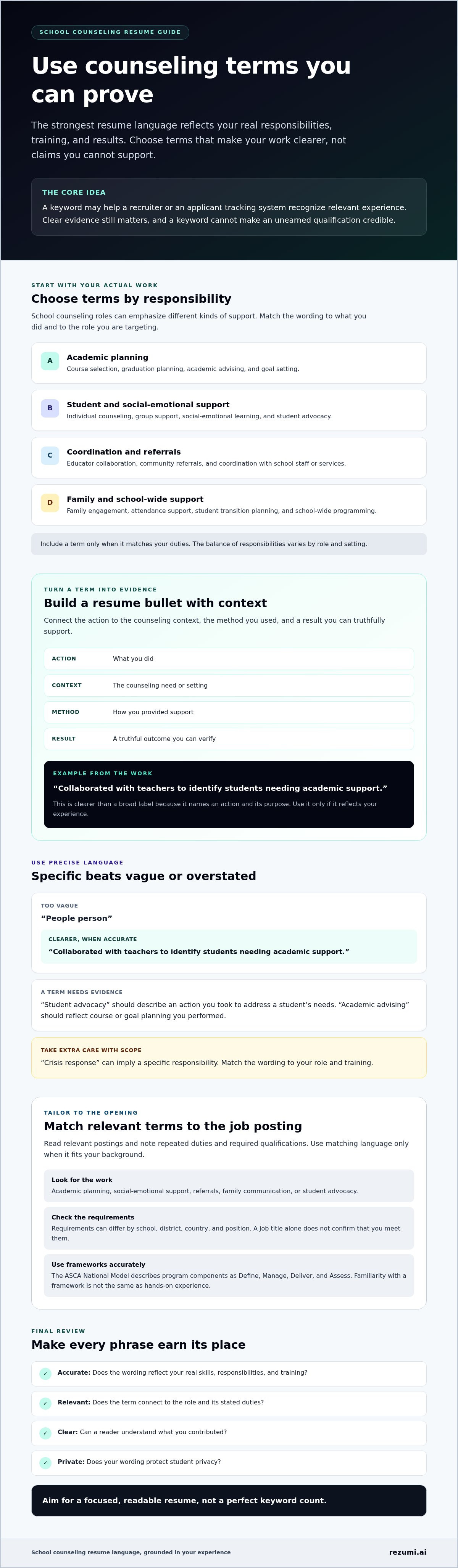
The most useful school counseling resume terms are the ones you can support with real work. A search for “school counseling buzzwords resume” may turn up long lists, but the right terms depend on your experience, training, and results. A relevant keyword may help a recruiter or an applicant tracking system (ATS), software some employers use to organize applications, recognize your experience. It can’t replace clear evidence or make an unearned qualification credible.
Start with the work you’ve actually done. School counseling roles often involve student support, academic planning, social-emotional learning, and collaboration with families or school staff. The balance varies. A role focused on graduation planning may call for different language than one centered on small-group support or school-wide programming.
What makes a school counseling term useful?
Choose precise language and connect it to a duty, method, student population, or outcome. “People person” is vague. “Collaborated with teachers to identify students needing academic support” gives a clearer picture, if it reflects your experience. Be specific enough to explain what you did, but don’t claim a result you can’t verify.
Before adding a term, make sure you can explain it in an interview. For example, “student advocacy” should refer to an action you took to help address a student’s needs, not just a general belief in supporting students. “Academic advising” may describe course or goal planning, but use it only if you performed that work. “Crisis response” can imply a specific responsibility, so match the wording to your role and training.
Which counseling terms appear in job descriptions?
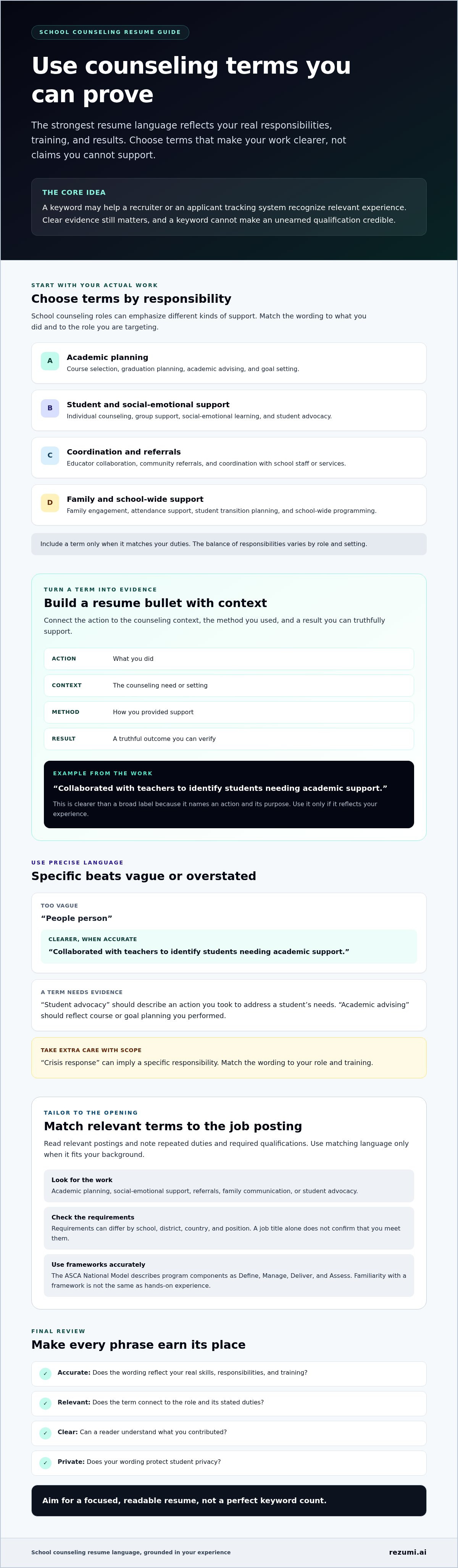
Read several relevant postings, then note repeated duties and required qualifications. Look for terms tied to:
- Academic planning, such as course selection or graduation planning
- Social-emotional support, such as individual or group counseling
- Referrals and coordination with school staff or community services
- Family communication and student advocacy
Use a term because it matches your experience and the posting, not simply because it appears often. Requirements can differ by school, district, country, and position. A job title alone doesn’t confirm that you meet its stated credentials or responsibilities.
In the United States, the American School Counselor Association (ASCA) offers professional context for school counseling programs. Its National Model describes program components as Define, Manage, Deliver, and Assess. Review current ASCA guidance when you use its language, and don’t present familiarity with a framework as hands-on experience. For a broad overview of a comprehensive school counseling program, use the source as background, then follow the job posting’s specific requirements.
Your strongest terms make your experience easier to understand. Next, choose language that fits both the work and the setting you’re targeting.
School Counseling Buzzwords Resume: Terms by Skill and Responsibility
Choose terms based on the setting and support you actually provided. “Social-emotional learning” could describe a classroom lesson, a small-group activity, or part of a school-wide program. Name the format and purpose so recruiters can see the scope of your work, not just the label.
Student support, academic planning, and social-emotional learning
Use terms such as student advocacy, academic advising, goal setting, and social-emotional learning when they match your duties. Add context by naming the students you served, what you did, or what the support addressed. For example, “guided students through course planning” is clearer than “provided academic support,” if course planning was part of your role.
- Individual counseling: Specify one-to-one support or student check-ins, and describe your role accurately.
- Group support: Name the group’s purpose, such as study skills or peer relationships, if that reflects your work.
- School-wide programming: Identify the activity or audience, such as delivering a lesson to students or coordinating a school-wide initiative.
Include attendance support or student transition planning only if you performed that work. The U.S. Bureau of Labor Statistics outlines typical duties and qualifications for School and Career Counselors and Advisors. Use it for general role context, then follow the requirements in the specific posting you’re targeting.
Collaboration, referrals, and school-wide support
Terms such as family engagement, educator collaboration, and community referrals can show how you coordinated support. Be precise about your part. A referral means you connected or directed a student or family to another resource. It doesn’t mean you delivered that provider’s services.
Use MTSS (Multi-Tiered System of Supports), IEP (Individualized Education Program), and 504 plan only if you have relevant experience. Spell out an acronym on first use if readers may not know it. Describe your actual contribution, such as participating in a meeting or coordinating with educators, rather than implying you created or managed a plan if you didn’t.
If you’re searching for “school counseling buzzwords resume,” use the terms you find as ideas, then check that each one matches your experience and the job posting. You can also compare your resume with a school counselor job description and review the wording for accuracy before you apply.
How to Turn School Counseling Buzzwords into Resume Evidence
A strong resume bullet connects a clear action to the counseling context, the method you used, and a truthful result. This structure helps recruiters understand what you did instead of having to infer your role from a list of keywords.
Use this quick formula: Action + context + method + supported result. You may not have a measurable result for every task. In that case, describe the work accurately and leave the outcome out.
Rewrite generic duties as specific resume bullets
“Helped students” doesn’t show what support you provided. Replace broad wording with a specific action and purpose. Use verbs such as coordinated, advised, referred, facilitated, or tracked only if they accurately describe what you did.
- Before: Helped students with schoolwork.
After: Advised students on course planning to support their academic goals. - Before: Worked with families.
After: Coordinated family communication about student support plans with the school team. - Before: Helped students find services.
After: Referred students and families to appropriate support resources.
These are wording examples, not claims to copy. Adjust each one to match your duties. If your experience comes from a youth program, tutoring role, or community organization, name that setting. Present the skills as transferable experience, not as school counselor employment.
Show impact without overstating student outcomes
Separate what you did from what changed. Report an outcome only when you have records to support it and can explain where the information came from. Don’t add caseload totals, improvement rates, or claims about student progress just to make a bullet sound stronger.
When individual outcomes aren’t available or appropriate to share, describe your process or collaboration instead. For example: “Coordinated student referrals with school staff to connect families with support resources.” Keep student names and identifying case details off your resume. Protect privacy while showing the work.
The School Counseling Resume Guide offers another reference for resume skills and wording. Use it to generate ideas, then confirm that each term fits your role, training, and experience.
If you searched “school counseling buzzwords resume,” use this final test for every bullet: Can you describe the action, explain your method, and support any outcome? If not, revise the claim or leave the outcome out.
How to Match Counseling Keywords to a School Job Posting
Tailor your resume by matching the posting’s priorities with evidence from your experience. Don’t copy every phrase or add a keyword to imply a qualification you don’t have. A clear match helps recruiters understand your fit, while being honest about gaps keeps your application accurate.
Build a job-description-to-evidence map
Use this four-step process for each school counselor role:
- Identify requirements. Separate required credentials from preferred skills and general duties. A required credential is a stated condition of the role. Preferred skills can strengthen your application but may not be essential.
- Map your evidence. Create a two-column worksheet. Put each relevant posting term in the first column, then note the matching experience, training, or qualification in the second.
- Choose exact terms. Use wording from the posting when it accurately describes your background. Prioritize core duties and qualifications, not every phrase in the ad.
- Review readability. Check that your resume still sounds natural and makes your experience easy to follow.
For example, if a posting asks for academic advising, list a real course-planning or goal-setting task only if you performed it. If you can’t support a required qualification, don’t disguise the gap with related keywords. Assess whether you meet the requirement before applying.
ATS products and employer workflows differ. There isn’t one universal ranking formula to write toward, so avoid keyword stuffing and unsupported claims about how every system screens resumes. For a broader overview, read this ATS resume optimization guide.
Keep ATS readability and human clarity in balance
Use familiar section headings, such as “Experience,” “Education,” and “Skills,” with clean, readable formatting. Place relevant terms where they make sense. A counseling skill belongs in your experience section when you can show how you used it, and in your skills section when it accurately summarizes your abilities.
Then read the resume aloud. Remove repeated phrases, unexplained jargon, or wording you wouldn’t use to describe your work. The North American resume format guide can help you review structure and presentation.
Use resume tailoring tools to compare your resume with the posting.
Finalize Your School Counseling Resume with a Focused Review
Before submitting, compare your resume with the school counselor posting one last time. Look for clear evidence of the main requirements, then check that your counseling language is accurate, readable, and appropriate to share. A focused review is more useful than trying to reach a perfect keyword count.
A final checklist before you submit
Use this checklist to catch problems that can weaken an otherwise relevant application:
- Accuracy: Can you explain each counseling term, skill, and qualification using your experience or training?
- Relevance: Does your resume show evidence for the posting’s major duties and requirements where you have relevant experience?
- Readability: Are your bullets direct and free of repeated keywords, unexplained acronyms, or forced wording?
- Privacy: Have you removed student names, identifying details, and confidential case information?
- Evidence: Can you verify every number and outcome, and explain its source if asked?
If a term sounds impressive but you can’t explain how it applies to your work, remove it or revise it. The goal isn’t to include every school counseling buzzword suggested by resume searches. It’s to make your fit for this specific role clear without stretching the facts.
Use resume feedback to refine your next application
A resume tool can help you compare your document with the job description and spot relevant experience that may be missing or hard to find. Rezumi provides AI-driven feedback to support that review. It can flag possible alignment opportunities, but it can’t confirm that your experience, credentials, or student-support claims are true.
Make the final call yourself. Confirm each suggested edit against your actual duties, then read the resume aloud to check that the tone sounds like you and fits the role. This review matters especially when a posting uses terms tied to specific training or responsibilities.
Once your resume reflects your experience and the school’s priorities, save a version tailored to that posting. Revisit the checklist each time you apply. A careful review can keep your language focused and help readers see how your background matches the role.
Make Your Counseling Experience Clear on the Page
Choose school counseling buzzwords for your resume that are accurate, specific, and tied to evidence. Focus on terms that match your real responsibilities, then show how you applied them. Tailor your wording to the job posting, but don’t add keywords just to chase a match.
Before you apply, check that your claims are supportable, your language is easy to read, and your resume protects student privacy. Recruiters should understand your contribution without guessing what a phrase means.
Rezumi is designed for North American job seekers. It can help you tailor your resume to a specific school counselor job description and review resume quality with AI-driven feedback. Treat that feedback as a review aid, then confirm every suggestion against your experience and qualifications.
Your experience deserves clear, honest wording. Make each term count, then explore Rezumi’s resume optimization plans to tailor your resume to a school counselor job description.
Frequently Asked Questions
What are the best buzzwords for a school counselor resume?
There’s no single list that fits every school counselor role. Choose terms that match the job posting and your actual experience, such as academic advising, student advocacy, family engagement, or social-emotional learning. Support each phrase with a responsibility, method, or result you can explain. Include terms like MTSS, IEP, or 504 only if you’ve had relevant experience with the work or process they describe.
Should I use the phrase social-emotional learning on my resume?
Use “social-emotional learning” when your experience includes related instruction, programming, or counseling support. Explain what you did, whom you supported, and the setting. For example, name a lesson or group activity you facilitated if that reflects your work. Don’t use the phrase as a substitute for evidence. If the posting uses related language, include it naturally where it fits your experience.
How do I add school counseling keywords for an ATS?
Start with the job description and identify relevant skills, duties, and qualifications. Use matching terms in your experience or skills sections only when they accurately describe your background. Keep headings and formatting clear for both software and people. ATS tools and employer review processes vary, so no keyword formula can guarantee selection. Read the finished resume as a recruiter would, not just as a list of search terms.
Can I use counseling buzzwords if I am a new graduate?
Yes, if you connect each term to supervised practice, an internship, coursework, or relevant work or volunteer experience. Label the setting clearly so employers can tell what you did and whether the work was supervised. Don’t present classroom learning as independent professional experience. Instead, show transferable skills with specific examples, such as supporting student goal setting during a supervised placement, if that reflects your background.
What are examples of school counselor resume action verbs?
Choose verbs that match your responsibility, such as advised, coordinated, facilitated, referred, supported, or tracked. A verb makes your role easier to understand, but it isn’t proof by itself. Follow it with the activity and context, such as “coordinated family communication about student support.” Use a stronger verb only if it accurately describes your contribution, and include an outcome only when you can support it.
How can I show measurable impact without sharing private student information?
Use verified information that doesn’t identify students and is appropriate to share. You can describe a program, process, or collaboration without revealing case details. For example, explain how you coordinated referrals with school staff, even if you can’t share individual student outcomes. Don’t invent a statistic or include confidential information to make a resume bullet seem stronger. Accuracy and privacy matter more than a number.
Should I list IEP, 504, or MTSS on a school counselor resume?
List IEP, 504, or MTSS only if your experience genuinely involved the related process or collaboration. Spell out an acronym on first use if readers may not know it, then describe your role accurately. For example, state that you participated in coordination if that’s what you did. Don’t imply that you managed a plan or performed another professional’s duties unless that was part of your role.
How often should I tailor my school counselor resume?
Review your resume for each school counselor role you apply to. Compare the posting with your experience, then adjust relevant skills, examples, and terms without changing the facts. Keep a master resume with your full range of experience so you can select the strongest evidence for each application. Your school counseling buzzwords resume should read naturally and show a clear match, not repeat every phrase in the posting.
Disclaimer
This article is provided for general informational purposes only and does not constitute professional, legal, financial, or career advice. While Rezumi strives for accuracy, we make no warranties as to the completeness or reliability of this content. Hiring practices, ATS behavior, and job-market conditions vary by employer, industry, and region — always verify against your specific situation. Any action you take based on this article is at your own risk.