STAR Method Interview Questions: Your Strategic Guide to Commanding the Room
The average cost per hire is approximately $4700. Companies are not just looking for a body in a chair. They are looking for a strategic investment. When a recruiter asks you STAR method interview questions, they are testing your ability to deliver a return on that investment. Most candidates fail this test because they ramble. They lose the thread. They forget the specific data that actually proves their worth.
You likely feel the pressure to perform when a recruiter says, "tell me about a time." It's common to worry that your stories aren't impressive enough or that you'll forget the most important details under pressure. You don't have to guess what they want to hear. This guide will show you how to transform your past wins into structured, high-impact narratives. You will learn how to build a bank of ready-to-use stories that prove your value. This strategy replaces anxiety with the confidence to command the room and secure an offer letter from a top North American employer.
Key Takeaways
- Understand how recruiters use STAR method interview questions to predict your future success based on your past professional wins.
- Structure every answer using the Situation, Task, Action, and Result framework to prevent rambling and keep your stories concise.
- Build a bank of 5 to 7 versatile stories that demonstrate your skills in leadership, problem solving, and managing heavy workloads.
- Align your stories with specific keywords from the job description to show you are the exact fit for the employer's needs.
- Use AI coaching to refine your pacing and tone, replacing interview anxiety with data-backed confidence before the meeting starts.
What Are STAR Method Interview Questions?
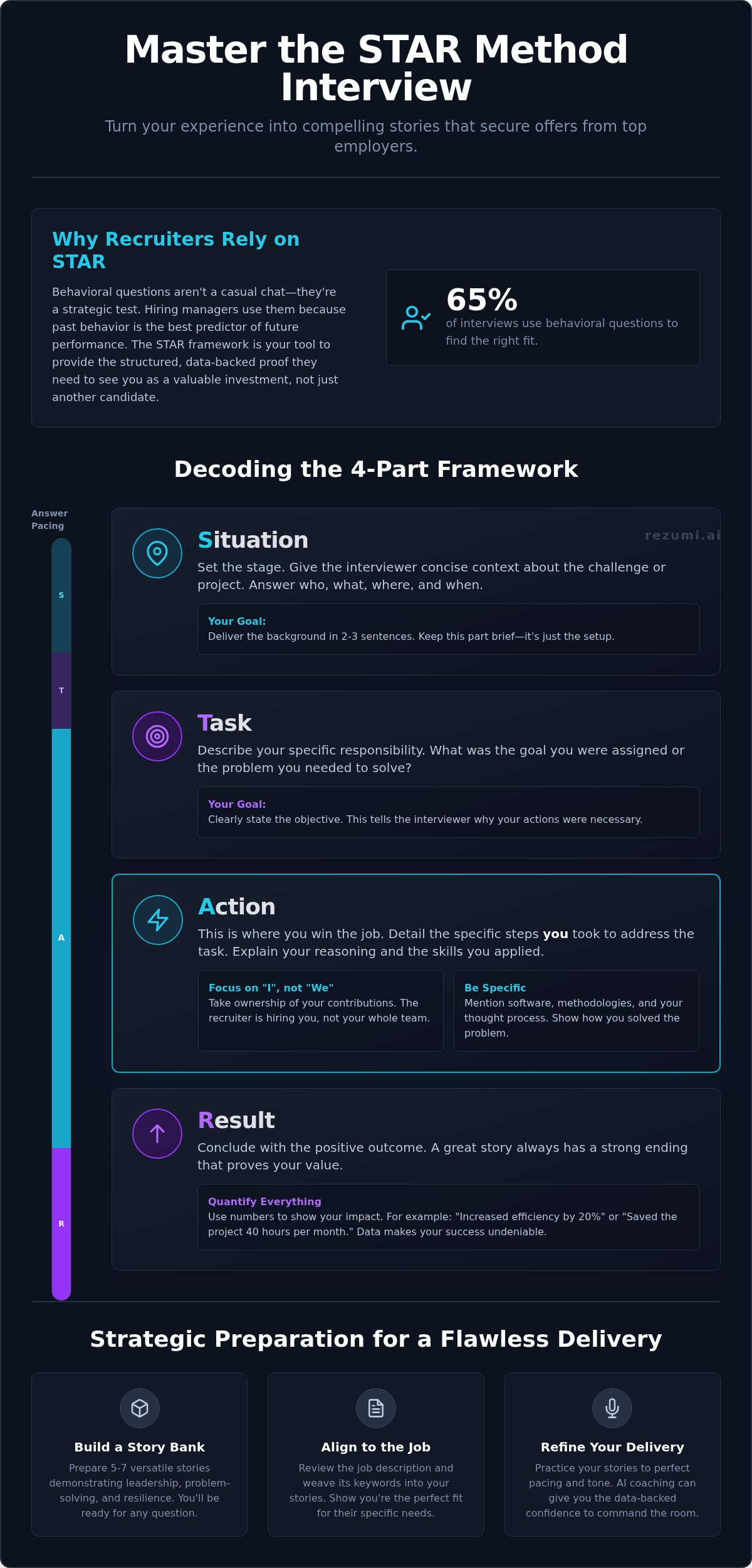
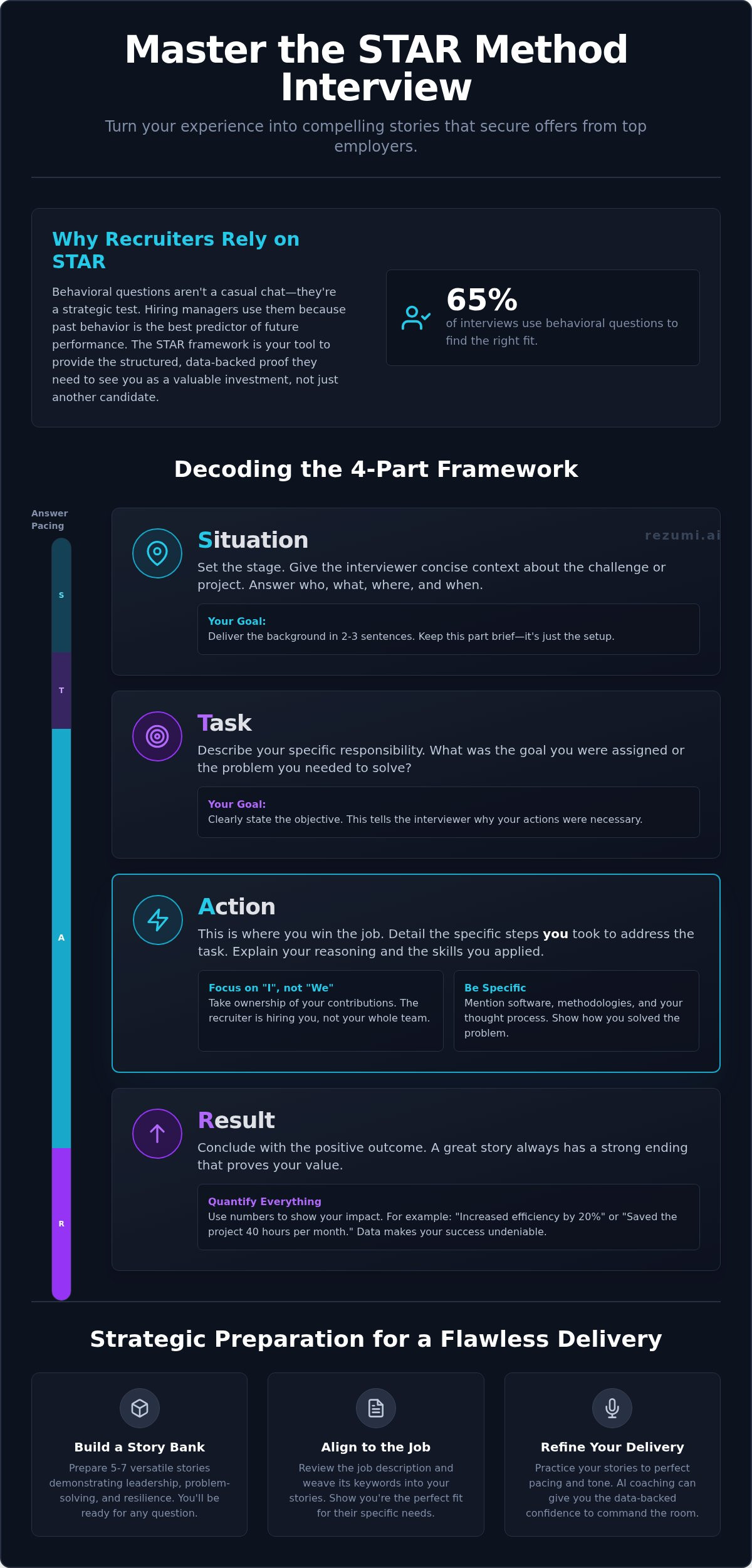
STAR is a communication framework designed to help you answer behavioral questions with precision. It stands for Situation, Task, Action, and Result. When you use the Situation, Task, Action, Result (STAR) method, you provide a clear roadmap for your interviewer to follow. This structure ensures you don't ramble or lose the hiring manager's interest. Effectively answering STAR method interview questions forces you to focus on the specific impact you made rather than speaking in vague generalities. It turns a messy professional history into a series of clear wins.
You can spot these questions easily. They usually start with phrases like "Tell me about a time when" or "Give me an example of a situation where." These are behavioral questions, and they require more than a simple yes or no. The interviewer is digging for a story that proves you have the skills listed on your resume. Without a framework, it's easy to forget key details or get stuck in the weeds of a story that doesn't actually show your value.
Why Recruiters Love Behavioral Questions
Hiring managers use these questions because past behavior is the best predictor of future performance. According to industry data from Workable, 65% of interviews incorporate behavioral questions to assess how candidates handle real world pressure. They aren't just looking for technical skills. They want to see your problem solving abilities, leadership potential, and resilience in action. Evidence based answers are much harder to fake than general claims about your work ethic. By asking for a specific example, the recruiter can verify your contributions and see how you think through complex challenges. They are looking for patterns in how you handle stress and collaborate with others.
The Difference Between General and Behavioral Questions
General questions focus on your traits or opinions. Behavioral questions focus on your actual proof. A general question might be, "Are you a team player?" Most candidates will simply say yes. A behavioral question asks, "Tell me about a time you resolved a team conflict." This shift requires you to provide a compelling professional narrative. Using the STAR framework turns a generic claim into a powerful demonstration of your value. It moves the conversation from what you say you can do to what you have actually achieved. This distinction is critical in a competitive market where employers are looking for high performance results. You aren't just telling them you are good. You are showing them the data to prove it.
Decoding the STAR Framework for Maximum Impact
Mastering STAR method interview questions requires more than just memorizing four letters. It's a strategic way to package your professional worth. Think of it as a four part story where you are the hero who solves a specific crisis. You need to move through each phase with purpose to keep the recruiter engaged.
The first two steps, Situation and Task, should be brief. You're simply setting the stage. Describe the project or challenge in two sentences. Then, state your specific responsibility. This creates the tension in your story. It tells the interviewer why your actions mattered in the first place.
The Action Phase: Where the Battle is Won
The Action section is where you win the job. You should spend about 60 percent of your total answer here. This is your chance to structure the examples you give so they highlight your unique skills. Focus on what you did specifically, not what your team did. Use "I" instead of "we" to ensure you get full credit for the work.
Describe the exact steps you took to handle the task. Mention the software you used or the specific logic behind your decisions. If you chose one path over another, explain why. This shows the recruiter that you are a deliberate professional who uses data and strategy to get things done. It's not enough to say you did the work. You must show how you did it better than anyone else.
The Result Phase: Proving Your Value
The Result is your payoff. Never leave an answer without a positive outcome. This is where you prove that your actions led to a tangible win for your employer. Use real numbers whenever possible to make your impact undeniable. Metrics like "increased revenue by 20 percent" or "saved 10 hours of work per week" provide the proof recruiters crave.
If you don't have hard numbers, focus on qualitative impact. Mention that you improved team morale or received a direct commendation from a client. These details show you understand how your work affects the bottom line. To ensure your results are polished and impactful, you can practice your delivery with our AI interview coaching tools. Getting immediate feedback on your structure helps you refine these stories until they are perfect.
Top 10 STAR Method Interview Questions and How to Answer Them
Preparing for STAR method interview questions requires a library of stories you can adapt on the fly. You don't need a hundred different examples to succeed. You need about seven high-quality stories that cover the most common categories recruiters care about. When you have these stories ready, you can handle unexpected questions without the fear of rambling or forgetting key details.
Recruiters use these questions to see how you'll fit into their culture and handle their specific pressures. They are looking for patterns in your behavior that suggest you will be a high-performance employee. By preparing ahead of time, you ensure that every answer you give is a strategic win for your candidacy.
Questions About Teamwork and Conflict
Recruiters ask about difficult coworkers or team failures to see how you handle friction. Never use this as a chance to vent about a past boss or colleague. Focus on your ability to remain professional and solution oriented throughout the conflict. Explain how you put the company's goals above personal disagreements. This shows the interviewer you have the emotional intelligence to thrive in a North American corporate environment. Common questions in this category include:
- Describe a situation where you had to deal with a difficult coworker.
- Give an example of a time you failed and how you handled it.
When you discuss failure, be honest but brief about the mistake. Spend the majority of your time explaining the corrective action you took and what you learned to prevent it from happening again. This turns a negative experience into a proof point for your professional growth.
Questions About Problem Solving and Adaptability
These questions measure your resilience and your technical approach to challenges. Highlight your ability to think on your feet and stay calm under pressure. Mention specific technical tools, software, or task management frameworks you used to solve the problem. If you managed a heavy workload, explain how you prioritized tasks to meet every deadline. Common questions in this category include:
- Tell me about a time you had to manage a heavy workload.
- Tell me about a project you are most proud of.
When discussing your proudest project, emphasize the Result phase. Use the data points we discussed earlier to prove your success. If you can show that your problem solving saved the company time or money, you become a much more attractive candidate.
Sample Answer: Handling a Tight Deadline
Here is how a high-impact answer looks when you use the STAR framework for a common deadline question. Notice how the Action section is the longest part of the response.
Question: Tell me about a time you faced a tight deadline.
- Situation: Our main developer fell ill two days before a major product launch.
- Task: I had to ensure the final code review and deployment happened on time despite the missing resource.
- Action: I reallocated tasks to the junior team and spent six hours personally auditing the critical path. I used our project management tool to track every remaining bug in real time.
- Result: We launched on schedule with zero critical bugs reported in the first 48 hours. The client was impressed with our speed and reliability.
When you practice these STAR method interview questions, focus on keeping your delivery natural and your results specific. This level of detail makes it impossible for a recruiter to doubt your skills.
Strategic Preparation: Building Your Story Bank
Success in an interview isn't about being the smartest person in the room. It's about being the best prepared. Most candidates wait for the recruiter to ask a question before they start digging through their memories. This leads to long pauses and half-baked answers. You need a bank of five to seven versatile stories that you can adapt to different STAR method interview questions. These stories should cover high-stakes categories like leadership, failure, and major success.
Your job description is a cheat sheet for the interview. Review it to find the specific keywords the employer values most. If the posting emphasizes "data-driven decisions," your stories must highlight your use of metrics. If they focus on "stakeholder management," your narratives should feature your communication skills. Mapping your wins to these keywords proves you are the perfect fit for the role. It shows you aren't just giving a generic answer but are solving their specific problems.
Aligning Stories with the Job Description
Terminological alignment builds instant rapport. If the job asks for "cross-functional collaboration," prepare a story about working with other departments. Use the exact words found in the job posting. This signals that you understand the company culture and the technical requirements of the position. You should also check your resume for consistency. Your verbal stories must support the written accomplishments that helped you pass the ATS in the first place.
The 'So What?' Test for Every Story
Every detail in your story must serve a purpose. Before you finalize a narrative, put it through the "so what?" test. Ask yourself if the result actually matters to the hiring manager. Focus on outcomes that save time, save money, or improve quality. If a detail doesn't lead directly to the final success, cut it. Your goal is to be concise and impactful. Eliminate the fluff that does not respect the recruiter's time.
Practice your stories out loud until they feel natural. Aim for a length between 90 seconds and 2 minutes. This timing is long enough to provide depth but short enough to keep the interviewer engaged. Recording yourself can help you spot verbal fillers or sections where you tend to ramble. When you can deliver a story with calm confidence, you take control of the interview room.
Command the Interview with Rezumi AI Coaching
You have built your story bank. Now you must refine your delivery. Knowledge alone does not win the job. Execution does. Rezumi's AI Interview Prep provides a safe space to practice your responses to STAR method interview questions without judgment. The system does not get tired or bored. You can practice as many times as you need until your delivery feels natural and professional.
Our technology analyzes your pacing, tone, and the structure of your answers in real time. You don't have to guess if your stories are working. The AI gives you instant feedback on whether your Action and Result sections are strong enough. This is critical because these phases are where you prove your worth to a North American employer. If your explanation is too brief or your results are too vague, the system will flag it immediately.
Most candidates fail because they don't know how they sound to others. They speak too fast or use too many filler words. Our AI coaching tools identify these weaknesses before you step into the room. This moves you from a state of uncertainty to a state of total control. You can see your scores improve with every session, giving you the data-backed confidence to handle any challenge.
Why AI Coaching Beats Traditional Mock Interviews
AI coaching provides objective metrics that human partners often miss. A friend might tell you that you sounded good, but they cannot tell you that your speaking rate was 160 words per minute. Rezumi tracks these specific data points for you. You can practice 24/7 without needing to schedule an appointment with a busy career coach. This flexibility allows you to prepare on your own terms.
Human partners are also prone to bias or politeness. The AI is strictly focused on the quality of your content and the clarity of your speech. It helps you eliminate filler words like "um" or "like" that can undermine your authority. By the time you reach the actual interview, your speech will be polished and high-impact. You will sound like the strategic partner the company is looking for.
Moving from Application to Job Offer
A complete career strategy requires more than just a great resume. You must be able to back up your written claims with verbal proof. Combining your optimized resume with expert interview skills creates a path to a job offer. Rezumi helps you track your progress from the initial application to the final interview stage. You can see your confidence grow as your scores move higher.
Take control of your career journey by using technology to your advantage. This strategy replaces the anxiety of the unknown with the reassurance of readiness. You are no longer just another applicant. You are a prepared professional with a bank of proven stories. Secure your future at a top employer by refining your skills today.
Command Your Future Performance
You now have the tools to turn your professional history into a series of high impact wins. By using the STAR framework, you replace rambling with precision. You know how to select stories that match the job description and how to prove your value with real data. This preparation is what separates a candidate from a future employee.
Mastering STAR method interview questions gives you the control you need in a high stakes room. You don't have to fear unexpected questions when you have a bank of versatile stories ready. Rezumi was built by professionals who understand the North American hiring system. We provide the AI driven feedback you need to ensure your delivery is perfect every time.
Your experience is valuable. You just need the right structure to show it. Take these strategies and move forward with the confidence that you are the best investment a company can make. The offer letter you want is within your reach.
Frequently Asked Questions
How long should a STAR method answer be?
Aim for a response that lasts between 90 seconds and 2 minutes when answering STAR method interview questions. This is the sweet spot for keeping a recruiter's attention while providing enough detail. Use about 20 percent of your time on the Situation and Task. Spend 60 percent on the Action phase to show your skills. Finish with a quick 20 percent on the Result. This balance ensures you don't get stuck in the weeds of the setup.
What if I cannot think of a specific example for a question?
Ask for a few seconds to think or pivot to a closely related skill. It is better to pause for five seconds than to ramble through a fake story. If you can't find a perfect match, tell a story that demonstrates the core competency the recruiter is looking for. For example, if they ask about leadership and you haven't been a manager, tell a story about leading a specific project or initiative.
Can I use the same story for multiple interview questions?
Yes, but you must highlight different skills in each version of the story. A single complex project often involves leadership, conflict resolution, and technical problem solving. You can use the same Situation, but change your Action to focus on the specific trait the recruiter asked about. Just make sure you don't repeat the exact same narrative twice. It's better to show a range of experiences whenever possible.
How do I talk about a failure using the STAR method?
Focus on the lesson you learned and the corrective actions you took. Briefly describe the mistake in the Situation phase, but spend most of your time on the Action. Explain how you fixed the error and what system you put in place to prevent it from happening again. The Result should highlight your professional growth and your commitment to high quality work. This approach turns a negative into a proof point.
Should I write down my STAR stories before the interview?
Yes, write out bullet points for each phase to organize your thoughts. You should not memorize a script because you will sound robotic. Writing helps you identify the specific data points and keywords that matter most to North American employers. Practicing these STAR method interview questions aloud ensures your delivery stays natural. It also helps you spot any parts of your story that feel too long or confusing.
What are the most common behavioral questions for senior roles?
Strategy, organizational change, and stakeholder influence are the primary focus. Recruiters for senior roles want to see how you drive long term business value. They will ask how you managed a major budget shift or how you developed a high performing team. Your answers should focus on your ability to think several steps ahead. You must show that you can align multiple departments toward a single, strategic goal.
How do I quantify my results if I do not work in sales or finance?
Focus on efficiency, quality, and project completion metrics. You don't need a dollar sign to show value. If you improved a workflow, mention that you saved your team five hours of work every week. If you managed a launch, state that you finished the project 10 percent ahead of schedule. These numbers provide the concrete proof recruiters need to verify your skills and see your impact on the business.
Is the STAR method still relevant for remote interviews in 2026?
Yes, it is essential for remote clarity. In 2026, many companies use AI tools like HireVue to screen and score your responses. These systems look for clear structure and specific data points. Using the STAR method interview questions framework ensures that both the software and the human recruiter can track your wins. It helps you stay focused when you don't have in person body language to guide you.
Disclaimer
This article is provided for general informational purposes only and does not constitute professional, legal, financial, or career advice. While Rezumi strives for accuracy, we make no warranties as to the completeness or reliability of this content. Hiring practices, ATS behavior, and job-market conditions vary by employer, industry, and region — always verify against your specific situation. Any action you take based on this article is at your own risk.