STAR Method Interview Questions: Your Strategic Guide to Commanding the Room
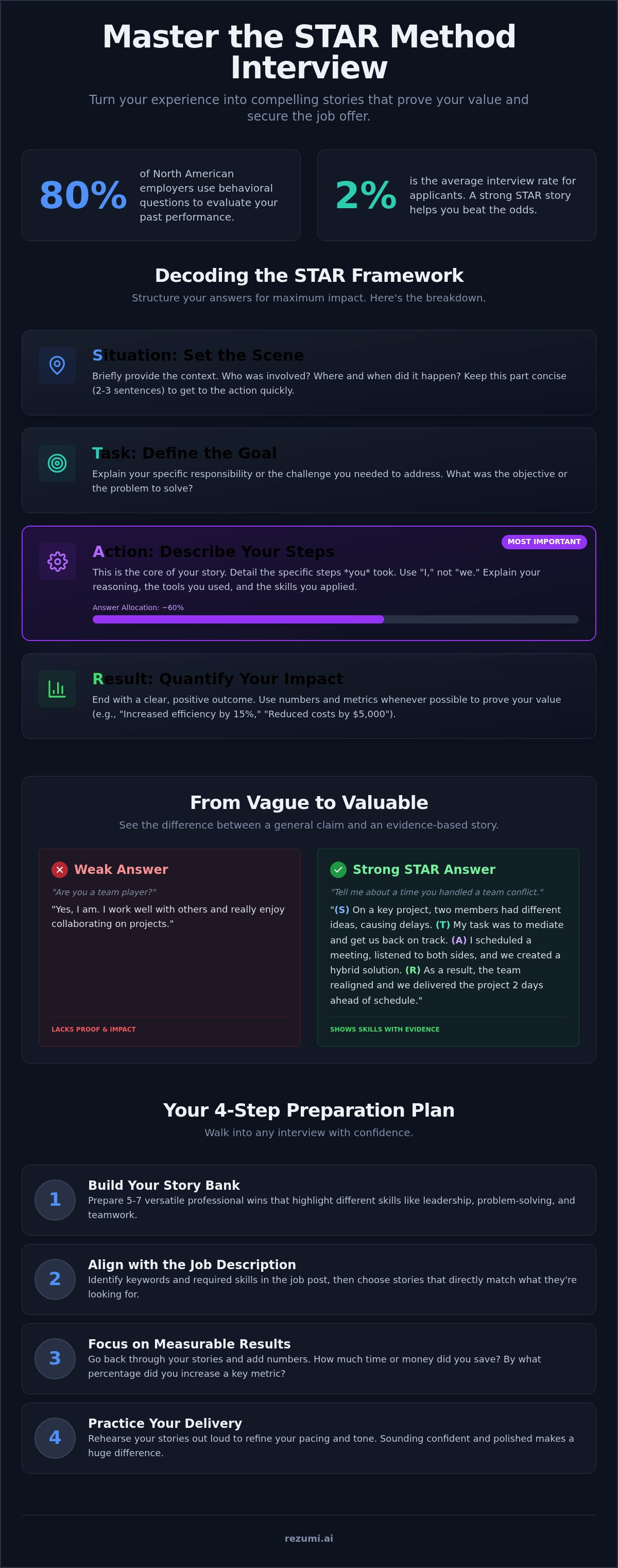
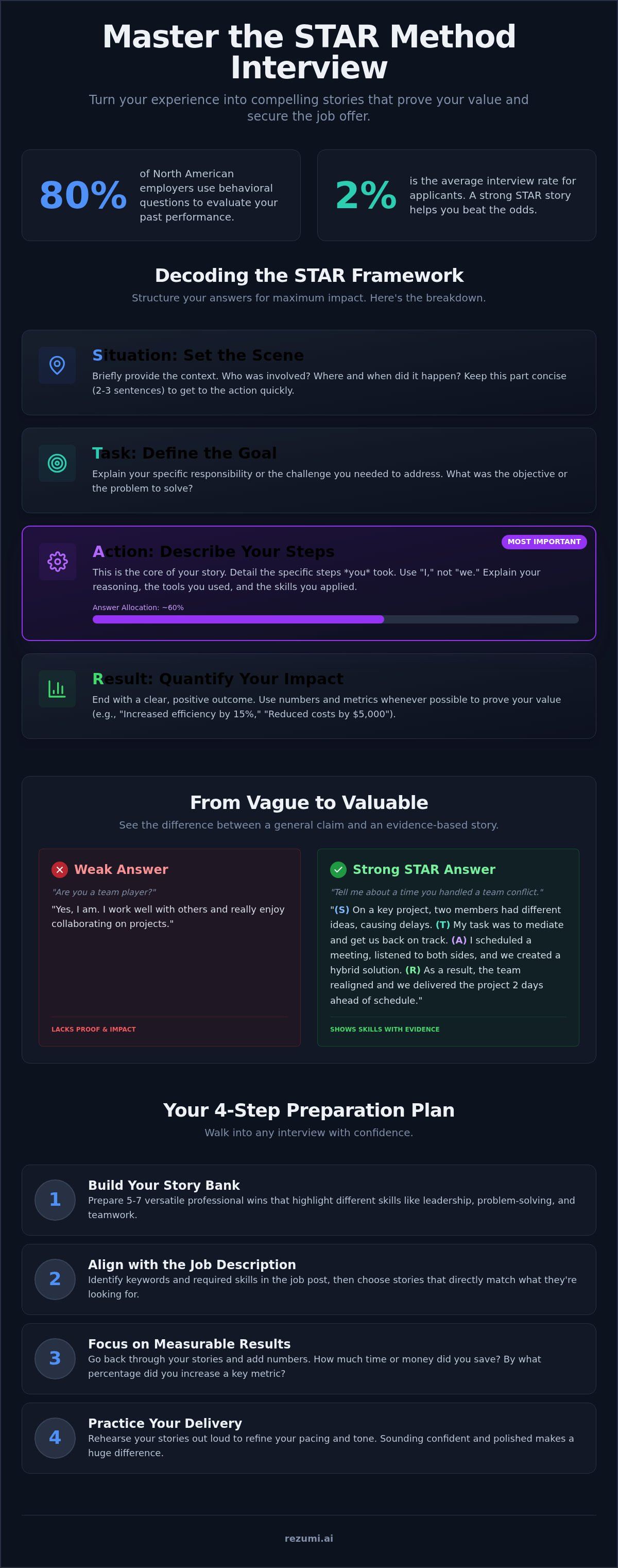
About 80% of North American employers use behavioral interviews to evaluate candidates. Your success depends on how you handle STAR method interview questions. Most applicants walk into the room with vague ideas instead of a clear plan. They ramble through their history and hope the recruiter finds the value. You need a better strategy to stand out in a market where only 2% of applicants receive an interview invitation.
It is normal to feel pressure when a hiring manager asks about your past mistakes or complex projects. You might worry about forgetting key details or feel that your experience isn't impressive enough. We understand these challenges. Our goal is to replace that uncertainty with data backed confidence. You deserve a clear path from the first screening to the final offer letter.
This guide teaches you how to structure your professional wins into high impact stories. You will learn to identify your best examples and format them for maximum clarity. We provide a bank of ready to use stories and techniques to handle unexpected questions. You will soon have the tools to command any interview room and secure a role at a top employer.
Key Takeaways
- Structure your past experiences using the Situation, Task, Action, and Result framework. This proves your professional value through logical, evidence-based storytelling.
- Prepare for the most common STAR method interview questions by building a bank of five to seven versatile professional wins.
- Move beyond general descriptions by detailing your specific responsibilities and the measurable impact of your actions.
- Align your stories with North American hiring standards by identifying the specific keywords employers value most in their job descriptions.
- Refine your pacing and tone with AI driven practice sessions. Data-backed feedback helps you sound confident and polished before the actual interview.
What Are STAR Method Interview Questions?
STAR is an acronym that stands for Situation, Task, Action, and Result. It is a logical framework designed to help you answer behavioral questions without rambling or losing the interviewer's attention. When you use this method, you transform your past experiences into structured stories that prove your value. Mastering STAR method interview questions is the most effective way to show recruiters that you have the skills they need.
You can identify these questions by how they begin. They typically start with phrases like "Tell me about a time when" or "Give me an example of a situation where." These are not simple yes or no questions. They require you to provide a specific narrative that demonstrates your abilities. The structure ensures you stay focused on the most important details. Situation sets the context. Task defines the challenge. Action explains your specific steps. Result shows the measurable outcome of your work.
Why Recruiters Love Behavioral Questions
Hiring managers use these questions to predict your future performance based on your past actions. They want to see your problem solving skills in action rather than just reading about them on a resume. Recruiters look for specific soft skills like teamwork, leadership, and resilience. It is easy for any candidate to claim they are a hard worker, but it is much harder to fake a detailed story about a specific project deadline you met under pressure.
Evidence based answers are more reliable than general statements. By asking for a story, the interviewer forces you to reveal your thought process and decision making style. This helps them understand how you interact with colleagues and how you handle professional stress. It removes the guesswork from the hiring process and gives them a clear picture of your actual capabilities. This approach is the standard for top North American employers who value data and concrete results.
The Difference Between General and Behavioral Questions
General questions focus on your traits, opinions, or goals. Behavioral questions focus on your actual proof. A general question might ask, "Are you a team player?" You could simply say yes and provide a vague explanation about liking people. A behavioral question asks, "Tell me about a time you resolved a team conflict." This shift forces you to move from generalities to specific evidence.
The STAR method interview questions format turns a simple "yes" into a compelling professional narrative. Instead of just saying you are good at your job, you show exactly how you do it. This technique helps you build a bank of ready to use stories that highlight your expertise. It gives you the confidence to handle unexpected prompts because you have a reliable structure to follow every time you speak.
Decoding the STAR Framework for Maximum Impact
Success with STAR method interview questions requires a precise balance of context and action. Most candidates spend too much time on the background and not enough on the actual solution. You must treat this framework as a strategic roadmap that guides the interviewer through your logic. Each of the four components serves a specific purpose in proving you are the right hire for the role.
The Situation and Task sections should be brief and direct. You need to set the scene by giving context about the project or challenge you faced. Limit this to two or three sentences to ensure you don't lose the listener's interest. Define your specific responsibility within that situation. If the team was failing to meet a quota, your task was to identify the bottleneck and fix it. Once the stage is set, you can move to the most critical part of your response.
The Action Phase: Where the Battle is Won
You should spend approximately 60 percent of your answer on the Action section. This is where you explain exactly what you did to handle the task. Recruiters look for your individual contribution, so you must use "I" instead of "we" throughout this part of the story. If you only talk about what the team did, the interviewer won't know if you were a leader or just a bystander.
Describe your specific steps in a logical progression. Mention the tools you used, such as specialized software or project management frameworks. Explain the reasoning behind your decisions to show your strategic thinking. For example, if you chose to reorganize a workflow, explain why that specific change was better than the alternative. This level of detail makes your expertise undeniable to a hiring manager.
The Result Phase: Proving Your Value
Every story must finish with a positive outcome that justifies your actions. North American hiring managers prioritize results that can be measured with data. Whenever possible, use clear metrics to show your impact. You might say you increased revenue by 20 percent or saved the company 10 hours of manual labor per week. These numbers provide concrete proof that your actions led to a meaningful win for your employer.
If you don't have hard numbers, focus on qualitative results. You can describe how you improved team morale or received a formal commendation from a client. The goal is to leave the interviewer with a clear mental image of your success. To ensure your stories hit these marks every time, you can check out our AI coaching tools to get real-time feedback on your structure and impact.
Top 10 STAR Method Interview Questions and How to Answer Them
You can prepare for almost any behavioral prompt by mastering a few core themes. Most STAR method interview questions test your ability to handle stress, work with others, or recover from mistakes. Recruiters want to see how you behave when things don't go according to plan. Having a bank of stories ready allows you to respond with precision instead of searching for words in the moment.
Common questions include:
- Tell me about a time you had to manage a heavy workload.
- Describe a situation where you had to deal with a difficult coworker.
- Give an example of a time you failed and how you handled it.
- Tell me about a project you are most proud of.
- Describe a time you disagreed with a manager's decision.
- Tell me about a time you had to learn a new tool quickly.
- Give an example of how you handled a sudden shift in priorities.
- Describe a time you went above and beyond for a customer.
- Tell me about a time you led a project with no formal authority.
- Give an example of how you used data to solve a problem.
Questions About Teamwork and Conflict
When asked about a difficult coworker, focus on your ability to remain professional and solution oriented. Explain how you put the company's goals above personal disagreements. This shows your communication skills and emotional intelligence in action. Don't complain about the person or vent your frustrations. Instead, describe the specific steps you took to reach a compromise that benefited the final project outcome. This approach proves you are a mature professional who prioritizes results over ego.
Questions About Problem Solving and Adaptability
Questions about heavy workloads or failures highlight your ability to think on your feet and stay calm under pressure. Mention specific technical tools or frameworks you used to solve the problem. If you are discussing a failure, explain how you learned from the situation to prevent future issues. This demonstrates resilience and a growth mindset. Employers value candidates who take ownership of their mistakes and implement better systems to ensure they don't happen again.
Sample Answer: Handling a Tight Deadline
The following example shows how to use the framework for a high stakes situation. You can adapt this structure for your own professional wins.
Situation: Our main developer fell ill two days before a major product launch.
Task: I had to ensure the final code review and deployment happened on time despite the missing resource.
Action: I reallocated tasks to the junior team and spent six hours personally auditing the critical path. I also set up a temporary communication channel to handle real time bug reporting from the testing team.
Result: We launched on schedule with zero critical bugs reported in the first 48 hours. The client was impressed with our team's speed and reliability under pressure.
Strategic Preparation: Building Your Story Bank
Don't wait for the interview to start thinking about your past. You need a bank of five to seven versatile stories ready before you log into the call. These examples should cover broad themes like leadership, overcoming failure, and achieving success. This proactive approach ensures you never get caught off guard by complex STAR method interview questions. It's about being strategic with your history rather than memorizing a script for every possible prompt.
By preparing these stories in advance, you can adapt one example to answer several different questions. A story about a difficult project could demonstrate both problem solving and teamwork. You simply shift the focus of your Action section based on what the interviewer asks. This flexibility allows you to remain calm and focused even when the pressure is high.
Aligning Stories with the Job Description
Your preparation must be tailored to the specific role you want. Read the job description carefully and highlight the keywords the employer values most. If the posting emphasizes "cross functional collaboration," you need a story about working with other departments. Use the exact terminology found in the posting to build instant rapport with the recruiter. This shows you speak their language and understand their specific needs.
Mapping your stories to these keywords acts as a bridge between your past and their future goals. If an employer wants someone who understands "agile project management," mention the specific tools you used in your past roles. Check your resume to ensure your verbal stories match your written accomplishments. This consistency proves you are the exact candidate they described in the job ad.
The 'So What?' Test for Every Story
Every story in your bank must pass the "so what?" test. Ask yourself if the result of your narrative actually matters to a hiring manager. If your story doesn't end with a measurable win, it won't land with impact. Focus on outcomes that save the company money, reduce project time, or improve the quality of a product. These are the results that North American employers prioritize when making hiring decisions.
Eliminate any minor details that don't contribute to the final success of the story. If a detail doesn't support your result, it's just noise that distracts the interviewer. Keep your focus on the actions you took and the data that proves those actions worked. This ensures your answers remain punchy and professional throughout the entire conversation.
Practice your stories out loud to ensure they flow naturally. Aim for a duration between 90 seconds and 2 minutes. This is the optimal window to provide enough detail without losing the listener's focus. Use a timer to track your pacing and refine your delivery for different STAR method interview questions. You want to sound like a professional who is in control, not someone who is rambling under pressure.
Command the Interview with Rezumi AI Coaching
Practice is the bridge between a good story and a job offer. Rezumi AI provides a safe space to rehearse your responses to STAR method interview questions without the pressure of a human audience. You don't have to worry about making mistakes or sounding awkward. The platform is built for refinement. You can repeat your stories as many times as you need until your delivery feels natural and confident.
Our AI Interview Prep module analyzes your pacing, tone, and the structure of your answers in real time. It specifically evaluates the strength of your Action and Result sections. As we covered earlier, these are the parts recruiters care about most. If your result is too vague, the AI will prompt you to add more data. This ensures every story in your bank is optimized for maximum impact.
Why AI Coaching Beats Traditional Mock Interviews
Human partners are helpful, but they aren't always available. You might have to wait days for a career advisor to have an opening. With AI coaching, you can practice 24/7. The system provides objective metrics that humans often miss. It tracks how long you speak and ensures you stay within the optimal two minute window.
One of the biggest hurdles in a behavioral interview is the use of filler words like "um" or "like." These small habits can undermine your authority and make you sound unprepared. Our AI identifies these patterns immediately. By eliminating these distractions, you project a professional image that aligns with North American hiring standards. You move from being a nervous applicant to a calm, technological expert.
Moving from Application to Job Offer
Securing a high paying role requires a complete strategy. You need an ATS optimized resume to get through the door and expert interview skills to close the deal. Rezumi acts as your strategic partner for the entire journey. You can track your progress over multiple sessions and see your confidence scores grow. This data backed approach replaces anxiety with a sense of control.
Technology has changed the way companies hire. You should use that same technology to your advantage. By combining your professional wins with AI driven coaching, you remove the anxiety of the unknown. You can access our full suite of AI tools to start your preparation today. This is how you take control of your career and move from applicant to employee.
Secure Your Next Career Move
Mastering STAR method interview questions is the final step in turning a strong resume into a signed offer letter. You now have a strategic framework to organize your professional wins into compelling stories. Recruiters don't just look for what you did. They want to see the specific actions you took and the measurable data that proves your success. This evidence based approach is what sets top candidates apart from the rest of the applicant pool.
Your preparation shouldn't stop at reading this guide. Building a versatile story bank and aligning your history with the job description gives you a massive advantage. Practice your delivery until your pacing is perfect and your confidence is undeniable. You are no longer guessing what the interviewer wants to hear. You are providing the exact proof they need to hire you.
Take these strategies and apply them with the help of professionals who understand the North American hiring system. You have the experience and the logic to succeed. It's time to walk into your next interview with total control over your professional narrative.
Frequently Asked Questions
How long should a STAR method answer be?
Aim for a duration between 90 seconds and two minutes. This timing provides enough detail to prove your expertise without losing the recruiter's attention. You should spend about 60 percent of this time on the Action phase. If you talk for less than a minute, you likely missed critical details. If you go over two minutes, you risk rambling. Keep your delivery punchy and focused on measurable results.
What if I cannot think of a specific example for a question?
It's acceptable to ask for a moment to collect your thoughts. Taking five to ten seconds to think shows you are a thoughtful professional. If a specific example doesn't come to mind, pivot to a story that demonstrates the core skill the interviewer is testing. For instance, if they ask about leadership but you haven't been a manager, tell a story about leading a project or mentoring a colleague.
Can I use the same story for multiple interview questions?
You can use the same story for different STAR method interview questions if you adjust your focus. A single project often involves teamwork, problem solving, and technical expertise. When you reuse a story, change the Action and Result sections to match the specific prompt. However, try to have at least five distinct stories in your bank. Relying on just one example for the entire interview makes your experience look limited.
How do I talk about a failure using the STAR method?
Focus on your growth and the corrective actions you took after the mistake. Briefly explain the Situation and Task, then spend most of your time on the Result. Describe the specific lessons you learned and how you changed your workflow to ensure the failure never happened again. Employers value candidates who take ownership of their errors. This approach shows you have a growth mindset and are committed to continuous professional improvement.
Should I write down my STAR stories before the interview?
Writing down your stories is an essential part of your preparation. It helps you identify the key metrics and logical steps that make your experience stand out. You don't need to memorize every word, but you should have a clear outline of each phase. This practice ensures you don't forget important details under pressure. Use these notes during your AI coaching sessions to refine your delivery and improve your confidence.
What are the most common behavioral questions for senior roles?
Senior candidates often face questions about long term strategy and leadership through change. Recruiters might ask about a time you had to make a difficult decision with limited data or how you managed a team through a major transition. They also look for stories about resolving high stakes conflicts between departments. Your answers should highlight your ability to manage complex systems and deliver results that impact the company's bottom line over several months.
How do I quantify my results if I do not work in sales or finance?
You can measure success even if your role doesn't involve direct revenue. Look for metrics like time saved, error reduction, or improved project completion rates. For example, if you organized a file system, you might have saved the team five hours of work per week. If you work in customer service, mention your satisfaction scores or response times. These numbers provide the concrete proof that North American hiring managers expect during the interview process.
Is the STAR method still relevant for remote interviews in 2026?
The framework remains the gold standard for remote interviews in 2026. Many companies now use AI tools to analyze the structure and logic of your responses during video screenings. These systems look for the logical progression of the STAR method interview questions to assess your communication skills. Using this structure helps you stay organized while speaking to a camera. It ensures your value remains clear even when you aren't in the same room.
Disclaimer
This article is provided for general informational purposes only and does not constitute professional, legal, financial, or career advice. While Rezumi strives for accuracy, we make no warranties as to the completeness or reliability of this content. Hiring practices, ATS behavior, and job-market conditions vary by employer, industry, and region — always verify against your specific situation. Any action you take based on this article is at your own risk.