The Truth About Free ATS Resume Checkers: Myths and Realities in 2026
A high score on a free ats resume checker is often a vanity metric that hides the real reasons your application is failing. You have likely spent hours adjusting margins and hunting for keywords to satisfy an online algorithm. It feels productive when the bar turns green. Then the reality hits. You receive a generic rejection email from Workday or Taleo minutes after applying. You are doing the work, but the results are not following. It is a frustrating cycle that leaves many qualified professionals feeling invisible.
This guide explains why these scores can be misleading and how to actually optimize your resume for the North American market. You will learn the truth about how modern semantic search works in 2026. We will expose the formatting traps that trigger automatic rejections and provide the strategic steps needed to turn your applications into real conversations with top-tier employers. It is time to move past the score and start landing interviews.
Key Takeaways
- Understand why a high score on a free ats resume checker is a vanity metric that doesn't guarantee a human will ever see your application.
- Learn how modern hiring systems use semantic search (AI logic that understands meaning) to evaluate your experience beyond simple keyword matching.
- Use the "Save as Plain Text" method to reveal the hidden formatting errors that cause modern systems to misread your data.
- Master the specific North American formatting rules, such as using US Letter paper size, to avoid technical rejections.
- Transition from passive checking to proactive optimization by tailoring your resume so it's ready for the specific needs of recruiters.
What is a free ATS resume checker and the score trap?
A free ats resume checker is a diagnostic tool. It is designed to simulate how an Applicant Tracking System (ATS) reads your document. In 2026, over 98% of Fortune 500 companies use these systems to filter the thousands of applications they receive. The checker scans your file, extracts the text, and compares it against a job description. Most tools then provide a percentage score. This number is meant to represent your match rate for a specific role.
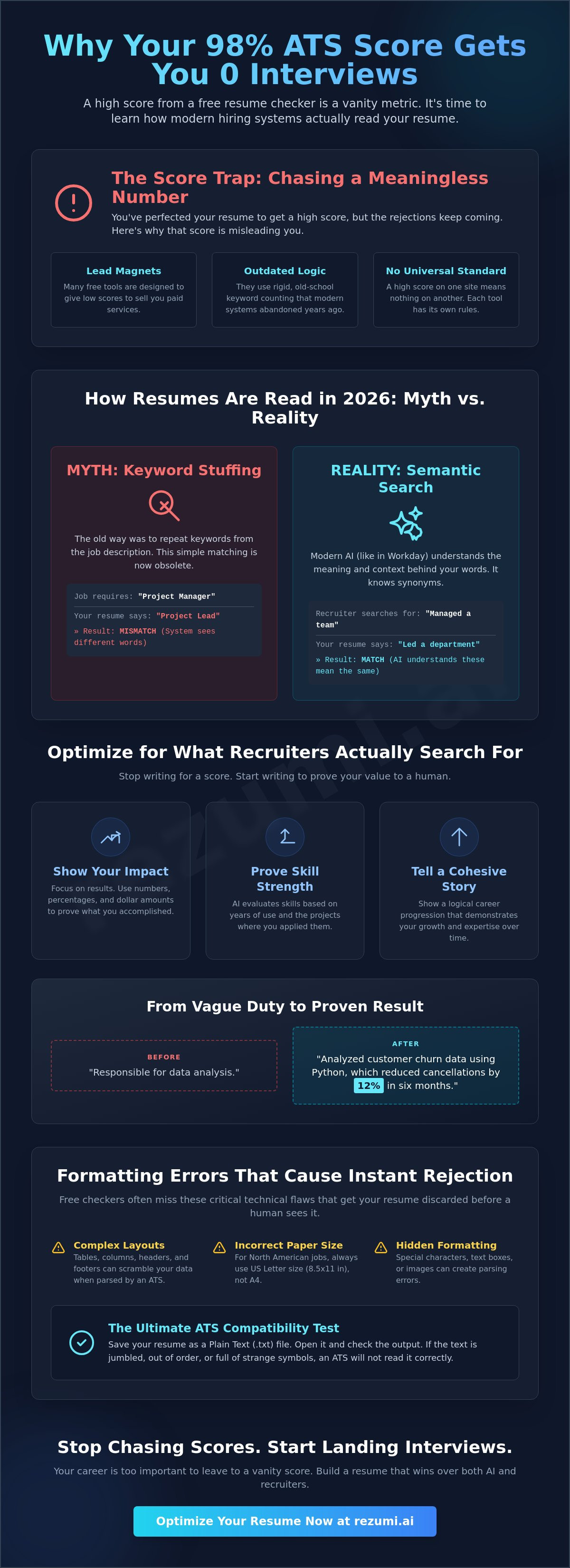
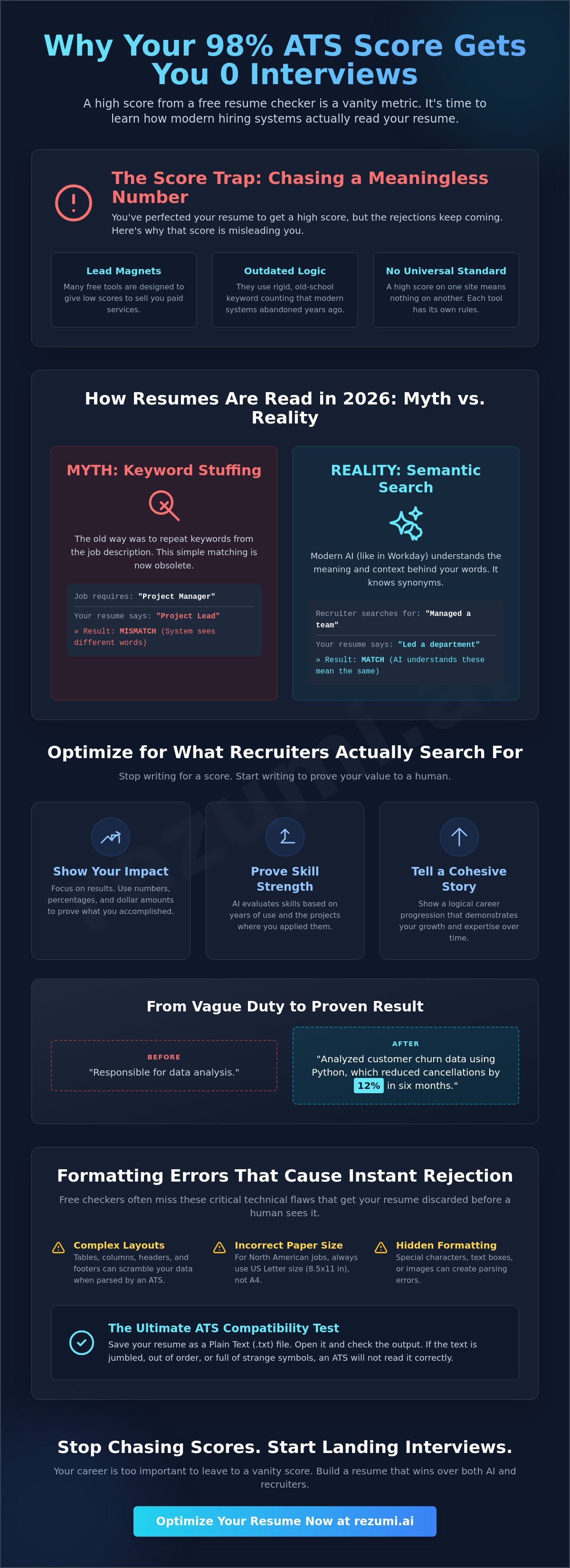
Many job seekers fall into the score trap. Most free tools are lead magnets for paid services. They are often programmed to give lower scores to create a sense of urgency. You see a 45% match and feel a rush of anxiety. You think your resume is the problem. In reality, the tool might be using a rigid, outdated algorithm that doesn't reflect how recruiters actually work. This explains why your resume gets a high score on one free ats resume checker but fails on another. There is no universal standard. Each tool uses its own proprietary logic to decide what "good" looks like.
How these tools calculate your initial score
The process begins with a parser. This is a program that strips away your headers, footers, and styling. It turns your resume into a plain text file. The tool then performs three main checks to generate your score:
- Text Extraction: It identifies key sections like Education, Experience, and Skills. If your layout is too complex, the parser might miss these sections entirely.
- Keyword Comparison: It counts how many times specific terms from the job description appear in your text. It looks for exact matches rather than context.
- Formatting Validation: It looks for characters, tables, or columns that might break a real system.
Why a 100 percent score can still lead to a rejection
A perfect score does not guarantee an interview. You can "game" most checkers by repeating keywords over and over. This is called keyword stuffing. While the software might give you a 100 percent match, the human recruiter who sees it next will see right through the tactic. Recruiters prioritize the impact of your work, not just the vocabulary you use. A checker cannot tell if your experience is high quality. It only knows if the words are present. You might have the right keywords but lack the actual years of experience or the specific industry background the company needs. A score is a measure of visibility. It is not a measure of talent.
Myth vs Reality: Why keyword stuffing no longer works
Old applicant tracking systems were simple scanners. They looked for exact matches of specific words. If a job description asked for a "Project Manager" and you wrote "Project Lead," you were often invisible. Those days are over. In 2026, hiring technology has moved toward semantic search. This means the computer understands the meaning and intent behind your phrasing. If you use a free ats resume checker that only tells you to add more keywords, you are following an outdated strategy. These tools often ignore the logic that modern recruiters actually use.
Semantic search identifies that "Managed a team" is the same as "Led a department." You don't need to guess which specific synonym a recruiter typed into a search bar. The AI handles the translation for them. Your real goal is to provide the proof of your skills rather than just repeating the names of those skills. The robot is reading for logic. The human is reading for value. You must satisfy both to land an interview.
The shift from simple scanners to AI parsing
Modern systems like Workday now use machine learning to categorize your career history. They don't just see the word "Sales" and move on. They analyze the "strength" of that skill based on how many years you used it and where it appears in your timeline. The AI can identify if your bullet points actually prove the skill you claim to have. It looks for a logical progression in your responsibilities. If your resume lacks this context, even a high score from a free ats resume checker won't save you from a rejection.
Why context matters more than frequency in 2026
Frequency is a myth that can hurt your chances. Mentioning "Python" ten times in your skills section is less effective than describing one major project where you used it to solve a problem. Recruiters search for outcomes like revenue, time saved, or growth. They want to see how you used your tools to create a result. For example, instead of just listing "Data Analysis," write: "Analyzed customer churn data using Python, which reduced cancellations by 12 percent in six months." This provides a real number that proves your worth.
Writing for the modern market requires a balance of technical accuracy and human storytelling. You can see how your current document measures up by exploring our ATS resume optimization options. Stop focusing on how many times a word appears. Start focusing on the impact those words describe. Every bullet point should be a data-backed argument for why you are the best fit for the role.
Formatting secrets that free checkers often miss
Your resume layout is the foundation of your application. If the structure is broken, the content doesn't matter. Most job seekers rely on a free ats resume checker to spot these errors, but these tools have a major blind spot. They often use global standards that don't apply to the specific needs of the North American market. You might get a passing grade from a tool while your resume is actually unreadable to a recruiter in New York or Toronto.
One common mistake is the paper size. In the US and Canada, the standard is US Letter (8.5 by 11 inches). Much of the rest of the world uses A4. If you use a template designed for the European market, your resume might look perfect on your screen. However, when a recruiter tries to print it or view it in a system like Taleo, the margins may cut off important contact details or dates. This small technical error can make you look unprofessional before a human even reads your first bullet point.
Fonts also play a critical role in high-speed parsing. Stick to standard, web-safe fonts like Arial, Calibri, or Georgia. These are designed for digital clarity. Avoid decorative or "unique" fonts that require custom software to display correctly. If the ATS can't recognize the character set, it will replace your text with garbled symbols. A free ats resume checker might extract the text successfully, but it won't warn you if the font choice will cause a display failure on the recruiter's end.
The North American standard for resume design
Simplicity is your best strategy. You should always use a single-column layout. Modern parsers read from top-to-bottom and left-to-right. When you use multiple columns, the software often blends the text from both sides into a single, nonsensical sentence. This ruins your professional narrative. You also need to avoid putting critical information in headers or footers. Many systems treat these areas as "dead zones" and ignore them entirely. If your phone number is only in the header, the recruiter won't know how to call you. Use standard section titles like "Professional Experience" or "Education." Creative titles like "My Journey" confuse the algorithm and may cause it to skip that section.
Why your PDF might be unreadable to an ATS
Not all PDFs are created equal. Some PDF generators, especially older ones or specific "Portfolio" style tools like Canva, turn your text into a flat image. To a computer, your resume looks like a photograph of a document rather than a text file. The scanner sees nothing. You can test this yourself in seconds. Open your resume file and try to highlight a sentence with your mouse. If you can't select and copy the text, the ATS can't read it either. Avoid templates that use complex layers, graphics, or tables. These elements create "noise" that breaks the reading flow of the software. A clean, text-based document is the only way to ensure your data arrives intact.
How to manually check your resume for ATS compatibility
You don't always need an external tool to find major formatting errors. While a free ats resume checker provides a quick baseline, it often misses the fine details that cause a technical rejection. You can perform a deep diagnostic check yourself in under two minutes. This manual audit shows you exactly what the hiring software sees before it reaches a recruiter's desk. It is the most reliable way to ensure your contact information and experience are parsed correctly.
Start by checking your contact details. Your name, phone number, and email address must be at the very top of the document. Never place this information inside a text box or a graphic element. Most applicant tracking systems cannot see inside these containers. If your details are trapped in a text box, the recruiter might see a blank profile. This leads to an instant rejection because they have no way to contact you. Keep your header simple and text-based.
The Plain Text test you can do in seconds
Open your resume in your word processor. Save the file as a Plain Text (.txt) document. This action strips away all the visual styling, leaving only the raw data. Open that new text file and review it closely. Look for these specific red flags:
- Missing words: If sentences end abruptly, the parser is failing to read your document.
- Strange spacing: Words that are smashed together or have massive gaps between them will confuse the search algorithm.
- Incorrect order: If your Skills section appears in the middle of your Experience section, your layout is too complex.
Identifying hidden formatting errors in your PDF
PDFs are great for preserving design, but they can hide technical flaws. Open your final PDF file. Select all text, copy it, and paste it into a blank Notepad window. This reveals ligatures. These are characters like "fi" or "fl" that are stuck together as a single image. Old scanners might read "field" as "eld" because they cannot recognize the combined "fi" character. You should also verify your date formats. Use a consistent MM/YYYY format. This allows the system to calculate your tenure accurately. If the system cannot read your dates, it might assume you have zero years of experience.
Manual checks are the first step toward a perfect application. If you want to move beyond basic checks and ensure every bullet point is optimized for success, explore our professional ATS resume optimization services. We help you fix these technical gaps so you can focus on the interview.
Moving from checking to true resume optimization
Checking your resume is a passive act. It is like looking at a flat tire without picking up a wrench. A free ats resume checker might tell you that your document has issues, but it won't fix them for you. Optimization is a proactive strategy. It is the process of intentional refinement to ensure you aren't just "passing" a test, but actually winning the job. In the competitive North American market, you need a document that speaks the language of both the algorithm and the hiring manager.
Tailoring your resume for every single job description is the only way to stay ahead in 2026. Generic resumes are easy for AI to ignore. When you optimize, you are telling the employer exactly how your past success solves their current problems. This requires a shift in mindset. You are no longer just listing your history. You are building a data-backed argument for your own value. If you want to stop receiving instant rejection emails, you must move beyond basic checking.
Tailoring your resume for specific job descriptions
The job description is your cheat sheet. You don't have to guess what the company wants because they have already told you. Start by identifying the top three skills mentioned in the posting. Place these skills directly in your professional summary. This ensures the parser identifies you as a high-match candidate immediately. You should also use the exact phrasing from the job post for your job titles when it is accurate. If the company is looking for a "Customer Growth Lead" and your previous title was "Senior Account Manager," adjusting your title to reflect the growth focus can help the AI categorize you correctly.
Link your achievements directly to the company's goals. If the job post mentions increasing efficiency, your bullet points should highlight how you saved time or reduced costs in your previous roles. Use real numbers and percentages to prove your impact. This provides the context that modern semantic search systems crave. It shows that you don't just have the skill, but you know how to use it to get results.
Using Rezumi to align with hiring standards
Rezumi is designed to bridge the gap between your experience and complex hiring standards. We provide real-time feedback that goes deeper than a standard free ats resume checker. Our system analyzes your resume against specific North American benchmarks to ensure your tone and formatting match local expectations. You get instant suggestions to improve your phrasing and fill skill gaps before you hit the submit button.
Optimization doesn't stop at the resume. Our platform also generates AI-powered cover letters that perfectly complement your document. This creates a unified professional brand that stands out to recruiters. You can take control of your career path right now. Check out the Rezumi pricing plans to start your optimization today. Stop settling for a "passable" score and start landing the interviews you deserve.
Take control of your career path
A high score on a free ats resume checker is only the beginning of your journey. You now understand that modern hiring systems in 2026 prioritize context and semantic meaning over simple keyword counting. Success requires a document that satisfies the technical requirements of a parser while proving your actual value to a human recruiter. By simplifying your layout and focusing on data-backed achievements, you remove the technical barriers between your experience and a top-tier interview.
Our platform was built by global professionals specifically for the North American market. We provide AI-driven real-time resume feedback and a centralized workspace to manage your entire search. You don't have to guess if your resume is working anymore. View Rezumi pricing and start optimizing your resume to turn your applications into job offers. Your expertise deserves to be seen. You have the tools and the knowledge to stand out. It is time to stop checking and start winning.
Frequently Asked Questions
Is a free ATS resume checker safe to use?
Most free tools are safe for a basic diagnostic, but you should always review their privacy policy before uploading your document. Some platforms collect your personal data or resume content to sell to third-party recruiters or to train AI models without your consent. It is safer to use a trusted platform that follows North American privacy standards and focuses on protecting your professional information.
What is the best file format for an ATS-friendly resume?
A text-based PDF is the gold standard for job applications in 2026. It preserves your design and formatting while allowing the software to extract your text accurately. You can also use a standard Word document (.docx) if the job posting specifically requests it, but avoid using image-based files or formats like .pages which many systems cannot read.
How do I know if my resume is ATS-friendly?
You can verify your document by copying all the text and pasting it into a basic Notepad file. If the words appear in the correct order and your contact details are visible, your resume is likely compatible. This simple manual test is often more reliable than the feedback from a generic free ats resume checker because it shows you exactly what the parser sees.
Can an ATS read resumes with two columns?
Most applicant tracking systems struggle with multi-column layouts. They often read across the entire page from left to right, which jumbles the text from both columns into a nonsensical sentence. You should use a single-column layout to ensure the software reads your experience and skills in the correct logical order.
Do I need a different resume for every job application?
You must tailor your resume for every role to remain competitive. You don't need to rewrite your entire history, but you should adjust your professional summary and your top bullet points to match the specific priorities of the job description. This alignment proves to both the algorithm and the recruiter that you have the exact experience they need.
Why did a free checker give me a low score even though I have the right skills?
A free ats resume checker might give you a low score if it relies on outdated exact-match keyword logic. If you use a synonym like "Staff Management" instead of the job post's "Team Leadership," an old system might mark you as a zero percent match. Focus on providing context and measurable results rather than just chasing a perfect score on a limited tool.
Will an ATS reject my resume if I use a template?
The system will not reject you simply for using a template, but it will fail if the template is poorly designed. Avoid templates with heavy graphics, tables, or complex layers that hide your text from the scanner. A clean, professional template that follows a standard top-to-bottom flow is perfectly safe for modern hiring systems.
How can I beat the ATS in 2026?
You win by writing for the human recruiter while satisfying the technical needs of the software. Focus on semantic search by describing your achievements with real numbers and percentages rather than just listing job duties. Ensure your document uses North American standards, such as US Letter paper size and standard section titles, to avoid technical glitches.
Disclaimer
This article is provided for general informational purposes only and does not constitute professional, legal, financial, or career advice. While Rezumi strives for accuracy, we make no warranties as to the completeness or reliability of this content. Hiring practices, ATS behavior, and job-market conditions vary by employer, industry, and region — always verify against your specific situation. Any action you take based on this article is at your own risk.