Ways to Stay Motivated When Job Hunting With Daily Goals
A job search needs structure, not an endless workday. A focused block of four hours a day can give you time to apply, make connections, and improve your materials without letting the search take over your life. To learn how to stay motivated when job hunting, set clear daily goals and track progress you can control, not just replies from employers.
It’s normal to feel discouraged when applications go unanswered. A steady routine can help you keep moving while making room for rest, reflection, and support from others.
You’ll find practical ways to balance job hunting with the rest of your life, set achievable daily targets, and respond to setbacks without losing momentum. You’ll also learn how networking and simple reflection habits can help you see progress, adjust your approach, and keep the search manageable.
Key Takeaways
- Set a focused daily job-search block and protect time for rest, work, and personal commitments.
- Use journaling and coping strategies that have helped you through past challenges to manage stress.
- Choose achievable daily goals, then review your progress with an accountability partner or simple tracker.
- Treat rejection as information, not a verdict, and use reflection to decide what to adjust next.
- Build networking into your routine by tracking conversations, following up, and asking for introductions.
1. Balancing job-search time with other activities
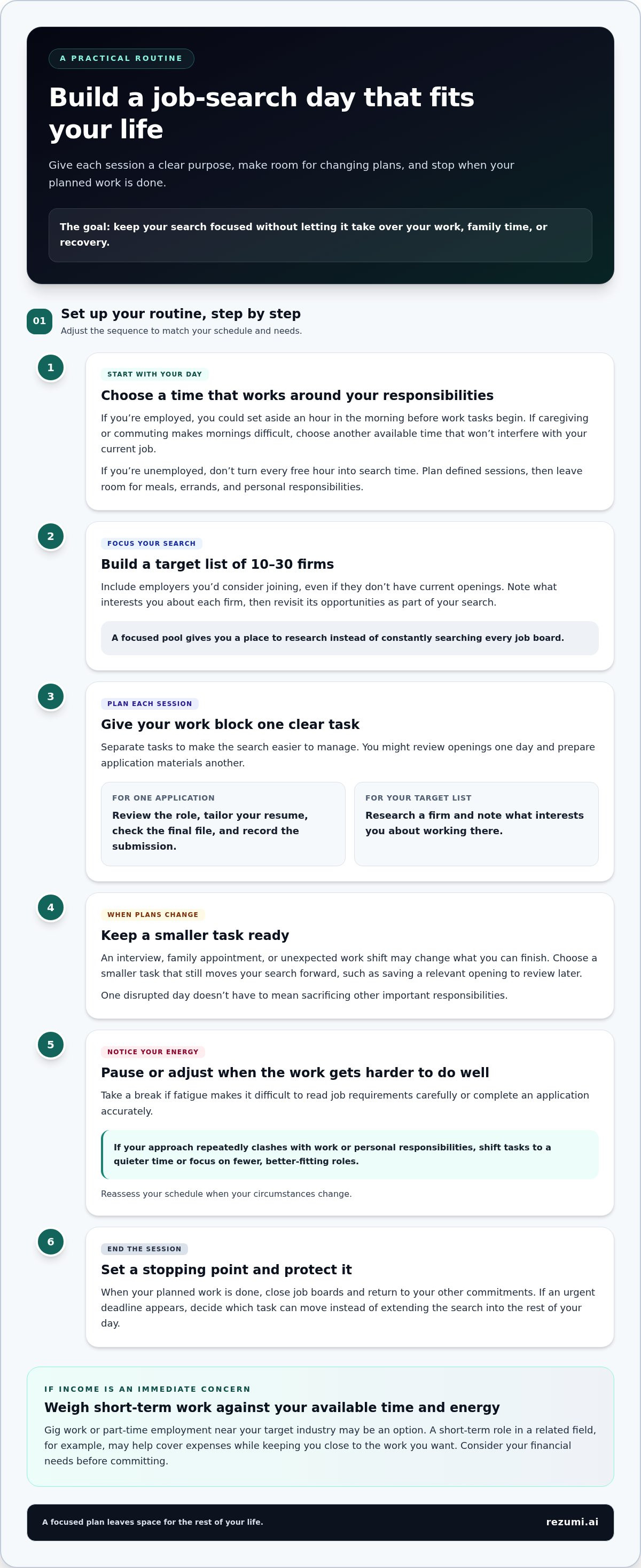
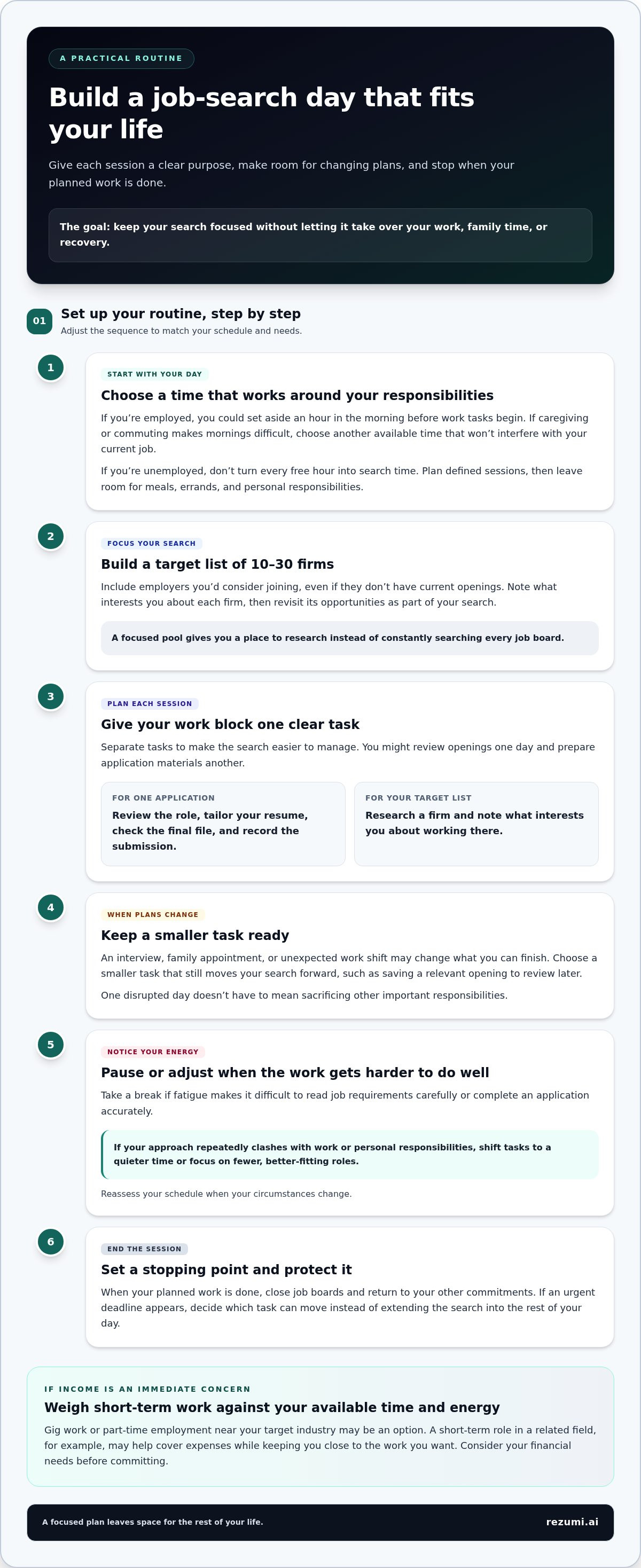
Build your search around the responsibilities that already shape your day. If you’re employed, protect a block of time before work tasks begin to review a suitable opening and tailor your materials. If mornings clash with caregiving or commuting, choose another available period that won’t interfere with your current job.
When you’re unemployed, don’t treat every free hour as job-search time. Choose a defined task for each session, then leave room for meals, errands, and personal responsibilities. For example, review openings one day and prepare application materials another. Separating tasks can make the search easier to manage alongside everyday life.
Keep a target list of 10-30 firms you’d consider joining. Include employers even when they have no current openings. This gives you a focused pool to research instead of requiring constant searches across every job board. Note what interests you about each firm, then revisit its opportunities as part of your search.
If income is an immediate concern, consider gig work or part-time employment near your target industry, if possible. A short-term role in a related field, for example, may help cover expenses while keeping you close to the work you want. Weigh each option against your available time, energy, and financial needs before committing.
Plan for different kinds of days. An interview, family appointment, or unexpected work shift may change what you can complete. Choose a smaller task that still moves the search forward, such as saving a relevant opening to review later. This keeps one disrupted day from forcing you to sacrifice other important responsibilities.
Take a break when fatigue makes it hard to read job requirements carefully or complete an application accurately. Change your strategy if your current approach repeatedly conflicts with work or personal responsibilities. For example, shift application tasks to a quieter time or focus on fewer, better-fitting roles. Reassess your schedule when circumstances change.
Set a clear stopping point for job-search tasks. When the planned work is done, close job boards and return to your other commitments. If an urgent deadline appears, decide which task can move rather than extending the search into the rest of your day. This boundary helps protect time for work, family, and recovery.
For employed job seekers, setting aside an hour in the morning for applications can leave the rest of the day for work and other duties. One answer recommends working for 18hrs to complete all job-search objectives in a day, a demanding schedule to weigh against personal responsibilities.
2. Coping strategies and journaling
During a long search, use a short journal, a familiar coping habit, and one manageable next step. These actions help you process rejection without treating it as a judgment of your worth. After an unanswered application, for example, write down what happened, what you can control, and the next task you’ll complete. Keep it specific, such as revising one resume bullet or preparing a follow-up message.
Set aside 20-30 minutes for journaling. Start with three prompts: “What am I feeling?”, “What happened today?”, and “What will I do next?” Separate facts from assumptions. “I haven’t received a reply” is a fact; “I’ll never get hired” is an assumption. This distinction helps you focus on the next useful action instead of letting one outcome define the whole search.
Recall coping strategies that helped you through past challenges. If a walk helped during a difficult exam period, schedule one after application work. If talking with a friend helped during a stressful project, arrange a regular check-in. Choose stress-reduction activities that suit your needs and routine, then plan them in advance. A break works best as a deliberate part of your day, not another reason to criticize yourself.
If you’re unemployed, manage stress and finances by listing essential expenses, reviewing available funds, and setting a spending plan. Separate necessary costs from expenses you can pause, then choose a regular time to review the plan. Keeping money decisions visible can ease the pressure of guessing and help you decide how much time to devote to job-search tasks.
Use a simple weekly money check-in. Record upcoming bills, expected income, and spending you can delay. If the numbers feel difficult to manage, talk through the plan with someone you trust. A family member or friend, for example, can help you sort priorities without taking over your decisions. Keep job-search goals realistic alongside financial needs, and consider income options that fit your circumstances.
When discouragement rises, use a repeatable reset: step away from the screen, name the immediate concern, and choose one action within your control. A journal entry might read, “I’m frustrated by the silence. Tomorrow, I’ll review my resume for one role.” This won’t control employer responses, but it gives your next work session a clear starting point. Notice which coping habits help you refocus, then keep them in your routine.
3. Daily job-search goals and accountability
Daily goals make a job search easier to manage and review. Choose actions you control, such as tailoring an application or contacting someone. Don’t measure a day only by employer replies, which depend on other people. A completed task gives you a clear record of effort and helps you spot where your routine needs adjustment.
Keep your targets realistic. Sending 500 resumes at the start can push you toward rushed, generic applications. Instead, set a target that leaves time to read each job description and match your experience to its requirements. An example goal is 15 emails or applications per day. Treat that as a sample, not a quota that overrides fit.
Break a large target into specific tasks. For one application, you might review the role, tailor your resume, check the final file, and record the submission. Then note what remains, such as preparing a follow-up. This task-based approach makes progress clear, even when an employer hasn’t responded.
Use calendar blocks to give each task a place. One sample routine reserves 1 to 3 p.m. for following up on jobs, then 3 to 4 p.m. for contacting people on LinkedIn. Adjust the timing to your responsibilities. The useful part is assigning a purpose to each block, rather than leaving the whole afternoon open-ended.
A 05:30 alarm appears in one example of a job-search routine, but an early start isn’t required. Choose a start time that fits your sleep, work, and family commitments. Before ending the day, write down tomorrow’s first task. A clear next step can reduce time spent deciding where to begin.
Track actions in a simple spreadsheet or notebook. Record the employer, role, application date, follow-up date, and current status. Add a short note when you tailor your resume for a role. This record helps you avoid duplicate applications and gives you useful details if an employer contacts you.
Accountability can make a plan easier to follow. Share your weekly goals with a trusted friend, then report what you completed. Keep the discussion focused on actions, not promises of interviews. Review whether you completed planned applications, follow-ups, and outreach, then adjust the next week’s schedule.
At the end of each work block, compare planned tasks with completed ones. If a task took longer than expected, revise tomorrow’s plan instead of adding hours without thought. Keep targets flexible enough to allow for interview preparation or a new opportunity. A sustainable routine helps you take deliberate steps through a changing search.
4. Managing expectations and discouragement
Employer silence can feel personal, but it doesn’t explain why an application stalled. A decision may depend on role fit, timing, or other candidates. Separate what you know from what you’re assuming. “I haven’t heard back” is a fact. “I’ll never find work” is a conclusion the silence can’t prove.
Use a sample funnel to set expectations, not predict your outcome. Fifty applications and 20 LinkedIn messages could lead to 10 responses, four interviews, second interviews with two companies, and one offer. The stages help explain why effort may not create an immediate result. Track each stage separately, so you can see where your process needs attention.
If you’re sending applications but getting few responses, review role fit and your materials. If conversations happen but interviews don’t follow, examine how you describe your experience. If interviews end before later rounds, practice clearer examples for common questions. Change one part at a time, then observe whether your next applications or conversations improve.
One job seeker described applying for about 75 jobs and receiving about 70 rejections while seeking a first professional role after graduate school in the late ’90s. That account shows how rejection can accumulate without defining a person’s ability. Your own search has different conditions, so use the example as perspective, not a required number of applications.
Job-search timelines can also stretch beyond your plan. One technology job seeker was advised in Q4 of 2023 to expect a year-long search, then completed it in two years. That experience doesn’t set your timeline. It does show why a fixed deadline can create pressure when hiring takes longer than expected.
After a rejection or other bad news, take three actions to respond constructively. First, record what happened without adding assumptions. Second, identify one adjustment you can make, such as refining an interview example. Third, choose a useful action, like contacting someone relevant or moving on to another suitable role. This turns a setback into a clear next step.
A practical way to stay motivated when job hunting is to track actions and lessons alongside outcomes. At the end of each week, review applications, replies, interviews, and what you’ve learned. If the same stage repeatedly stalls, adjust your process there. If you’re progressing, keep your routine steady. This review gives you evidence for your next decision, rather than letting one difficult day set the direction.
5. Networking beyond existing contacts
Expand your network by speaking with people connected to your target field, not only friends and former coworkers. One job seeker spent four hours a day communicating in person or on LinkedIn, and less than an hour seeking openings. That approach prioritizes conversations, but keep time for both outreach and finding roles that fit.
Make each message specific. Mention the person’s role, organization, or a shared professional interest, then explain what you’d like to learn. For example, ask a product designer how their team works with researchers. A focused question is easier to answer than a general request for help finding a job.
Use informational conversations to learn about work, teams, and hiring needs. Ask which skills matter in their role or how their organization approaches a common challenge. Keep the conversation focused on their experience. Before ending, ask whether they recommend someone else you could speak with. That question can introduce you to another relevant contact.
Networking can also help you learn about firms before they post an opening. Reach out to people at organizations that interest you, even when no role is advertised. A conversation may help you understand the team’s work and recognize a suitable opening later. Jay Hawkinson says over 70% of jobs are found through networking, but conversations still need to be genuine and relevant.
Track your contacts in a spreadsheet. Include each person’s name, organization, how you found them, notes, and planned follow-up. For example, record meeting a marketing manager at an industry event and discussing campaign reporting. Add a date to reconnect so useful conversations don’t disappear into your inbox.
Review your spreadsheet weekly and schedule follow-ups on your calendar. A short message can mention a detail from your last conversation, share a useful update, or thank the person for their time. Avoid sending the same generic note to every contact. A specific reminder makes it easier for both of you to continue the discussion.
Set a networking target that fits your schedule, such as attending two networking events per week. Prepare a short introduction before each event, then identify people whose work connects to your goals. Afterward, add useful contacts to your tracker and send a personal follow-up. Measure conversations and follow-ups, not just new connections.
Use networking to add context to your applications, not replace them. Insights from a conversation can help you understand an organization’s needs and explain your fit more clearly. Pair what you learn with focused applications, then note which conversations lead to useful next steps.
Rezumi: ATS Resume Optimization
Rezumi helps you prepare application materials with ATS Resume Optimization, which tailors your resume to a job description. An applicant tracking system, or ATS, helps employers manage applications. Use resume optimization when you’re ready to apply for a specific role and want to present your experience clearly against its requirements.
You can also use the AI Cover Letter Generator to draft role-specific letters, AI Interview Prep to practice responses, and Resume Design & PDF Export to format your resume. These tools support the application process; your daily goals, networking, and reflection remain yours to manage.
Visit rezumi.ai to explore Rezumi’s career tools.
Keep your next move within reach
A job search can change direction as you learn which roles fit and where your applications need work. Let what you learn guide your next decision. Choose one action you can complete, then review what it taught you before setting another target.
The answer to how to stay motivated when job hunting isn’t to feel confident every day. It’s to keep making deliberate choices, even when a result disappoints you. You can pause, reassess your approach, and continue with a clearer sense of what matters to you.
If preparing applications is taking time away from your search, Rezumi’s career tools can help with that part of the process. Explore them as a practical next step, while keeping your goals and decisions in your hands.
You don’t need to solve the whole search today. Take the next useful step, and give yourself credit for moving forward.
Frequently Asked Questions
How can you set realistic weekly goals for job hunting?
Start with your current search stage, then choose goals that address its main need. If you’ve found suitable roles but don’t have tailored materials, prioritize preparing them. If applications are already out, focus on interview practice or researching employers. Separate essential goals from optional ones so an unexpected interview or personal commitment doesn’t derail your plan.
How many jobs should you apply to per week for the best results?
There’s no single weekly application count that fits every search. A role requiring a tailored resume and thoughtful responses takes different effort from a straightforward application. Apply when the position matches your experience and priorities, rather than chasing a quota. If you’re unsure whether a role fits, compare its core duties with work you’ve done and skills you can demonstrate.
How can you handle job-search rejection and avoid burnout?
After a rejection, separate the employer’s decision from your view of your abilities. If you interviewed, write down which answers felt clear and where you struggled to give a specific example. Use that note to prepare for a future interview. If the rejection brings up strong feelings, step back before making a major career decision or abandoning a field you still want to pursue.
What daily routine helps keep a job search organized and manageable?
Choose a routine that matches the work due that day. Before an interview, review the job description and prepare examples that show your relevant skills. Before submitting an application, check that your resume and cover letter name the correct role and employer. Group similar tasks, such as reading postings or preparing interview answers, to reduce unnecessary switching.
How can networking help you stay motivated and find job opportunities?
Networking can expose you to career paths and skills you may not see in job postings. Join a professional discussion related to your field, contribute a useful comment, or share a project that shows how you approach work. These exchanges let you participate before you need a referral. They can also help you learn whether a role’s daily work matches your interests.
How can you track applications and measure progress while job hunting?
Look for patterns by grouping applications by role type or where you found them. If one group leads to more relevant conversations, examine what those roles share before changing your approach. Record which resume version you used, too. This helps you compare materials fairly and avoid drawing broad conclusions from a single employer’s response.
Disclaimer
This article is provided for general informational purposes only and does not constitute professional, legal, financial, or career advice. While Rezumi strives for accuracy, we make no warranties as to the completeness or reliability of this content. Hiring practices, ATS behavior, and job-market conditions vary by employer, industry, and region — always verify against your specific situation. Any action you take based on this article is at your own risk.