What Hiring Managers Look for: 2026 Resume Guide
A resume can echo a job posting and still fail to make a convincing case. If you’re wondering what do hiring managers actually look for in a resume, start with credible evidence of fit: relevant skills, clear contributions, and results you can explain. Keywords can help your resume match a role, but a list of terms won’t replace proof.
Your resume may also need to pass through an applicant tracking system, or ATS, before a recruiter reviews it. An ATS can help organize applications, so use clear section headings, simple formatting, and job-related wording that accurately describes your experience. Once a person reads your application, make it easy to see how your background connects to the work.
This guide shows you how to identify the signals hiring managers use to assess fit, describe your impact without overstating it, and tailor your resume to a specific role. You’ll also learn how to use keywords naturally and make your experience easier to scan. The goal is a resume that’s accurate, focused, and clear to both automated systems and human reviewers.
Key Takeaways
- To answer what do hiring managers actually look for in a resume, focus on relevant fit, credible evidence, and clear information. Priorities vary by role, seniority, industry, and employer.
- Connect your skills to real examples so readers can see the context, your contribution, and the outcome.
- Replace broad claims with specific details you can support, and make sure every example is accurate.
- Tailor your resume by identifying a role’s needs, matching them to your experience, revising, and proofreading.
- Choose one target role and strengthen your clearest evidence of fit. Use job-description-based feedback to guide edits, not to predict hiring results.
What Hiring Managers Actually Look for First in a Resume
Hiring managers look for relevant fit, credible evidence, and information they can follow easily. They want to understand how your experience connects to the role, then see details that support your claims. A clear resume helps them find the most relevant parts without having to search.
Resume fit is the connection between a role’s needs and the relevant skills, experience, and results your resume can show. There’s no universal score or checklist that defines fit. Priorities vary by role, seniority, industry, and employer. A hiring manager reviewing a technical role may look for different evidence than one hiring for a customer-facing position.
Your resume’s first impression is not a complete assessment of your ability. It helps a reader decide whether your background seems relevant enough to review more closely. A strong first impression makes that next step easier, but it can’t show everything you could contribute or replace a full evaluation.
How quickly can a hiring manager understand your fit?
Put the details most relevant to the role where they’re easy to find, especially near the top of your resume. A brief summary or opening section can orient the reader by naming your field, key strengths, and the type of work you’ve done. Aim for a useful snapshot, not a string of broad claims.
For example, “Customer Support Representative | Issue Resolution and Account Support” signals a focus more clearly than “Hardworking professional.” It doesn’t claim a credential or result. It gives the reader a starting point they can compare with your work history and skills.
What signals make a resume feel credible?
Credibility comes from details that connect your work to the role. Responsibilities show what you handled. Outcomes show what changed, when you can support them with accurate details. Compare “responsible for improving processes” with “updated the team’s intake checklist to reduce missing information.” The second example names an action and its purpose without claiming an unverified result.
- Describe your responsibilities clearly instead of relying on job titles alone.
- Include outcomes you can explain and support, such as a completed project or documented change.
- Keep dates, titles, and work-history details consistent so the reader can follow your experience.
Broad self-descriptions like “excellent communicator” carry less weight on their own. A relevant example, such as explaining a process to customers or coordinating updates across a team, gives the reader something concrete to assess.
The Wikipedia definition of a resume describes its purpose and common components. For your application, those components work best when they tell a clear, accurate story about your fit. To answer what do hiring managers actually look for in a resume, focus on evidence they can understand and verify, not claims that sound impressive but lack detail.
How Hiring Managers Read Experience, Skills, and Results
Hiring managers read your experience as a chain of evidence. They look at what you were responsible for, the setting or challenge, what you did, and what followed. A job title alone gives limited context. A clear example helps them judge whether you’ve handled work that matters to the role.
So, what do hiring managers actually look for in a resume? A believable connection between the role’s needs and your actions. Skills matter more when your experience shows how you used them. A number can make an outcome clearer, but only if it’s accurate and meaningful. Not every achievement needs a metric.
Evidence-based resume writing means describing work you can support with specific, truthful examples.
How to show impact without overstating your contribution
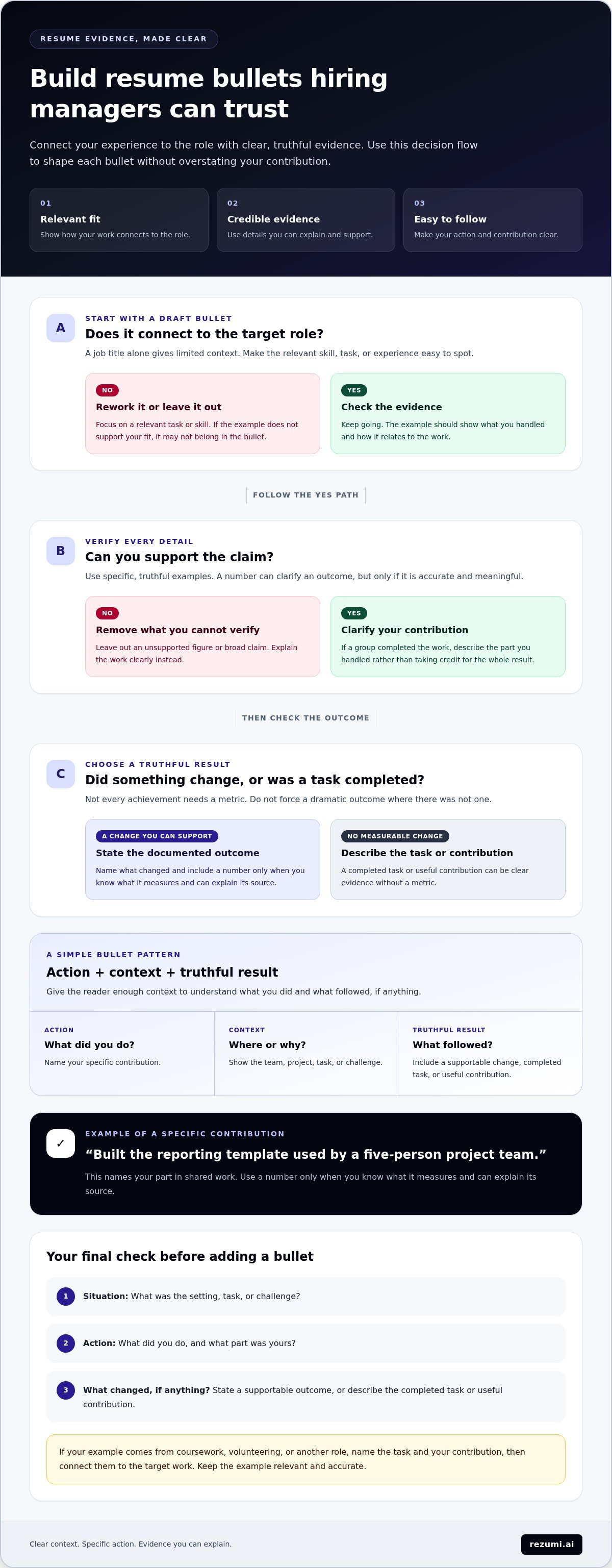
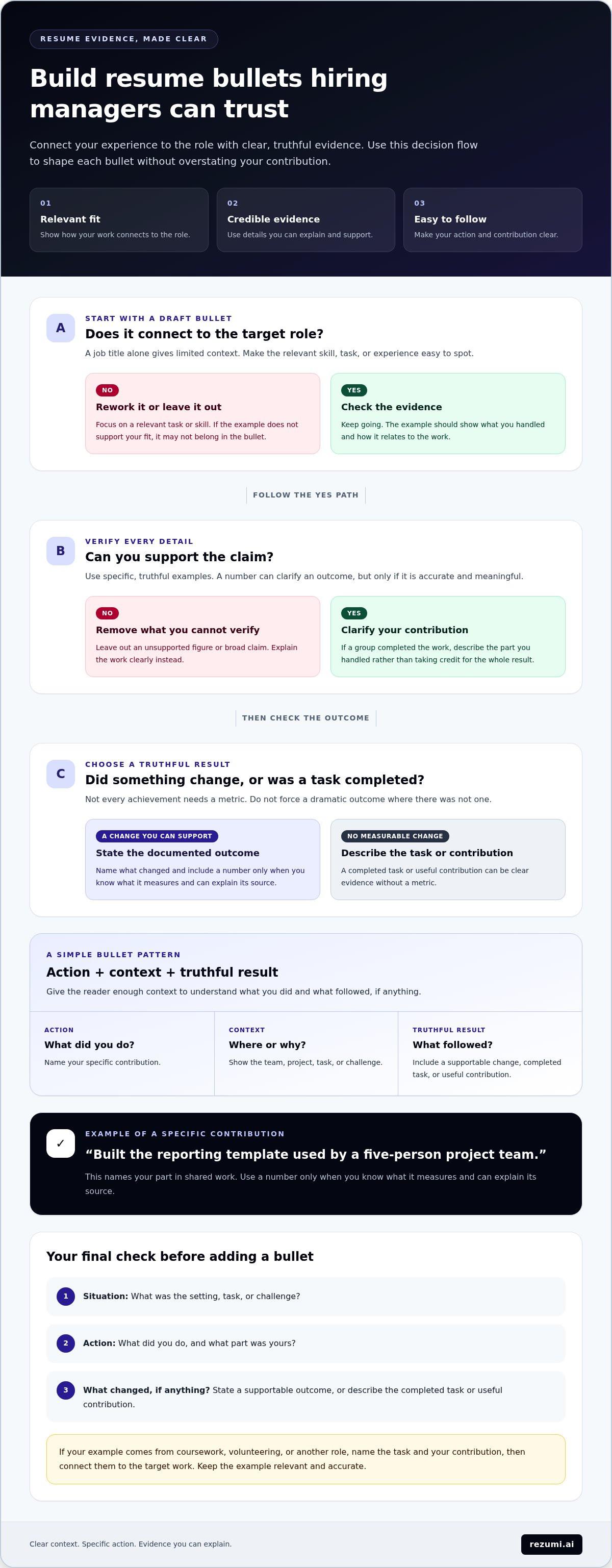
Use a simple pattern: action, context, and truthful result. For example, “Organized [type of records] for [team or project], helping [documented outcome].” The brackets are placeholders, not suggested results. Replace them only with details you can verify. If you can’t support a figure, leave it out and explain the work clearly instead.
Be precise about your role in shared work. If a group delivered a project, describe the part you handled rather than taking credit for the whole result. “Built the reporting template used by a five-person project team” makes your contribution clearer than “Delivered the project.” Use a number only when you know what it measures and can explain its source.
How transferable skills become relevant evidence
Your strongest example doesn’t have to come from a job with the same title. Coursework, volunteering, and other roles can show skills that apply to your target position. Name the task and your contribution, then connect them to the work in the posting. A skill label alone doesn’t show how you use it.
For example, instead of listing “communication,” describe a time you explained a complex topic to classmates, coordinated volunteers, or shared project updates with a group. For problem-solving, identify the issue and the steps you took. For teamwork, specify your role and how you worked with others. Keep each example relevant and accurate.
Before adding a bullet, check that it answers three questions: What was the situation? What did you do? What changed, if anything? Your answer might be a concrete result, a completed task, or a useful contribution. Don’t force a dramatic outcome where there wasn’t one. Clear context and a truthful account give the reader a fair basis for judging your experience.
As you tailor your resume, compare each example with the role’s needs and keep only evidence you can stand behind. Job-description-based resume feedback can help you review how clearly your experience connects to a specific posting. Use it as an editing aid, then confirm every claim reflects your own work.
Resume Claims That Build Trust Versus Claims That Raise Questions
Trust comes from details a reader can understand and you can support. Broad praise, inflated claims, and repeated keywords may sound forceful, but they leave the hiring manager with little evidence to judge. Specific wording gives context without asking the reader to take your word for it.
The examples below are illustrative templates, not claims about real candidates or results. Replace bracketed text with facts from your own experience. If you can’t verify a detail, leave it out.
| Claim that raises questions | More specific, evidence-led alternative |
|---|---|
| “Excellent communicator.” | “Prepared [type of update] for [audience] to share [relevant information].” |
| “Improved team efficiency by 50%.” | “Revised [process] for [team or task], contributing to [verified outcome, if known].” |
| “Expert in every major project tool.” | “Used [relevant tool] to complete [task or project responsibility].” |
| “Proven leader and problem-solver.” | “Coordinated [specific activity] with [group or team] to address [work-related need].” |
What makes a resume bullet specific and believable?
A strong bullet names the task and, where useful, its scope or audience. Then it states what you did and the outcome you can substantiate. Don’t add an employer name, tool, team size, or result just to make a sample sound impressive. Your wording should match what happened and what you could explain in an interview.
Not every bullet needs a large numerical result. A completed task, clear responsibility, or useful contribution can show relevant experience. Use numbers when they add meaning, such as verified volume, timing, or change. Don’t estimate a figure or attach a percentage to an outcome you can’t confirm.
How to handle gaps, career changes, or imperfect matches
Keep your work history accurate. Don’t change dates or rearrange roles to hide a gap. If your job titles don’t match the posting, show related tasks and skills in your experience bullets. A career change can still show transferable fit, but don’t claim experience you haven’t gained.
Superlatives such as “best,” “expert,” or “top performer” raise questions when no evidence supports them. Keyword stuffing does too. Repeating a skill or phrase without showing where you used it makes your resume harder to read and doesn’t explain your value. Use language from the job description when it accurately describes your experience, then support it with a concrete example.
In short, what do hiring managers actually look for in a resume? Claims that connect your experience to the role and show the basis for your statements. Review each bullet and ask: Is this accurate? Does it show relevant work? Can I explain the details behind it? If not, revise it or remove it. Clear evidence builds more trust than polished wording alone.
How to Tailor Your Resume to What the Hiring Manager Needs
Tailor your resume by matching the job’s priorities with experience you can genuinely support. You’re not rewriting your history or copying the posting. You’re making your strongest relevant evidence easier to find while keeping every claim accurate.
A useful way to answer what do hiring managers actually look for in a resume is to compare the role’s needs with the proof your background can provide. Use this workflow for each application:
- Identify role needs. Read the job description and note repeated responsibilities, required skills, and terms specific to the work. Separate core needs from preferences when the posting makes that distinction.
- Map your evidence. For each priority, find a relevant example from your work, education, or volunteer experience. Note what you did and any outcome you can accurately describe.
- Revise for relevance. Move your strongest matching examples where they’re easy to see. Use job-related wording when it truthfully describes your experience, but don’t copy full lines or add skills you can’t support.
- Proofread before applying. Check that the revised resume reads clearly and that all details remain accurate and consistent.
How to translate a job description into resume priorities
Look for patterns, not just keywords. If a posting repeatedly mentions scheduling, client communication, and record keeping, treat those as clues to the work. Match each priority to a real example. If you’ve coordinated appointments and updated client records, describe that work directly. Leave out requirements you can’t substantiate instead of implying you have that experience.
For help choosing a layout that supports clear, relevant information, see Choosing the Best Resume Format for the 2026 North American Job Market. The format should make your experience easier to follow, not hide parts of your work history or draw attention away from your strongest evidence.
How to review the finished resume before applying
Read the document as if you’re seeing it for the first time. Can you quickly find the experience that best matches the role? Do your bullets explain what you handled, or do they rely on broad skill labels? An ATS may also process your resume text, so use a straightforward layout, standard section headings, and relevant language naturally. Avoid design choices that make information harder to read or extract.
Then check the details. Confirm job titles and dates, correct spelling, and consistent formatting for headings, punctuation, and bullet points. Reading the resume aloud can help you catch awkward phrasing that a quick visual scan misses. Compare the finished version with your source information to make sure revisions haven’t changed the facts.
Tailor your resume to a specific posting with job-description-based resume tools, then review each suggested change against your actual experience.
Turn Hiring Manager Priorities Into a More Focused Application
Make your next application easier to manage by choosing one role and keeping a clear record of the version you submit. A short note about which examples you highlighted and why can help you prepare for follow-up questions and make thoughtful edits for future applications.
Where AI resume tools can support your judgment
AI suggestions can offer another way to review your wording, but they don’t know the full context behind your work. Check each change against your experience, remove anything inaccurate, and keep the language natural to you. Treat the output as a prompt to consider, not a verdict on your fit or a prediction of a hiring decision.
A practical next step for your next application
Choose one open role and save a copy of the resume you plan to submit. Note which parts of your background you want the reader to notice, then track the application and any next steps in your job-search workspace. This gives you a useful record as your search progresses, without relying on memory to track each version.
Rezumi brings job-search tasks into a centralized workspace, where you can organize applications, tailor your resume to job descriptions, and get AI-powered feedback. Use the tools that fit your process, and make each application a deliberate reflection of your experience.
Make Your Next Application More Intentional
Choose one role and decide what you want the hiring manager to understand about your background. The question of what do hiring managers actually look for in a resume can help you focus your message, but your application should still sound like you, not a template.
Before you submit, save a copy of the final version and note any details you may want to discuss later. This gives you a reference if you’re invited to an interview and helps you track what you shared with each employer.
Then take the next step in your search. Review the posting, prepare to talk about the work you highlighted, and keep moving toward roles that fit your goals.
You don’t need to make your experience sound bigger than it is. Present it with care, stand behind your claims, and apply with confidence.
Frequently Asked Questions
What do hiring managers look for first on a resume?
They often begin by checking whether your recent background and stated qualifications relate to the opening. Make your current or most recent role easy to identify, and include any required credential if you hold it. What do hiring managers actually look for in a resume varies by employer, so use the job posting to decide which details deserve attention first.
Do hiring managers care more about skills or experience?
Neither always matters more. The balance depends on the role and how much relevant experience you have. A hiring manager may look for hands-on use of a tool in one position, but focus on your ability to learn it in another. Make your skill level clear, and be ready to explain when you last used a key tool or method if it comes up in an interview.
Can a resume get noticed without exact job-title experience?
Yes. Focus on the work you’ve done that is closest to the role, even if your title comes from another field. For example, a teacher applying for a training role could highlight lesson planning or onboarding work, if those duties are part of their experience. Keep your official job title accurate, then use the surrounding details to make the connection between your past work and the new role clear.
How many accomplishments should you include on a resume?
There’s no set number. Give more space to roles that best support your current application, and trim older or less related details if they crowd out that information. Your resume should help a reader understand your work history without turning every task into an accomplishment. For a long career, a shorter account of earlier roles can leave room for the experience most relevant to the job you want now.
Do hiring managers read every resume word for word?
Not necessarily, and review habits vary. A manager may first review key parts, then return to the full work history when comparing candidates or preparing for an interview. That’s one reason your resume should hold up to closer reading, not just a quick glance. Make sure the details support one another, and be prepared to explain the choices or transitions shown in your work history.
Should you include a summary at the top of your resume?
Include one if it adds context the rest of your resume might not make clear, such as a career change or a shift from specialist work into management. Use it to state your direction and relevant background, not to repeat a list of traits. If your opening would only restate your job title and skills section, skip it and give that space to more useful detail.
Do hiring managers care about resume keywords?
They can help, especially when a posting uses a specific term for a skill, tool, or credential. Check whether the posting uses an acronym, its full name, or both, and use the form that accurately matches your experience. For example, include both a full term and its acronym when that makes the detail clearer. Don’t add a term simply because it appears in the posting if it doesn’t describe your background.
Disclaimer
This article is provided for general informational purposes only and does not constitute professional, legal, financial, or career advice. While Rezumi strives for accuracy, we make no warranties as to the completeness or reliability of this content. Hiring practices, ATS behavior, and job-market conditions vary by employer, industry, and region — always verify against your specific situation. Any action you take based on this article is at your own risk.