Why Am I Not Getting Interviews With My Resume? 2026 Fixes
No interviews don’t automatically mean your resume is bad. If you’re asking, “why am I not getting interviews with my resume,” the cause may be a mismatch between your experience, the roles you’re targeting, or how clearly your application shows your fit.
It’s frustrating to apply repeatedly and hear nothing back. Without feedback, it’s hard to know whether your resume needs work, the role wasn’t a strong match, or the hiring process hasn’t moved forward. Rewriting everything won’t necessarily help. A focused review can show you what to change first.
This guide will help you look for patterns, compare your resume with a job description, and make practical edits based on your real experience. You’ll also get a repeatable way to review future applications and track what you changed. Start with the evidence in your application, not guesswork.
Key Takeaways
- Use your response pattern to narrow down why am I not getting interviews with my resume, and identify whether role fit or application quality may be an issue.
- Make relevant experience easier to spot by prioritizing clear, truthful evidence that matches the target role.
- Understand what an applicant tracking system does, and why its use doesn’t mean every resume faces the same automatic rejection rule.
- Follow a repeatable application workflow and track your edits so you can compare versions over time.
- Use resume feedback to spot possible gaps, but verify every suggestion before including it.
Why Your Resume Is Not Getting Interviews: Diagnose the Bottleneck
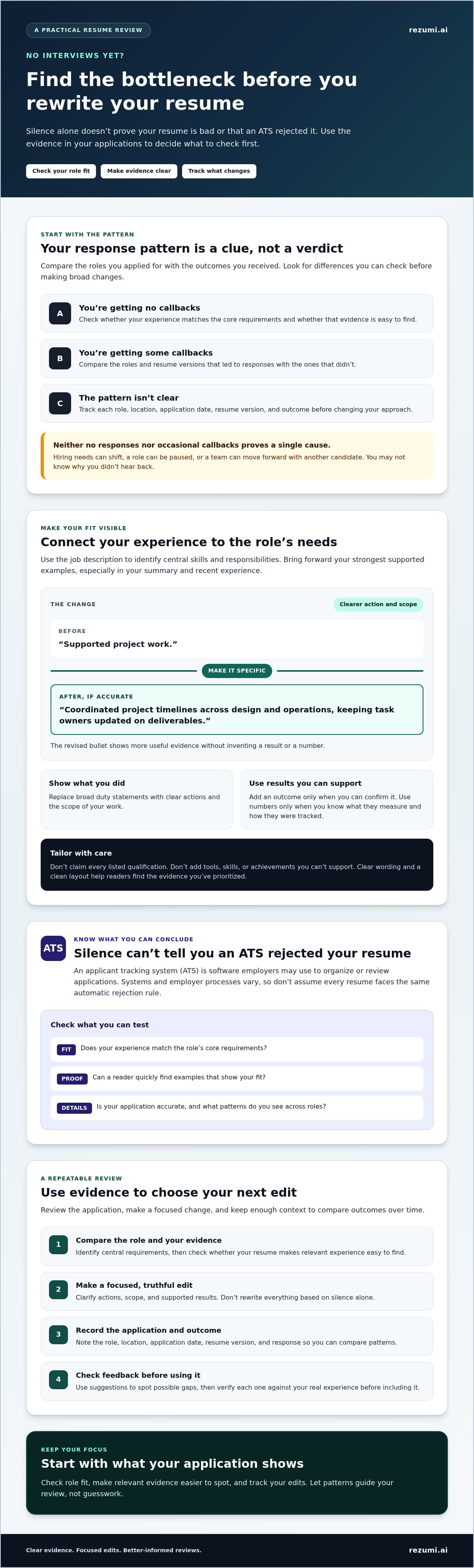
No interviews can point to a mismatch in your resume, the roles you’re targeting, the quality of your applications, or factors on the employer’s side. Don’t rewrite your entire resume based on silence alone. First, look for a pattern that suggests what to investigate.
If you’re asking, “why am I not getting interviews with my resume,” compare your applications with their outcomes. Your resume summarizes your experience and skills, but it also needs to make the most relevant parts easy to find for each role. For a neutral overview of what a resume is, see Wikipedia’s guide to resume formats and use.
What your response pattern can and cannot tell you
No responses across different roles may be a reason to review your targeting, qualifications, and application materials. Occasional callbacks suggest that some role and application combinations are working, even if your results are inconsistent. Neither pattern proves a single cause. Treat each outcome as a clue, not a verdict.
Look for differences you can check. Are you getting responses for one role type but not another? Do results vary by seniority, location, or the roles you apply for? Note the patterns, then review the applications behind them.
- No callbacks: Check whether your experience matches the core requirements and whether that evidence is easy to find.
- Some callbacks: Compare the roles and resume versions that led to responses with those that didn’t.
- Unclear pattern: Track each role, location, application date, resume version, and outcome before making broad changes.
Resume problem or hiring-process factor?
An employer’s needs can shift after a job is posted. A role may be paused, priorities may change, or the team may move forward with another candidate. You usually can’t confirm why you didn’t hear back, so don’t assume the hiring process rejected you or blame the market without checking what you can control.
Compare the posting with your evidence before rewriting. Can a reader quickly find examples that show you meet the main requirements? If the role asks for project coordination and your resume only says “supported projects,” clarify what you coordinated and delivered, if that accurately describes your work.
An applicant tracking system, or ATS, is software employers may use to organize or review applications. Systems and employer processes vary. Silence alone can’t prove an ATS rejected your resume. Start with what you can test: role fit, visible evidence, application accuracy, and the pattern in the roles you’re choosing.
How Resume Relevance and Evidence Affect Interview Decisions
Your resume can include relevant experience and still fail to show why it matters for a particular role. Hiring teams need to connect your skills and results to the job’s needs. Make that connection clear by prioritizing truthful, relevant evidence instead of repeating every phrase in the posting.
Match your resume to the role’s core requirements
Start with the job description. Identify the skills and responsibilities that appear repeatedly or are central to the work. Then bring your strongest supported examples forward, especially in your summary and recent experience. Tailoring doesn’t mean claiming every listed qualification. Don’t add tools, skills, or achievements you can’t support.
For example, if a posting emphasizes coordinating projects, a bullet that says “Supported project work” may leave your role unclear. If accurate, make the action and scope more specific:
- Before: Supported project work.
- After: Coordinated project timelines across design and operations, keeping task owners updated on deliverables.
The revised bullet gives the reader more useful evidence without inventing a result or a number. If you can confirm an outcome, such as meeting a deadline or improving a process, include it. If you can’t verify the result, don’t guess.
Make your achievements easier to assess
Strong bullets often show what you did, the scope of your work, and the result, when you can support it. Replace broad duty statements with clear actions. For instance, “Handled customer issues” could become “Resolved billing questions by reviewing account records and explaining next steps,” if that reflects your actual work.
Use numbers only when you know what they measure and can explain how they were tracked. A figure without context can confuse the reader or weaken trust. Clear wording matters, too. MIT Career Advising & Professional Development offers practical guidance on optimizing for Applicant Tracking Systems, including ways to keep resume content readable by software and people.
Layout supports relevance. A clean format helps readers find the evidence you’ve prioritized, while a cluttered page can bury it. For more guidance, see this 2026 resume format guide. If you’re reviewing your resume against a specific posting, explore role-specific resume feedback as one way to spot possible gaps. AI suggestions can help with editing, but verify every change and keep each claim accurate.
Is an ATS Rejecting Your Resume or Something Else?
An applicant tracking system (ATS) is software an employer may use to organize or review job applications. It can extract details from a resume into searchable records, but ATS tools and hiring processes vary. There isn’t one universal rule that every system uses to reject candidates.
What an ATS may do with your resume
Parsing means extracting details such as your name, work history, and skills from a document. Clear section headings like “Experience” and “Education,” along with a readable layout, can reduce confusion when software processes your resume. They can’t guarantee an interview or tell you how a specific employer reviews applications.
For additional resume guidance, see Harvard Kennedy School’s resume advice. Focus on both readability and the evidence your resume presents. A resume can parse correctly without clearly showing why you fit the role.
Separate possible causes before changing your resume
If you’re wondering, “why am I not getting interviews with my resume,” separate what you know about each application from what you can’t confirm. Silence alone doesn’t reveal whether software, a recruiter, or another factor affected the outcome.
| Possible issue | What to check |
|---|---|
| Parsing problem | Are your contact details, job titles, and experience readable in the file you submitted? |
| Missing evidence | Does your resume show examples of the required skills, not just a list of skill names? |
| Role mismatch | Do your experience and seniority match the role’s core duties and stated requirements? |
| Human or employer-side review | Could hiring needs, timing, or review decisions explain the silence? You may not be able to confirm. |
Check the posting for stated location or work-authorization requirements, too. If you apply to roles in different locations or at different levels, compare outcomes across several applications before blaming one software filter. A pattern may point to targeting or evidence, but it still isn’t proof of a single cause.
Readable formatting and accurate role language can make your qualifications easier to review, but they can’t guarantee an interview. If you want to compare your resume with a target job description, review Rezumi’s resume optimization options as one possible step. Check every suggested edit and keep your claims accurate.
How to Improve Your Resume and Test Your Next Applications
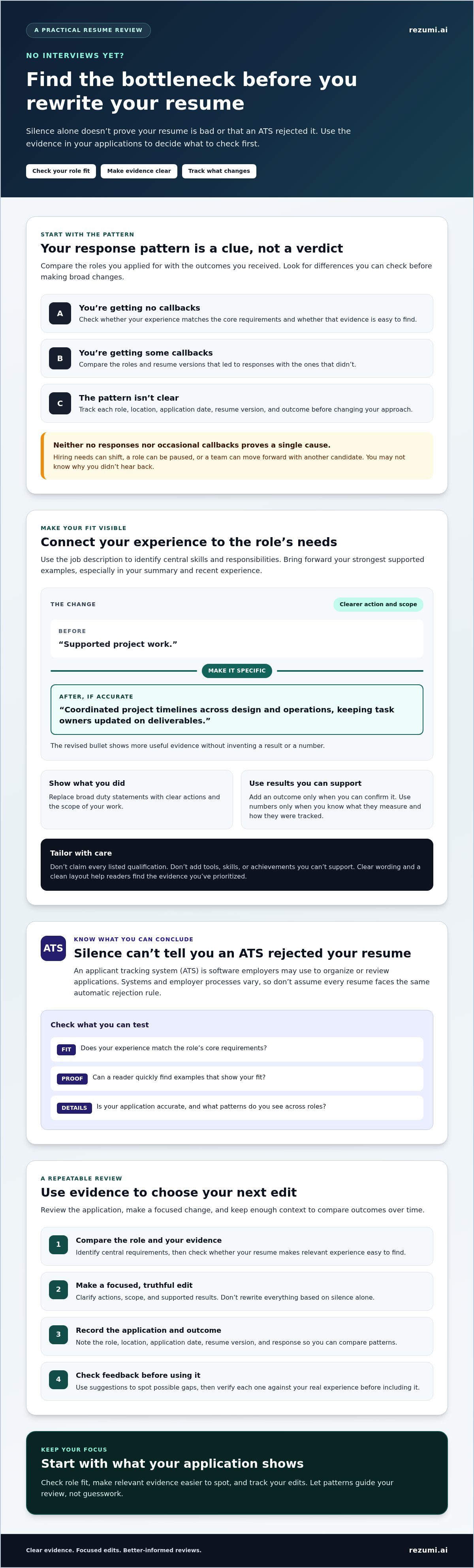
Use a repeatable process for each application. It helps you connect your resume to the role, catch preventable errors, and remember what you changed. If you’re still asking, “why am I not getting interviews with my resume,” test one likely issue at a time instead of changing everything at once.
A practical resume review before you apply
Follow these steps for each role. Keep a copy of the version you submit so you can compare it with later edits.
- 1. Select a role. Choose a job that fits your experience, level, and the stated requirements.
- 2. Identify evidence. Note the key skills and responsibilities in the posting. Find truthful examples from your work, education, or projects that support them.
- 3. Tailor your resume. Bring the strongest relevant evidence into your summary and early experience bullets. Use the employer’s terms when they accurately describe your background, but don’t add unsupported skills or claims.
- 4. Proofread and check. Confirm your contact details and dates are correct, spelling is clean, and the document is readable. Check that each listed skill is supported by experience elsewhere in the resume.
- 5. Submit the right version. Make sure you send the tailored copy, not an older draft.
- 6. Track the application. Record the role, application date, resume version, and any response from the employer.
Before submitting, scan the top third of your resume. Does your summary reflect the role’s central needs? Do your first experience bullets make your most relevant contributions clear? If the evidence is buried, move it up. If a skill appears only in a list, add a truthful example of how you used it.
Track outcomes and make focused adjustments
Keep changes reviewable. For example, update the summary and one or two relevant bullets, then save that version. Avoid changing the layout, wording, and target roles all at once. If your results shift, you’ll have a clearer record of what changed, although a small number of applications can’t prove that an edit caused the difference.
Compare applications for similar roles and levels, rather than treating every job in your tracker as alike. If interviews remain absent, revisit whether the roles match your experience and whether your resume shows the required evidence. Adding more keywords won’t fix a gap between your background and the job’s needs.
Rezumi’s resume tailoring and feedback tools can help you review your resume against a specific job description. Check every suggestion before using it, and keep your final claims accurate.
Build a Repeatable Job Application System With Resume Feedback
A reliable job search process connects the roles you choose with the evidence on your resume, a careful application review, and organized follow-up. If you’re still asking, “why am I not getting interviews with my resume,” use feedback to identify a specific gap, then decide whether the suggested change is accurate and useful.
Use feedback without surrendering your judgment
Resume feedback can point out skills or experience from a job description that are difficult to find in your application. Treat those notes as prompts to review, not instructions to follow automatically. If a tool suggests a qualification you don’t have or wording that doesn’t sound like you, leave it out.
Before applying, check the final resume against the job description and your own records. Confirm that each claim is true, the most relevant evidence is easy to find, and the wording is clear. AI can help with editing, but you’re responsible for verifying every change.
Keep your application process organized
Save each submitted resume with the role and application date. Record any response and note what changed between versions. This makes it easier to compare applications for similar roles without assuming one outcome proves an edit worked.
Keep the rest of your application materials aligned with the same target. If the employer requests a cover letter, or you have useful context that your resume doesn’t show, prepare one that supports your application. If you receive an interview invitation, shift your focus to preparation. Interview practice helps you explain your experience, but it can’t replace a resume that clearly fits the role.
Rezumi supports resume optimization, cover letter creation, interview preparation, and application tracking. It can help you review role alignment and organize parts of your search, but it doesn’t provide job placement or guarantee an interview. You remain in control of which roles to pursue and which edits to use.
Build a process you can repeat: choose a suitable role, check your evidence, review your application, and record what happens next. Small, accurate improvements give you a clearer basis for refining future applications.
Make Your Next Application More Targeted
If you’re asking, “why am I not getting interviews with my resume,” treat each application as a chance to gather clues, not as a verdict on your experience. Silence can have more than one cause, so look for patterns before making broad changes.
Choose roles that fit your background. Make your strongest, truthful evidence easy to find. Keep your resume readable, check it carefully, and track the version you send. Reviewing results across similar roles can help you decide what to adjust without assuming one application proves anything.
Rezumi can support this process with resume tailoring against specific job descriptions, resume quality feedback, and application tracking. Use feedback to spot possible gaps, then verify every edit and make sure the final resume still sounds like you. No tool can promise an interview, but a focused process can help you make more deliberate applications.
Keep refining your approach one application at a time. Your next step is to make your fit clear and let your real experience lead.
Frequently Asked Questions
Why am I not getting interviews even though I meet the job requirements?
Meeting the listed requirements doesn’t always make your fit clear on the page. If you’re asking, “why am I not getting interviews with my resume,” compare the job description with your resume and move your strongest relevant evidence closer to the top. Show how you used key skills, not just that you have them. Also check whether the role’s level, location, and stated application requirements match your background.
Can an ATS reject my resume before a recruiter sees it?
An applicant tracking system (ATS) can help an employer collect and organize applications, and some systems support screening workflows. The process varies by employer and software, so a lack of response doesn’t prove an ATS rejected your resume. Use readable formatting and accurate, role-relevant language. Then check whether your resume shows the required experience and whether your application details match the posting.
How long should I wait before changing my resume if I am not getting interviews?
There’s no single waiting period that fits every employer or role. Don’t change your resume based on one unanswered application. Track comparable applications, including the role, date, resume version, and any response. If a pattern emerges, review your targeting, role level, evidence, and document clarity together. Make focused edits and record them, so you can see what changed without treating a small number of outcomes as proof.
What should I change first on my resume to get more interviews?
Start with the target role, not a full rewrite. Identify its main requirements, then check whether your summary and recent experience show truthful evidence for them. Move the most relevant achievements where they’re easy to find and remove details that distract from your fit. Proofread the final file, and keep a copy of the version you submit. Only include claims you can support with real experience.
Can applying to too many different jobs hurt my interview chances?
The number of applications alone doesn’t show whether your approach is working. But applying to very different roles can make it harder to present a clear case for each one if you send the same resume everywhere. Check that each role fits your experience, then tailor the resume to highlight relevant evidence. A focused set of applications is also easier to compare and improve than unrelated applications using one unchanged version.
Should I use AI to improve my resume if I am not getting interviews?
AI can compare your resume with a job description, flag sections that may be unclear, and suggest edits. Treat those suggestions as a starting point, not verified facts or a promise of an interview. Review every change yourself. Remove unsupported claims, keep the wording true to your experience, and check that your voice still feels natural. Use feedback alongside careful role selection and application tracking.
Disclaimer
This article is provided for general informational purposes only and does not constitute professional, legal, financial, or career advice. While Rezumi strives for accuracy, we make no warranties as to the completeness or reliability of this content. Hiring practices, ATS behavior, and job-market conditions vary by employer, industry, and region — always verify against your specific situation. Any action you take based on this article is at your own risk.