150+ Resume Action Verbs to Command the North American Job Market in 2026
Your resume isn't just a list of past duties. It's a strategic data set designed to pass a machine filter. Most job seekers use the same tired phrases like "responsible for" or "handled," which tells a recruiter nothing about their actual impact. You likely worry about sounding arrogant or feeling repetitive. It's a common struggle that keeps talented professionals stuck in the "applied" stage.
This guide changes that. You'll learn how to use high-impact resume action verbs to change passive descriptions into professional achievements. These specific words are the triggers that North American Applicant Tracking Systems (ATS) look for to verify your seniority and skill level. Replacing one weak word with a precise verb can be the difference between a rejection and an interview invite.
We've compiled over 150 verbs categorized by role and industry. You'll also find a simple formula to write better bullet points and strategies to improve your Rezumi resume score. By the end, your resume will speak the language of North American hiring managers with confidence and technical precision.
Key Takeaways
- Replace weak phrases like "responsible for" with high-impact words to show recruiters your actual results instead of just your daily duties.
- Use specific resume action verbs to signal your seniority level and help ATS algorithms categorize your experience correctly for 2026 standards.
- Access a curated list of over 150 verbs organized by leadership, technical, and creative roles to make tailoring your resume faster and more accurate.
- Apply a simple two-step formula that combines a strong verb with measurable data to build bullet points that prove your professional value.
- Use Rezumi to automatically scan your resume against job descriptions and identify the exact verbs needed to improve your overall resume score.
Why Passive Words Kill Your Resume and How Action Verbs Fix It
Your resume is a high-stakes marketing document. In the North American market, recruiters spend less than six seconds scanning your application before making a decision. If they see passive language, they see a passenger. You need to be the driver. Resume action verbs are short, punchy words that start your bullet points. They replace weak fillers like "duties included" with direct evidence of your success.
Passive language hides your impact. It makes your career sound like something that happened to you rather than something you built. When you use active verbs, you take control of the narrative. You aren't just listing tasks; you are proving your value to a potential employer. This shift in language signals technological confidence and a solution-oriented mindset. It moves the reader from uncertainty about your skills to total reassurance of your capabilities.
The difference between duties and achievements
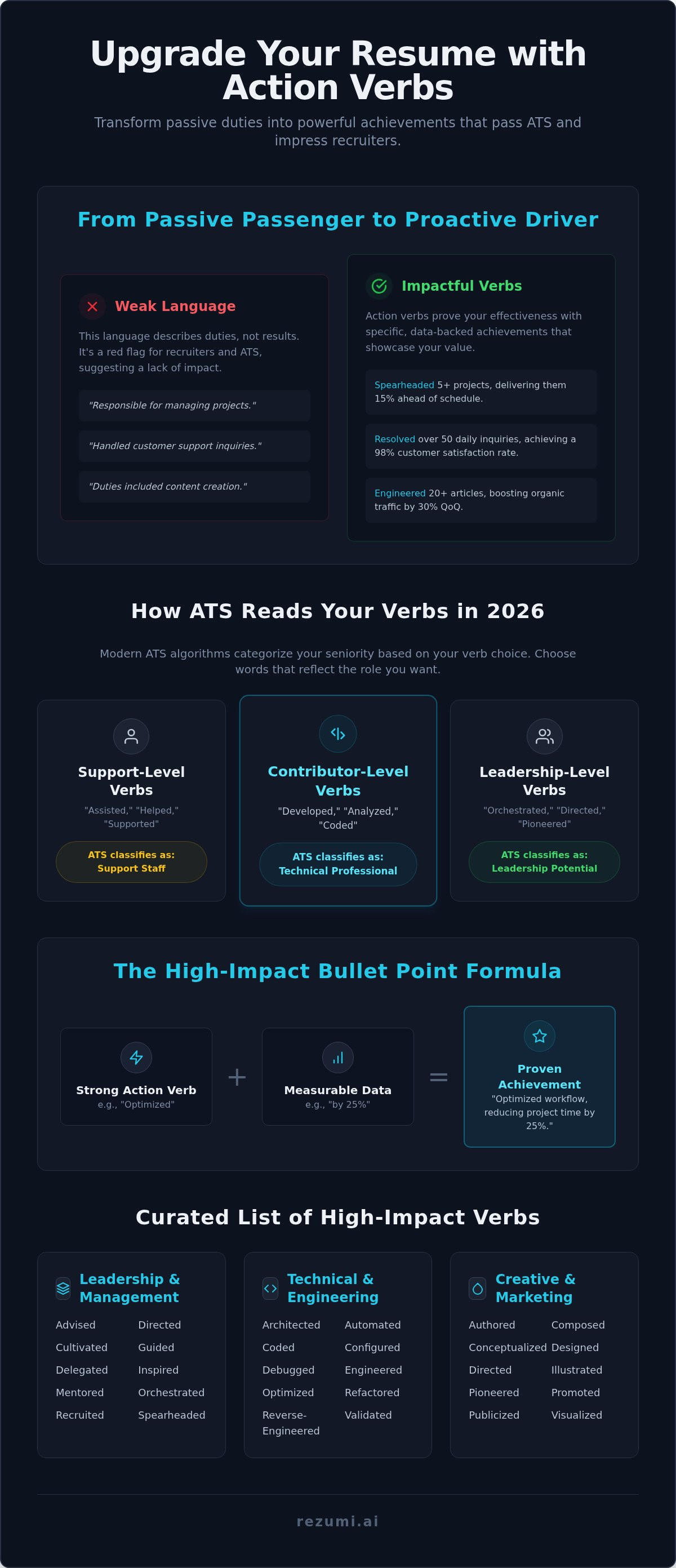
Duties describe what you were told to do. They are passive and often feel like a list of chores. For example, "Answered phones" is a duty. It doesn't tell the recruiter if you were good at it. Achievements describe what you actually accomplished. "Resolved 50+ customer inquiries daily with a 98% satisfaction rate" is an achievement. Using strong resume action verbs forces you to focus on the outcome of your work. It shifts the reader's attention from your job description to your actual results. This is how you stand out from hundreds of other applicants who only list their daily requirements.
Why "Responsible for" is a resume red flag
Starting a sentence with "Responsible for" tells a recruiter you were present, but it doesn't prove you were effective. It is a filler phrase that wastes valuable space. Modern ATS algorithms prioritize verbs that signal ownership and initiative. If you "managed" a project, the system sees leadership. If you were just "responsible for" it, your impact remains vague. You want to show that you took initiative. Phrases like "Spearheaded" or "Orchestrated" tell a much stronger story. They show you didn't just show up; you made things happen. This level of detail is exactly what helps you gain a higher resume score on optimization tools.
Using passive phrases makes you sound arrogant because you are asking the recruiter to trust your vague claims. Active verbs do the opposite. They provide a data-driven strategy for your career history. You provide the proof, and the recruiter sees the results. It's a faster, more efficient way to communicate your worth.
How ATS Systems Read Your Action Verbs in 2026
Modern Applicant Tracking Systems (ATS) are more than simple keyword scanners. They act as automated gatekeepers that categorize your seniority level based on the verbs you choose. Your resume is a data set. If you use "assisted" or "helped," the algorithm classifies you as a support staff member. If you use "orchestrated" or "directed," the system flags you for leadership potential. Your choice of resume action verbs tells the machine exactly where you sit in the corporate hierarchy.
Algorithms in 2026 also look for context. They analyze how your verbs connect to the job title and the company's needs. Using the right verbs helps your resume align with the specific requirements of the job description. This isn't about tricking the system. It's about speaking the same technical language as the hiring company. When you match their verbs, you lower the friction between your application and a human recruiter's desk.
Verbs as skill indicators
Verbs act as proof for your technical and soft skills. In technical roles, verbs like "coded," "debugged," or "deployed" verify your proficiency with software and systems. They show you have hands-on experience with the product lifecycle. For client-facing or management roles, verbs like "negotiated," "presented," or "mentored" prove your interpersonal abilities. The fastest way to pass the initial screen is to mirror the job posting. If the description asks for someone who "developed" a team, use that exact verb. This alignment signals to the ATS that your experience is a direct match for their current problems.
Avoiding verb stuffing
Do not use complex verbs just to sound smart. ATS algorithms are now programmed to detect natural language patterns. They see through "verb stuffing" where a candidate uses every synonym for "led" in a single paragraph. This makes your resume look like it was written by a bot rather than a professional. Focus on accuracy over vocabulary size. Ensure every verb you use is backed by a specific result or a hard number. If you claim you "optimized" a process, you must show the percentage of time or money you saved. You can easily check your resume score to see if your word choices are strong enough to trigger an interview invite.
Stop guessing which words work. Accuracy wins every time. A clean, data-driven resume that uses precise language will always outperform one filled with vague marketing fluff. Your goal is to provide the ATS with clear, undeniable evidence of your professional impact.
The Master List of Action Verbs for Every Industry
Selecting the right resume action verbs depends on your industry and the specific impact you want to show. A long alphabetical list is hard to use when you are trying to tailor your resume quickly. You need verbs grouped by function so you can find the exact word that matches your professional achievements. Using these categorized lists ensures you don't repeat the same tired words in every bullet point.
Leadership and Management
- Chaired: Use this for formal committees or board meetings.
- Directed: Use this when you had total control over a department's output.
- Mentored: Use this to show you developed junior staff or interns.
- Orchestrated: Use this for complex, multi-stage projects involving many people.
- Spearheaded: Use this for the initial launch of a new initiative or product.
Technical and Engineering
- Built: A direct way to show the creation of tools, hardware, or software.
- Debugged: Essential for showing problem solving in code or technical systems.
- Deployed: Proves you can take a product from development to a live environment.
- Engineered: Suggests a high level of design, planning, and technical rigor.
- Programmed: Specific to software development, automation, and script writing.
Communication and Influence
- Authored: Use for reports, white papers, or technical documentation.
- Briefed: Shows you can summarize complex data for executives or stakeholders.
- Collaborated: Proves you work well within cross-functional teams to reach a goal.
- Negotiated: Essential for sales, procurement, or legal and contract roles.
- Persuaded: Shows you can win buy-in for new ideas or strategic shifts.
Efficiency and Results
- Accelerated: Shows you increased the speed of a process or a project timeline.
- Consolidated: Proves you reduced waste by merging redundant systems or teams.
- Optimized: A key verb for showing refinement and better performance in any system.
- Restructured: Shows you changed an organization or process for better results.
- Yielded: Focuses on the final result, profit, or specific outcome produced.
Verbs for Management and Leadership
Effective managers use resume action verbs that show growth and execution. Use "Cultivated" when you want to discuss team culture or individual development. It suggests a long-term investment in your staff. Use "Executed" when you took a high-level strategy and turned it into a reality. If you fixed a system that was completely broken, use "Overhauled." It is a strong word that signals a total transformation of a department or process.
Verbs for Creative and Marketing Roles
Creative professionals need verbs that show the birth of an idea. Use "Conceptualized" to describe the very start of a brand, campaign, or artistic vision. If your work involved creating a lot of written or visual assets, use "Published." For design-centric projects where you turned data into a visual story, use "Visualized." These words help recruiters see your creative process from the initial spark to the final delivery.
Verbs for Data and Financial Roles
In finance and data science, accuracy is everything. Use "Audited" to highlight wins in compliance, data integrity, or financial health. If your role involved planning for future trends, "Forecasted" is the best verb to show strategic thinking. For complex problem solving where you had to make two sets of data match, use "Reconciled." These words tell the hiring manager that you are precise, detail-oriented, and technically sound.
Building High-Impact Bullets with the Achievement Formula
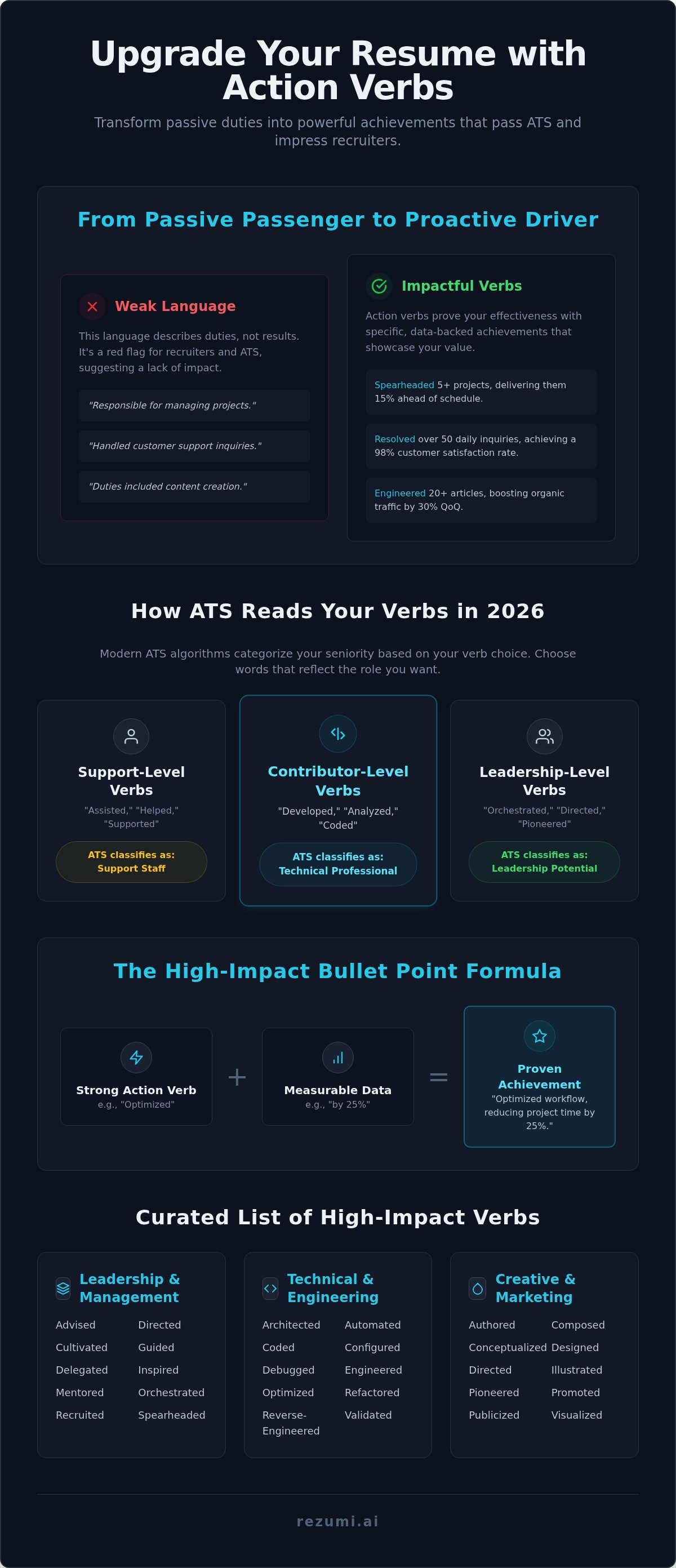
A strong verb is only the engine of your sentence. To win the interview, you need the full vehicle. Most candidates pick resume action verbs but fail to connect them to a business outcome. This leaves the recruiter wondering what you actually achieved. You can fix this by using a simple three-step formula that turns vague duties into undeniable proof of your value. The North American job market in 2026 demands this level of precision. Generic claims are ignored. When you use this formula, you provide a data-driven narrative that is hard to dismiss.
- Step 1: Start with a high-impact action verb from our master list.
- Step 2: Add the specific task, project, or technical problem you solved.
- Step 3: Finish with a measurable result or a specific impact on the business.
Consider this example. Instead of writing "I was in charge of the supply chain," you write: "Optimized the supply chain process, reducing operational costs by 15%." The verb "Optimized" signals technical proficiency. The "supply chain process" provides the context. The "15% reduction" provides the proof. This structure satisfies both the human recruiter and the ATS algorithm because it provides context and data in a readable format. It replaces the anxiety of a difficult process with the reassurance of a strategic strategy.
Using the STAR method with action verbs
The STAR method is a classic interview technique. It also works for your resume. Situation and Task provide the background. Your action verb is where you shine. It describes the specific move you made to solve a problem. The Action is the core of your bullet point. The Result is the payoff. If a bullet point doesn't have a result, it doesn't belong on your resume. Every line must prove that you can deliver a tangible outcome. This is how you transition from uncertainty to control.
Varying your sentence starts
Repetition kills interest. Don't start three bullets in a row with the word "Led." It makes your resume feel automated and boring. Use synonyms to keep the recruiter engaged. If you led a team, use "Mentored" for one bullet. Use "Directed" for the next. This variety makes your profile feel well-engineered and professional. You should also look at our guide on choosing the best resume format for more layout tips that maximize the impact of your words.
Optimize Your Resume Verbs Automatically with Rezumi
You don't have to guess which words will trigger a recruiter's interest. Rezumi handles the heavy lifting by automating the selection of high-impact resume action verbs tailored to your specific industry. Our platform acts as a strategic partner. It scans your document against real-time North American job descriptions to identify the exact language hiring managers expect to see in 2026. This moves you from a place of uncertainty to a position of total control over your application's success.
Data-backed decisions outperform guesswork every time. When you upload your resume, you receive a real-time Resume Score that evaluates the strength of your professional descriptions. This score isn't just a number. It's a measurement of how well your experience aligns with current global standards. If your verbs are weak or passive, the system identifies the flaw and provides a direct corrective action. You get a bespoke experience that ensures your resume is built for serious results.
Tailoring at scale
Editing every bullet point for every job application is a slow, tedious process. Rezumi fixes this by allowing you to swap weak verbs for powerful ones in seconds. The technology understands the hidden mechanics of modern ATS algorithms. It ensures your word choices signal the correct seniority level for your role. Accuracy is the goal. You can view the Rezumi pricing to access these premium optimization features and start refining your profile with technological confidence. This efficiency allows you to apply to more roles with higher quality documents in less time.
From resume to interview
Strong verbs do more than just pass a machine filter. They provide the foundation for your interview stories. When your resume uses precise language like "Orchestrated" or "Restructured," you have already framed yourself as a leader. You can use these optimized bullets to prepare your answers for the most difficult interview questions. A well-engineered resume makes the transition to the interview stage feel natural and rapid. To complete your career strategy, read our guide on ATS Resume Optimization. This deep dive will help you master the checker and secure more interviews in the competitive North American market.
Stop sounding like a passenger in your own career. Use a high-performance tool built to highlight your successes. Your path to a better job is clear, structured, and fast when you use data to drive your writing. Don't leave your professional future to chance when you can use a sophisticated system to prove your worth.
Command Your Career Narrative
You now have the tools to transform your professional story. By replacing passive phrases with high-impact resume action verbs, you shift the focus from what you were told to do to what you actually achieved. This strategic change helps you pass automated machine filters and captures the attention of human recruiters in seconds.
Remember to use the achievement formula for every bullet point. Combining a strong verb with measurable results provides the data-driven proof that hiring managers in the North American market demand. You are no longer just a candidate; you are a solution to their business problems.
Rezumi is built by global professionals to give you a strategic edge. Use our real-time ATS scoring and AI-powered tailoring to ensure your resume is ready for 2026. You have the experience, so let's make sure the world sees it. Your next career move starts with the right words.
Frequently Asked Questions
What are resume action verbs?
Resume action verbs are specific, dynamic words used to start your bullet points and describe professional achievements. They replace passive phrases like "responsible for" or "duties included." By using these verbs, you tell the recruiter exactly what you did instead of just listing what you were told to do. This makes your experience sound proactive and result-oriented. It helps you stand out in the competitive North American job market where impact is everything.
Can I use the same action verb more than once on my resume?
You can use the same verb more than once, but you should avoid repeating it within the same job description. Repetitive language makes your resume feel automated and uninteresting to recruiters. Instead, use synonyms to show a wider range of skills. If you used "Led" for one project, try "Spearheaded" or "Orchestrated" for the next. This variety keeps the reader engaged and highlights your ability to handle different types of professional challenges.
Should I use past or present tense for resume action verbs?
Use past tense for all previous roles and present tense for your current position. For example, you would use "Developed" for a job you left in 2024 but "Develop" for your current role. If you finished a specific project at your current company, you can use past tense for that specific bullet point. Consistent use of resume action verbs in the correct tense makes your resume look professional and easy for hiring managers to scan.
What are the most powerful action verbs for leadership roles?
The most powerful verbs for leadership go beyond simple management. Verbs like "Orchestrated," "Mentored," and "Cultivated" signal that you grew a team or a strategy. These words show you took ownership of a department's success. Instead of saying you "managed" a team, say you "Mentored five junior developers to improve sprint velocity by 20%." This technical precision proves you are a senior professional who understands how to drive tangible business outcomes in high-stakes environments.
How do action verbs help my resume pass the ATS?
Applicant Tracking Systems (ATS) use these verbs to categorize your seniority and professional level. If you use "Assisted," the system might flag you for entry-level roles. If you use "Engineered" or "Architected," the algorithm identifies you as a high-level technical expert. Using strong resume action verbs ensures the machine reads your data correctly. This alignment increases your Resume Score and helps your application reach a human recruiter's desk for a final review.
Can action verbs replace keywords on my resume?
Action verbs and keywords serve different purposes on your resume. Keywords are usually nouns or phrases like "Cloud Computing" or "Strategic Planning" that represent specific skills. Action verbs are the words that show how you used those skills to achieve a goal. You need both to pass the ATS and impress hiring managers. Think of keywords as the tools you use and action verbs as the specific ways you put those tools to work.
How many action verbs should I include in each job description?
You should include one action verb at the start of every bullet point in your job descriptions. Most professional resumes feature between three and six bullet points per role, which means you will use the same number of verbs. Every line of your experience section must begin with a word that shows movement or success. This structure ensures your resume is scannable and focuses entirely on your achievements rather than a list of daily chores.
Are there any action verbs I should avoid using?
Avoid vague or overused words that don't describe a specific impact. Verbs like "Utilized," "Assisted," "Helped," or "Participated" are often too weak for the North American market. They suggest you were a passenger in a project rather than the person driving the results. Replace these with more precise words like "Deployed," "Collaborated," or "Resolved." This shift in language provides the data-backed strategy that recruiters look for when they scan your professional history.
Disclaimer
This article is provided for general informational purposes only and does not constitute professional, legal, financial, or career advice. While Rezumi strives for accuracy, we make no warranties as to the completeness or reliability of this content. Hiring practices, ATS behavior, and job-market conditions vary by employer, industry, and region — always verify against your specific situation. Any action you take based on this article is at your own risk.