ATS Resume Keywords: How to Master the Filter in 2026
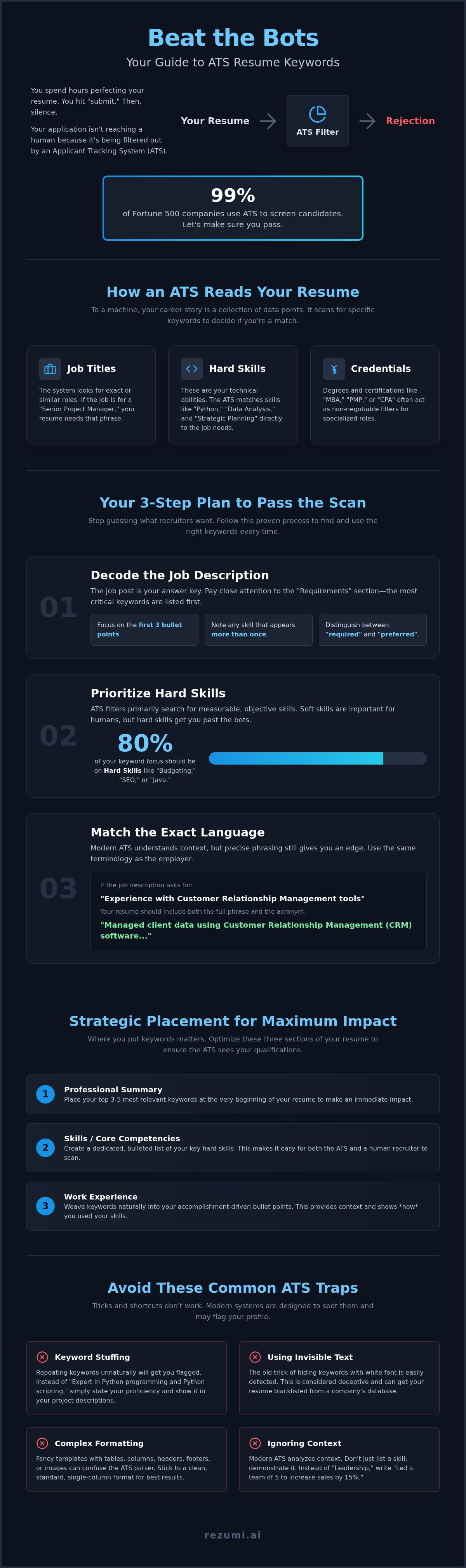
Nearly 99% of Fortune 500 companies use an Applicant Tracking System to filter candidates before a human ever sees a resume. You spend hours tailoring your experience. You click submit. Then, silence. It feels like your application vanished into a black hole. This happens because your ATS resume keywords are either missing or poorly placed. It's a technical hurdle that keeps your best work hidden from human eyes and prevents you from reaching the next stage of the hiring process.
You deserve a strategy that puts you back in control of your job search. This guide shows you how to find and place the right keywords to pass the automated screening and land the interview. We'll break down how modern systems analyze your skills and where to position them for maximum impact. You'll get a clear plan to improve your response rates and stop the frustration of manual tailoring for every single application. It's time to move past the filter and get your resume into the right hands.
Key Takeaways
- Understand why North American recruiters use automated filters and how specific terms determine if a human ever sees your application.
- Identify the most important requirements by focusing on the first three bullet points of any job description.
- Master the placement of ATS resume keywords in your summary and skills sections to achieve a higher match rate.
- Protect your reputation by avoiding tricks like white fonting or keyword stuffing that modern systems easily detect.
- Get a real-time score and instant feedback on your resume quality using AI-powered optimization tools.
Understanding How ATS Keywords Control Your Application
Think of your resume as a data packet. To a human, it's your career story. To a machine, it's a collection of data points called ATS resume keywords. These are the specific skills, job titles, and professional credentials that recruiters use to filter thousands of applicants. If your resume doesn't contain the exact terms the system is programmed to find, it likely won't reach a human recruiter. Understanding What is an Applicant Tracking System? is the first step toward taking control of your job search. These systems act as a gatekeeper, ranking your experience against a job description to produce a match score. High scores move to the top of the pile, while low scores are archived immediately.
The technology has evolved significantly by 2026. Older systems relied on simple word counting, but modern ATS now uses contextual AI analysis. This means the software understands the relationship between words. It knows that "managed a team" is related to "leadership" and "personnel management." Simply listing words isn't enough anymore. You must demonstrate how you used those skills in a professional setting to satisfy the system's scoring logic. When you align your language with the job description, you're essentially speaking the system's language.
What counts as a resume keyword?
Keywords aren't just random industry jargon. They fall into three specific categories that the system scans for during the initial filter:
- Job Titles: The software looks for exact or closely related roles, such as "Senior Account Executive" or "Software Engineer."
- Hard Skills: These are technical proficiencies like "Python," "Data Analysis," or "Strategic Planning."
- Credentials: Degrees and certifications like "MBA," "PMP," or "CPA" often act as mandatory filters for specific industries.
Why North American recruiters rely on keyword filters
Hiring in the United States and Canada has become a high volume game. Remote and hybrid roles often attract hundreds or even thousands of applications within days. Recruiters use these filters to manage the sheer scale of the task. Automated scoring ensures a standardized screening process, which helps companies maintain compliance with hiring regulations. Speed is also a critical factor. Research shows that top candidates are usually off the market in just 10 days. Automated filters allow recruiters to identify those top tier professionals in seconds rather than weeks. This efficiency is why mastering your keywords is no longer optional for a successful North American job search.
Identifying the Keywords that Matter in a Job Description
The job description is your roadmap to success. You don't have to guess what recruiters want because they've already provided the answer key. Start by saving the job posting as a document you can edit. Highlight every skill, tool, and qualification that appears more than once. These recurring terms are your primary ATS resume keywords. If a term shows up three times, the system is likely programmed to prioritize it.
Pay close attention to the first three bullet points under the "Requirements" or "Qualifications" section. North American companies list their most critical needs at the top. If the posting leads with "Expertise in Google Analytics," that is a mandatory filter. If you don't include that exact phrase, the system might rank you below less qualified candidates who used the right terminology. You can find more tips on aligning your language in the University of Florida's Resume Guide, which outlines how to match your experience to employer needs.
Distinguish between 'must have' and 'nice to have' language. Phrases like "required," "minimum of," or "essential" indicate hard filters. Words like "preferred," "a plus," or "familiarity with" are secondary. Focus your optimization on the mandatory requirements first to ensure you pass the initial scan. Note the specific phrasing used for technologies. If they ask for "Customer Relationship Management" instead of "CRM," use the full version or both to be safe.
Hard skills vs. soft skills: finding the balance
Focus 80 percent of your effort on hard skills. These are measurable abilities like Python, Project Management, or Budgeting. Hard skills are the primary filter for most automated systems because they are objective and easy to track. Use soft skills, such as Leadership or Communication, as supporting context rather than primary keywords. A bot can verify a "PMP Certification," but it cannot easily verify "strong work ethic" without specific data points to back it up.
Spotting recurring industry terms and requirements
Identify industry-standard acronyms like KPI, ROI, or CRM. Use both the full term and the acronym throughout your document. Some systems are programmed for "Key Performance Indicators," while others look for "KPI." Cross-reference multiple job postings for the same role across different companies. This helps you find universal keywords that are standard for your profession. If you want to see how your current draft compares to a specific job description, you can view your resume match score to identify missing terms in seconds.
Strategic Placement: Where to Put Keywords for Results
Placement is as vital as selection. You have the skills. Now you need the structure. Modern systems analyze where a term appears to determine your level of expertise. High-impact areas like your professional summary carry more weight than a buried bullet point. Strategically distributing your ATS resume keywords ensures the system sees a consistent, high-value profile that matches the job requirements. Proper organization turns a list of words into a professional narrative that a machine can rank and a human can read.
Optimizing your professional summary and skills section
Your professional summary is the first thing a system scans. Include your target job title in the very first sentence. This immediately aligns your profile with the recruiter's search query. For the skills section, group your terms into logical categories like Technical Proficiencies or Core Competencies. This improves readability for both the bot and the human recruiter who eventually sees it. Limit this section to 10 to 15 highly relevant terms. Overloading this area looks like spam. It can actually hurt your ranking if those terms aren't reflected in your work history.
Weaving keywords into your work experience bullet points
Context is the bridge between a keyword and an interview. Avoid just listing a skill in your work history. Instead, show how you applied it to drive a specific outcome. Use the ATS resume keywords naturally within a sentence to prove your proficiency. For example, instead of just writing SQL, write "Utilized SQL to increase data accuracy by 20 percent." This provides the how and why that modern AI filters look for. When a keyword is surrounded by achievement-based data, it signals to the system that your experience is legitimate. This builds trust with the algorithm and the hiring manager alike.
Positioning Education and Certifications
Place your credentials where they are expected. If a job requires a specific degree or certification, the ATS will look for it in the dedicated education or certification sections. Standardizing your layout helps the system parse your data accurately. Do not hide these in your summary unless they are a top-tier requirement for the role. Clear organization ensures the bot identifies your mandatory qualifications in the first pass. This reduces friction and moves your application through the filter faster.
Avoiding Keyword Mistakes that Lead to Rejection
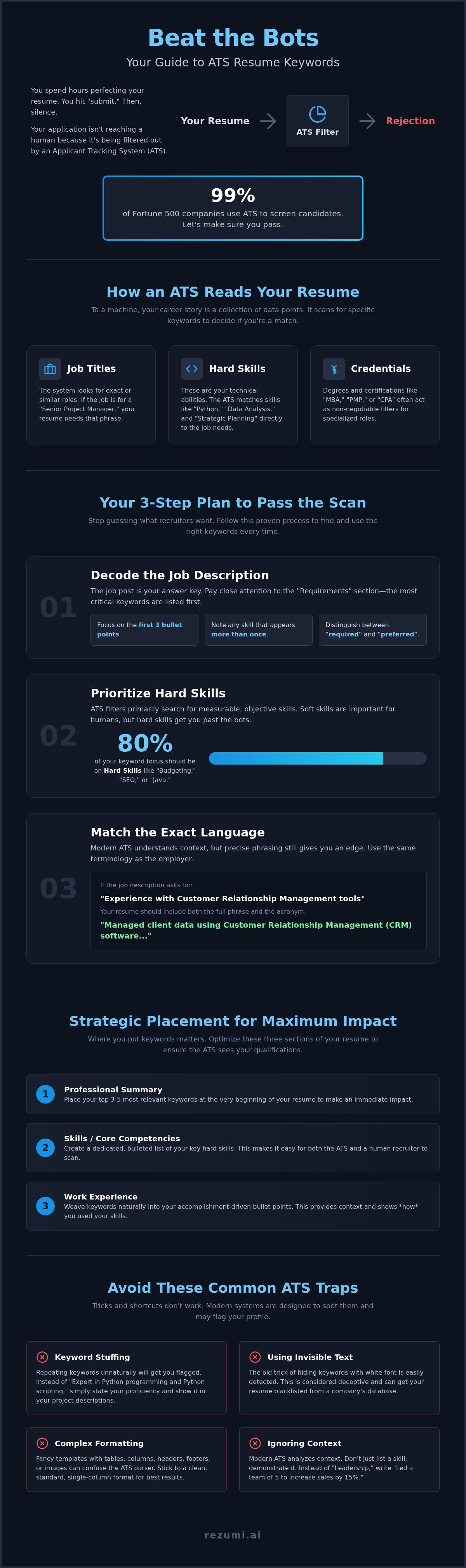
Tricking a machine is a losing game. It's also a fast track to the rejection pile. You might hear advice about "white fonting" or stuffing your footer with tiny text to fool the algorithm. These tactics fail because modern systems easily detect hidden text when they convert your document into a plain text file for analysis. If a recruiter sees a wall of invisible ATS resume keywords in their system view, they'll question your professional integrity and move to the next candidate.
Keyword stuffing is equally dangerous. While a bot might rank you high for volume, a human still has to read your work. A resume that reads like a list of search terms lacks the narrative flow required to prove your value. You must balance machine optimization with human readability. Lying about skills you don't possess is the final nail in the coffin. Technical interviews will expose the truth, permanently damaging your reputation with that employer.
The myth of 'beating' the system with hacks
Modern ATS platforms are sophisticated enough to strip away complex formatting and reveal hidden text. Instead of chasing hacks, focus on choosing the best resume format to ensure your data is parsed correctly. A clean, standard layout is your best defense against technical errors. Recruiters value honesty and clear communication over clever tricks. Your goal is to be the most qualified candidate, not the best at gaming an algorithm.
Ensuring your keywords match the job description exactly
Precision matters when you're dealing with automated filters. While some systems understand context, many still look for exact matches. Pay attention to the following details to ensure your ATS resume keywords are actually counted:
- Singular vs. Plural: Use the exact form found in the job posting. Use "Project Manager" instead of "Project Management" if the posting specifically asks for the title.
- Standard Headings: Stick to clear titles like "Work Experience" and "Education." Inventive headings like "My Professional Journey" can confuse the bot and make your keywords invisible to the scanner.
- Spelling Accuracy: A single typo can render a high-value keyword useless. If the software can't recognize the word, it can't give you credit for the skill.
Tailoring Your Resume with Rezumi AI Optimization
Manual tailoring is a relic of the past. It consumes hours you don't have and often results in missed opportunities. Rezumi automates the heavy lifting by scanning your resume against specific job descriptions in seconds. The platform identifies the exact ATS resume keywords needed to trigger a high match score. You move from uncertainty to total control. It replaces the anxiety of wondering if your resume is good enough with the reassurance of a data-backed strategy.
Your application receives a real-time score based on keyword alignment and formatting precision. This score isn't a vanity metric. It's a direct reflection of how a modern system will rank your experience. By 2026 standards, speed and accuracy are the only ways to stay competitive. Rezumi ensures your document is engineered for success before you ever hit the submit button. You save hours of manual editing while increasing your chances of getting a response from a human recruiter.
Using AI to scan and score your resume instantly
The optimization process starts with a simple upload. Provide your current resume and the target job description to trigger an immediate gap analysis. The system highlights exactly which high-impact keywords are missing from your professional summary and work history. It doesn't just list words. It provides actionable feedback on where to place them for maximum impact. This precision ensures your skills are visible to the algorithm's primary filters. Learn more about mastering these technical hurdles in our guide to ATS resume optimization.
Tailoring every application for specific roles
Generic resumes are archived instantly. You need a bespoke version for every role you target. Rezumi allows you to generate tailored bullet points that highlight the most relevant skills for each specific job. This ensures your resume meets North American standards for every submission without the manual grind. You can refine your profile and export a polished PDF in minutes. Once your resume passes the filter, prepare for the human interaction with our AI Interview Prep. This tool helps you articulate your experience with the same precision used in your resume. View Rezumi pricing and start optimizing your applications today.
Take Control of Your Application Strategy
The automated filter doesn't have to be a barrier to your career. You now understand that ATS resume keywords are the bridge between your professional experience and a recruiter's desk. By identifying mandatory requirements and placing them strategically, you move your application to the top of the pile. Precision and context are your most powerful tools in the 2026 North American job market.
Rezumi provides the technological advantage you need to win. Our platform offers real-time resume scoring and AI-powered keyword gap analysis tailored specifically for North American hiring standards. You can stop guessing which skills matter and start applying with the confidence of a data-backed strategy. It is time to replace the silence of the black hole with the momentum of scheduled interviews.
Your next career move is too important to leave to chance. Take these strategies and transform your resume into a high-performance document that gets results. You have the experience; it's time to make sure the bots know it too.
Frequently Asked Questions
What are the best keywords to put on a resume?
The best keywords are hard skills and specific job titles that appear directly in the job description. Focus your effort on technical proficiencies like "Data Analysis" or "Python" and mandatory certifications like "PMP." These are the primary data points recruiters use to filter qualified candidates. While soft skills are helpful for context, hard skills are the mandatory gates you must pass to secure an interview.
How many keywords should I include in my resume?
Aim for 10 to 15 highly relevant ATS resume keywords in your dedicated skills section. You should also weave these terms naturally into your work experience bullets to provide proof of your abilities. Avoid overwhelming the document with every skill you have ever used. Instead, only include terms that directly match the specific requirements of the role you are targeting to maintain a high match score.
Does the order of keywords matter for ATS?
Yes, the placement and prominence of keywords affect your match score significantly. Systems often weigh terms in your professional summary and recent work experience more heavily than those buried at the bottom of the page. List your most critical skills early in the document to signal their importance. This helps the software's ranking logic identify you as a top tier candidate during the initial scan of your profile.
Should I use abbreviations or full terms for keywords?
Use both the full term and the abbreviation to ensure the system recognizes your expertise regardless of its settings. For example, write "Search Engine Optimization (SEO)" or "Certified Public Accountant (CPA)" at least once in your document. This strategy covers all bases regardless of how the recruiter has programmed the search parameters. It ensures you don't get disqualified simply because the bot was looking for a different version of the word.
What is keyword stuffing and why is it bad?
Keyword stuffing is the practice of repeating the same terms excessively or hiding them in white text to manipulate the system. This is a high-stakes mistake because modern software can detect these hacks easily. Even if you pass the bot, a human recruiter will reject a resume that reads like a random list of search terms. It's better to use keywords naturally within achievement-based sentences.
How do I find keywords in a job posting effectively?
Identify keywords by looking for terms that repeat multiple times or appear in the first three bullet points of the requirements. These are usually the "must have" qualifications that the company needs most. Pay close attention to specific software names, action verbs, and industry standard certifications that the employer emphasizes. Cross-referencing three similar job postings can also help you find universal keywords that are standard for your specific industry.
Can I use the same keywords for every job application?
No, you must tailor your ATS resume keywords for every specific application to be successful. Even similar roles at different companies will use different terminology and prioritize different skills based on their unique culture. Using a generic list across multiple applications is a common reason for immediate rejection. Taking five minutes to align your language with the job description can be the difference between an interview and a rejection.
Will using too many keywords make my resume look fake?
High keyword density only looks fake when the terms lack context or evidence. If you list 20 skills but don't show how you used them in your work history, the resume appears manufactured. Balance your keyword usage by proving your proficiency through achievement-based bullet points and real-world results. A natural human rhythm in your writing helps convince recruiters that your expertise is legitimate and valuable.
Disclaimer
This article is provided for general informational purposes only and does not constitute professional, legal, financial, or career advice. While Rezumi strives for accuracy, we make no warranties as to the completeness or reliability of this content. Hiring practices, ATS behavior, and job-market conditions vary by employer, industry, and region — always verify against your specific situation. Any action you take based on this article is at your own risk.