ATS Resume Template: The 2026 Strategic Guide to Passing Every Screen
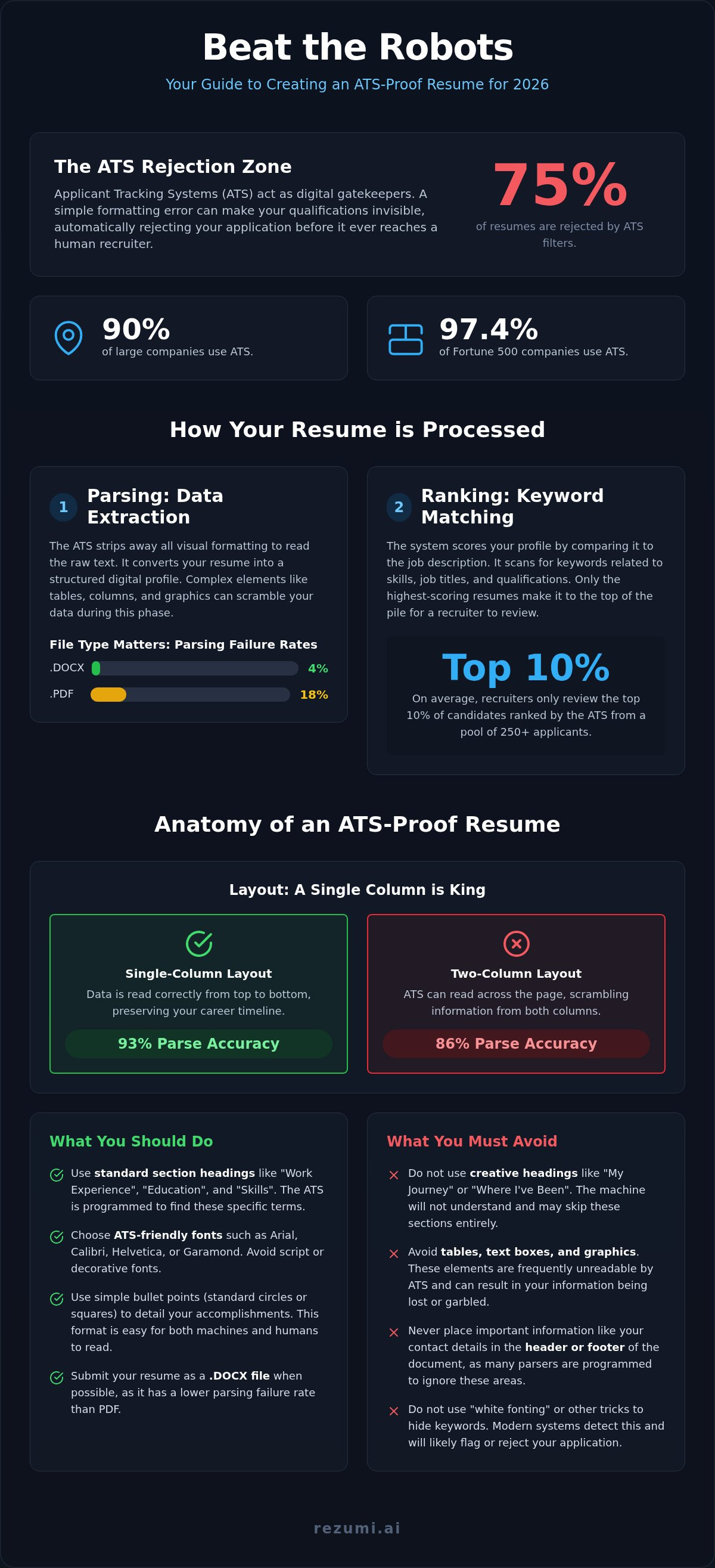
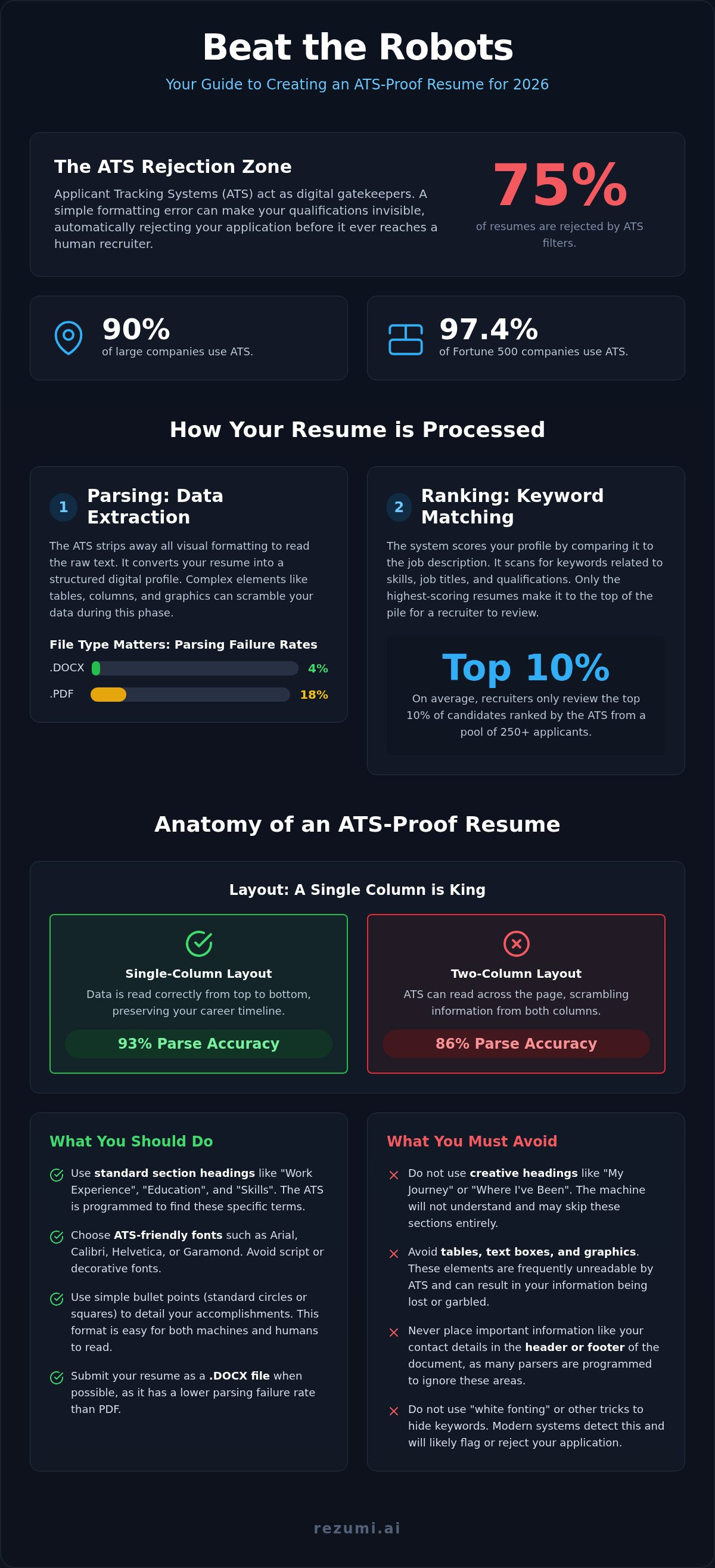
You can beat the 75 percent rejection rate of Applicant Tracking Systems (ATS) by using a strategic ATS resume template. This statistic from TopResume highlights a harsh reality for job seekers in 2026. You've worked hard on your career. Yet a simple formatting error can make your experience invisible to recruiters. It's a high-stakes hurdle. It turns talented professionals into digital ghosts.
You likely feel the frustration of formatting breaking after an upload. It's confusing to choose between a stylish design and a safe one. You deserve a resume that looks professional to humans and reads perfectly for a machine. This guide will show you how to select a layout that guarantees your data is parsed correctly every time. You'll gain the tactical advantage needed to move past the software and into the interview room.
We'll break down the specific fonts, layouts, and structures that work for modern hiring software. You will learn how to verify your document's technical accuracy and build a strategy that brings results. Let's turn your application into a high-performance tool that actually gets noticed.
Key Takeaways
- Use a strategic ATS resume template designed for machine parsing to ensure your professional data is readable by the 90 percent of large employers using these systems.
- Understand how ranking algorithms match your file against job descriptions so you can optimize your content for higher visibility and better placement.
- Prioritize technical structure over complex visual designs to prevent your formatting from breaking during the automated data extraction process.
- Follow a strict 2026 formatting checklist for the US and Canadian markets to meet the non-negotiable standards of high-tier recruiters.
- Transition from static documents to AI-driven optimization to get real-time feedback and a clear score on your application's performance.
What is an ATS resume template and why you need one
An ATS resume template is a technical blueprint designed for machine parsing. It ensures that software extracts your professional data with 100 percent accuracy. Without the right structure, your career history can turn into unreadable gibberish. This is a high-stakes problem for any job seeker. You need a document that speaks the language of modern hiring software.
The numbers show why this matters. Research indicates that 97.4 percent of Fortune 500 companies use automated filters to screen candidates. If the software cannot find your skills, a human recruiter will never see your application. What is an Applicant Tracking System (ATS) exactly? It is a specialized database that organizes and ranks applicants. It acts as the primary gatekeeper for the North American job market.
The core components of ATS readability
Software logic relies on predictable structures and standard labels. Your template must use recognized headings like Work Experience, Education, and Skills. These terms act as anchors that tell the parser where to look for specific information. If you use creative titles like "My Journey" instead of "Work Experience," the machine might skip your entire history.
Simple hierarchies are vital for technical success. You should use a logical, top-to-bottom flow. This helps the machine map your career timeline without errors. A clean layout also benefits the human side of the process. It allows recruiters to scan your profile in under six seconds once you pass the digital screen. You want to make it easy for both the robot and the person to find your value.
Why standard creative templates often fail
Visual appeal often comes at the cost of technical structure. Many creative templates use images, icons, and non-standard fonts that software cannot process. These elements often appear as blank spaces or errors in the recruiter's database. This immediately disqualifies your application regardless of your talent. You're being judged by what the machine can read, not what you can see.
Columns are a major technical risk. Many systems read text straight across the entire page rather than down each individual column. This scrambles your data and mixes your job titles with your dates of employment. Industry data shows that single-column layouts have a 93 percent accuracy rate. This is significantly higher than the 86 percent accuracy found in two-column designs. Stick to a vertical flow to ensure your data stays intact during the upload.
How Applicant Tracking Systems scan and rank your data
Your resume goes through a digital meat grinder the moment you hit "submit." The software doesn't care about your font choice or your color palette. It only cares about data extraction. If your ATS resume template isn't built for this process, your information will be lost before a human ever sees it.
The parsing phase: turning your PDF into text
Parsing is the technical conversion of your document into a structured digital profile. When you upload your file, the system strips away all formatting to read the raw text underneath. If you use tables or complex graphics, the parser might read your contact info as part of your work history. This creates a broken profile. Research shows that while DOCX files have a 4 percent failure rate, PDF files fail about 18 percent of the time.
Avoid the "white fonting" trap. Some job seekers hide keywords in white text to boost their score. Modern systems are designed to catch this. It often results in an immediate rejection or a permanent blacklist. Stick to visible, high-quality content that a human can also read. Accuracy is the only way to ensure the machine sees your true value.
The scoring phase: how you reach the top of the pile
The system calculates a percentage match score by comparing your profile to the job description. It looks for specific technical skills, previous job titles, and educational requirements. Because the average corporate job posting receives 250 applicants, recruiters rely on these scores. They often only review the top 10 percent of ranked candidates. If you aren't in that group, you're effectively invisible.
Recruiters use these scores to narrow the field quickly. In fact, 99.7 percent of recruiters use filters within their ATS to find specific skills. If your resume is missing a single key term, you might be filtered out before the ranking even begins. You can find more deep-dive strategies in our guide to ATS resume optimization.
Exact keyword matches are non-negotiable. If a job description lists "Project Management," don't shorten it to "PM." Some older systems aren't smart enough to know they are the same. Use the full term and the abbreviation to cover all bases. To ensure your ATS resume template is performing at its peak, you can check your real-time optimization score to see exactly how you rank against the competition.
Comparing template sources: Word vs. Canva vs. AI
Visual appeal should never come at the cost of technical structure. If the software cannot read your file, your graphic design skills will not matter. You need a document that balances human aesthetics with machine logic. Choosing the right source for your ATS resume template is the first strategic decision in your job search. You must use a platform that understands the North American market and its specific parsing rules to avoid being filtered out early.
The Canva trap: when design hurts your chances
Many job seekers fall for the "pretty" template. Canva is a powerful tool for social media, but it is often a disaster for online job portals. Most Canva designs rely on floating text boxes to place information exactly where the designer wants it. Applicant Tracking Systems do not read these boxes in a logical order. The parser might pull your "Skills" section and drop it into the middle of your "Education" history, creating a scrambled profile that recruiters will immediately reject.
Graphics like skill bars and star ratings are another major technical liability. A machine cannot quantify a 4 out of 5 star rating for "Project Management." It requires text based evidence of your proficiency. These visual elements take up valuable space without providing searchable data. Save these creative resumes for networking events, career fairs, or hand-delivery. For any online application portal, they are a high-risk choice that often leads to ghosting.
Microsoft Word and Google Docs: the safe but basic choice
Standard word processors are the industry benchmark for a reason. They offer the highest compatibility with any ATS resume template structure. Because these files are text based from the start, parsers rarely struggle to extract the data. However, the trade-off is often a dated appearance. Making a standard Word doc look professional and modern requires significant manual effort and a deep understanding of layout principles. Most people end up with a document that looks like it belongs in 2010.
If you choose this route, always save your final version as a PDF. This preserves your layout across different devices while keeping the text selectable for the machine. You must ensure the PDF is not saved as an image file. If you cannot highlight and copy the text in your PDF, the ATS will see a blank page. This simple check can prevent your application from disappearing into a digital void.
Rezumi offers a sophisticated alternative to these generic options. It combines the technical safety of a Word document with the modern aesthetics of a high-end design tool. By using a platform built specifically for the North American market, you gain access to real-time feedback and scoring. This ensures your resume is ready for both the software and the hiring manager before you ever hit submit. You can start building your optimized profile by exploring our Resume Design and PDF Export tools today.
The 2026 checklist for North American resume formatting
Passing an automated screen requires more than just the right keywords. You must follow the technical conventions of the North American hiring market to ensure your data stays intact. These rules are non-negotiable if you are targeting high-tier professional roles in the US or Canada. A reliable ATS resume template serves as your foundation for meeting these standards.
Hiring managers and software alike expect a specific document structure. If you deviate from these norms, you risk appearing unprofessional or becoming invisible to the system. You want to eliminate every possible technical barrier between your experience and a human reviewer. Following this checklist will give you the control you need over your application's performance.
Page setup and technical specifications
Start with the physical dimensions of your document. You must use US Letter size (8.5 by 11 inches) rather than the international A4 standard. Recruiters in the US and Canada expect a specific visual rhythm. When you use A4, the document appears slightly longer and narrower than what they are used to seeing. This subtle difference can be distracting and may affect how your resume prints or displays in a recruiter's portal.
Set your margins to exactly one inch on all sides for a balanced, professional look. This provides enough white space for readability while maximizing the area for your career data. Smaller margins can make your document look cluttered. They might also cause parsing errors in older systems that expect standard padding around the text.
Font choice is a technical decision that impacts both humans and machines. Stick to safe, standard fonts that every operating system can recognize without issues. Some of the most reliable options include:
- Arial
- Calibri
- Georgia
- Tahoma
Avoid obscure or "handwritten" styles that might confuse a machine's optical character recognition (OCR) software. If the parser cannot identify the characters, it cannot index your skills. You should also keep your font size between 10 and 12 points for the body text to ensure it's legible for human eyes after the digital screen.
Content structure and section headers
Your section headers act as signposts for the software. Use traditional labels like "Professional Experience" or "Work History" instead of creative phrases like "My Journey" or "Where I've Been." The machine is programmed to look for specific words to categorize your data. If it doesn't recognize a header, it might misfile your entire work history under "Miscellaneous" or ignore it entirely.
Place your contact information at the very top of the page in the main body of the document. You should avoid putting this data in the header or footer section of a Word document. Many Applicant Tracking Systems still fail to scan these areas. If your name and phone number are trapped in a header, the recruiter might see a blank entry in their database. This forces them to open the file manually, which they rarely have time to do.
Consistency is vital for your layout and timeline. You can find visual examples of these rules in action by reviewing our best resume format guide. Following these patterns ensures your ATS resume template stays organized during the data extraction phase.
Beyond the template: optimizing your resume with Rezumi
A high-quality ATS resume template is your foundation. But a blueprint is useless without the right materials inside. You need to move beyond static formatting to dynamic, data-driven optimization. Rezumi transforms your application from a generic document into a targeted, high-performance tool. It replaces the uncertainty of manual editing with the precision of machine logic.
Static templates often fail because they don't account for the specific job description you are targeting. You might have a clean layout, but if your content doesn't match the recruiter's filters, you will still be ghosted. Optimization is the bridge between a readable file and a successful hire. It is the final step that turns a professional profile into an interview invitation.
Real-time scoring and ATS feedback
Our AI analyzes your resume against specific job descriptions in seconds. It identifies the exact technical skills and keywords that recruiters use to filter their databases. You receive a clear, numerical score that reflects your match for the role. This replaces the anxiety of guessing with the confidence of a data-backed strategy. You see exactly what the machine sees before you send your file.
You get more than just a score. Rezumi provides actionable steps to improve your profile immediately. If you're missing a specific competency or a formatting choice puts your data at risk, the system flags it. You can make corrections in real time and watch your score rise. Knowing your resume works before you hit the submit button gives you a massive competitive advantage.
Tailoring your application for every role
Manual personalization is slow and often leads to errors. Rezumi acts as a centralized workspace for your entire job search. You can track every application and tailor your content with surgical precision. Our platform ensures that every version of your ATS resume template is optimized for the specific company and role you want. This level of tailoring was once impossible for the average job seeker.
The Rezumi ecosystem supports you through the final phase of the hiring process. Our AI cover letter generator creates supporting documents that align perfectly with your optimized resume. Once you pass the digital screen, our AI interview prep tools help you refine your message for human recruiters. This end-to-end support ensures you are ready for every hurdle in the North American job market.
You don't have to navigate this complex system alone. You can take the first step toward a more effective application strategy right now. We invite you to check pricing and start optimizing for your next career move.
Take Control of Your Application Strategy
You now have the technical roadmap to beat the 75 percent rejection rate. Success starts with a clean ATS resume template that prioritizes machine readability over complex graphics. Your document must follow specific North American standards, including US Letter sizing and standard section headers. By aligning your career history with the ranking algorithms, you transform your resume from a gamble into a strategic tool.
Transitioning from a static file to a dynamic profile is the most effective way to secure more interviews. Your career is too important to leave to chance. You have the tools to ensure every byte of your data is parsed correctly. Rezumi provides real-time ATS scoring and feedback tailored for US and Canadian hiring standards. We also include AI-powered interview coaching to prepare you for the final stage.
You've done the work to build a great career. Now it's time to make sure the world sees it. You're ready to submit with confidence and land the role you deserve.
Frequently Asked Questions
Can an ATS read a two-column resume template?
Most modern systems can parse multiple columns, but it significantly increases the risk of errors. Research shows single-column layouts have a 93 percent accuracy rate compared to only 86 percent for two-column designs. Many older systems read text straight across the page, which scrambles your data. You should use a single-column ATS resume template to ensure your work history remains in the correct chronological order during the extraction process.
Is it better to submit a resume as a PDF or a Word document?
A Word document (.docx) is the safest format for technical compatibility. While most systems now accept PDFs, they have an 18 percent parsing failure rate compared to only 4 percent for Word files. If a job portal specifically asks for a PDF, use it. Otherwise, stick to a Word file to minimize the chance of your data becoming unreadable during the upload. Always verify your file isn't saved as an image.
What fonts are the most ATS-friendly for a professional resume?
Standard sans-serif and serif fonts are the most reliable choices for machine reading. You should stick to recognized options that are pre-installed on most computers. Safe choices include:
- Arial
- Calibri
- Georgia
- Tahoma
Avoid using custom fonts that the software might not have in its database. If the machine cannot identify the characters, it will treat your resume as a blank page and disqualify you immediately.
How many pages should an ATS-friendly resume be in 2026?
Your resume should typically be between one and two pages. The average corporate job posting receives 250 applicants, so brevity is vital for the human recruiters who see your file after the digital screen. While the software can process longer documents, it ranks candidates based on keyword density. A concise document allows you to highlight your most impactful achievements without diluting your match score with irrelevant details.
Does an ATS scan the header and footer of a document?
Many Applicant Tracking Systems cannot reliably scan information placed in the header or footer sections. Industry data indicates that 25 percent of systems miss contact information when it's tucked away in these areas. This can result in a recruiter seeing a profile with no way to contact you. You should place your name, phone number, and email address at the very top of the main body of the document instead.
Can I use colors and bold text in an ATS resume template?
You can safely use bold text and professional colors to emphasize your achievements. Bolding helps recruiters scan your profile quickly after you pass the initial screen. However, you should avoid using light colors or complex gradients that might interfere with optical character recognition. Stick to dark colors like navy blue or charcoal. Ensure your ATS resume template remains clean and legible for both the machine and the hiring manager.
How do I know if my resume template is actually working?
The only way to be certain is to use a real-time scoring tool that simulates the parsing process. You shouldn't wait for a rejection letter to find out your formatting is broken. AI-powered platforms analyze your file against specific job descriptions to provide a clear performance score. This allows you to identify technical errors and keyword gaps before you submit. Testing your application ensures you maintain full control over your job search results.
Disclaimer
This article is provided for general informational purposes only and does not constitute professional, legal, financial, or career advice. While Rezumi strives for accuracy, we make no warranties as to the completeness or reliability of this content. Hiring practices, ATS behavior, and job-market conditions vary by employer, industry, and region — always verify against your specific situation. Any action you take based on this article is at your own risk.