Beat the ATS: Strategic Guide for the 2026 Job Market
You hit send. Your resume disappears into a digital void. It feels like a machine decided your fate before a human even saw your name. This is the reality for most job seekers in 2026, where 97.4% of Fortune 500 companies use software to manage applications. If you are tired of instant rejections, it is time to change your strategy. Learning how to beat the ats is not about tricking a computer. It is about aligning your data so a recruiter can actually find you.
It is exhausting to spend hours on an application only to receive zero feedback. You know you have the skills, but the system is not ranking you correctly. We understand the high stakes of your job search. This guide will teach you exactly how these systems work and the specific steps to ensure your resume reaches a human recruiter. We will break down technical formatting and keyword optimization so you can stop guessing and start getting interview invites.
Key Takeaways
- Understand that modern systems rank candidates for recruiters rather than just deleting files. This knowledge is the foundation of how to beat the ats and get noticed.
- Use standard section headings and safe file formats to avoid parsing failures. Simple layouts ensure the software captures your data accurately every time.
- Avoid hidden text and keyword stuffing that trigger red flags for recruiters. Authentic alignment works better than trying to trick the software.
- Extract the primary hard skills from job postings to mirror the employer's specific language. Using their exact terms helps you climb to the top of the candidate list.
- Adopt AI optimization tools to tailor your resume for every application. Speeding up the technical alignment lets you focus more on your actual career growth.
Understanding the ATS: Why Good Resumes Get Rejected
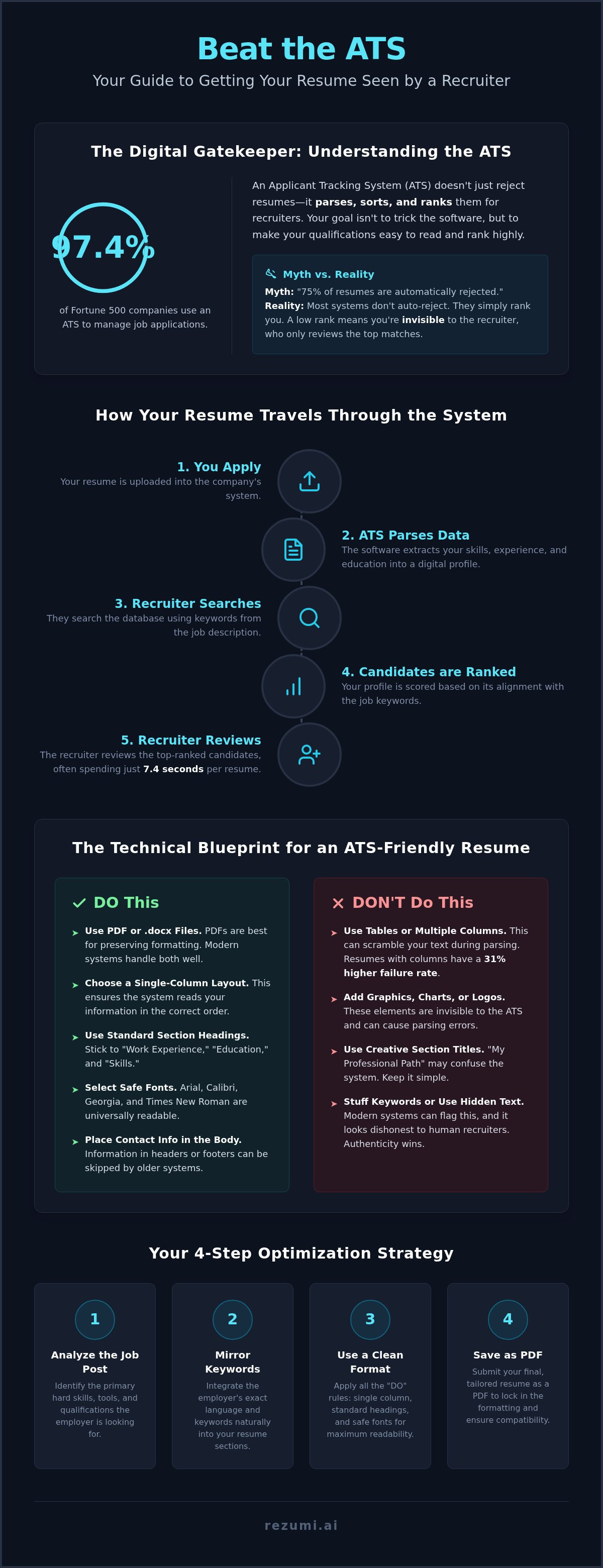
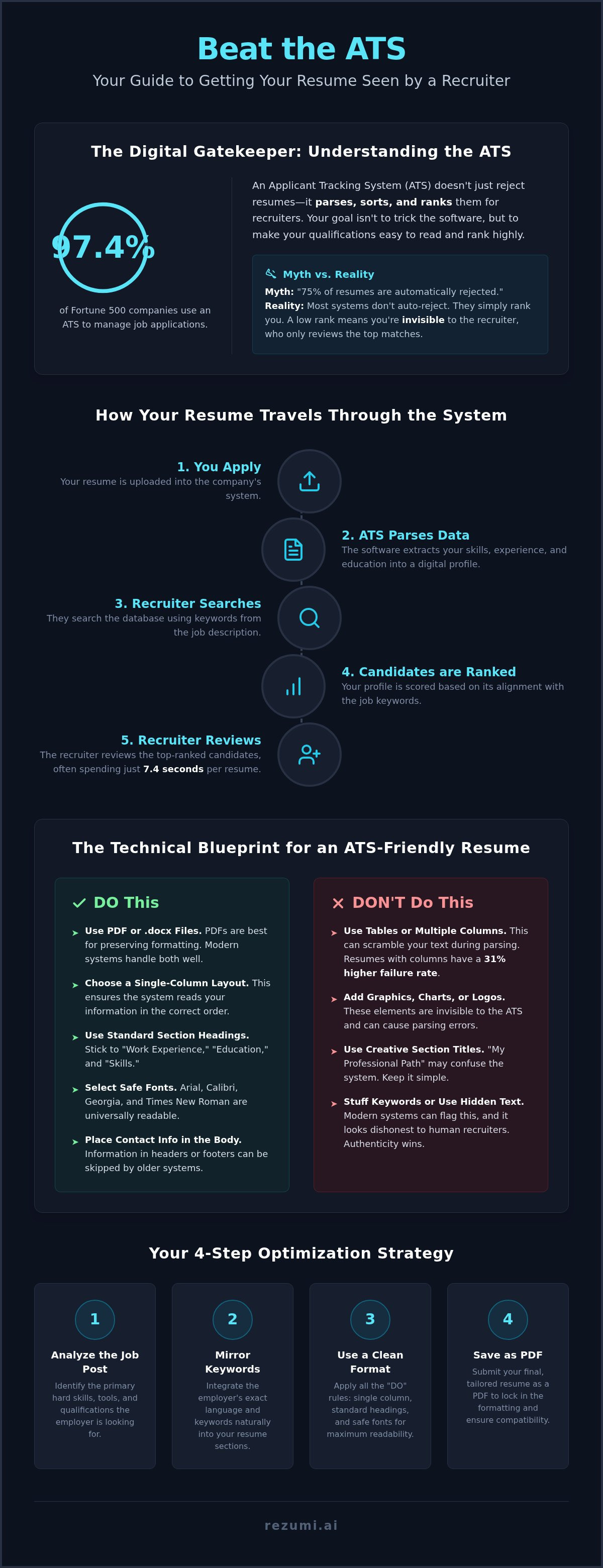
An Applicant Tracking System (ATS) is a software tool that acts as a digital gatekeeper for employers. It helps companies manage thousands of job applications by scanning resumes and storing them in a searchable database. Most large companies in North America rely on these systems to handle high application volumes. In fact, 97.4% of Fortune 500 companies used a detectable ATS in 2026. You likely recognize names like Workday, which holds over 40% of the market, or Greenhouse and SAP SuccessFactors. Understanding What is an Applicant Tracking System? is the first step in your professional strategy.
When you apply for a job, the software parses your resume. This means it pulls out your contact information, work history, and skills to create a digital profile. Recruiters do not read every resume that comes through the door. Instead, they search the database using specific keywords related to the job description. If your resume contains the right terms, it appears in their search results. If it doesn't, your application stays buried. Learning how to beat the ats is really about making sure your data is easy for a recruiter to find and rank.
The Problem of the Digital Filter
Many people believe that an ATS automatically rejects 75% of resumes. Recent data shows this is mostly a myth. A 2025 survey found that 92% of recruiters say their system does not automatically reject people based on resume content alone. The real problem is ranking. If your resume has formatting errors, the software might fail to read your skills. Tables, columns, or unusual fonts can turn your professional history into a jumble of symbols. When the system cannot read your data, it cannot rank you. You aren't being rejected by a robot. You are simply becoming invisible to the human recruiter because your file didn't parse correctly.
How Recruiters Use ATS Results
Recruiters use these systems to save time. They often receive between 180 and 300 applications for a single hire. To manage this volume, they look at a ranked list of candidates based on a match score. This score shows how well your resume aligns with the job description. A recruiter might only look at the top 10 or 20 people on that list. Research shows that recruiters spend as little as 7.4 seconds on their initial manual review of a resume. If you aren't at the top of the list, your resume will likely never be seen. Your goal is to optimize your document so you land in that top group every time.
The Technical Blueprint for ATS Compatibility
To get past the digital screen, your resume must be machine-readable. If the software can't parse your text, your application disappears. Parsing is the process where the computer translates your document into a digital profile. This technical alignment is the most direct way to understand how to beat the ats and ensure your skills are actually seen. You don't need a complex design to stand out. You need a clean structure that the system can index without errors.
File Types: PDF vs Word
Standard PDF files are your best choice for modern applications. They keep your design intact and prevent your text from shifting when a recruiter opens the file. While some older guides suggest only using Word documents, 2026 data shows that plain-text .docx files have a 4% failure rate. This is low, but modern PDF parsers are now the industry standard. Never use image files like JPEGs or PNGs. The system cannot read the text inside an image, which leads to an immediate, silent rejection. Using ATS-friendly resume formatting ensures the software captures every word of your experience correctly.
Layout and Design Rules
Use a single column layout to keep the reading order logical for the machine. Systems read from left to right and top to bottom. When you use multiple columns, the software often blends the text from both sides together. This creates a confusing mess that a human recruiter won't take the time to fix. A 2026 study by EDLIGO found that resumes using tables or columns have a failure rate of 31% or higher. If you want to be safe, stick to a linear path that guides the software through your history.
Follow these specific rules to keep your data clean:
- Place contact details in the main body. Many systems still ignore text inside headers and footers.
- Use standard fonts like Arial, Calibri, or Georgia. Fancy fonts can confuse the parsing engine and turn your text into gibberish.
- Stick to traditional headings like "Work Experience" and "Education." Creative titles like "My Professional Path" might not be recognized by the software.
- Avoid graphics, charts, and progress bars. These look great to humans but are invisible or distracting to the software.
If you find this technical setup frustrating, you don't have to do it alone. You can check our optimization plans to see how we automate these formatting rules for you. By following a clean blueprint, you ensure your resume works for both the robot and the human recruiter who eventually reads it.
Truth vs Fiction: Common ATS Hacks That Do Not Work
Social media is full of bad advice that can ruin your job search. You might have heard that pasting the entire job description in tiny white text is a clever trick to get noticed. It isn't. Modern software is designed to detect these manipulations easily. When a recruiter opens your profile, the system often strips away formatting and displays all text in a single color. Your hidden keywords suddenly appear as a suspicious block of text. This makes you look dishonest and most recruiters will discard your application immediately if they see signs of cheating.
The "Standard Template" is another trap that catches many job seekers. Using a generic resume that you send to every opening rarely works in 2026. These documents usually contain only 48% of the keywords found in a specific job description. If you don't speak the employer's language, you won't rank high enough to be seen. Stop trying to find a shortcut and start focusing on technical alignment. Learning how to beat the ats is about professional accuracy, not digital trickery.
Why Hidden Tactics Backfire
Modern systems like Greenhouse and Workday prioritize transparency. They are built to help recruiters find the best fit, not to be tricked by hidden text. If you try to game the system, you are betting against sophisticated algorithms that flag unusual keyword density. These red flags tell the recruiter that you are trying to bypass the rules rather than proving your value. Authentic alignment creates a better first impression than any secret hack ever could.
The Importance of Context
Context is the most important factor in modern ranking. In 2026, algorithms look for keywords within your actual job duties and achievements. Simply listing a skill like "Project Management" ten times at the bottom of your page is ineffective. Recruiters want to see how you used that skill to get results. A study of nearly 140,000 applications found that tailored resumes had an interview rate of 4.23%, which is double the rate of non-tailored resumes. This success comes from providing context that proves your expertise.
Focus on natural language that shows your impact. If a job asks for "Strategic Planning," describe a specific time you managed a budget or led a team through a transition. This approach works for both the robot and the human. By aligning your data with the employer's needs, you position yourself as a high-performance candidate who understands the mechanics of the modern market.
Your Step-by-Step Strategy to Pass the Digital Screen
You need a plan. Generic applications are the reason most resumes fail to get a response. Research shows that unoptimized resumes contain only 48% of the keywords needed to rank well in a search. You can change this by analyzing the job description before you write a single word. Look for hard skills that appear multiple times in the ad. These are the primary signals the recruiter uses to sort their database and find candidates.
Mirror the exact language of the job posting. If the employer asks for a "Project Management Professional (PMP)," don't just write "certified project manager." Use the full title and the acronym exactly as they appear. The software looks for specific character strings. If you miss the exact match, you might miss the interview. This is the most effective way to learn how to beat the ats without using risky hacks.
Extracting High-Impact Keywords
Read the "Requirements" section of the job ad carefully. Identify every tool, software, and certification listed as mandatory. If a skill like "Python" or "SQL" is required, it must appear in both your skills section and your work history. This repetition tells the system you have deep experience in that area. Place these keywords naturally within your bullet points to show how you applied them in real world scenarios.
The Power of Numbers
Recruiters want proof of your success. A 2025 survey of 384 recruiters found that 58.2% value measurable achievements as the top factor that makes a candidate stand out. Use dollar amounts, percentages, and timeframes to prove your impact. Instead of saying you "managed a budget," say you "managed a 250,000 dollar budget and reduced costs by 15%." Numbers are easy for the system to categorize. They help the software flag you as a high performer compared to candidates who only list their duties.
Choosing the Right Format
A chronological format is the most reliable choice for 2026. It lists your experience from newest to oldest, which is exactly how the software expects to find your data. This structure ensures your most relevant roles appear at the top of your digital profile. For more details, see our guide on choosing the best resume format. Understanding how to beat the ats requires this level of technical precision to ensure your history remains readable.
Optimizing Your Career Strategy with AI Tools
AI technology is no longer just a tool for recruiters. It is your most powerful ally in a competitive market. While companies use software to filter you out, you can use the same technology to ensure you get in. This shift in strategy is the final piece of the puzzle in learning how to beat the ats. You can now move from manual, repetitive editing to a high-speed, data-driven approach that respects your time and maximizes your results.
Rezumi allows you to scan your resume against specific job descriptions in seconds. You get a real-time score that shows exactly where you align and where you fall short. Instead of guessing why you aren't getting calls, you see the technical gaps immediately. This automated feedback loop lets you refine your document with surgical precision before you ever hit submit. You can read more about ATS resume optimization to see how this process works in detail.
Tailoring at Scale
Applying for jobs is a volume game, but quality cannot suffer. Rezumi helps you adjust your resume for every application without starting from scratch. You can maintain a centralized dashboard to track every version and every response. This organization keeps you focused on the roles that matter most. When you automate the technical alignment, you free up your energy to focus on the human side of your career. It is the most efficient way to manage a modern job search.
Beyond the Resume
A high-ranking resume gets you the interview, but your performance in the room gets you the job. Our platform provides AI-driven interview coaching to help you prepare for the next step. You can practice your answers to common industry questions and receive instant feedback on your delivery and content. This builds the confidence you need to transition from a digital profile to a hired professional. Practice makes your success repeatable rather than accidental.
Success in the 2026 job market requires a blend of human expertise and technological speed. You don't have to manage the complex mechanics of hiring systems alone. By using a strategic partner, you ensure your resume works for you every hour of the day. Check out our pricing plans to start your optimized search today.
Take Control of Your 2026 Career Search
You now have the technical blueprint to stop being invisible to recruiters. By focusing on clean layouts and matching the specific language of job descriptions, you turn the system into a tool for your success. Passing the digital screen is no longer a matter of luck. It is a matter of strategic alignment and professional accuracy. You have learned that the robot is not your enemy. It is simply a search engine that needs the right data to find you.
Understanding how to beat the ats is about aligning your real-world impact with the specific terms recruiters are searching for right now. You don't have to guess if your resume is compliant with North American standards or worry about parsing failures. Rezumi provides AI-powered resume scoring and real-time tailoring for any job description to ensure your profile ranks at the top of the list.
Your next career move is closer than you think. With the right technical setup and a data-driven strategy, you are ready to reach a human recruiter and secure the interviews you deserve.
Frequently Asked Questions
How do I know if my resume is ATS friendly?
You can test your document by copying the text into a plain text editor like Notepad. If the text appears jumbled or sections are missing, the software cannot read it. A more accurate method is using a scoring tool that mimics how these systems parse data. Rezumi provides real-time feedback on your technical alignment so you can see exactly what a recruiter sees before you hit submit.
Can ATS read columns or tables in a resume?
Most modern systems still struggle with complex layouts. Tables and multiple columns often cause the software to read across the page, mixing your dates and job titles into a confusing mess. A 2026 study found that resumes with these elements have a failure rate of 31% or higher. Stick to a single-column, linear format to ensure every word of your experience is captured correctly.
Should I use a PDF or a Word document for my application?
A standard PDF is the best choice for 2026 applications. It preserves your formatting and is easily read by modern parsers like those used in Greenhouse or Workday. While .docx files are a safe backup, they have a slightly higher failure rate of 4% when parsed. Unless the job portal specifically asks for a Word file, use a clean PDF export to maintain professional consistency and readability.
How many keywords should I include to beat the ATS?
Focus on quality and context rather than a specific number. You should include the primary hard skills and tools mentioned in the job description at least once. Research shows that resumes missing these terms often contain only 48% of the necessary keywords to rank well. Learning how to beat the ats is about natural integration in your work history, not just listing words in a block at the bottom.
Does the ATS automatically reject candidates with low scores?
No, automatic rejection is a common myth. A 2025 survey found that 92% of recruiters say their system only ranks and sorts candidates. However, a low score means you land at the bottom of a list of hundreds of people. Since recruiters often only review the top-ranked profiles, a low score functionally acts like a rejection because your resume is never actually seen by a human eye.
Is it better to use a simple resume template or a creative one?
Simple templates are far more effective for passing the digital screen. Creative templates often use graphics, icons, and non-standard fonts that the software cannot translate. These elements look good to people but are invisible to the machine. Use a clean, professional design that follows North American standards to ensure the software prioritizes your actual experience over your resume's visual style and decorative elements.
How do I find the best keywords for a specific job description?
Look for terms that the employer repeats in the requirements and responsibilities sections. These usually include specific software, certifications, and hard skills like budget management or SQL. Pay attention to full titles and acronyms. If the ad uses both, your resume should too. This strategy is a core part of how to beat the ats and move your application to the top of the candidate pile.
Will using AI to write my resume get me in trouble with recruiters?
Using AI for optimization and tailoring is a standard professional practice in 2026. Recruiters care about the accuracy and quality of the information, not the tool you used to format it. As long as the content is true and reflects your actual experience, AI tools are viewed as a sign of technical literacy. They help you meet the high standards of modern hiring systems without making manual errors.
Disclaimer
This article is provided for general informational purposes only and does not constitute professional, legal, financial, or career advice. While Rezumi strives for accuracy, we make no warranties as to the completeness or reliability of this content. Hiring practices, ATS behavior, and job-market conditions vary by employer, industry, and region — always verify against your specific situation. Any action you take based on this article is at your own risk.