Career Change Resume With No Experience: A Practical 2026 Guide
You don’t need direct experience to make a convincing case for a new career. A career change resume no experience can show employers what you bring through skills you’ve used, training you’ve completed, and results you can support. The key is to connect your real background to the role without overstating what you’ve done or relying on job titles that don’t match your goal.
If you’re unsure which parts of your work history still matter, or worried an applicant tracking system will miss the connection, focus on clear evidence and relevant wording. The answer isn’t to invent experience. It’s to show how your existing skills relate to the work in the job description.
This guide will help you identify transferable skills, choose examples that support them, and build a resume tailored to your target role. You’ll also learn how to organize your work history and include relevant training, projects, or volunteer work when they strengthen your case. By the end, you’ll have a practical way to apply with confidence while representing your experience accurately.
Key Takeaways
- A career change resume no experience can make a strong case by showing how your past work connects to the target role.
- Map each job requirement to a real skill, where you used it, and the result you achieved.
- Choose a resume structure that puts relevant skills near the top while keeping your work history clear.
- Use wording from the job description only when it accurately describes skills and experience you can support.
- Track the resume version you send to each employer so you can review and refine your approach.
Career Change Resume With No Experience: What Employers Need to See
A career change resume with no experience should show evidence connecting your background to one target role. “No experience” often means you haven’t worked directly in that field, not that you have no useful skills or accomplishments. Employers need to understand what you can do, where you’ve done it, and how it relates to the work you’re applying for.
Transferable experience shows you’ve used a relevant skill in another setting; direct industry experience means you’ve applied it within the target field. For example, coordinating schedules in an office can demonstrate planning and organization, even if you haven’t worked in the industry you’re entering. Make the connection clear by naming the skill and describing a real example. A transferable skills overview can help you understand how abilities developed in one setting may apply to another.
What counts as experience when you are changing careers?
Your evidence can come from paid work, education, personal projects, volunteering, or relevant community responsibilities. Include an example when it demonstrates a skill named or implied in the target role. A class project may support a claim about research or data analysis if you completed that work. A volunteer role may show event coordination if you helped plan and deliver an event.
Be precise about what you completed. Separate finished work and results from plans, interests, or goals. “Completed a course in spreadsheet analysis” is different from “experienced data analyst.” If you can name a result, include it. If you can’t measure the outcome, describe what you did and what it supported without implying an unverified result.
Start with one specific target role
Choose a realistic target title before drafting. Review several relevant job postings and note the duties, tools, and skills that appear repeatedly. These requirements give you a practical standard for deciding which parts of your background belong on the resume.
Keep the focus narrow. A general resume for unrelated career paths can make your strongest evidence harder to find. If you’re considering project coordination and customer support, for example, create a separate version for each. Choose the examples and wording that fit the role, then confirm that every claim reflects what you actually did. The goal is to make the match clear, not rewrite your work history.
Find Transferable Skills and Turn Them Into Evidence
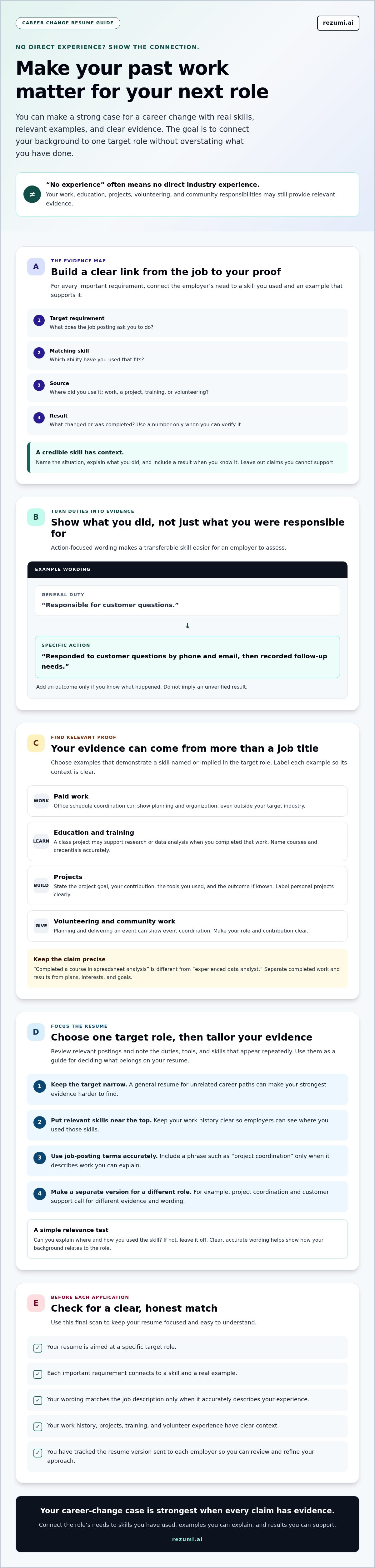
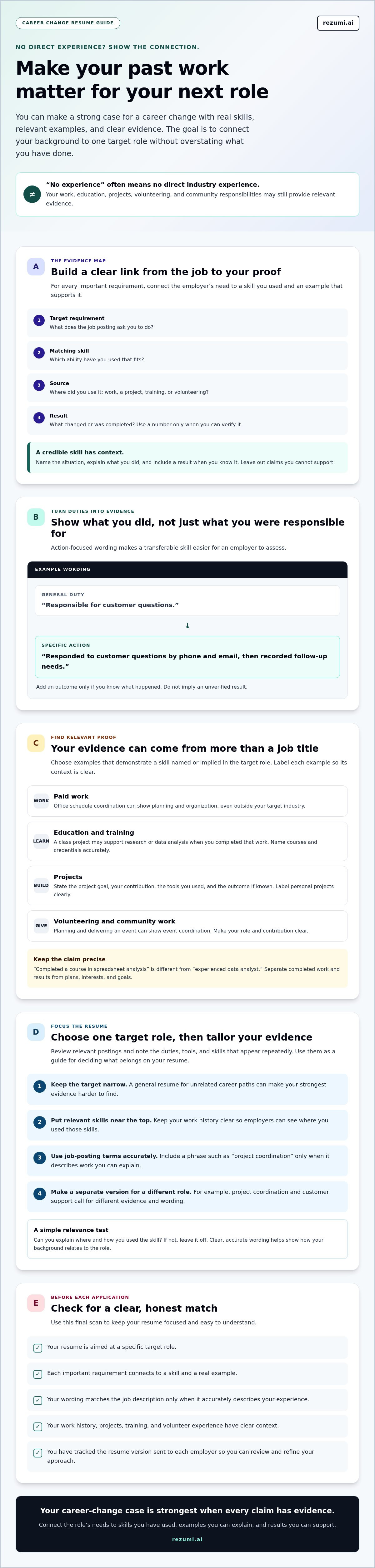
Match each requirement in your target job posting to a skill you’ve used and an example that supports it. A career change resume no experience needs more than a list of strengths. It needs a clear link between what the employer needs and what you’ve already done.
Transferable skills become credible on your resume when you support each one with a specific situation, action, and result. Before writing bullet points, build a simple evidence map:
- Target requirement: What does the job posting ask you to do?
- Matching skill: Which ability have you used that fits?
- Source: Where did you use it, such as work, a project, training, or volunteering?
- Result: What changed or was completed? Use a number only if you can verify it.
This map helps you choose relevant evidence and avoid inflated claims. Start with recent examples that closely match the role. Then turn general duties into action-focused statements. Instead of “responsible for customer questions,” describe what you did: “Responded to customer questions by phone and email, then recorded follow-up needs.” Add an outcome only if you know what happened.
Match job requirements to skills you already use
Look for repeated requirements across the job postings you reviewed, such as communication, analysis, customer support, or project coordination. For each one, write down a situation and the action you took. “Strong communication skills” is difficult to assess on its own. An example of explaining a process, resolving a concern, or sharing findings gives the employer something concrete to evaluate.
Use the posting’s terms when they accurately describe your work. If it asks for “project coordination” and you organized tasks, timelines, and updates, that phrase may fit. Don’t add a skill just because it appears in the ad. If you can’t explain where and how you used it, leave it off.
Add projects, courses, and volunteer work with context
Projects and unpaid work can provide useful evidence, especially when your paid roles don’t show a relevant skill clearly. State the project’s goal, your contribution, the tools you used, and the outcome if known. Label personal projects and volunteer roles so employers understand the context. For courses or credentials, use the correct title and provider, and say whether you’ve completed them or are still studying.
AI can help tailor wording to a posting, but it can’t verify your evidence for you. Review every suggested claim for accuracy. If you want help matching your experience to a specific job description, explore resume tailoring tools, then decide which details belong on your resume.
Choose a Resume Structure That Makes Your Career Change Clear
Choose a format that makes your most relevant evidence easy to find without obscuring your work history. For a career change resume no experience, a combination format can work well: it puts relevant skills near the top, then shows the roles and dates behind them.
The three main formats organize information differently:
- Chronological: Lists work history in reverse order, starting with your most recent role. It’s familiar and easy to scan, but your target-field skills may be less visible if they appear only in past job descriptions.
- Functional: Groups content by skill rather than job. This can bring relevant abilities forward, but it may be harder to see where and when you used them.
- Combination: Opens with a concise summary and relevant skills, followed by a clear work history. It balances skill visibility with context about your experience.
For more detail on how these formats work in North American applications, read this North American resume format guide.
When does a combination resume help career changers?
Use a combination format when your strongest evidence comes from skills you gained outside the target field. Put a short summary and focused skills section before your employment history. Then support each highlighted skill with examples in your experience, project, or volunteer sections. A skills list without evidence can read like a set of unsupported claims.
Keep role titles, employer names, and dates easy to find. Use standard headings such as “Work Experience,” “Projects,” and “Education.” Clear labels help readers follow your story and make it easier for resume software to identify key details. Don’t hide a work gap or change a job title to make it sound closer to your target role.
What belongs in a career-change resume?
Include sections that reflect your actual evidence. Depending on your background, that might mean experience, projects, education, certifications, or volunteer work. Put the most relevant achievements first within each section, and trim duties that don’t help explain your fit for the role.
Keep the layout consistent. Use the same date style, heading format, and spacing throughout. Avoid tables, graphics, and decorative elements that can distract from your content or make it harder to read. A clean structure makes your strongest evidence easier to find while keeping your career history clear.
Tailor Your Career Change Resume to a Job Description
Tailor each resume to one job posting. For a career change resume no experience, that means connecting the employer’s stated needs to evidence you can support, not repeating every phrase in the ad. Use this five-step process:
- 1. Analyze the posting. Note the main duties, required skills, tools, and repeated terms. Separate required qualifications from preferred ones.
- 2. Select your evidence. Match each relevant requirement to a real example from your work, projects, training, or volunteer activity. Leave out requirements you can’t support.
- 3. Tailor your language. Use accurate terms from the posting when they describe your experience. For example, if you coordinated schedules and updates, “project coordination” may fit if it reflects what you did.
- 4. Check every claim. Confirm that your wording doesn’t overstate your role, skill level, or results. If a skill is developing, name the course or project where you’re building it.
- 5. Review the resume. Check that your target role is clear, relevant evidence is easy to find, and the document is accurate and readable.
Applicant tracking systems, or ATS tools, help employers organize applications and candidate information. They don’t all use the same screening process, and employers decide how they review applicants. Clear headings, readable formatting, and relevant keywords can help present your qualifications, but no resume can guarantee a particular screening outcome. For more on formatting and keyword use, see this ATS resume optimization guide.
How do you match keywords without exaggerating?
Use a keyword only when it accurately describes something you’ve done or learned. If a posting asks for data analysis and you used a spreadsheet to review project results, describe that task plainly. Don’t claim advanced expertise if your evidence comes from one course exercise. Remove terms that don’t connect to a specific example elsewhere on your resume.
Review the resume before each application
Before sending, check that your target role is clear in your summary and that your most relevant examples appear where employers will expect them. Verify dates, job titles, contact details, and spelling, then check that the exported document is readable. Open the final file to confirm the layout hasn’t shifted.
AI resume tailoring can help you adapt wording to a job description, but treat suggestions as drafts. Review each edit and keep only claims you can explain and verify.
Build Your Career Change Resume and Prepare Your Next Application
Before submitting your career change resume with no experience, check that it tells one clear story: the role you want, the evidence you bring, and how your background connects. A final review can catch unsupported claims or details that distract from your fit.
What should you do before submitting your first application?
Compare your resume with the job requirements one last time. Remove claims you can’t support, save a version for that specific role, and record the employer, job title, application date, and file name in a tracker. This makes it easier to see which resume you sent and update it without losing track of earlier applications.
Prepare a few short examples that explain how your past work relates to the new field. For each skill you highlight, be ready to describe the situation, what you did, and the outcome. If you list coordination, for example, prepare a real example of how you organized tasks or shared updates. Keep the details consistent with your resume.
Where can AI support your career-change job search?
AI can help compare your resume with a job description, suggest relevant terms, and draft edits that make your experience easier to connect to the role. It can also help organize applications. Treat its suggestions as a starting point, not proof. Check every change for accuracy, a natural tone, and truthful representation before using it.
Use this final checklist for each application:
- Target role: Is the job title or career goal clear?
- Evidence: Does each key skill have a real example behind it?
- Structure: Can a reader find your relevant skills and work history quickly?
- Tailored language: Does your wording match the posting where it accurately describes your experience?
- Accuracy: Have you checked names, dates, contact details, spelling, and the final file?
Rezumi offers tools to tailor resumes to job descriptions and a centralized workspace for tracking applications and resume feedback. If a structured workflow would help you manage tailored versions and application details, explore Rezumi resume and job-search tools. Review all AI-generated edits yourself before sending your application.
Make Your Next Career Move With a Clear Plan
A career change resume no experience can still make a strong case when it connects your real skills to the role you want. Choose one target job, support relevant skills with clear examples, and use a format that keeps your strengths and work history easy to follow.
Before each application, tailor your wording to the job description and check every claim for accuracy. Keep a record of the resume version you send, then prepare concise examples that explain how your past work relates to the new field. These steps help you apply with a clear, consistent story.
Rezumi offers tools to tailor resumes to job descriptions, create cover letters, prepare for interviews, and organize applications. Use AI suggestions as a starting point, then review them to make sure they reflect your experience and voice.
Your career history is more than a list of job titles. With specific evidence and a focused resume, you can show employers the value you’re ready to bring to your next role.
Frequently Asked Questions
Can I get a job in a new field with no direct experience?
Yes, it can be possible if you show credible evidence related to the role. Use skills from past work, projects, training, or volunteering, and explain how they apply. For example, describe a project where you organized tasks if the new role calls for coordination. Choose a specific target job and tailor your application, but don’t claim expertise you haven’t built.
How do you write a resume for a career change with no experience?
Start with one target role, then identify the skills and duties that appear in its job postings. Match each requirement to a real example from work, education, a project, or volunteering. A career change resume no experience should make those connections clear through a focused summary, relevant skills, and concise achievement statements. Keep your work history accurate and tailor your wording without adding unsupported claims.
What resume format is best for a career change?
A combination format can help you put relevant skills and evidence before your work history while still showing employers your roles and dates. Use a short summary, a focused skills section, and clear employment details. Choose simple headings and a consistent layout. The best format is the one that makes your relevant qualifications easy to find and lets employers follow your experience without confusion.
Should I include unrelated jobs on a career-change resume?
Include jobs that establish your work history or provide evidence of skills relevant to the target role. You can shorten older or less related positions, focusing their bullet points on useful contributions. Keep employer names, titles, and dates truthful. Don’t remove details in a way that creates a misleading gap or suggests experience or responsibilities you didn’t have.
How do I show transferable skills on a resume?
Name the skill and support it with a specific example of how you used it. Explain the situation, your action, and the result if you can verify it. For example, connect customer support to communication by describing how you answered questions or explained a process. This gives employers evidence to assess instead of relying on broad claims such as “excellent communicator.”
Do I need a cover letter when changing careers?
Follow the application instructions first. If a cover letter is requested or would help explain your career change, use it to connect your strongest evidence to the role. Keep the explanation concise and add context that isn’t already clear from your resume. Avoid repeating your resume line by line, and make sure every claim matches your actual experience.
Can an ATS reject my resume because I am changing careers?
An applicant tracking system, or ATS, helps an employer manage applications, but each employer sets its own screening process. A career change alone doesn’t show exactly how your resume will be handled. Use clear headings, readable formatting, and job-posting terms that accurately describe your experience. An ATS score or tool result can offer feedback, but it can’t guarantee how an employer will assess your application.
Disclaimer
This article is provided for general informational purposes only and does not constitute professional, legal, financial, or career advice. While Rezumi strives for accuracy, we make no warranties as to the completeness or reliability of this content. Hiring practices, ATS behavior, and job-market conditions vary by employer, industry, and region — always verify against your specific situation. Any action you take based on this article is at your own risk.