Cracking the PM Interview: Your 2026 Guide to Landing Product Roles
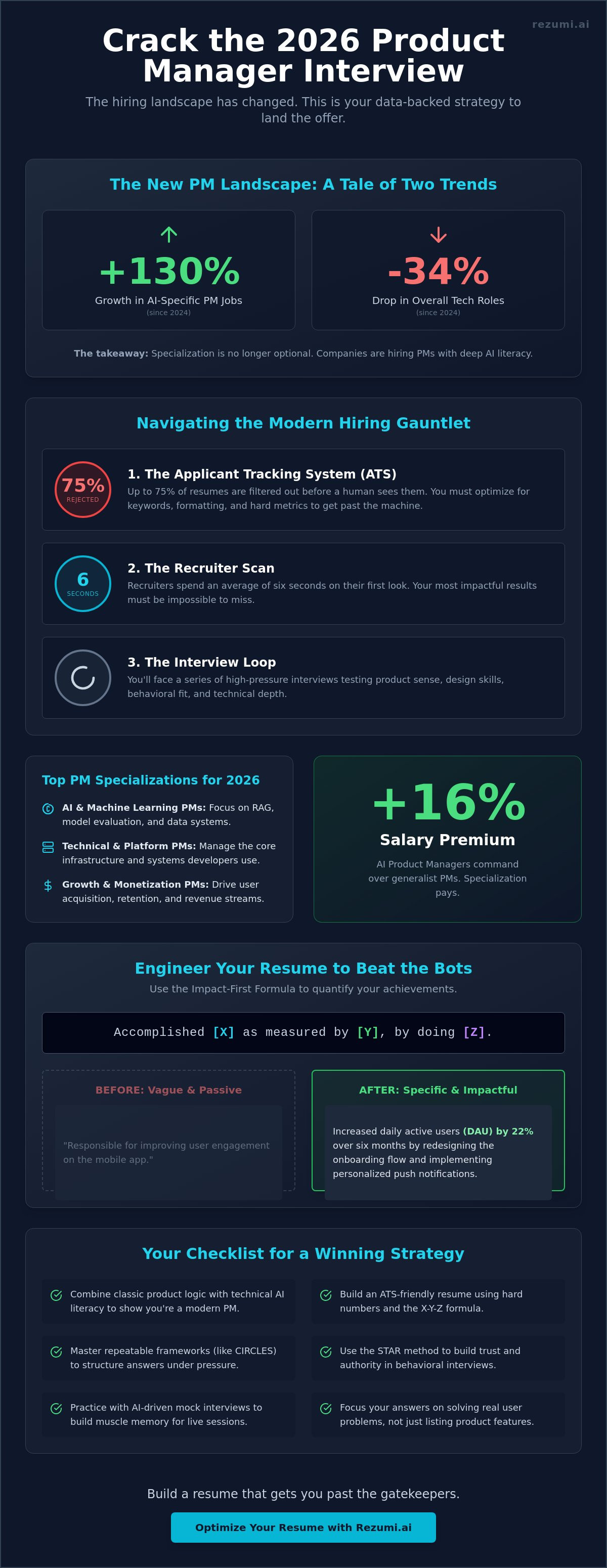
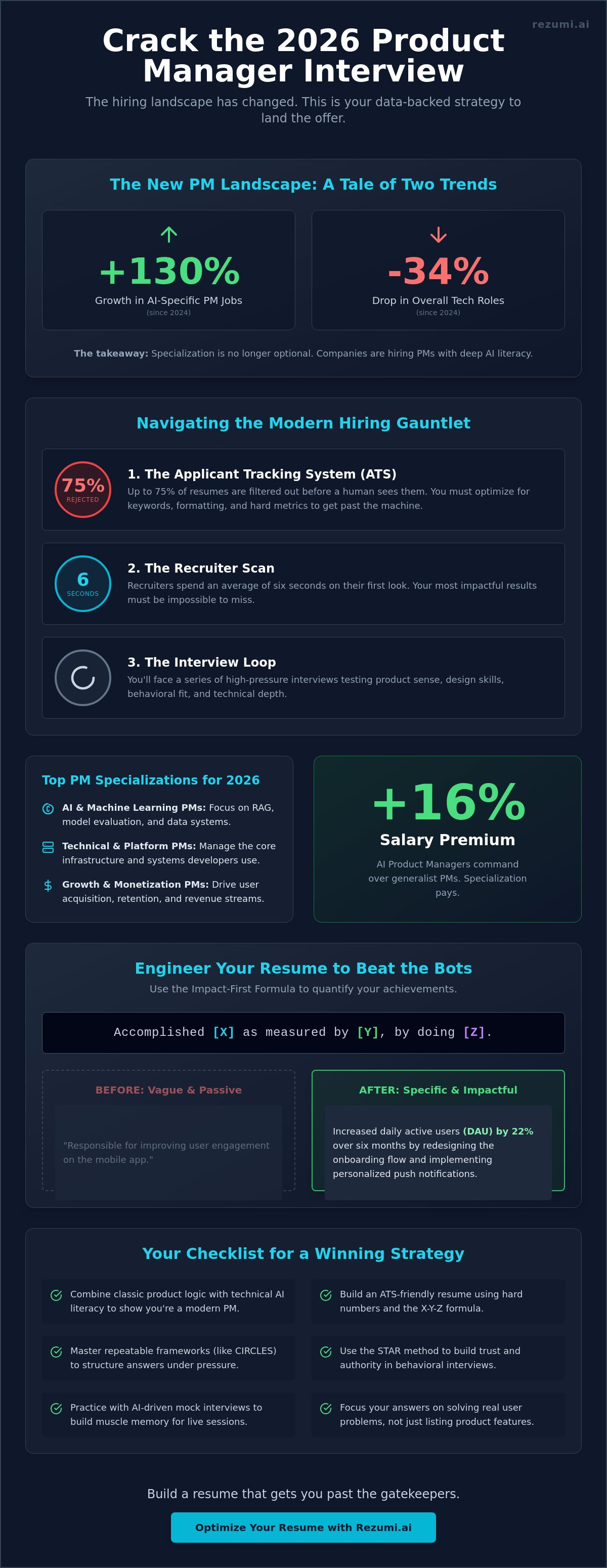
AI-specific job postings have grown by over 130% since 2024, but overall tech roles have dropped by 34%. This massive shift has made cracking the pm interview harder than ever. You have the right experience. Your resume still hits an ATS wall. When you finally get the call, the pressure of a live product design question can make even the best frameworks feel like a blur.
It's frustrating to feel like a qualified candidate who can't get past the gatekeepers. You know you can do the job, but the hiring rules have changed. In 2026, standard answers are no longer enough. You need to speak the language of AI while maintaining the strategic mindset of a seasoned leader. Success requires a data-backed strategy that replaces anxiety with control.
This guide will give you the exact systems you need to regain your competitive edge. You'll learn how to build a high-scoring resume that clears recruiter screens and master the AI tools top PMs use to automate their workflow. We're breaking down the frameworks that turn high-pressure questions into structured, winning answers that secure offers.
Key Takeaways
- Learn how to combine classic product logic with the technical AI literacy needed to stand out in the 2026 hiring market.
- Build an ATS-friendly resume that uses hard numbers and North American hiring standards to get you past the initial screen.
- Master a repeatable framework for cracking the pm interview that focuses on solving real user problems instead of just listing features.
- Use the STAR method to structure your behavioral answers so you come across as a confident leader who delivers results.
- Move beyond passive reading by using AI-driven mock practice to build the muscle memory needed for high-pressure live sessions.
Understanding the 2026 PM Interview Landscape
Cracking the pm interview in 2026 requires more than just memorizing frameworks from a decade ago. The process has evolved into a high-stakes competition where machines often judge your potential before a human ever sees your face. You face three distinct hurdles. First, the Applicant Tracking System (ATS) scans for specific keywords and formatting. Second, the recruiter performs a high-level alignment check. Finally, you enter the "loop," a series of intensive interviews designed to test your technical depth and product sense.
Many top tech firms now use AI-powered assessments to gauge your skills early. These tools analyze how you prioritize features or handle conflicting data points. If you don't show structured thinking in these automated rounds, you never reach a live person. A modern product manager must be ready to demonstrate expertise in a data-driven environment that values speed and precision. This shift means your preparation must be more technical and outcome-focused than in previous years.
The Shift from Generalist to Specialist PMs
Generalists are struggling to find roles. The 2026 market favors specialists with deep domain knowledge. If you want a top offer, your resume must signal specific technical or growth skills. For example, AI product managers currently command a 16% salary premium over general roles. This reflects the 130% growth in AI-specific job postings. Companies want to know you understand the systems you're building, not just the general theory of product management. You need to prove you can handle technical components like model evaluation or data privacy regulations.
Top PM roles in demand for 2026 include:
- AI and Machine Learning PMs focusing on RAG and model evaluation
- Technical Infrastructure and Platform PMs
- Growth and Monetization Specialists
- Fintech PMs with expertise in global data regulations
Why Frameworks Still Matter
Frameworks are not scripts. They're mental maps that keep you from getting lost under pressure. When you're cracking the pm interview, use these structures to organize your thoughts, but don't sound like a robot. Recruiters value clarity and the ability to communicate complex ideas over finding a single "correct" answer. Your goal is to show a logical progression from a problem to a solution. Since 72.2% of PMs spend 25% or less of their time on strategy, your interviewers will look for your ability to execute tasks and manage operational work effectively. Use frameworks to prove you can handle that complexity without losing focus on the user.
Engineering a PM Resume for North American ATS
You can't start cracking the pm interview if your resume never reaches a human. In the North American market, automated Applicant Tracking Systems (ATS) filter out up to 75% of applicants before a recruiter even looks at a file. These systems aren't looking for "passion" or "team player" clichés. They're programmed to find specific technical skills and evidence of data-driven decision making. If your resume lacks the right keywords or formatting, it's invisible.
To win, you must prove your value with hard numbers. Vague descriptions of your duties will get you rejected. Instead, focus on the scale of your products and the specific revenue or efficiency gains you achieved. If you aren't sure which metrics to focus on, reviewing 50+ PM Interview Questions can help you identify the key performance indicators (KPIs) that top tech companies actually care about. Use these insights to reverse-engineer your past experiences into high-impact bullet points.
The Impact-First Resume Formula
Use the X-Y-Z formula: Accomplished [X] as measured by [Y], by doing [Z]. This structure forces you to lead with the result, which is the first thing a recruiter looks for.
- Before: Responsible for improving user engagement on the mobile app.
- After: Increased daily active users (DAU) by 22% over six months by redesigning the onboarding flow and implementing personalized push notifications.
Keep it tight. Brevity is your best friend on a two-page CV. Recruiters spend an average of six seconds on their initial scan. If your biggest wins are buried in a wall of text, you've already lost. You can use the Rezumi Profile Editor to ensure your formatting is clean, professional, and optimized for quick reading.
Tailoring Your CV for Specific PM Roles
Generic resumes are dead. You must match your skills to the specific job description for every application. If a role emphasizes "retrieval-augmented generation" or "product-led growth," those exact phrases must appear in your experience section. This isn't just about keywords; it's about signaling that you have the exact domain expertise the team needs right now. Companies are looking for specialists who can deliver immediate value.
You can use Rezumi ATS Resume Optimization to verify your match rate against specific job postings. This data-backed approach removes the guesswork from your job search. For an extra edge, use our AI Cover Letter Generator to add a personal touch that connects your past wins to the company's future goals. Cracking the pm interview starts with a resume that proves you are the solution to their specific problem.
Mastering Product Sense and Design Questions
Product sense is the most critical skill for cracking the pm interview because it shows how you think, not just what you know. Interviewers don't want a list of cool features. They want to see you identify a real human problem and solve it systematically. You win this round by proving you can make logical decisions under pressure.
Start by narrowing the scope. Many candidates fail because they try to build everything for everyone. You must pick a specific user segment and stay focused on their unique needs. Use a simple impact versus effort matrix to decide which features make the cut. This shows you understand that engineering resources are limited and expensive. Every choice you make should tie back to the user pain point you identified at the start.
The Modern Product Design Framework
The old CIRCLES method often feels too scripted and robotic for 2026 hiring standards. Today's interviewers prefer a fluid conversation that starts with the "Why" before you ever discuss the "What." You must establish the business goal and user pain point first. This prevents you from building a solution in search of a problem. Use your first few minutes to build a mental map of the situation.
Ask these three questions to clarify the problem space immediately:
- "Are we optimizing for a specific business goal, such as user acquisition or long-term retention?"
- "Is there a specific platform or technical constraint, like a mobile-first requirement, that I should keep in mind?"
- "Are we focusing on a particular geographic region or demographic group?"
Defining and Measuring Success
Your design is useless if you can't prove it works. You must define a North Star metric that aligns with your primary goal. Avoid vanity metrics like total signups or page views. Instead, focus on behavioral data that shows true value, like the percentage of users who complete a core action within their first 24 hours. This proves you understand the difference between noise and real growth.
Different products require different yardsticks:
- SaaS: Focus on net revenue retention or reduced time-to-value.
- B2C: Track daily active users (DAU) or social sharing rates.
- AI Products: Measure output accuracy, latency, or the rate of user corrections.
Be ready to discuss trade-offs. If a new feature increases short-term revenue but decreases long-term user trust, you must explain your reasoning for choosing one over the other. This level of nuance proves you have the maturity of a senior leader. To refine your delivery and handle these high-stakes scenarios, you can use AI Interview Prep to practice until your logic feels natural and confident.
Behavioral Rounds: Building Trust and Authority
Behavioral interviews are often the most underestimated part of cracking the pm interview. Candidates spend weeks practicing estimation questions but treat their own career stories as an afterthought. This is a mistake. Recruiters use these rounds to see if you can lead through influence, resolve conflict with engineering, and own your mistakes without making excuses. In the 2026 market, cultural alignment and emotional intelligence are just as important as technical skills.
Leadership in product management rarely comes from a formal title. Since you often don't manage engineers or designers directly, you must demonstrate how you use data and empathy to drive alignment across different teams. Your stories should show you as a partner who simplifies complex decisions rather than a bottleneck. If you can't articulate how you handled a roadmap pivot or a difficult stakeholder, you won't pass the final loop. You need to prove that you can deliver results through collaboration.
The STAR Method for PMs
The STAR method (Situation, Task, Action, and Result) is the industry standard for structuring your responses. In a PM context, you must be specific about the technical and business constraints you faced. The "Action" part of your story is the most important. It should take up about 60 percent of your answer because it reveals your specific decision making process. Don't just say "we" did something. Focus on what you specifically did to move the project forward.
Results must be quantified with metrics that matter to the business. Mentioning that you "improved communication" is vague. Stating that you "reduced sprint carryover by 15 percent" is concrete and shows a clear outcome. For a deeper look at how to structure these high-performance stories, read our STAR technique guide. Using this structure ensures you stay on track and avoid rambling when the pressure is high.
Handling the "Tell Me About a Failure" Question
Interviewers ask about failure to test your self-awareness and growth mindset. They want to see that you can identify a mistake, take ownership, and implement a system to prevent it from happening again. A common trap is using a "fake" failure that is actually a hidden boast, such as "I worked too hard." This signals to the recruiter that you are either hiding something or lack the maturity to handle real setbacks. It ruins the trust you've built during the session.
Structure your answer by briefly explaining the mistake and focusing heavily on the post-mortem and the corrective action. For example, perhaps you launched a feature that missed its adoption goal because you skipped user discovery. Explain how that failure led you to implement a new research phase in your current workflow. This shows you are a professional who values data over ego. To make sure your stories hit the right notes and sound natural, start practicing with Rezumi AI Interview Prep today.
Command the Room with AI-Driven Mock Practice
Watching mock interviews on YouTube won't get you hired. It feels like progress, but it's actually passive consumption that doesn't build the skills you need. Cracking the pm interview requires you to move from observing others to performing under pressure yourself. You must be able to articulate complex frameworks out loud while maintaining a calm, authoritative presence that signals leadership.
AI coaching bridges the gap between theory and reality by providing a safe space to iterate on your delivery. You can use Rezumi AI Interview Prep to simulate the high-pressure environment of a live loop. This tool gives you the real-time feedback needed to refine your logic before you ever step into a real interview room. Daily practice is the only way to ensure your answers sound natural rather than rehearsed.
How AI Interview Coaching Works
The system analyzes your speech patterns to identify filler words, pacing issues, and tone. It evaluates the structure of your content to ensure you're sticking to the STAR method or your chosen product framework. Practicing in this low-stakes environment allows you to experiment with different approaches without the risk of a rejection. You can record your sessions and review your performance to spot non-verbal cues that might undermine your confidence during the final rounds.
Final Preparation Checklist
Consistency is the key to building muscle memory. Set aside 30 minutes every day to practice one product design question and two behavioral stories. This routine ensures that your frameworks become second nature. When the logic is automatic, you can focus on building rapport with your interviewer instead of struggling to remember the next step in your framework.
Use this checklist 24 hours before your session:
- Review your top three behavioral stories and their associated metrics.
- Test your video and audio setup to ensure technical stability.
- Research your interviewer's recent product launches or public talks.
- Practice your "Tell me about yourself" pitch one last time.
- Get a full night of sleep to stay sharp during the multi-hour loop.
Check our pricing options to get full access to the AI Interview Prep tool and start your training. You've done the hard work of building a high-scoring resume and mastering the frameworks. Now, it's time to prove you can lead. Start your first mock session today and walk into your interview with the confidence of a candidate who has already won.
Secure Your Product Manager Offer
Success in the 2026 job market requires a shift from passive preparation to active engineering. You've seen that a high-scoring resume is your ticket through the ATS wall, and fluid frameworks are your tools for the design round. Cracking the pm interview is no longer about following an outdated script. It's about demonstrating technical depth and leadership through data-backed stories that prove your specific value.
Rezumi provides the technical edge you need with AI-powered ATS optimization built for North American tech standards. You can get real-time feedback on your interview answers from a system designed by professionals who understand the PM hiring loop. This transition from uncertainty to control is what turns qualified candidates into new hires. You have the talent, and now you have the strategy to match.
The competition is intense, but your preparation is now stronger. Take the systems you've learned here and start your daily practice today. You're ready to command the room and land your next offer.
Frequently Asked Questions
How is cracking the PM interview different in 2026 compared to 2013?
Cracking the pm interview in 2026 requires deep AI literacy that was not expected a decade ago. The technical component of interviews has shifted significantly, with the ratio of technical to product questions moving from 20/80 to 60/40. You are now expected to understand concepts like model evaluation and retrieval-augmented generation rather than just general feature roadmaps.
Do I need a technical background to pass the PM interview?
You don't need a computer science degree, but technical fluency is now mandatory for most roles. AI product managers currently command a 16% salary premium because they can bridge the gap between engineering and business. You must be able to discuss technical trade-offs and system constraints without sounding like you're reading from a script.
What are the most common PM interview questions at Google and Meta?
Google frequently asks product improvement questions such as "How would you improve Google Maps for a specific user group?" Meta focuses heavily on product sense and execution, often asking how you would decide whether to launch a new feature. Both companies use behavioral questions to see if you can lead through influence without having a formal title over your team.
How long does it typically take to prepare for a PM interview loop?
Most candidates spend 4 to 8 weeks preparing for a full interview loop. This time is used to master product design frameworks and refine behavioral stories using the STAR method. Your preparation for cracking the pm interview should include daily mock practice to ensure your delivery is confident and your logic is easy to follow.
Can I use a standard resume template for my PM application?
Generic templates often fail because they aren't optimized for North American ATS standards. Your resume must be tailored to the specific job description to pass automated filters that reject up to 75% of applicants. Using a specialized tool like the Rezumi Profile Editor ensures your formatting is clean and your keywords are aligned with what recruiters want to see.
Is the STAR method still the best way to answer behavioral questions?
The STAR method is still the industry standard, but your "Action" section must be the focus of your answer. Aim to spend 60% of your response detailing the specific steps you took to solve a problem. This proves your individual impact and prevents your stories from sounding like vague team achievements.
How does an ATS score impact my chances of getting a PM interview?
Your ATS score is the first gatekeeper between you and a recruiter. If your resume doesn't hit a high match rate for the specific keywords in the job posting, it's often discarded before a human ever sees it. A high score ensures that your experience is visible to the hiring team so you can actually get the call for an interview.
Should I mention AI experience on my PM resume even if it was a small project?
You should absolutely include AI experience because it's the fastest growing segment of the product job market. AI-specific job postings have grown by over 130%, and even small projects signal that you are ready for modern technical challenges. Highlighting these skills shows you are a specialist who can handle the technical demands of 2026 product roles.
Disclaimer
This article is provided for general informational purposes only and does not constitute professional, legal, financial, or career advice. While Rezumi strives for accuracy, we make no warranties as to the completeness or reliability of this content. Hiring practices, ATS behavior, and job-market conditions vary by employer, industry, and region — always verify against your specific situation. Any action you take based on this article is at your own risk.