Essential Keywords for Administrative Assistant Resumes in 2026
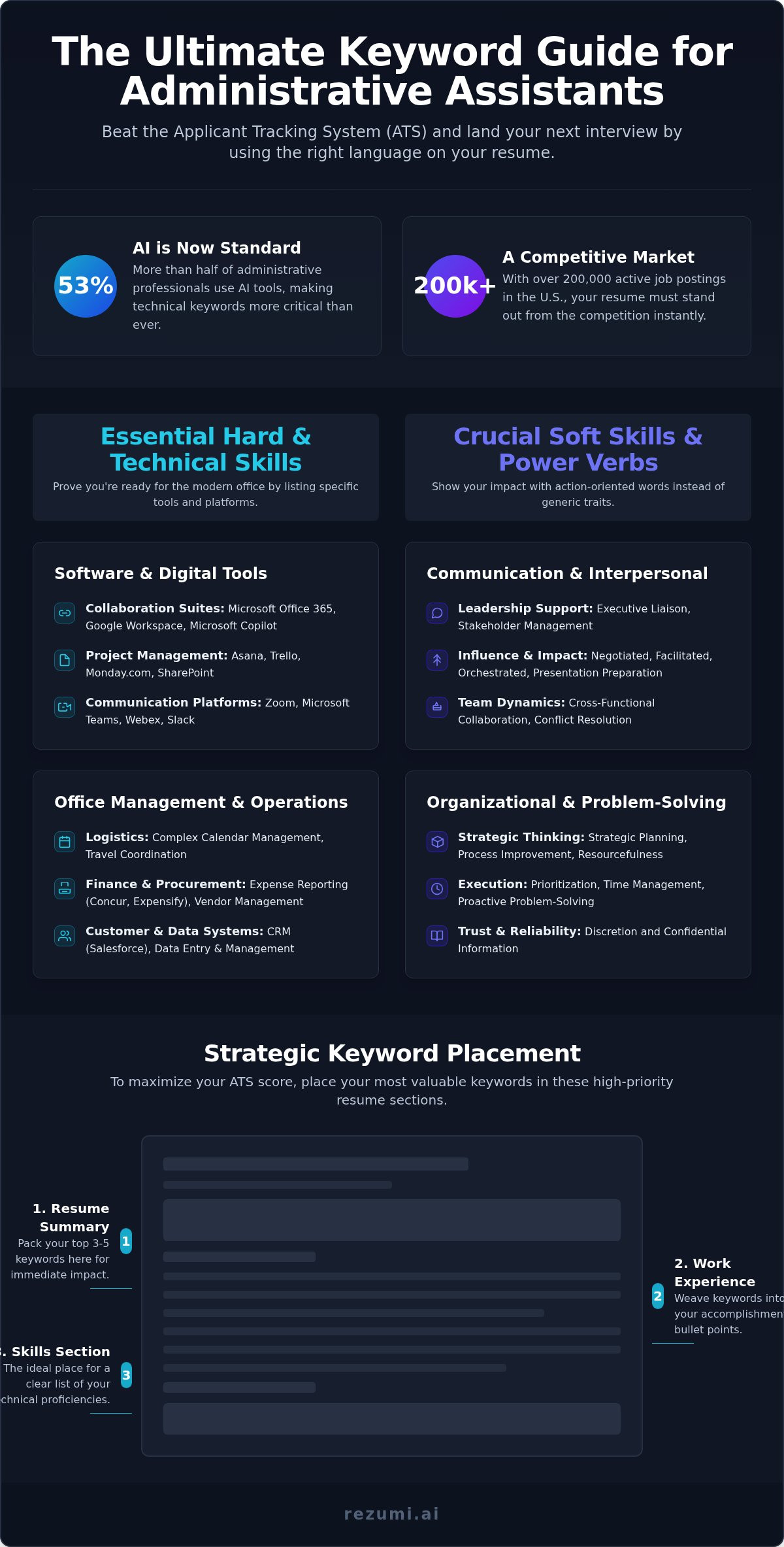
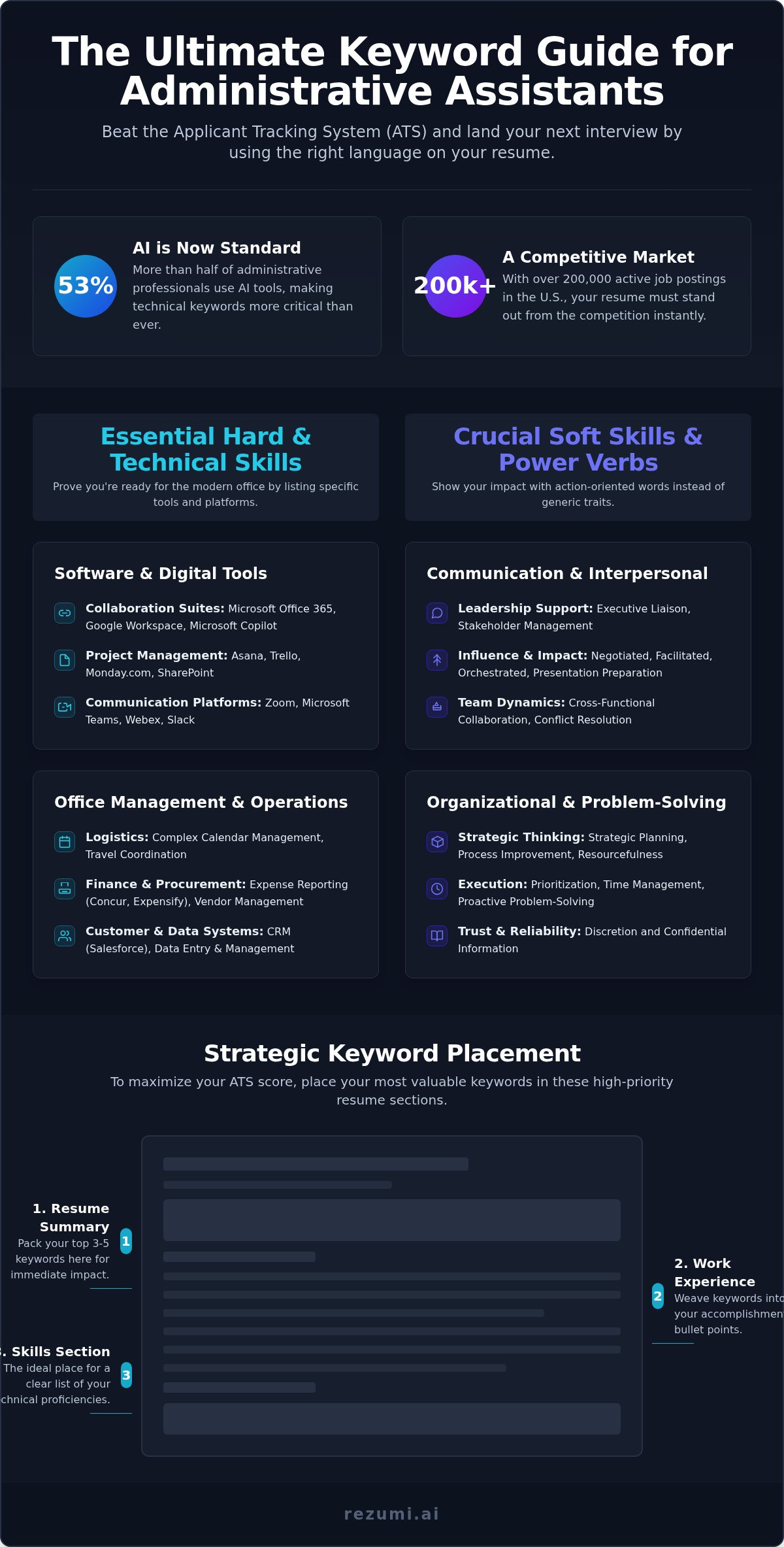
More than 53 percent of administrative professionals now use AI tools to manage their daily workflows. Even with over 200,000 active job postings in the U.S., the market is becoming more competitive as automation changes the industry. You have the experience and the drive. However, your resume might still be failing the initial scan because it lacks the specific keywords for administrative assistant that modern software requires.
It's a common struggle for talented professionals. You shouldn't lose out on a career-defining role just because your document didn't speak the language of the Applicant Tracking System. We've identified the high-impact phrases that will help you bypass these digital gatekeepers and catch a recruiter’s eye. You'll learn which technical skills are mandatory in 2026, how to describe your soft skills without sounding generic, and the exact strategy for placing these words to maximize your score on North American job portals.
Key Takeaways
- List specific software tools like Microsoft Copilot and Google Workspace instead of using broad categories.
- Replace generic traits with power verbs that show recruiters exactly how you manage workflows and solve problems.
- Identify the specific keywords for administrative assistant roles in your target industry to meet specialized hiring needs.
- Place your keywords in high-priority resume sections to help the ATS rank your application at the top of the list.
- Use ATS Resume Optimization to automate your keyword research and ensure your resume is perfectly tailored for every job.
The Essential Hard Skills and Technical Keywords
Technical proficiency is the first metric an Applicant Tracking System (ATS) evaluates. If your resume lacks the specific keywords for administrative assistant roles that the software is programmed to find, a human recruiter might never see your application. Modern hiring processes in North American markets prioritize candidates who can hit the ground running with specific digital tools. You must move beyond general descriptions like "computer skills" and name the exact platforms you use every day.
Data from the 2026 Workforce Planning Guide shows that AI adoption among administrative professionals jumped to 53 percent in 2025. This means your technical section must reflect a high level of digital literacy. Listing certifications alongside these keywords also increases your credibility. It proves your skills are verified by industry standards rather than just self-reported.
Software and Digital Tools
Cloud-based collaboration is now the standard for most corporate environments. You should explicitly list Microsoft Office 365 and Google Workspace. Don't stop at the suite names. Include specific components like advanced Excel (VLOOKUPs and Pivot Tables), SharePoint, and Google Drive management. To show you are ready for remote or hybrid work, include proficiency in project management tools like Asana, Trello, or Monday.com. You should also mention video conferencing platforms such as Zoom, Microsoft Teams, and Webex, as these are foundational for modern communication.
Office Management and Operations
The core of office administration involves keeping a business running smoothly through precise operational control. Recruiters look for keywords that prove you can handle high-stakes logistics without supervision. You should include terms like complex calendar management, travel coordination, and expense reporting. If you have experience with specific platforms like Concur or Expensify, name them directly. For roles involving customer data, mention vendor management, procurement, and CRM systems like Salesforce. These keywords for administrative assistant positions signal that you understand the underlying mechanics of a successful office. They transform your resume from a list of tasks into a map of your professional capabilities.
Crucial Soft Skills and Power Verbs for Admin Roles
Soft skills are the engine that drives a high-performing office. In 2026, recruiters don't want to see "organized" or "hardworking" on your resume. These are baseline expectations, not competitive advantages. You need keywords for administrative assistant roles that demonstrate your ability to function with high-level autonomy. You must prove you can handle the pressure of executive support through specific, action-oriented language. This approach turns a static list of traits into a narrative of professional success.
The Occupational Outlook Handbook highlights that interpersonal skills are critical for managing office operations. This means your resume should feature keywords that show you are a strategic partner. Use power verbs like "orchestrated," "facilitated," or "negotiated" to illustrate your impact. These words show the recruiter that you don't just perform tasks; you deliver results. High-level support requires a proactive mindset that the ATS can only detect if you use the right terminology.
Communication and Interpersonal Keywords
Managing professional correspondence is a standard task, but framing it as "stakeholder management" suggests a higher level of responsibility. It implies you understand the hierarchy and the stakes involved in every interaction. If you have prepared presentations for board meetings, use "presentation preparation" to signal your technical and creative range. You should focus on these specific keywords:
- Executive liaison: Proves you are trusted to communicate on behalf of leadership.
- Conflict resolution: Demonstrates emotional intelligence in high-pressure situations.
- Cross-functional collaboration: Highlights your ability to work across different departments to reach a common goal.
- Public speaking: Shows confidence and the ability to represent the office in formal settings.
Organizational and Problem-Solving Keywords
Strategic planning and process improvement are the most valuable keywords for administrative assistant candidates today. They suggest you don't just follow a workflow; you optimize it. For example, mentioning how you handled "discretion and confidential information" builds trust immediately. Resourcefulness is your best asset in a hybrid work environment where your manager might not be in the same building. Consider adding these terms:
- Prioritization: Shows you can manage a heavy workload without dropping critical tasks.
- Time management: Proves you respect deadlines and can estimate project timelines accurately.
- Proactive problem-solving: Signals that you find solutions before a minor issue becomes a crisis.
- Resourcefulness: Indicates you can find information and tools independently.
Refining these descriptions ensures your resume sounds human while still satisfying the machine. To see how your current phrasing stacks up against top-tier standards, you can explore tailored optimization plans that match your specific career goals.
Industry-Specific Keyword Variants
A generic resume is a rejected resume. Administrative roles vary significantly across different sectors, and the ATS is programmed to find industry-specific terminology. You must tailor your keywords for administrative assistant applications to reflect the specialized nature of the target company. This alignment proves you understand the specific compliance and regulatory requirements of that field.
Data from O*NET OnLine confirms that the specific tasks and technology skills required for administrative support vary based on the industry mission. A medical office prioritizes patient safety and privacy, while a law firm focuses on procedural accuracy and deadlines. Using the wrong jargon can signal a lack of experience, even if your general admin skills are excellent. You must match the vocabulary of the hiring manager to move past the initial screening phase.
Legal and Medical Administration
Accuracy in these fields is a legal requirement. For legal roles, include keywords like litigation support, e-filing, and document drafting. Mention case management software to show you can handle the high-volume workload of a professional practice. If you're applying for medical roles, your resume must highlight HIPAA compliance and electronic health records (EHR). These are non-negotiable standards in North America. You should also include specific billing and coding terminology to show you can manage the financial side of patient scheduling effectively.
Executive and Corporate Support
Executive Assistant (EA) roles require keywords that suggest high-level partnership. Terms like gatekeeping and board relations show you can manage the complex professional hierarchies of the C-suite. If the role involves financial oversight, use keywords like accounts payable, accounts receivable, and budget tracking. For HR-focused administrative positions, highlight your experience with onboarding, recruitment coordination, and employee records. These specific phrases demonstrate that you can handle the sensitive data and logistical planning required for corporate operations.
Tailoring these industry variants manually can take hours of research. You can speed up this process by using ATS Resume Optimization to identify the exact industry jargon required for your specific job posting. This ensures your resume reflects the precision and readiness that North American employers demand in 2026.
Strategic Keyword Placement to Beat the ATS
Strategic placement is the bridge between your experience and a recruiter's inbox. It's not enough to possess the right skills. You must position them in a way that aligns with the digital architecture of modern hiring systems. The ATS typically scans documents from top to bottom, assigning greater relevance to terms found in the professional summary and section headers. If your most critical keywords for administrative assistant roles are hidden in the middle of a long paragraph, you risk a lower match score.
Optimizing Your Professional Summary and Skills Section
Your professional summary is your first opportunity to signal a match. Include your top 3 to 5 most relevant keywords here to establish immediate relevance. Following this, a dedicated skills section ensures the ATS can parse your technical and soft skills without friction. This section should be a scannable list that mirrors the requirements of the job posting exactly. For more information on organizing these sections, refer to our guide on choosing the best resume format.
Integrating Keywords into Work Experience
The work experience section is where you provide the "how" behind your keywords. Weave your terms into bullet points naturally rather than listing them as standalone words. You should always quantify your achievements to provide proof of your impact. For example, consider this transition:
- Before: Handled office scheduling and travel.
- After: Managed complex calendar scheduling and travel coordination for 4 senior executives, reducing travel costs by 15 percent through vendor negotiation.
This approach satisfies the ATS while giving the human recruiter the data they need to justify an interview. You can verify your keyword density and placement by using an ats resume checker before you hit submit.
Avoid the temptation to include every keyword you find. Keyword stuffing, or the repetitive listing of terms without context, is a red flag for modern systems. It also makes your resume unreadable for the human who eventually reviews it. Focus on precision. If a job description emphasizes "stakeholder management," ensure that exact phrase appears in your document. Minor variations can sometimes confuse older software, so stick to the employer's specific language when using keywords for administrative assistant applications.
Automating Your Resume Tailoring with Rezumi
Manual keyword research is a slow, tedious process that often leads to missed opportunities. You might spend hours analyzing a job description only to miss a subtle requirement that the ATS considers essential. This leads to the frustration of being rejected despite having the perfect skill set. Rezumi removes the guesswork by using advanced technology to align your document with specific employer needs. This ensures your resume meets strict North American hiring standards without requiring you to become an expert in data analysis.
The platform acts as your strategic partner, replacing the anxiety of a difficult process with the reassurance of a data-backed strategy. You no longer have to wonder if your software skills are still relevant or if your soft skills sound too generic. By automating the identification of keywords for administrative assistant positions, you can focus on what matters most: preparing for the actual interview. It's a high-performance tool built for serious professionals who value their time and their career growth.
AI-Powered Keyword Identification
The system simplifies the most difficult part of the application process. You can upload any job description, and the platform will immediately extract the vital keywords for administrative assistant roles. It provides real-time feedback on your keyword density and placement. This ensures you aren't under-representing your skills or falling into the trap of keyword stuffing. You'll gain a clear understanding of exactly what recruiters want to see before you ever click the submit button. This precision is what allows you to bypass automated hurdles and reach the human decision-makers.
Ready to Secure Your Next Interview?
Sending out generic resumes is a strategy that rarely yields results in a competitive market. You need a document that acts as a precise match for the role you want. Rezumi provides the professional tools you need to manage your entire application process in one centralized workspace. From generating tailored cover letters to using our AI interview prep, you can move through each phase of the hiring cycle with confidence and control. The platform is designed to minimize friction, ensuring you can absorb the value of your career strategy at a glance.
You don't have to struggle with manual formatting or vague advice. You can build a strategic, ATS-optimized application that highlights your unique value. It's time to take control of your career path and stop letting automated filters block your progress. View our pricing plans and start optimizing your resume today.
Master Your Application Strategy
Success in 2026 requires more than just a list of duties. It demands a strategic alignment with the technology that screens you. By replacing vague traits with outcome-focused keywords for administrative assistant roles, you transform your resume into a high-performance career tool. You've learned how to name specific software, use industry jargon, and place these terms where they matter most.
Don't let a digital gatekeeper stand between you and your next career move. You now have the blueprint to optimize your document for the North American market. Rezumi provides the AI-driven matching and application tracking you need to stay ahead of the competition in the USA and Canada.
You have the skills. It's time to make sure every recruiter can see them. Take the next step with confidence.
Frequently Asked Questions
How many keywords should I include in an administrative assistant resume?
Aim for 20 to 30 unique keywords across your entire document. This range provides enough variety to cover technical software, interpersonal traits, and industry-specific terms. You should focus on quality rather than just hitting a specific number. Including too many can make your resume look like a list of tags instead of a professional story. Every word must reflect a real skill you possess.
Can I just copy and paste keywords from the job description?
No, you should never copy and paste entire blocks of text from a job description. Modern systems can detect keyword stuffing, which is the repetitive use of terms without context. Instead, you must weave the exact terminology into your bullet points naturally. This demonstrates that you actually have the skill and know how to apply it in a real-world scenario. Recruiter trust is lost when a resume feels bot-generated.
What are the most important software keywords for 2026?
Focus on AI-collaboration tools and cloud suites. Microsoft Copilot, Google Workspace, and Zoom are baseline requirements. You should also include project management platforms like Asana or Trello. These specific keywords for administrative assistant roles show you are ready for a hybrid or remote office. Listing these tools proves you can manage digital workflows without constant supervision or technical support.
Should I use a separate section for my administrative skills?
Yes, a dedicated skills section is essential for clean ATS parsing. This section should be a scannable list of your technical and operational abilities. It helps the software identify your core competencies immediately. You should still repeat these keywords in your work history to provide context and proof. This dual-placement strategy ensures the machine sees the word and the human sees the achievement.
How do I include soft skills as keywords without sounding like a cliché?
Use power verbs and specific professional outcomes to ground your claims. Instead of saying you are "organized," say you "orchestrated complex travel logistics." Replace "hardworking" with "managed a $50,000 office budget." This demonstrates your value through action rather than using empty adjectives that recruiters often ignore. Specificity is the best way to prove your soft skills are real and impactful.
Does the ATS care about the order of my keywords?
Yes, the ATS often prioritizes keywords found near the top of the document. Terms in your professional summary and skills section carry more weight than those at the bottom. You should place your most relevant keywords for administrative assistant roles in these high-visibility areas. This strategy ensures you achieve a higher match score and stay at the top of the candidate list during the initial scan.
Is it better to use acronyms or full titles for certifications?
You should use both the full title and the acronym. Some systems look for "Certified Administrative Professional," while others search for "CAP." Including both versions ensures you don't miss out on a match. This approach covers all possible search queries the recruiter might use. It also makes your resume more readable for humans who may only recognize one version of the title.
How often should I update the keywords on my resume?
You should update your keywords for every single job application. Every company uses different language in their job descriptions. One might ask for "vendor management" while another wants "procurement." Tailoring your resume to match the specific posting is the only way to ensure a high match score. A generic resume rarely makes it past the first digital filter in a competitive market.
Disclaimer
This article is provided for general informational purposes only and does not constitute professional, legal, financial, or career advice. While Rezumi strives for accuracy, we make no warranties as to the completeness or reliability of this content. Hiring practices, ATS behavior, and job-market conditions vary by employer, industry, and region — always verify against your specific situation. Any action you take based on this article is at your own risk.