Example of a Cover Letter: A Strategic Guide for the 2026 Job Market
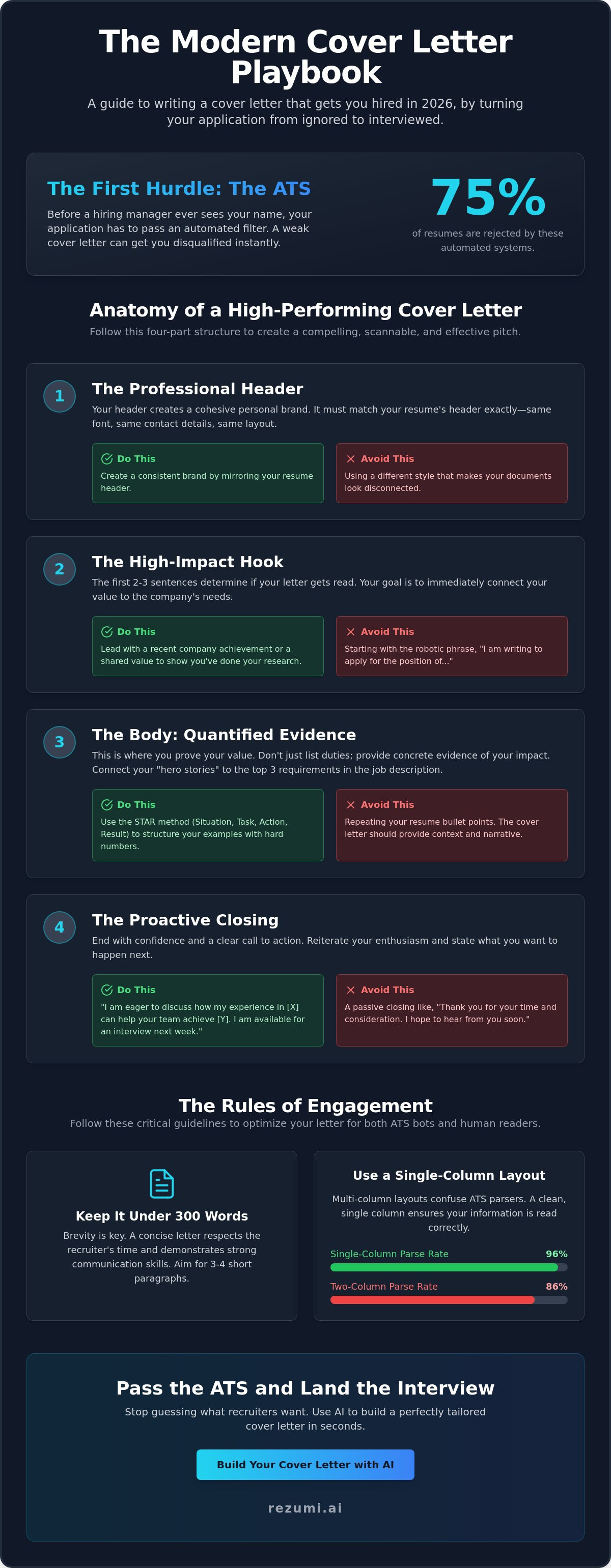
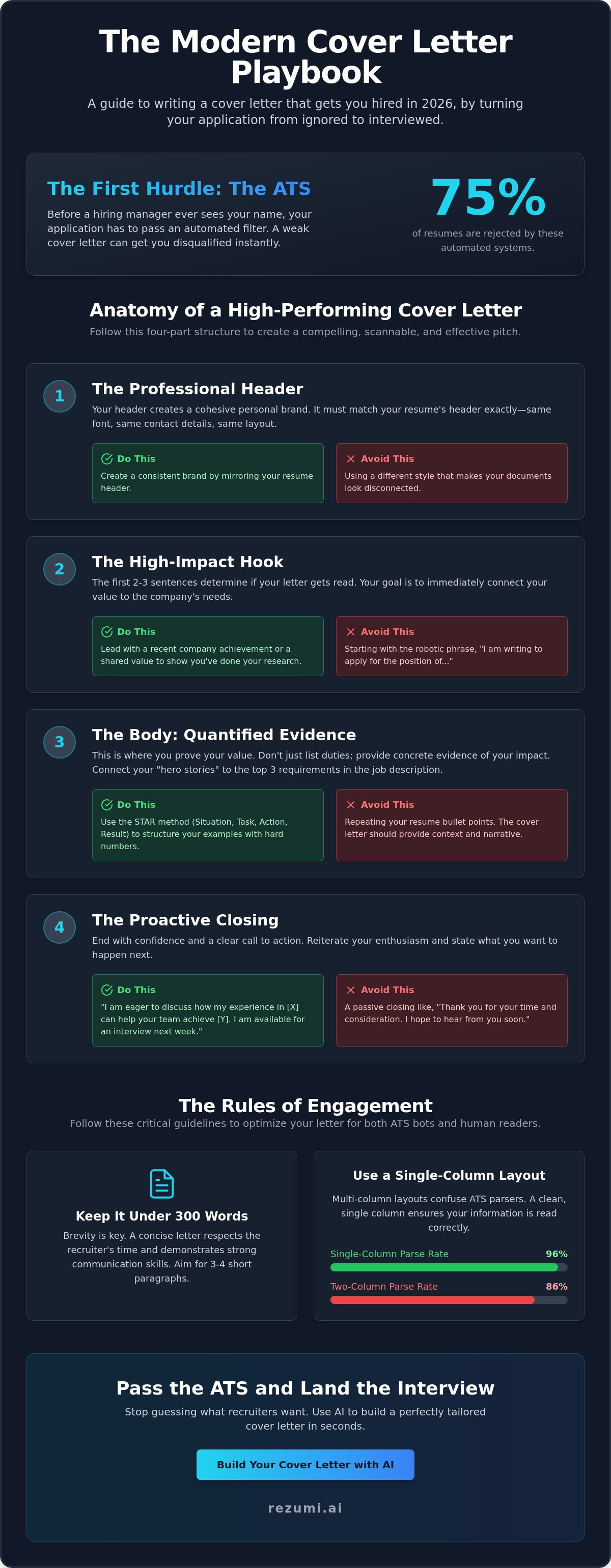
75% of resumes are rejected by automated filters before a human eye ever sees them. This reality turns the job search into a high-stakes game. You likely feel that cover letters are a waste of time or a source of constant uncertainty. It's difficult to sound professional without feeling stiff, especially when you're worried about ATS compatibility. We understand the frustration of sending applications into a digital void.
You need a strategy that turns your cover letter into a marketing document rather than a history lesson. This guide provides a clear example of a cover letter designed for the 2026 job market. You will learn how to build a letter that clears technical filters and convinces hiring managers you are the perfect hire. We'll show you how to use the STAR method to prove your value, keep your word count under 300, and tailor your message fast.
Key Takeaways
- Treat your cover letter as a targeted pitch. It connects your past wins to the company's future goals and acts as the human layer of your application.
- Master the anatomy of a high-performing application. Use a professional header and a specific hook to ensure your opening immediately grabs a hiring manager's attention.
- Avoid robotic templates that hiring managers often ignore. A modern example of a cover letter shows you how to prove professional maturity through specific tailoring.
- Match your hero stories to the top three job requirements. This method helps you demonstrate tangible value instead of just listing your previous duties.
- Use AI tools to clear automated filters in seconds. This ensures your letter meets strict North American standards and reaches a human reader.
Why an example of a cover letter is your best starting point
A cover letter is a targeted pitch that connects your past wins to a company's future needs. It isn't a repeat of your resume. Instead, it's a strategic document that explains why your specific skills solve a hiring manager's current problems. While an ats resume checker validates your technical qualifications, the letter provides the context those systems might miss. It acts as the human layer of your application. This is where you translate your data points into a narrative that resonates with a real person.
Using a high-quality example of a cover letter is your best starting point because it sets the professional standard for the North American market. It helps you master the tone, pacing, and formatting that recruiters in the US and Canada expect. Most job seekers struggle with how to sound professional without being stiff. An example provides a blueprint for that balance. A well-structured letter also serves as proof of intent. It demonstrates that you've investigated the company's goals and tailored your message accordingly. This level of effort immediately separates you from candidates who send generic, bulk applications.
To understand the foundational purpose, you can look at the broader context of What is a cover letter? and how it functions for employment. In 2026, the goal is to reduce uncertainty for the employer. You aren't just asking for a job. You're offering a solution to their specific pain points. By studying a strong example of a cover letter, you see how to lead with value rather than just expressing interest.
The role of the cover letter in a digital-first market
Recruiters still rely on these documents to judge cultural fit and communication skills. In a market where AI content is everywhere, your unique voice is a competitive advantage. A cover letter is the perfect place to explain career pivots or employment gaps that a resume cannot justify. If you're switching industries, the letter bridges that gap by highlighting transferable skills. You should move away from formal, outdated phrases like "To Whom It May Concern." Modern openings are direct and personalized. They mention specific achievements or a genuine connection to the company mission, showing you understand their brand identity.
ATS vs. human readers: Finding the balance
Finding the right balance between machine readability and human engagement is vital. Some Applicant Tracking Systems (ATS) parse your cover letter for keywords to help rank your application. However, your primary goal is to impress the human reader who might only spend 30 seconds scanning your page before making a decision. Use standard fonts like Arial or Calibri and keep your layout clean. Stick to a single-column format to prevent parsing errors. Research shows single-column layouts have a 93-96% parse rate by ATS, while two-column templates drop to 86%. When you use a professional template as a guide, you ensure your formatting stays within these safe technical boundaries while still telling a compelling story.
Anatomy of a high-performing cover letter example
A successful cover letter is a piece of high-stakes engineering. It converts interest into interviews by following a strict four part structure: a professional header, a high impact hook, quantified evidence, and a proactive closing. When you look at a modern example of a cover letter, you won't see a wall of text. You'll see a document designed for speed, typically ranging between 150 and 300 words. This brevity respects the recruiter's time while ensuring every sentence serves a strategic purpose.
Your header must match your resume exactly. This creates a cohesive personal brand and makes it easy for hiring managers to keep your documents together. Use the same font, contact details, and layout style for both. Consistency signals professional maturity and attention to detail before the reader even gets to your first sentence.
The Hook: Moving past 'I am writing to apply'
The first three sentences of your letter determine if the rest gets read. Stop using generic openings that state the obvious. Instead, lead with a recent company win or a shared value. If the company just launched a new product or hit a sustainability goal, mention it. State the specific role you want and briefly explain why your background makes you the logical choice to help them reach their next milestone. The University of Wisconsin-Madison provides excellent foundational advice on how to write a cover letter, emphasizing that your opening must bridge the gap between your skills and the company's needs.
The Body: Proving value with real numbers
Use the middle paragraphs to expand on one "hero" achievement from your resume. This is your chance to tell the story behind the data point. While 65% of job seekers use AI tools to draft letters, only 15% of employers report liking the results because they often feel generic. You can beat these odds by including specific metrics like:
- Revenue growth percentages (e.g., "increased quarterly sales by 22%")
- Dollar amounts saved (e.g., "reduced overhead costs by $15,000")
- Time efficiency gains (e.g., "cut project turnaround time by 5 days")
The Closing: Professional and proactive
Your closing should be confident, not passive. Reiterate your excitement for the specific mission of the company and mention your availability for a call. Don't wait for them to guess the next step. Suggest a discussion about your strategy for the role. Use a standard professional sign off like "Best regards" or "Sincerely" to maintain a polished edge. This proactive approach shows you're ready to contribute from day one. By following this example of a cover letter structure, you transform a standard requirement into a powerful marketing tool.
Comparing a generic template to a tailored AI example
Generic templates are the fastest way to get your application ignored. While they offer a quick starting point, they lack the strategic depth required to beat 2026 competition. Recruiters can spot a cover letter template google docs immediately. These static documents often rely on outdated industry fluff and generic praise. They don't speak to the specific needs of the company you're applying to.
Tailored letters demonstrate intent. They show you've researched the role and understand the company mission. AI tools help you achieve this level of customization without spending hours on every application. The goal is to use technology for the heavy lifting while keeping your unique voice for the final polish. When you use a modern example of a cover letter, you see that the best results come from a blend of data-driven structure and personal storytelling.
Why static templates fail in 2026
Static templates fail because they're built for everyone, which means they're built for no one. They rarely include the specific keywords found in modern job descriptions. This is a fatal flaw for ATS systems that scan for alignment. If your letter doesn't match the job's technical requirements, you might never reach a human reader. Many job seekers look for cover letter tips only to find advice that worked five years ago. In the current market, generic language is a signal of low effort. It suggests you're mass-applying rather than seeking a specific opportunity.
The AI advantage: Tailoring at scale
AI turns a generic example of a cover letter into a bespoke marketing tool. Rezumi analyzes the job description to identify the top three skills you must highlight. It ensures your narrative matches the specific language used by the hiring team. You can adjust your tone with a single click. Whether you need a conservative corporate style or a creative startup vibe, the AI adapts the structure to fit the culture. This process removes unnecessary filler. Every sentence is engineered to serve a purpose. You aren't just filling space; you're building a case for your hire. By using AI to draft the skeleton of your letter, you can focus on adding the personal "hero" stories that prove your impact. This synergy between human insight and machine precision is how you win in 2026.
How to write your cover letter using a sample as a guide
An example of a cover letter gives you a visual target, but the real work happens in the customization. You must transform that static sample into a living document that proves you understand the company's current challenges. Following a structured process ensures you don't miss the technical or emotional cues that lead to an interview. Your goal is to move from a generic draft to a high-impact pitch that speaks directly to a hiring manager's needs.
Start by deconstructing the job description to find the 'top three' requirements. These are usually the skills listed first or repeated most often in the posting. Once you identify these priorities, match them to your 'hero' stories. These are specific instances where you achieved a measurable result, such as increasing efficiency by 15% or managing a $50,000 budget. This alignment makes your value undeniable to a recruiter and provides the evidence they need to trust your expertise.
Next, draft your hook based on a recent company news item or a high-profile project. If the company recently expanded into a new market or won an industry award, mention it to show you've done your research. For the technical review, ensure your letter is ATS compatible. Over 98% of Fortune 500 companies use these systems to filter candidates. Remove any tables, images, or complex columns that might confuse automated scanners. Finally, proofread everything for North American spelling and grammar standards. Consistency in these details signals that you are ready for a professional role in the US or Canada.
Finding the 'Hidden' requirements
Hiring managers often leave clues about their ideal candidate's personality within the job description. Look for repeated words like 'collaboration,' 'adaptability,' or 'innovation.' These are your 'hidden' requirements. Address these soft skills directly in your body paragraphs to show you are a cultural fit. By aligning your personal work style with the company's stated values, you reduce the perceived risk of hiring you. This strategy turns you from a stranger into a logical partner for their team.
Final Polish: The 30-second scan test
Recruiters rarely read every word on the first pass, so you must pass the 30-second scan test to stay in the running. Keep your paragraphs short, ideally between two and four sentences, to maintain momentum. Ensure your contact information is clearly visible at the top of the page and matches your resume. Before you hit send, verify that you have saved the file as a PDF with a professional name like Firstname_Lastname_Cover_Letter.pdf. This small step prevents formatting issues and keeps your application organized.
Building a high-performance application shouldn't take all day. If you want to skip the manual work, you can use our AI cover letter tools to generate a tailored draft in seconds. Our platform handles the formatting and keyword optimization so you can focus on preparing for the interview.
Pass the ATS and land the interview with Rezumi
You've studied a high-performing example of a cover letter; now it's time to build yours. Rezumi’s AI Cover Letter Generator creates tailored letters in seconds. It removes the guesswork from your application by using data-backed strategies that work in the 2026 market. You don't need to spend hours staring at a blank screen. Our platform ensures your letter matches the strict standards of the North American job market, giving you a competitive edge over generic applicants.
Consistency is vital for a strong professional brand. You should pair your customized letter with our ai resume builder to ensure your documents look and feel like they belong together. When your resume and cover letter share the same layout and professional tone, you signal to recruiters that you are a high-value candidate who pays attention to detail. Stop guessing if your application is good enough and start using tools designed to win.
Tailoring every application without the burnout
Rezumi automates the tedious parts of job hunting so you can focus on preparing for the interview. Instead of looking at another example of a cover letter, you can generate one that is specifically built for your target role. Our platform provides a centralized workspace for all your application versions. You can track which letters you sent to which companies without getting lost in a mess of files. You also get real-time feedback on how well your letter aligns with the job description, allowing you to make instant optimizations before you hit send.
Ready to command your job search?
You have the strategy. Now you need the execution. Join thousands of professionals who use Rezumi to beat the ATS and secure more interviews. We offer different pricing plans to find the right fit for your specific career goals. Whether you are a new graduate or a senior executive, our tools are built to help you navigate the modern workforce with confidence. Take control of your professional future today. Your next big career move starts with a document that proves your worth.
Command Your Next Career Move
A high-performance application is more than a list of duties. It's a strategic argument for your hire. You now have the blueprint to move beyond static templates and build a document that speaks directly to hiring managers. By studying a modern example of a cover letter, you've learned to lead with value, use quantified metrics, and maintain a clean, ATS-optimized layout. These adjustments are what separate top-tier candidates from the rest of the pile.
You don't have to face the 2026 job market alone. Rezumi provides the tools you need to succeed, including AI-powered tailoring for the North American market and real-time feedback on your application quality. Our platform ensures every letter you send is engineered for maximum impact and technical compliance. It's time to replace the anxiety of the job search with the confidence of a data-backed strategy.
Generate your tailored cover letter with Rezumi today
Your next interview is within reach. Take these steps, trust your experience, and start applying with the authority you deserve.
Frequently Asked Questions
Is a cover letter still necessary in 2026?
Yes, a cover letter remains a vital part of a competitive application. While some companies make them optional, hiring managers use these documents to judge your communication skills and cultural fit. It's the only place in your application where you can explain career pivots or resume gaps that a standard resume cannot justify. A well-written letter reduces uncertainty for the employer and proves you've done your research.
How long should an example of a cover letter be?
You should keep your letter between 150 and 300 words. Brevity is a priority because recruiters often scan applications in under 30 seconds. A concise example of a cover letter focuses on one or two "hero" stories rather than listing every past duty. If your letter is too long, you risk losing the reader's attention before they reach your call to action.
Can I use the same cover letter for every job?
No, sending a generic letter is a strategic mistake that often leads to immediate rejection. Every example of a cover letter you see should be treated as a blueprint, not a final script. You must tailor the keywords and achievements to match the specific requirements of each job description. Generic letters signal a lack of effort and rarely pass the automated filters used by 98% of Fortune 500 companies.
How do I address a cover letter if I don't know the hiring manager's name?
Use a direct, professional greeting like "Dear [Department Name] Hiring Manager" or "Dear [Role] Search Committee." Avoid outdated phrases like "To Whom It May Concern" or "Dear Sir or Madam." If you can't find a specific name on LinkedIn or the company website, addressing the specific team shows you understand the company's organizational structure. This approach keeps the tone professional and modern.
What is the best format for a cover letter to pass the ATS?
The best format is a clean, single-column layout using standard fonts like Arial, Calibri, or Georgia. Avoid using tables, images, or complex headers that can confuse automated scanners. Research shows that single-column templates have a 93-96% parse rate by Applicant Tracking Systems. Sticking to a minimalist design ensures that both the machine and the human recruiter can read your value proposition without technical errors.
Should I include my home address on my cover letter?
No, you should only include your city and state or province. Full street addresses are no longer required in the North American market and are often removed for privacy reasons. Ensure your contact section includes your phone number, professional email address, and a link to your LinkedIn profile. This keeps your header clean and leaves more room for your persuasive writing.
How much of my resume should I repeat in the cover letter?
Repeat only your most impactful "hero" achievement that directly relates to the job requirements. Your cover letter shouldn't be a summary of your resume; it should be a marketing pitch that provides context for your data points. Use the space to tell the story of how you solved a specific problem. This adds a human layer to your application that a list of bullet points cannot provide.
Disclaimer
This article is provided for general informational purposes only and does not constitute professional, legal, financial, or career advice. While Rezumi strives for accuracy, we make no warranties as to the completeness or reliability of this content. Hiring practices, ATS behavior, and job-market conditions vary by employer, industry, and region — always verify against your specific situation. Any action you take based on this article is at your own risk.