How to Answer What Are Your Weaknesses in an Interview
Answering the what are your weaknesses interview question with "I am a perfectionist" is the fastest way to lose a recruiter's trust in 2026. It sounds scripted. It signals a lack of self-awareness. You might worry that being honest about a flaw will disqualify you from the role. In reality, North American hiring managers use this question to see how you handle your own limitations. They aren't looking for a perfect candidate. They are looking for a professional who knows how to improve.
You probably feel anxious about finding the right balance between being humble and staying confident. It is a difficult cultural tightrope to walk. This strategic guide will help you turn your professional flaws into proof of your growth and maturity. You will learn how to script a natural response that feels authentic rather than rehearsed. We will also provide the tools you need to handle difficult follow up questions so you can pass the behavioral round with total control.
Key Takeaways
- Understand that recruiters ask this to see if you can take feedback and grow from your mistakes.
- Learn to pick a secondary skill as your weakness so you don't mention a flaw that is central to the job description.
- Use a clear structure for the what are your weaknesses interview question that highlights your self-awareness and your plan for improvement.
- Review specific examples like public speaking or delegation to see how different roles require different strategic answers.
- Use AI practice tools to get real-time feedback on your performance and remove the anxiety of the behavioral round.
Why Recruiters Ask About Your Weaknesses
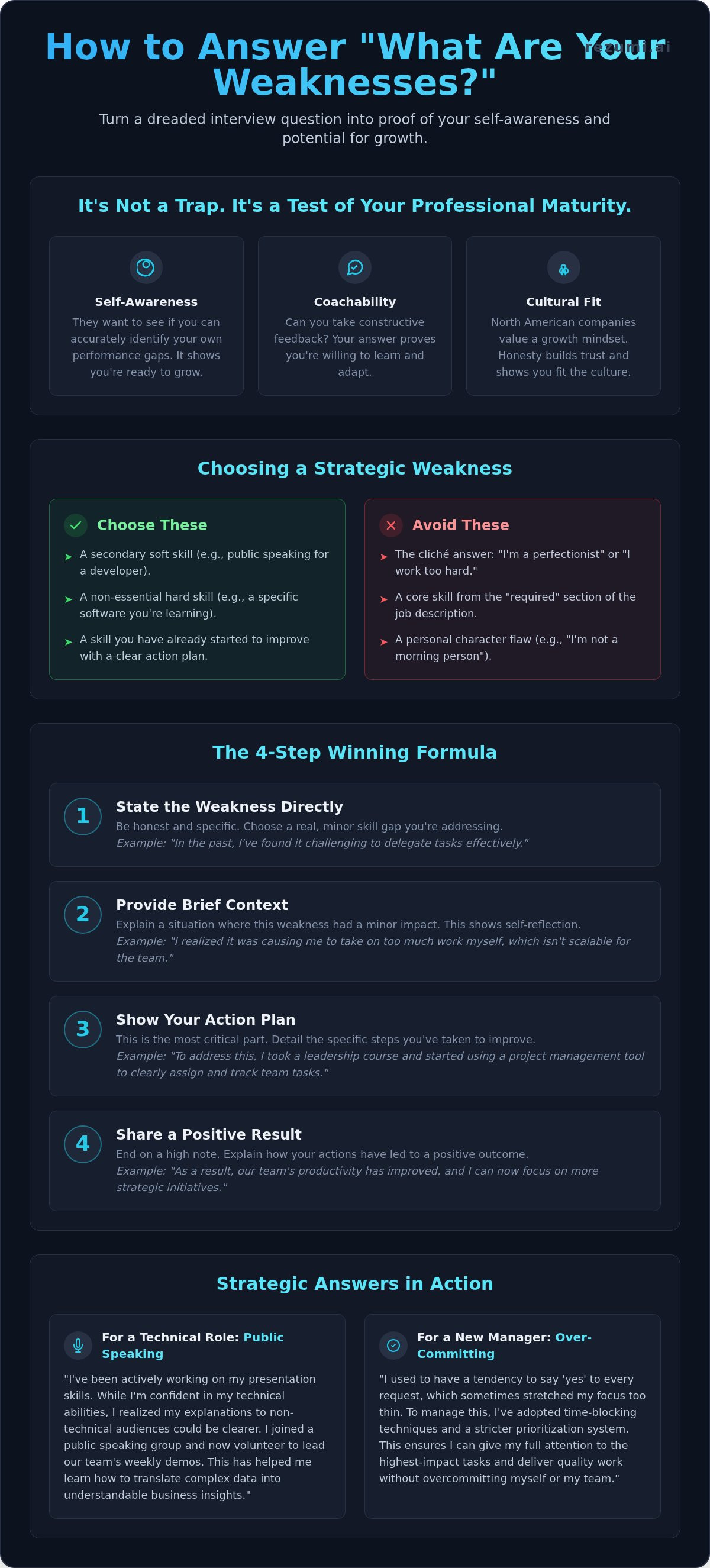
Recruiters don't ask this question to watch you fail. They ask because they want to understand how you function within a professional job interview process. Most candidates view this as a trap. It isn't. It is an assessment of your emotional intelligence. Hiring managers use the what are your weaknesses interview question to see if you can identify a problem and take steps to solve it. If you can't see your own flaws, you won't be able to take feedback from a manager later on.
When you prepare for the what are your weaknesses interview question, remember that they are also checking for red flags that might clash with the team. Every department has a specific rhythm. If your weakness is a struggle with ambiguity but the role requires constant pivoting, you might not be the right fit. It is also a direct test of how you handle uncomfortable conversations. If you can stay calm and articulate while discussing a personal flaw, it proves you can handle high-stakes pressure on the job. Recruiters want to know that you are coachable and resilient.
The Self-Awareness Test
Knowing your limits shows maturity. It proves you have the professional readiness to handle a complex role. When you give a vague or fake answer, you suggest that you might be difficult to manage. Managers don't want to spend their time arguing with an employee who thinks they are perfect. Self-awareness is the ability to spot and fix your own performance gaps. By providing a real weakness, you show that you are paying attention to your own output. You aren't just showing up. You are actively refining your professional toolkit.
Cultural Fit in North America
In the United States and Canada, firms value a growth mindset over the illusion of perfection. Hiring managers look for honesty that does not compromise your core duties. You shouldn't admit to a flaw that makes you incapable of doing the job, but you should show that you are a work in progress. Companies hire for potential, not just your current state. They want to see that you are aware of where you stand and where you are going. This transparency builds trust. It tells the employer that you will be honest about project hurdles instead of hiding them to look good.
Choosing the Right Weakness for Your Answer
Choosing the wrong weakness can end your candidacy immediately. You must be strategic. If you pick a flaw that is central to the role, you're telling the recruiter you can't do the job. If you pick a cliché, you're telling them you aren't honest. The goal is to find a middle ground where you are truthful but still qualified.
When you prepare for the what are your weaknesses interview question, avoid "deal-breaker" flaws. These are skills listed in the mandatory or required section of the job post. Instead, focus on:
- Hard skills that are non-essential for your specific role.
- Soft skills that are secondary to your primary duties.
- Skills you have already begun to master through recent training.
Stay away from the perfectionist trap. Recruiters in 2026 see through this instantly. It suggests you are hiding something or that you haven't done the work to understand your own professional gaps. It makes you sound unoriginal and untrustworthy. Honesty is your best tool for building a real connection with the hiring manager.
The Job Description Filter
Read the job post carefully before you decide on an answer. You need to identify what skills are mandatory. If you are applying for an accounting role, admitting you are bad with numbers is a disaster. If you are a software engineer, saying you struggle with code quality is a red flag. Look for the nice-to-have section instead. A developer might admit they find public speaking a challenge. An accountant might mention they are still learning a specific, non-essential piece of software. This shows you're human without proving you're incompetent.
The Improvement Proof
Honesty only works if it's paired with an action plan. You should only choose a weakness if you have already started fixing it. Recruiters want to see that you take initiative. Don't just name the flaw. Explain the specific steps you took to manage it. Maybe you took an online course to improve your data visualization skills. Perhaps you started using a time-blocking app to manage your tendency to over-commit.
You can refine these responses and test how they sound using AI interview prep tools that give you instant feedback on your delivery. Ensure the weakness you choose is either in the past or currently being managed with a clear habit. For example, if you struggle with delegation, mention the specific project management tool you now use to track team tasks. This turns a negative trait into a story about your professional optimization.
Real World Examples of Weakness Answers
Seeing how others handle the what are your weaknesses interview question makes it easier to draft your own. You need a narrative that shows a clear shift from a past struggle to a current strength. Generic lists don't work. Practical results do. Hiring managers want to see that your weakness has a resolution. They are looking for the "after" story where you have already corrected the behavior.
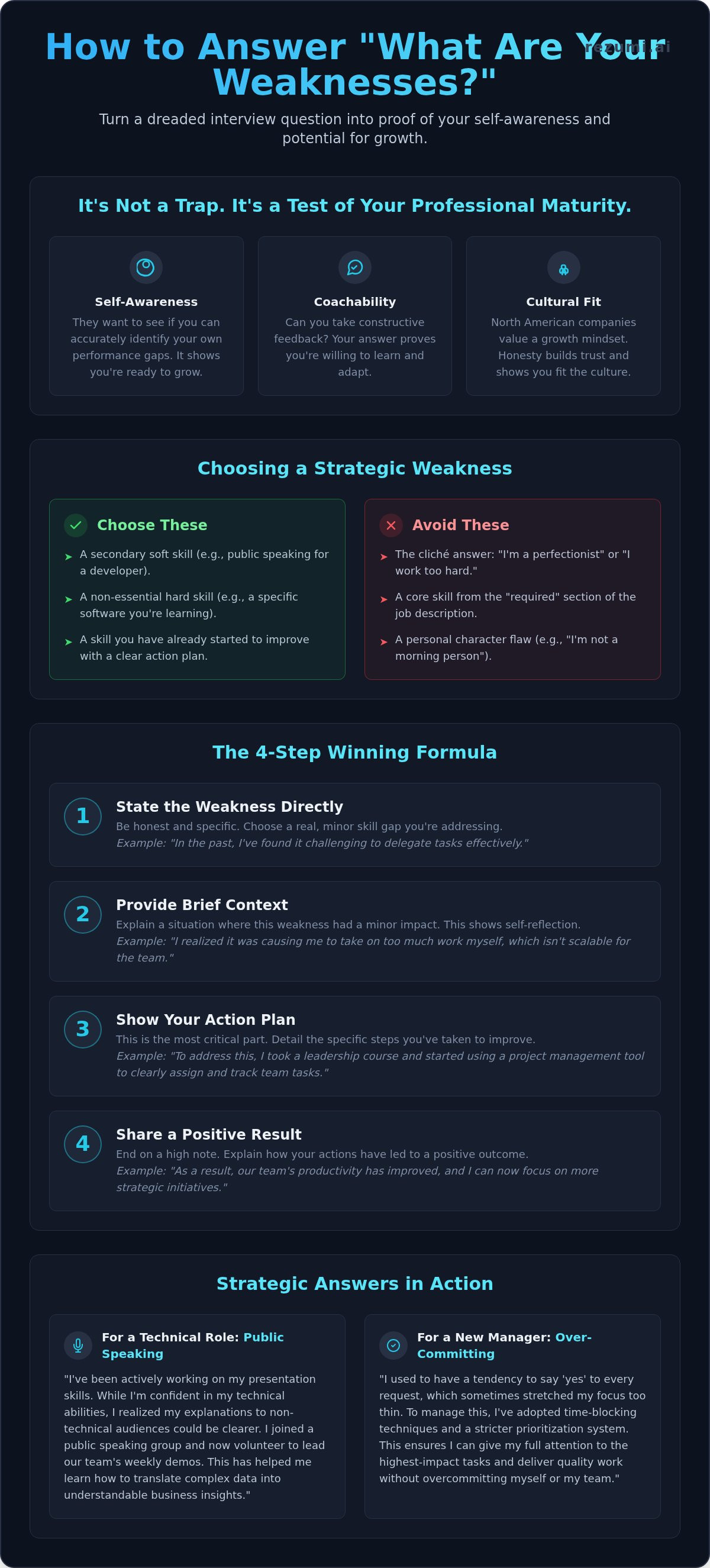
If you are in a technical role, public speaking is a safe and common choice. Before: You avoided client-facing meetings because you felt uncomfortable explaining complex data to non-technical stakeholders. After: You joined a communication workshop and started presenting at internal lunch-and-learns. You now lead monthly sprint reviews for ten people with total confidence.
For creative or people-focused roles, data analysis is a strong answer. Before: You relied entirely on intuition for marketing campaigns, which made it hard to justify budgets. After: You learned how to use dashboard tools to track conversion rates. Your last campaign outperformed the previous one by 15% because you adjusted the strategy based on real-time data.
Example for Junior Professionals
Junior candidates should focus on specific tool gaps or the learning curve of a new industry. You can turn a lack of experience into a story about your drive. Explain that you are using AI Resume Optimization to understand exactly which technical skills top employers are prioritizing in 2026. This shows you are proactive about your career development. It proves you don't wait for a manager to tell you what to learn. You are already closing the gap on your own time.
Example for Senior Leaders
For senior leads, the what are your weaknesses interview question is an opportunity to show leadership maturity. Discussing the transition from "doing" to "leading" shows you understand team scaling. Before: You were a high-performing individual contributor who struggled to let go of the details, leading to bottlenecks. After: You implemented a delegation framework that empowers your direct reports. By trusting your team with high-level tasks, you reduced project turnaround time by 25%. This shift allows you to focus on high-level strategy while your team grows their own skill sets.
How to Structure Your Response for Impact
A high-impact answer requires a repeatable formula. You can't rely on luck when the what are your weaknesses interview question comes up. You need a structure that moves from a problem to a solution in under ninety seconds. This approach proves you can manage your own professional development like a high-priority project. It replaces recruiter doubt with data-backed confidence.
The most effective answers follow a four-part progression. First, you name the weakness clearly without using qualifying language. Second, you explain the context of how this flaw used to affect your work. Third, you describe the specific steps you took to improve. Finally, you end with a positive result that proves the flaw is now under control. This structure ensures you don't wander off-topic or sound defensive.
The Action Step
Specificity is your greatest ally when describing your improvement. Don't just say you "read some books" or "tried harder." Detail the exact tools or mentors you used to change your behavior. If you struggled with organization, mention the specific project management software you mastered over a six-month period. Your improvement plan is a strategic project. It needs a clear timeline and measurable milestones. When you speak about your progress in technical terms, you signal that you are a disciplined professional who treats self-correction as a core job duty.
Ending on a High Note
Your goal is to spend only 20% of your time on the flaw and 80% on the solution. Do not linger on the negative aspects of your past performance. Move to the result quickly. Show how your new skill helped your previous company. Maybe your improved data skills saved your team five hours of manual reporting every week. Perhaps your better delegation allowed a project to finish two weeks ahead of schedule. You can find more closing techniques in our strategic interview tips guide. Ending with a win makes the recruiter remember your success rather than your struggle.
Use AI to Refine Your Interview Performance
AI is the strategic partner you need to bridge the gap between theory and execution. Traditional practice methods like talking to a mirror or a friend have significant limits. Friends are often too polite to give the objective, data-driven feedback required for high-stakes roles. AI tools provide a judgment-free zone where you can rehearse the what are your weaknesses interview question until you feel completely in control. This technology analyzes your performance to give you instant feedback on your tone, pacing, and clarity. You can identify exactly where you sound hesitant or defensive before you ever face a real hiring manager.
The Power of Mock Interviews
Mock interviews simulate the high-stakes pressure of a real recruiter call without the risk of disqualification. Rezumi's AI Interview Prep tool flags filler words and "throat-clearing" phrases that weaken your authority. If you start every sentence with "basically" or "I think," the system will catch it and suggest a more confident opening. You can review pricing for Rezumi premium tools to start your preparation today. This methodical practice ensures your final delivery is fluid, energetic, and aligned with modern hiring standards.
Connecting Resume to Reality
Your interview answers must match the professional narrative you built on your AI-built resume. Contradictions between your documents and your spoken words are immediate red flags for recruiters. If your resume highlights technical precision, admitting to a weakness in attention to detail will ruin your credibility. AI helps you spot these inconsistencies in your professional story by checking your spoken responses against your uploaded skills. It ensures that your weakness is truly secondary and does not undermine the core strengths you advertised to the ATS (Applicant Tracking System), which is the software companies use to filter candidates.
Final tip: true confidence comes from preparation, not from being perfect. The more you rehearse the what are your weaknesses interview question, the more natural you will sound. You want to reach a point where your answer feels like a real conversation rather than a scripted performance. By using data-backed strategies to refine your delivery, you turn a stressful hurdle into a clear demonstration of your readiness. You are no longer just guessing what the recruiter wants to hear. You are delivering a refined, optimized version of your professional self.
Secure Your Role with Strategic Preparation
You now have the blueprint to handle the what are your weaknesses interview question with precision. Passing the ATS is only the first step in your journey toward a new role. Real success depends on how you present your growth and self-awareness during the live behavioral round. Trusted by global professionals, Rezumi provides the specific tools you need to move from uncertainty to total control.
Our AI-driven coaching is built specifically for North American standards to ensure your delivery is polished and professional. You are ready to turn your flaws into proof of your professional maturity and readiness for leadership. Preparation is the difference between a missed opportunity and a signed offer.
You have the strategy. Now you just need the practice. Walk into your meeting with confidence and secure the position you deserve.
Frequently Asked Questions
What is a good weakness for an interview?
A good weakness is a non-essential hard skill or a secondary soft skill that you are currently improving. You should choose a flaw that does not prevent you from doing the core tasks of the job. For example, a software developer might mention public speaking as a weakness. This choice shows you have self-awareness without suggesting you are unqualified for your primary technical duties.
Can I say I have no weaknesses in a job interview?
You should never claim to have no weaknesses because it signals a lack of self-awareness or honesty to the recruiter. Every professional has areas where they can grow. Claiming perfection suggests you are difficult to coach and won't take feedback well. It is much better to be honest about a minor flaw and explain the specific steps you are taking to manage it.
Is being a perfectionist a good weakness to mention?
Being a perfectionist is a cliché answer that most North American hiring managers now view as a red flag. It sounds like you are trying to hide a strength inside a weakness, which feels scripted and dishonest. In 2026, recruiters value candidates who can admit to real challenges like delegation or over-communicating. This honesty builds trust and shows you are a mature professional.
How many weaknesses should I prepare for an interview?
You should prepare two or three weaknesses to ensure you are ready for any follow up questions. While most interviewers only ask for one example, some may ask for a second to see if you have more than one scripted response. Having a backup prevents you from panicking during the meeting. Ensure each example follows the structure of naming the flaw, the action taken, and the positive result.
What if my weakness is a skill listed in the job description?
You must avoid choosing a weakness that is listed as a mandatory requirement in the job post. Admitting you struggle with a core skill tells the recruiter you are a high-risk hire. When the what are your weaknesses interview question is asked, pivot to a secondary skill or a tool that is listed as "preferred" rather than "required." This keeps your candidacy safe while maintaining your professional integrity.
How do I talk about a weakness if I am a fresh graduate?
Fresh graduates should focus on their lack of real-world experience with specific industry tools or professional workflows. You can explain that you have the theoretical knowledge but are still refining your speed with a particular piece of software. Mention the specific online courses or AI tools you are using to bridge this gap. This shows the recruiter that you are proactive and eager to learn.
Should I mention a personal weakness or only professional ones?
You should only discuss professional weaknesses that relate to your performance in the workplace. Personal flaws like being disorganized at home or having a short temper with friends are not relevant to a recruiter. Keep the conversation focused on your professional development and career goals. Discussing a work-related gap shows you understand the boundaries of a professional environment and are focused on team success.
How long should my answer be for the weakness question?
Your answer to the what are your weaknesses interview question should be between 60 and 90 seconds long. You need enough time to explain your improvement plan without lingering too long on the flaw itself. Spend about 20% of your time naming the weakness and 80% describing the actions you took to fix it. This balance ensures the conversation ends on a positive and productive note.
Disclaimer
This article is provided for general informational purposes only and does not constitute professional, legal, financial, or career advice. While Rezumi strives for accuracy, we make no warranties as to the completeness or reliability of this content. Hiring practices, ATS behavior, and job-market conditions vary by employer, industry, and region — always verify against your specific situation. Any action you take based on this article is at your own risk.