Strategic Interview Tips to Command the North American Job Market in 2026
Your resume beat the algorithm, but the human interview is where most high-performing candidates lose their lead. It is a high-stakes environment where technical skills are assumed and your ability to communicate value is the only thing that matters. You need more than generic interview tips to succeed in the 2026 North American market. You need a data-backed strategy that mirrors the precision of your application.
You likely feel the weight of competition, especially with new AI-driven screening and stricter pay transparency laws in states like California. It's common to feel anxious or struggle to explain your biggest wins when the pressure is on. You've done the hard work of getting noticed, but now you have to prove your worth in a live conversation.
You will learn the exact strategies to align your interview performance with your ATS-optimized resume and secure your next role. We provide a clear framework to help you answer questions with authority, replace anxiety with control, and make a memorable positive impression. This is how you transition from being a name on a screen to the top choice for the job.
Key Takeaways
- Match your verbal responses to your resume data to build instant trust and validate your expertise.
- Apply the STAR method to organize your achievements into concise stories that emphasize your impact.
- Implement strategic interview tips that focus on your professional identity to ensure you stand out from the competition.
- Ask insightful questions about team goals to demonstrate your commitment to long-term results.
- Practice with AI Interview Prep technology to perfect your delivery and eliminate filler words before your meeting.
Aligning Your Interview Performance with Your ATS Optimized Resume
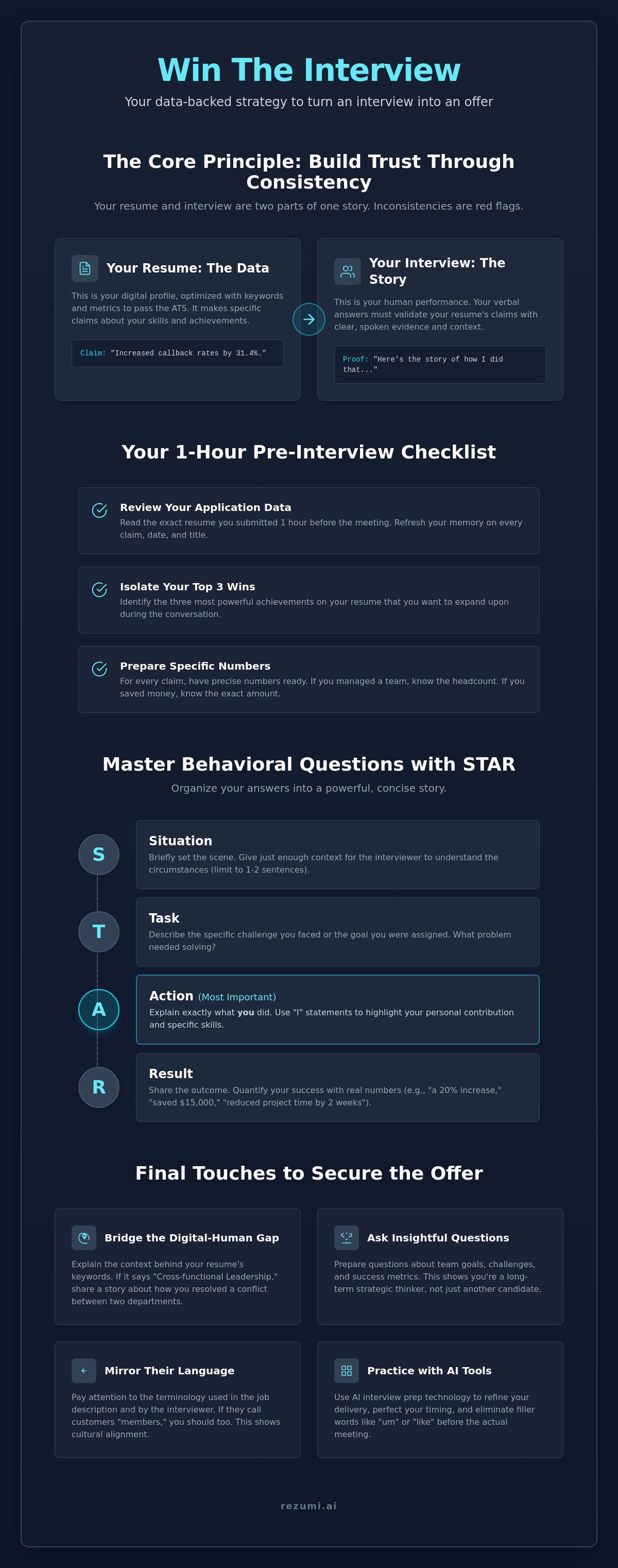
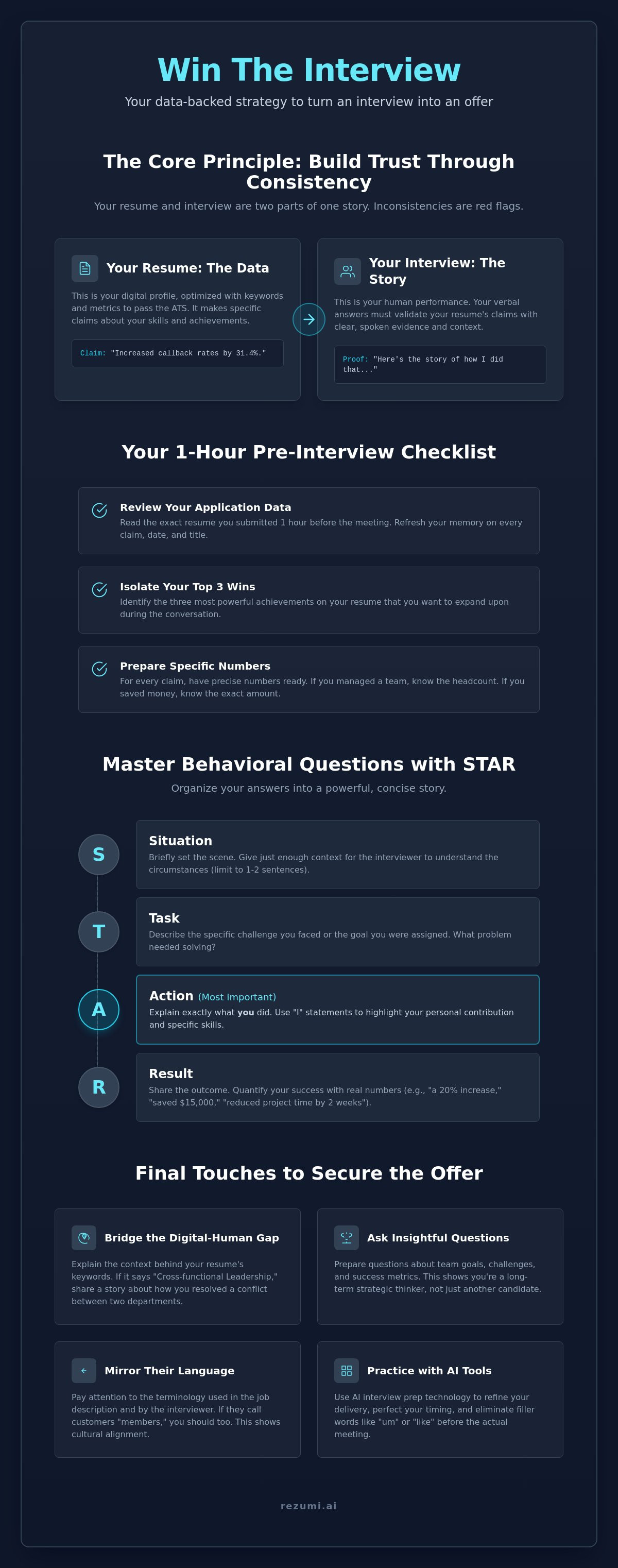
Your resume won the battle against the algorithm. Now, you must win the room. Many job seekers treat their CV and their interview as separate events, but they are two parts of the same job interview process. If your verbal answers don't match your digital profile, you create friction. Hiring managers use your resume as a roadmap. If you take a wrong turn, they notice immediately.
Consistency builds the trust needed to secure an offer. When a recruiter sees a specific metric on your page, they want to hear the story behind it. You must validate the data found on your resume with clear, spoken evidence. If you claimed a 31.4% lift in callback rates or a specific budget save, be ready to walk through the "how" without hesitation. Discrepancies between your written claims and your spoken words are red flags that can end your candidacy.
Review your resume design before you log onto that Zoom call or walk into the office. High-performance layouts often use bold text or callout boxes for key numbers. These are the first things an interviewer sees. You should know them by heart. Focus on the skills that the ATS flagged as high-priority. If the system prioritized "Strategic Planning," your interview tips should center on proving that specific competency with a real-world example.
Reviewing Your Application Data
Don't walk into a meeting cold. Read your submitted resume exactly one hour before the session starts. This refreshes your memory on the specific version you sent, which is vital if you tailored it for that role. You should also:
- Identify the top three achievements you want to expand upon during the conversation.
- Prepare specific numbers to back up every claim made in your CV.
- Check your dates and job titles to ensure your verbal timeline matches your document.
If you said you managed a team, know the exact headcount. If you mentioned a project timeline, remember the month it finished. This precision makes you sound like an expert rather than someone reading from a script.
Bridging the Digital and Human Gap
Keywords get you past the bot, but context gets you the job. Use your time to explain the context behind the keywords used on your resume. If your resume lists "Cross-functional Leadership," describe a time you settled a dispute between departments. Show how your past results solve the current problems the company faces. Look for clues in the job description to see what keeps the hiring manager up at night.
Use the same terminology the job description used to show alignment. If they call customers "members," you should use that word too. This alignment shows you already fit the culture and understand their specific needs. It transforms you from a candidate into a solution. Following these interview tips ensures your human narrative matches your digital excellence.
Using the STAR Method for High Impact Behavioral Answers
North American hiring managers use behavioral questions to predict how you will perform in the future. They want to hear about what you have actually done, not just what you think you would do. Using the STAR Method is the most reliable way to organize your experience into a logical story that commands attention. It prevents rambling and ensures you reach the payoff before the interviewer loses focus.
Mastering this framework is one of the essential interview tips for modern candidates. You should practice your responses until they sound natural and conversational. Stiff, rehearsed answers can feel robotic, which hurts the human connection you are trying to build. Your goal is to provide a clear narrative that validates the skills listed on your resume without wasting the recruiter's time.
Breaking Down the STAR Framework
The STAR method is a four step process designed to provide a complete picture of your professional capabilities. Each part serves a specific purpose in your story:
- Situation: Set the scene briefly. Give just enough detail so the interviewer understands the context. Limit this to two sentences.
- Task: Describe the specific challenge or goal. What was the problem that needed solving?
- Action: Explain exactly what you did. Use "I" statements rather than "we" to highlight your individual contribution. This should be the longest part of your answer.
- Result: Share the outcome. Use real numbers, such as a 20% increase in efficiency or a specific piece of positive feedback from a client.
Preparing Your STAR Stories
You don't need a different story for every possible question. Instead, create five versatile stories that cover different soft skills like leadership, conflict resolution, and problem solving. A single story about a difficult project can often be adapted to answer questions about teamwork or meeting tight deadlines. Review our guide on mastering the STAR technique for deeper examples of how to frame these narratives.
Preparation is the difference between a good interview and a job offer. If you want to refine your delivery with real-time feedback, explore our AI Interview Prep tools. These features help you simulate high pressure scenarios so you can walk into the room with total confidence. You will learn to eliminate filler words and hit your key points every time. Applying these interview tips consistently will make your behavioral answers feel effortless and professional.
Answering the Most Common Interview Questions with Confidence
Your professional identity is your anchor in any conversation. Start every response by stating exactly who you are in a business context rather than sharing personal hobbies or unrelated background. If you are a Senior Project Manager with a history of reducing overhead by 15%, lead with that fact. This immediate clarity helps the recruiter categorize your value and sets the tone for the rest of the meeting. These interview tips ensure you control the narrative from the first sentence.
Structure your introduction as a professional journey with a clear destination. You aren't just reciting your resume, you are explaining why your past experiences make you the inevitable choice for this specific role. Focus on your recent wins and show how they prepared you for the challenges this company faces. Avoid sharing personal information that does not relate to the job, as this can distract from your core message and waste valuable time.
Mastering the Introduction
The "Tell me about yourself" prompt is your first chance to command the room. Keep your answer under two minutes to maintain engagement and leave room for follow-up questions. You should follow our Tell me about yourself guide to build a script that moves from your past achievements to your future goals. Always connect your past experience to the specific needs of the company. If they need a leader who can scale teams, your introduction should highlight the time you grew a department from five to fifty people.
Handling Difficult Questions
Tough questions are opportunities to demonstrate self-awareness and growth. When asked about a weakness, discuss it as an area where you are actively improving. For example, if you struggle with public speaking, mention the specific course or practice group you joined to fix it. This shows you are proactive and coachable. Following U.S. Department of Labor interview guidance suggests that focusing on preparation and professional conduct is the best way to handle these high-pressure moments.
- Frame career gaps as periods of intentional skill development or personal growth.
- Explain why you are leaving your current role by focusing on your desire for new challenges.
- Never speak negatively about past employers or colleagues, as this reflects poorly on your professionalism.
Confidence comes from knowing your story inside and out. These interview tips help you turn common questions into a platform for your expertise. By staying focused on your professional wins, you replace anxiety with a clear, data-backed strategy for success.
Strategic Questions to Ask Your Interviewer to Command the Room
The final phase of the meeting is your opportunity to shift the power dynamic. You aren't just a candidate answering prompts. You are a professional evaluating a potential partnership. Asking the right questions shows you are thinking about the long-term success of the team rather than just getting a paycheck. These interview tips help you move from being a passive participant to a strategic leader in the room.
Avoid questions about salary or benefits until the final stages of the hiring process. Bringing up compensation too early can signal that you are more interested in the perks than the problems you were hired to solve. Instead, focus on the goals of the department and the specific culture of the team. Use your questions to uncover any hidden concerns the interviewer might have about your fit for the role. If you address these issues now, you can clear the path to an offer before the meeting ends.
Questions About Role Success
You need to know exactly how your performance will be measured. Ask the interviewer what success looks like for this position in the first six months. This shows you are already planning your contributions. You should also ask about the biggest challenge the team is currently facing. Understanding their pain points allows you to explain how your specific skills can provide immediate relief. Review our list of great questions to ask in an interview to see more examples that show your expertise.
Questions About Team Culture
Culture determines your long-term happiness and productivity. Ask how the team handles feedback and professional growth to see if they value continuous improvement. You should also find out what the most rewarding part of working for the organization is from the interviewer's perspective. This provides a glimpse into the actual day to day experience of the staff. Finally, ask how different departments collaborate on large projects. This reveals how siloed or integrated the company truly is.
Preparation is the only way to ensure your questions sound thoughtful and deliberate. If you want to refine your approach and practice these interview tips in a realistic setting, check out our AI Interview Prep plans. You will get the feedback you need to command every conversation and leave a lasting positive impression.
Refining Your Performance with AI Interview Coaching
Technology has changed how companies hire, and it must change how you prepare. AI coaching tools provide the real-time feedback you need to fix errors before they cost you a job offer. These systems analyze your pacing and word choice to ensure you sound confident and professional. Integrating these modern interview tips into your routine turns a stressful process into a controlled, data-backed exercise. You gain the advantage of knowing exactly how you sound to a recruiter before the meeting starts.
You can use technology to simulate high-pressure scenarios that mimic a real board room or a virtual screening. This allows you to identify filler words like "um" or "like" that weaken your impact and distract from your achievements. Repetitive phrases often signal a lack of preparation or high anxiety. If you are targeting specialized roles, you should follow specific strategies like those found in our guide on Cracking the PM Interview. This ensures your performance meets the technical and cultural standards of your industry.
The Benefits of Mock Interviews
Consistent practice reduces the physical symptoms of anxiety. You can stop shaking or fast speech by getting comfortable with the format of the conversation. Recording your sessions helps you notice non-verbal cues and your posture. You might realize you aren't making enough eye contact with the camera or that your hand gestures are too aggressive. Repeated practice makes your STAR stories feel like natural conversation. This is vital because a 2024 University of Texas audit found that AI-assisted support can lead to a 31.4% lift in callbacks when used correctly.
Getting Started with Rezumi AI Prep
Accessing professional coaching is simpler than ever. You can check our pricing page to get started with advanced interview modules designed for the 2026 job market. Once you have access, upload the job description for the role you want. The system will generate tailored practice questions based on that specific document. Use the feedback to polish your answers until they are professional, direct, and aligned with your resume. This approach removes the guesswork and gives you a clear framework for success. These interview tips ensure you remain the top candidate from the first application to the final handshake.
Command Your Career Future
Success in the 2026 job market requires more than just showing up. You must synchronize your verbal narrative with the data-backed claims on your resume to build immediate trust. By mastering the STAR method and asking strategic questions, you transform from a candidate into a high-value solution for any organization. These interview tips provide the framework you need to replace uncertainty with total control.
The gap between a callback and a job offer is closed through deliberate practice. You don't have to guess how you are performing when you can use AI-driven coaching to identify and fix your weaknesses. Our platform offers ATS-aligned preparation and deep North American market expertise to ensure you are ready for any scenario. It's time to stop feeling anxious and start feeling prepared.
Your next career move is within reach. Start your AI-powered interview prep with Rezumi today and enter your next meeting with the confidence of a top-tier professional. You have the strategy and the tools to win. Go secure the role you deserve.
Frequently Asked Questions
What should I wear to a job interview in 2026?
Dress one level above the daily office attire of the company. If the team typically wears jeans and t-shirts, you should wear a blazer and slacks. This shows respect for the process without appearing out of touch with the specific culture. For virtual meetings, ensure your top half is professional and your background is clutter-free to maintain a polished image.
How do I explain a gap in my resume during an interview?
State the reason for the gap clearly and move immediately to what you learned during that time. Frame the period as intentional skill development or personal growth. If you took six months off, mention a specific certification you earned or a freelance project you completed. This transforms a perceived weakness into a demonstration of proactivity and keeps the focus on your current readiness.
How long should my answers be in a behavioral interview?
Keep your responses between 90 seconds and two minutes to maintain engagement. This provides enough time to use the STAR method without losing the interviewer's attention. If an answer is too short, you lack detail. If it's too long, you risk rambling. Use these interview tips to monitor your pacing and ensure you reach the result of your story quickly.
What is the best way to follow up after an interview?
Send a personalized thank-you email to every person you spoke with within 24 hours of the meeting. Mention a specific topic discussed during the conversation to reinforce your interest and attention to detail. This is your final chance to remind them why you are the best fit for the role. Avoid generic templates. A tailored note shows you are serious about the opportunity and value their time.
How do I handle a panel interview with multiple people?
Direct your answer to the person who asked the question, but make brief eye contact with everyone else on the panel. This creates a sense of inclusion and shows you can manage complex group dynamics. Address individuals by name if possible. Taking notes helps you remember which interviewer prioritized specific topics like technical skills or team culture. It allows you to tailor your follow-up questions to their specific interests.
What if I do not have an answer to a specific question?
Don't guess or invent an answer. Instead, explain the steps you would take to find the information or solve the problem. You can say, "I haven't encountered that specific scenario yet, but here is how I would approach it." This demonstrates your problem-solving logic and honesty. Employers value a candidate who knows their limits and has a clear, reliable method for overcoming them.
Should I bring a physical copy of my resume to the interview?
Bring five printed copies of your resume in a professional folder for in-person meetings. Technical glitches happen and some interviewers prefer to have a physical document to write notes on. It shows you are prepared for any situation. For virtual interviews, have a PDF version ready to share in the chat if requested. This ensures the hiring team is looking at your most recent, optimized data.
How do I research a company effectively before my meeting?
Review the company's latest annual report or recent press releases from the last six months. This gives you insight into their current goals and market challenges. Check LinkedIn to see the professional backgrounds of your interviewers. Knowing their career paths helps you prepare relevant interview tips for building rapport. Use this data to ask questions that show you understand their specific industry position and future direction.
Disclaimer
This article is provided for general informational purposes only and does not constitute professional, legal, financial, or career advice. While Rezumi strives for accuracy, we make no warranties as to the completeness or reliability of this content. Hiring practices, ATS behavior, and job-market conditions vary by employer, industry, and region — always verify against your specific situation. Any action you take based on this article is at your own risk.