Great Questions to Ask in an Interview to Command the Room
Most candidates treat the final five minutes of an interview as a polite formality. They're wrong. This is the most high-stakes moment of the entire meeting. It's your chance to stop being the one under the microscope and start being the one in control. Using great questions to ask in an interview allows you to flip the script and audit the company while proving your professional value.
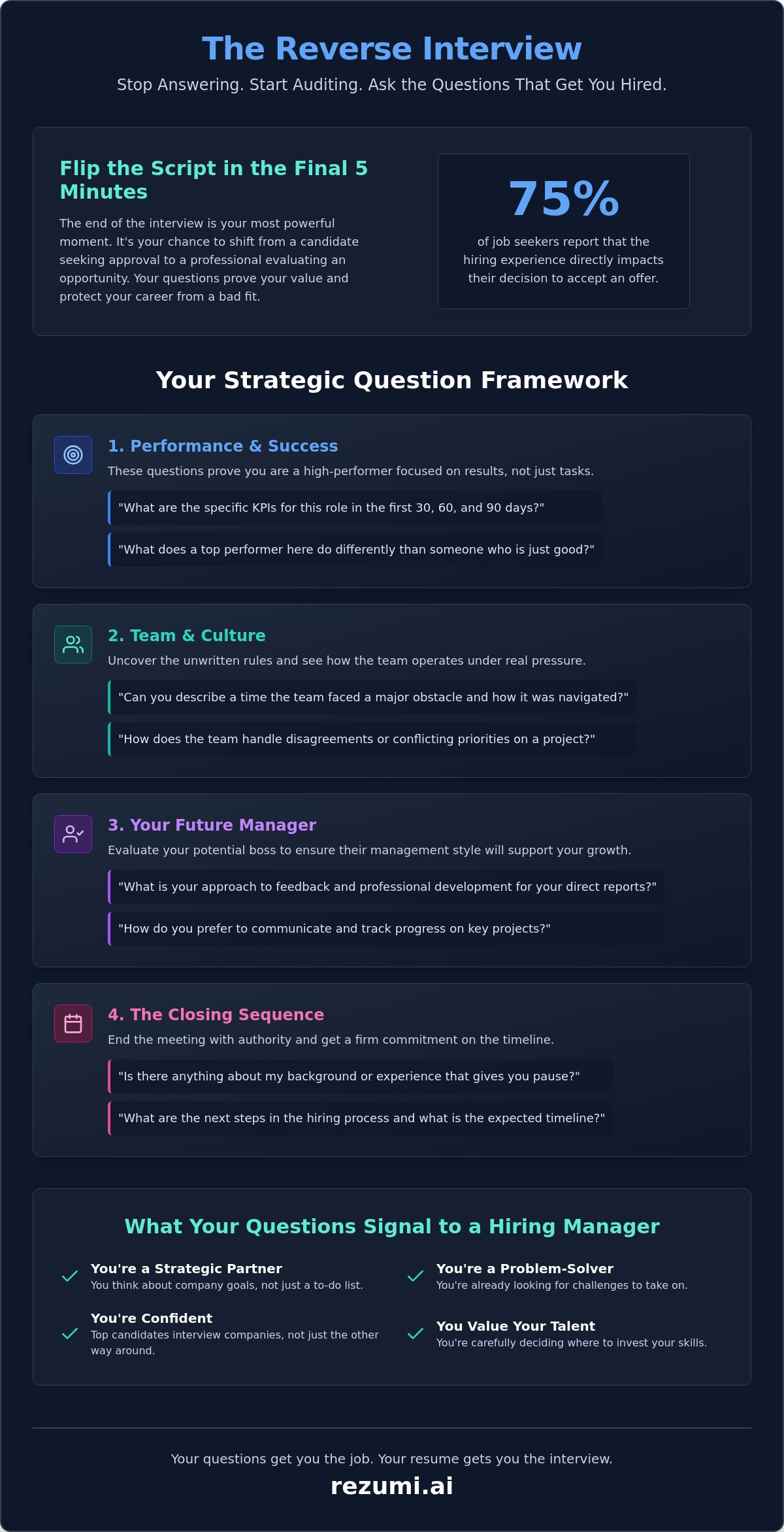
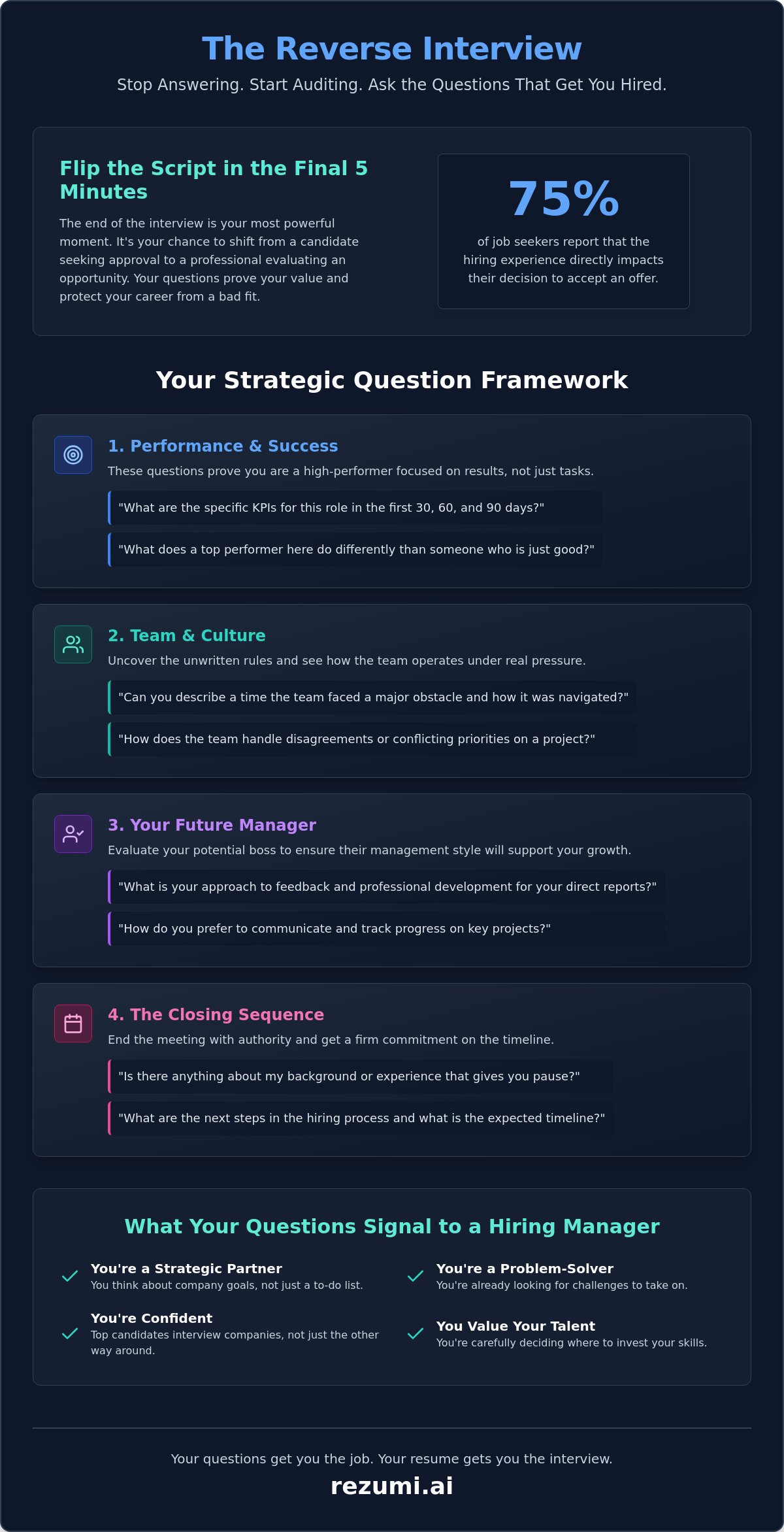
You've felt that spike of anxiety when a recruiter asks, "Do you have any questions for us?" It's a common fear. Research from July 2026 shows that 75% of job seekers say the hiring process itself impacts their decision to accept an offer. You want to sound like a strategic leader, but you also need to make sure you aren't joining a company with a toxic culture. You need more than just generic talking points to protect your career.
This guide delivers a curated list of high-impact questions and a framework for evaluating the answers you receive. You'll learn how to probe for red flags and demonstrate your expertise at the same time. We provide the exact tools needed to close every interview with absolute confidence and clear data. It's time to move from uncertainty to total control over your professional future.
Key Takeaways
- Don't just answer questions. Turn the interview into a two-way street by using the reverse interview strategy to signal your value as a top candidate.
- Identify great questions to ask in an interview. Focus on KPIs (key performance indicators) so the hiring team knows you're ready to deliver results.
- Look past office perks. Ask questions that reveal the unwritten rules of how a team actually works together when they're under pressure.
- Evaluate your potential boss. Use targeted questions about their management style to ensure they'll support your professional growth.
- Close the meeting with authority. Address any lingering concerns and get a firm commitment on the timeline for next steps.
The Reverse Interview: Why Your Questions Are a Secret Weapon
The interview ends the moment you stop answering and start asking. This is the "reverse interview." It is the most critical phase of the meeting because it shifts the power dynamic from a candidate seeking permission to a professional evaluating an opportunity. When you prepare great questions to ask in an interview, you aren't just filling time. You are conducting a high-stakes audit of your future employer.
Most people forget that the purpose of a job interview is a two-way exchange of information. They treat it like an interrogation. High-value candidates don't do this. They know that asking sharp, pointed questions signals they have other options. It shows they care about where they invest their talent. Your questions act as a mirror. They reflect your priorities, whether you value long-term stability, rapid growth, or a collaborative team culture.
Preparation prevents mistakes. Data from 2026 shows that 75% of job seekers say the interview experience directly influences their decision to join. If you don't ask the right questions, you risk accepting a role that looks good on paper but is a disaster in reality. It's about protecting your career path.
Defining the Strategic Q&A
A strategic question does more than gather data. It forces the hiring manager to visualize you already working in the role. Instead of asking "What is a typical day like?", which is often a wasted opportunity, ask about the current team's biggest roadblock. This shows you understand industry challenges. It proves you aren't just looking for a paycheck. You're looking for a problem to solve. It changes the conversation from "can you do this?" to "how will you do this?"
The Psychology of the Hiring Manager
Hiring managers are usually exhausted. They don't want to hire someone they have to micromanage. They want a partner who takes ownership. When you ask about specific goals and obstacles, you build immediate professional chemistry. You move from "applicant" to "solution." Great questions to ask in an interview should focus on outcomes. This tells the manager that your success is tied to the company's success. It replaces their hiring anxiety with the confidence that you are the right fit.
Performance and Success: Questions That Prove You Are a High-Performer
Hiring managers aren't just looking for someone who can do the job. They're looking for someone who can win. You prove you're that person by asking about the finish line before you even start. High-performers don't wait for a yearly review to find out if they're succeeding. They want to know the score from day one. This is why great questions to ask in an interview always focus on tangible outcomes rather than just daily tasks.
Start by asking about the specific Key Performance Indicators (KPIs) for this role in the first 90 days. Since 81% of employers focused on skills-based hiring in 2024, they expect you to care about measurable results. Are they looking for a certain amount of revenue? A specific number of bugs fixed? Knowing these numbers allows you to bridge the gap between your past achievements and their future needs. If your resume shows you saved a previous employer $50,000, you can explain exactly how those same methods will solve their current quarter's biggest challenge. Inquire about the biggest obstacle the team faced last month and how they navigated it. This shows you're ready to take ownership of problems, not just follow instructions.
Targeting Growth and Impact
Ask the interviewer: "What does a top performer in this role do differently than someone who is just good?" This is one of the most good questions to ask at an interview because it forces the manager to define excellence. Listen for specific behaviors. If they mention generic traits like "hard-working," keep digging for metrics. You should link this answer back to your high-performance CV by highlighting the data points that match their goals. If you want to practice delivering these answers with confidence, you can explore our AI-powered interview tools to refine your approach.
Understanding the Feedback Loop
You need to know how the team handles mistakes or missed deadlines. Ask: "How does the team handle it when a project goes off the rails?" This reveals the level of psychological safety and professional accountability in the office. A healthy team focuses on the solution, while a toxic one focuses on the scapegoat. Inquire about the frequency and structure of performance reviews to ensure you'll have a consistent roadmap for your professional growth. Great questions to ask in an interview about feedback prove that you are coachable and committed to long-term refinement.
Cultural Alignment: Identifying Your Future Team Dynamics
Culture is not about free snacks or office perks. It is about how people treat each other when a deadline is looming and the pressure is high. You cannot find the truth by asking "What is the culture like?" because you will only get a rehearsed marketing answer. Instead, you must use great questions to ask in an interview to uncover the unwritten rules of the organization. You need to know if the team is a collection of individuals or a unified machine that supports its members.
Focus your inquiry on how departments communicate. Ask about the friction points between the sales and product teams, or how marketing coordinates with engineering. If the interviewer claims there is never any friction, they are likely hiding a siloed environment where teams don't actually talk. You want to hear about a specific system for resolving conflict. This tells you if the company values transparency or if they prefer to sweep problems under the rug. Identifying these dynamics now prevents you from signing an offer letter for a role that will lead to burnout.
Decoding the Daily Grind
Ask the interviewer: "Can you tell me about a time the team had to pivot quickly on a project?" This question acts as a stress test for the company's agility. Listen for whether the pivot was a chaotic mess or a structured shift. You should also ask how the team handles collective stress. If they only celebrate big wins but ignore the small daily victories, the environment might be a grind. A healthy culture acknowledges the effort required to reach the finish line, not just the result itself.
Remote and Hybrid Realities
Hybrid work is now the standard for high-performing teams. Research from 2026 shows that companies with rigid return-to-office policies report 17% lower hire rates. You need to know if the company has a real strategy for this or if they are just winging it. Ask: "How does the team maintain alignment when working across different time zones?"
Inquire about their tools for asynchronous communication. This refers to communication that does not happen in real-time, such as project management boards or recorded video updates. If the answer is "we just send a lot of emails," prepare for a calendar full of draining, unnecessary meetings. You can use our AI-powered tools to practice asking these questions so you sound like a candidate who values efficiency and modern workflows.
Managing Up: Strategic Questions for Your Potential Boss
Your direct manager is the single most important variable in your daily work life. A bad boss can turn a dream role into a nightmare, while a great one can accelerate your career by years. You must use the closing minutes of your meeting to interview your potential manager. This is where you find great questions to ask in an interview that reveal their leadership philosophy and communication style. You need to know if they will be a roadblock or a catalyst for your success.
Strategic candidates look for managers who advocate for their teams. Ask how they represent their direct reports during budget meetings or organizational shifts. You want to hear about a leader who protects their team's time and secures the resources they need to perform. If they cannot give a specific example of how they supported a team member during a difficult project, consider it a major red flag. This part of the interview is about ensuring your professional values align with their management habits. You aren't just looking for a job. You're looking for a partnership.
North American corporate culture in 2026 demands more than just technical competence. Managers now prioritize candidates who can manage themselves and their superiors effectively. By asking about their expectations early, you prove that you understand the mechanics of a high-functioning team. It shows you are proactive about avoiding friction and maximizing output from the first day on the job.
Leadership Style and Expectations
Ask: "How do you prefer to receive updates on project progress?" The answer will tell you everything you need to know about their level of control. A micromanager will want daily, granular reports. A leader who values autonomy will prefer high-level milestones and weekly check-ins. You should also ask what would make this hire a "home run" for them. This forces them to define the specific value they need, allowing you to prove you can deliver it immediately. It changes your status from an applicant to a strategic asset.
Professional Development Support
Test their commitment to your future. Ask: "How have you helped a direct report reach their career goals in the past?" You are looking for a manager who views your growth as part of their own success. If you are applying for leadership or product management positions, refer to our PM interview guide for more targeted questions. To ensure you are ready to handle these high-stakes conversations with a future boss, you can start practicing with our AI Interview Prep tools today. This preparation ensures you sound like a peer, not just an applicant.
The Closing Sequence: Final Questions and Next Steps
The final minutes of an interview are not just a polite exit. They are your last chance to secure the role. Most candidates pack up their bags mentally before the meeting is actually over. This is a mistake. You must use this time to eliminate doubts and set the stage for your next move. Using great questions to ask in an interview in these closing moments ensures you leave the room as the clear front-runner. It transforms a standard conversation into a strategic closing sequence.
The Objection Killer Question
Ask the interviewer: "Based on our conversation, is there anything about my background that gives you pause?" This question takes significant courage to ask. It also gives you an immediate opportunity to clarify any misunderstandings that could cost you the job. Perhaps the interviewer thinks you lack experience in a specific software, or they are worried about your remote work setup. By asking this, you can address their concerns directly while you still have their full attention. This bold approach demonstrates high professional maturity because it shows you can handle direct feedback and solve problems in real-time. It proves you are more interested in the truth than in a comfortable conversation.
The Logistics of the Offer
You need to leave the room with a clear understanding of what happens next. Always confirm the timeline for their hiring decision. Research from July 2026 shows that the average time-to-fill for high-demand roles has increased to 44 days. Knowing their specific calendar prevents you from sending desperate follow-up messages too early. Ask: "What are the next milestones in your hiring process?" This helps you manage your own expectations and other job offers you may be considering.
Don't forget to ask if there is any additional information you can provide to help them make their choice. Sometimes a quick portfolio sample, a technical certification, or a list of references can tip the scales in your favor. Before you leave, ensure you have the correct contact information for everyone in the room. Verify the spelling of their names and their direct email addresses. This is the foundation for your interview follow-up email strategy. A well-timed, data-backed message can reinforce the value you demonstrated during the meeting. You have done the hard work of commanding the room. Now, use these final steps to cross the finish line with confidence.
Turn Your Next Interview Into an Offer
You now have the exact strategy needed to flip the script on your next hiring manager. By preparing great questions to ask in an interview, you move from a passive applicant to a high-value partner. You've learned how to audit company culture, measure performance expectations, and vet your future boss. These tactics ensure you don't just find a job, but find the right role for your long-term career path.
Preparation is the difference between feeling anxious and staying in control. Rezumi provides AI-powered interview prep specifically tailored for the North American market. Our platform gives you real-time feedback on your mock interview answers so you can refine your delivery before the high-stakes meeting. These tools were built by global professionals to help you secure competitive roles with data-backed confidence. Check out Rezumi pricing to get AI-driven interview coaching today and start practicing your closing sequence.
You've done the hard work of building your expertise and refining your resume. Now, it's time to lead the conversation and prove your value. Step into the room with authority and secure the future you deserve. You've got this.
Frequently Asked Questions
What are the top 3 questions I should always ask in an interview?
Focus on performance, roadblocks, and management style to get the most value. Ask what separates a top performer from someone who is just good. Inquire about the biggest challenge the team is currently facing. Finally, ask your potential manager how they prefer to give feedback. These three questions cover your success, the team's reality, and your daily work relationship.
Is it okay to ask about salary and benefits in the first interview?
Wait for the recruiter to mention compensation first or hold the question until the second round. Asking about money too early can make you seem focused only on the paycheck rather than the role's impact. Use the initial meeting to prove your value and build a strong case for a higher offer later. Once they are convinced you are the right fit, you will have more power to negotiate.
How many questions should I prepare to ask at the end of an interview?
Prepare a list of at least 5 to 10 questions before you walk into the room. You probably won't ask all of them, but a longer list protects you if the interviewer answers some during the normal conversation. Aim to ask 3 to 5 great questions to ask in an interview to show you are a serious candidate. Having options allows you to pick the ones that feel most relevant to the discussion you just had.
What should I do if the interviewer already answered all my questions?
Pivot to a deeper question based on something they mentioned earlier in the meeting. You can say, "We covered my initial list, but I'm interested in hearing more about the project you mentioned earlier." This proves you were listening and can think on your feet. You can also ask the interviewer what they personally find most rewarding about their work at the company.
Can I ask the interviewer about their own career path at the company?
Yes, asking about their journey is an excellent way to build rapport and understand internal growth. It reveals whether the company actually promotes from within or if people tend to get stuck in the same roles. Ask what has kept them at the company and how their role has changed over time. This gives you a clear picture of what your own future might look like if you join.
Is it a red flag if I do not have any questions for the employer?
Employers view a lack of questions as a sign that you are not truly interested in the role. It suggests you haven't thought critically about the work or the company's challenges. Even if you feel you understand the job, you must have great questions to ask in an interview to maintain your professional image. Silence at the end of a meeting is a missed opportunity to reinforce your value.
How do I ask about work-life balance without sounding lazy?
Reframe the topic around sustainable performance and team rhythms. Instead of asking about "hours," ask how the team manages its workload during high-pressure cycles or peak seasons. This shows you are committed to delivering high-quality results without burning out. It positions balance as a strategic requirement for long-term success rather than a request for less work.
Should I write my questions down on a piece of paper or bring them on a phone?
Always use a professional notebook and a pen rather than a digital device. Using a phone can make it look like you are distracted or checking personal messages. A notebook allows you to take notes on the interviewer's answers, which demonstrates active listening and serious preparation. It reinforces your brand as a polished professional who respects the process and the interviewer's time.
Disclaimer
This article is provided for general informational purposes only and does not constitute professional, legal, financial, or career advice. While Rezumi strives for accuracy, we make no warranties as to the completeness or reliability of this content. Hiring practices, ATS behavior, and job-market conditions vary by employer, industry, and region — always verify against your specific situation. Any action you take based on this article is at your own risk.