Tell Me About Yourself: How to Answer This Interview Question in 2026
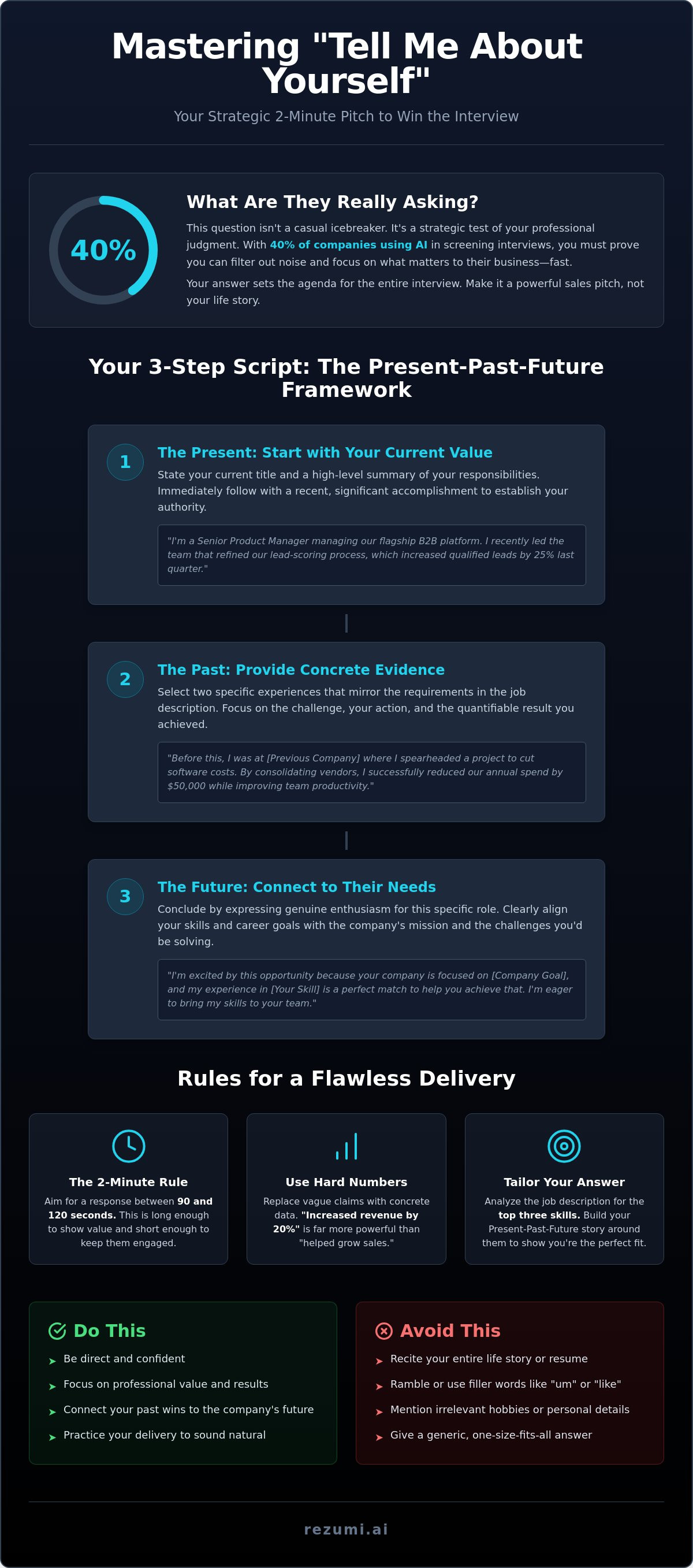
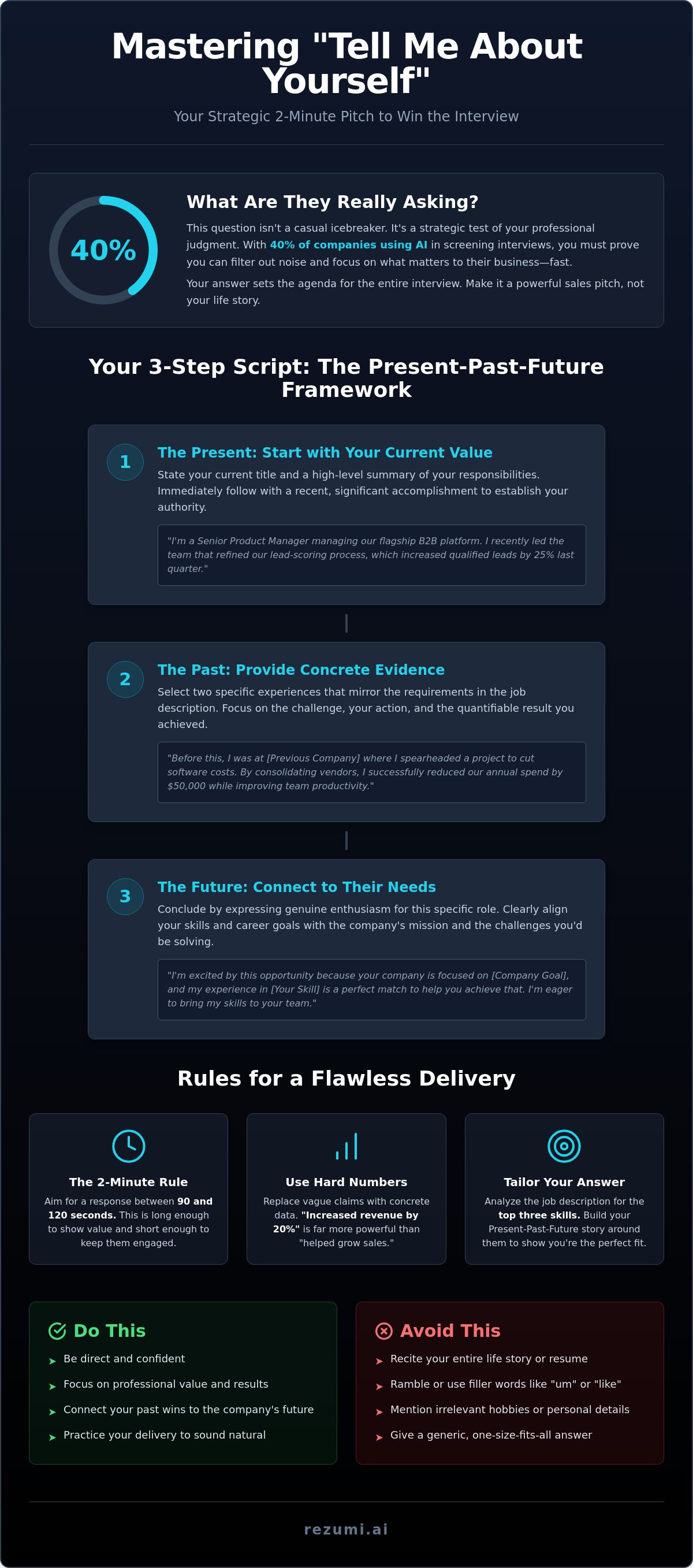
The "tell me about yourself" question is not an invitation to share your life story. It's a high-stakes sales pitch. You're the solution to a company's specific problem. In a hiring market where 40% of companies use AI to conduct screening interviews, your tell me about yourself interview question answer must be precise and data-driven. It needs to align with the job description immediately.
You might feel the urge to ramble. You might worry about sounding like a robotic script. It's difficult to identify which parts of your career are relevant when you have so much to offer. We'll give you a clear framework to turn this common opening into your strongest value proposition.
This guide shows you how to build a structured response that feels natural and confident. You'll learn to connect your past wins to the specific requirements of the role. We also cover how to share the right amount of personal info to build a connection without losing your professional edge.
Key Takeaways
- Master the Present-Past-Future framework to build a structured script that highlights your current role and career wins.
- Learn to analyze job descriptions so your tell me about yourself interview question answer aligns perfectly with the top three skills the employer is seeking.
- Replace vague descriptions with concrete data and real numbers to prove your professional value to the hiring manager.
- Practice your delivery with AI coaching tools to eliminate filler words and maintain a confident, natural pace throughout your response.
What Is the "Tell Me About Yourself" Question Really Asking?
Most candidates treat this question like a casual icebreaker. It is actually a strategic filter. When a recruiter asks this, they aren't looking for your life story. They are evaluating your professional judgment. They want to see if you can filter out the noise and focus on what matters to their business. In a market where 40% of companies are expected to use AI to conduct screening interviews in 2026, your ability to provide a concise, data-backed summary is your first real test.
Your tell me about yourself interview question answer serves as a baseline for your communication skills. Can you structure a narrative? Can you stay on track under pressure? Recruiters use this moment to decide which follow-up questions to ask. If you start with your childhood, you've already lost their attention. If you start with your most recent professional win, you've set the agenda for the rest of the meeting. You are proving that you can summarize complex information quickly and effectively.
This is a test of your ability to prioritize relevant value over personal history. Every second of your response should justify why you are the best fit for this specific role. It is a standard part of any job interview, but few people use it to its full potential. You aren't just answering a question. You're launching a pitch.
The Two-Minute Rule for Professional Impact
Timing is everything. Aim for a response that lasts between 90 seconds and two minutes. This is enough time to establish authority without boring the listener. Focus on the "why" behind your career moves. Don't just list titles. Explain the motivation behind your transitions and what you learned. Avoid the trap of mentioning college hobbies or childhood dreams. Those details don't help the hiring manager solve their current problems. They need to see a professional who understands the value of time.
Why North American Recruiters Value Directness
Hiring managers in the US and Canada prefer a bottom-line approach. They value efficiency and clarity. Lead with your current title and your most significant recent achievement. Use real numbers to back your claims. If you increased revenue by 20% or cut costs by $50,000, say it immediately. Connect your expertise to the company's specific goals in the first thirty seconds. This directness signals that you are a results-oriented professional. You can refine this delivery using tools like our AI Interview Prep to ensure your pacing is perfect. You can view our pricing page to see how our tools help you practice these responses until they feel natural.
The Present-Past-Future Framework: Your Three-Step Script
Most traditional career advice suggests starting with your education. This is a strategic error. Recruiters care about your current capabilities first. By reversing the order, you hook the listener with your immediate value. This framework ensures your tell me about yourself interview question answer is logical, persuasive, and results-oriented. It moves from your current success to your historical evidence and ends with your future potential.
The Present-Past-Future model prevents the common mistake of rambling. It gives you a clear path to follow. You don't have to guess what comes next. You simply move through three distinct phases of your professional story. This structure allows you to vary your sentence lengths to maintain a natural, human rhythm. It keeps the interviewer engaged while you prove you're the right hire.
The Present: Your Professional Identity
Start with a punchy statement of who you are right now. State your current title and a high-level summary of your responsibilities. You should mention one major project you are currently managing or recently finished. Use active verbs like "manage," "refine," or "execute" to show immediate impact. For example, instead of saying you work in sales, say you manage a portfolio of mid-market accounts and recently refined the lead-scoring process. This establishes your authority from the very first sentence.
The Past: Proving Your Track Record
This is where you provide the evidence. Select two specific experiences that mirror the requirements found in the job description. Don't list every job you've ever had. Briefly mention a challenge you faced and the specific result you achieved. Focus on professional growth and the acquisition of new skills. If the new role requires leadership, highlight a time you led a team through a difficult transition. Keep this section focused on how your past successes have prepared you for the challenges of this specific company.
The Future: Why You Are Here
End your response by looking forward. Express genuine enthusiasm for the specific challenges of the new role. Align your career goals with the company mission statement. This shows you've done your research and aren't just looking for any job. End with a clear transition that invites the next question. A simple phrase like "That is why I am excited to discuss how my background in operations can support your current expansion" works perfectly. You can refine this script using our AI Interview Prep to ensure your delivery is polished and professional.
Winning Answer Examples for Different Career Stages
A good answer summarizes your resume. A great answer solves a company's specific problem. Your tell me about yourself interview question answer must move beyond a simple list of duties. It needs to showcase your impact using hard data. If you say you "helped with sales," you sound like a passenger. If you say you "increased conversion rates by 12%," you sound like an expert who drives results.
Authority is often lost through filler words. Phrases like "I guess," "basically," or "sort of" signal uncertainty. Clean up your speech by replacing these with brief pauses or confident transitions. Recruiters in 2026 value clarity because they often compare your response against technical competency scores. They want to see that you can communicate complex ideas without wasting time.
Entry-Level Example: Focusing on Potential
You don't need a decade of work to sound like a professional. Showcase your internships and academic projects as professional experience. Highlight transferable skills like technical proficiency or project management. Connect your degree directly to the practical needs of the department you want to join.
The Script: "I recently graduated with a degree in Computer Science from State University. During my senior project, I led a team of four to develop a mobile app that tracked local food waste. We refined the code to improve load times by 35%. This project taught me how to manage tight deadlines and technical debt. I am eager to apply this focus on efficiency to your junior developer role."
Senior Professional Example: Highlighting Leadership
Focus on strategic outcomes rather than daily tasks. Senior roles require proof of leadership and revenue impact. Demonstrate a deep understanding of industry-specific terminology to show you understand the bigger picture. Mention team growth, process improvements, or direct financial gains.
The Script: "I have spent the last eight years managing regional operations for a logistics firm. Last year, I executed a process overhaul that cut shipping delays by 18%. This change saved the company $240,000 in annual overhead. I have also grown my department from five to twenty members while maintaining a 92% retention rate. I am ready to use this operational expertise to support your current expansion into the North American market."
Mid-career professionals should bridge these two styles. Show that you have mastered the technical side and are now driving broader results. Always tie every example back to the specific requirements of the job description. If you need help tailoring these examples to your specific background, our AI Interview Prep tools can help you generate custom scripts that fit your career stage perfectly.
How to Tailor Your Answer Using the Job Description
The job description is not just a list of wishes. It is a blueprint for your success. Most candidates ignore the specific language an employer uses. You should do the opposite. Treat the posting as a map of the recruiter's biggest priorities and current pain points. Your tell me about yourself interview question answer must mirror the document's structure to prove you are the specific solution they need.
Start by identifying the top three skills mentioned in the posting. If a company mentions "data integrity" three times, that is your cue. Don't just list your skills. Match them to specific stories from your professional past. This approach removes the guesswork. You aren't hoping they like you. You are showing them that you already possess the exact tools they are looking for.
Matching Your Skills to Their Problems
Every job posting contains hidden friction points. These are the problems the company is currently struggling to solve. Find these gaps in the requirements section. If they ask for "experience in fast-scaling environments," they are likely worried about growth pains. Position your past successes as the direct answer to those struggles. Use resume design principles to keep your verbal pitch as organized as your CV. A structured response prevents rambling and keeps the focus on your quantifiable results. It shows you can think clearly under pressure.
Using ATS Keywords in Your Verbal Pitch
Consistency builds professional trust. Recruiters often have your resume open during the call. They've already seen the keywords that helped you pass the ats resume checker. Use that same terminology in your verbal response. If your resume highlights "cross-functional leadership," use that exact phrase in your pitch. Don't swap it for "working with different teams." Using the same language reinforces your profile across all application touchpoints. It makes your expertise feel more solid and verified. It also helps the recruiter check off their internal requirements faster.
Reinforce your profile by being consistent. Your verbal pitch should feel like a live-action version of your high-performance CV. This alignment shows you are a precise and prepared candidate. It eliminates the anxiety of wondering what to say because the job description has already provided the script. To ensure your keywords and pacing are hitting the mark, you can use our AI Interview Prep to practice your tailored response until it feels natural.
Refining Your Delivery with AI Interview Coaching
A perfect script is useless if your delivery feels forced. You need to sound like a natural leader. Most candidates practice in front of a mirror, but mirrors do not talk back. They cannot track your words per minute. They cannot flag your use of filler words. AI coaching provides the objective data you need to fix these issues. It turns a shaky response into a polished value proposition.
Pacing is a major hurdle for many job seekers. If you speak too fast, you appear nervous. If you speak too slow, you lose the recruiter's interest. AI tools give you instant feedback on your speed. You can identify and remove words like "um" or "like" that distract from your professional message. This structured feedback ensures your tell me about yourself interview question answer stays within the ideal 90 to 120-second window.
The Power of Mock Interview Practice
Simulating the pressure of a real call builds professional muscle memory. Reading a script is easy. Executing it while being watched is difficult. You must maintain a calm, technological confidence during your delivery. This means staying steady even when the stakes are high. Once you have mastered your opening, check these great questions to ask in an interview. Preparing for the entire conversation flow helps you command the room from start to finish.
Final Polish: Pacing and Body Language
Physical cues are just as important as your spoken words. Ensure your eye contact remains steady. On a digital call, you should look at the camera rather than the screen. Watch for physical habits like fidgeting or slouching that suggest anxiety. Record yourself to check your tone and emotional energy. If you sound bored, the recruiter will be bored. You can check Rezumi pricing for access to advanced AI interview prep modules. These tools analyze your delivery in real-time so you can walk into your next meeting with total control.
Command the Room with Your Opening Pitch
Success in 2026 requires more than a generic summary. You've learned how to use the Present-Past-Future framework to build a script that focuses on immediate value. By matching your stories to the specific pain points in a job description, you prove you are the solution the employer needs. This strategic approach ensures your tell me about yourself interview question answer feels natural, authoritative, and data-backed.
Preparation is the bridge between anxiety and control. Don't leave your first impression to chance when you can refine your delivery with precision technology. Global professionals trust Rezumi for AI-driven coaching tailored specifically for the North American market. Our platform provides real-time feedback on your pacing and identifies distracting filler words before you ever hop on a call. You can master your interview delivery with Rezumi AI Prep and start every meeting with total confidence.
You have the skills and the track record to land the role. Now you have the framework to prove it. Take control of the conversation from the first minute and show them exactly why you're the right hire.
Frequently Asked Questions
How long should my answer to "tell me about yourself" be?
Your response should last between 90 seconds and two minutes. This is the optimal window to establish authority without losing the recruiter's attention. If you go under 60 seconds, you might seem inexperienced. If you go over two minutes, you risk rambling. Use this time to deliver a concise tell me about yourself interview question answer that connects your current success to the company's specific goals.
Can I talk about my hobbies in the "tell me about yourself" answer?
Only mention hobbies if they directly support your professional narrative. For example, if you are a developer and you contribute to open-source projects, that is relevant. Otherwise, keep the focus on your career. Recruiters want to know how you solve their business problems. They are less interested in how you spend your weekends during this initial pitch.
What is the best way to start my answer?
Start with the "Present" by stating your current professional title and a major recent win. This hooks the listener with your immediate value. Don't start with your education or childhood. Leading with your current role proves you are a high-performing professional who is ready to step into the new position without a steep learning curve.
Should I mention my current salary or expectations during this answer?
Never mention salary expectations in this initial response. This question is about your fit and value proposition, not your price tag. Talking about money too early can signal that you care more about the paycheck than the role. Wait for the recruiter to bring up compensation later in the hiring process after you've proven your value.
How do I answer if I am changing careers or industries?
Focus on your transferable skills that bridge the gap between your old role and the new industry. Identify core competencies, such as project management or data analysis, that apply to both fields. Explain how your unique background provides a fresh perspective. You should map your past successes to the new company's current challenges to show you can adapt quickly.
What if I have a gap in my resume? Should I mention it here?
Address a gap briefly and move back to your professional readiness. You don't need to provide deep personal details about why you were away. Instead, mention that you took time for personal development or family and emphasize that you are now fully prepared to contribute. Keep the focus on the skills you maintained or gained during that time.
Is it okay to bring notes or a script to the interview?
It is acceptable to have bulleted notes for a virtual interview, but you shouldn't read from a script. Reading makes you sound robotic and disconnected. Use notes only as a quick reference to ensure you hit your key data points and metrics. Keep your eye contact steady on the camera to maintain a professional connection with the interviewer.
How do I know if my answer is too long?
Watch for signs of disengagement, such as the interviewer looking away or checking their watch. If you find yourself listing every responsibility you've ever had, you are likely talking too long. Practice with timing tools to ensure your tell me about yourself interview question answer stays within the two-minute limit. This keeps your delivery punchy and impactful.
Disclaimer
This article is provided for general informational purposes only and does not constitute professional, legal, financial, or career advice. While Rezumi strives for accuracy, we make no warranties as to the completeness or reliability of this content. Hiring practices, ATS behavior, and job-market conditions vary by employer, industry, and region — always verify against your specific situation. Any action you take based on this article is at your own risk.