How to Beat the ATS and Secure More Interviews in 2026
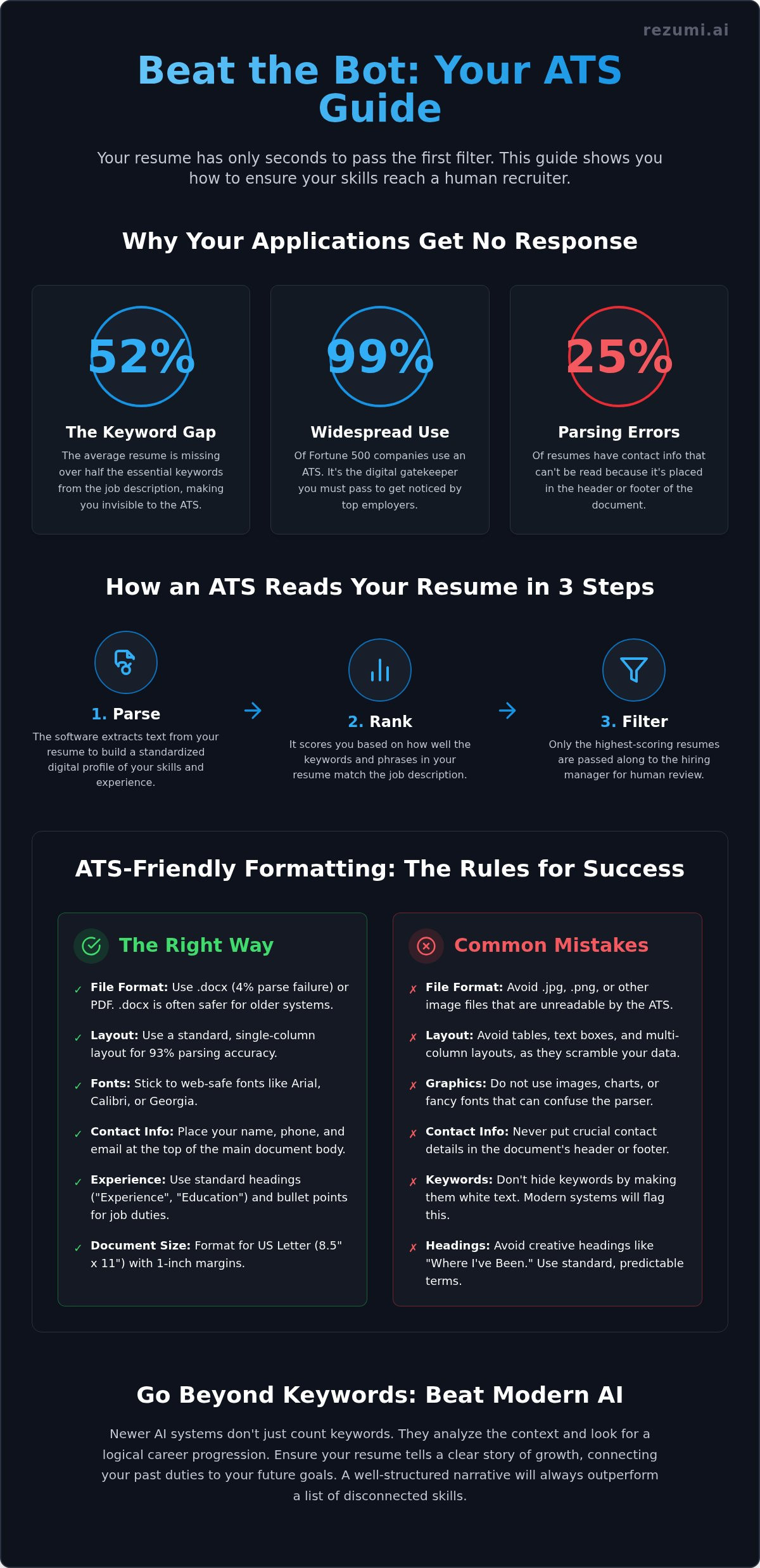
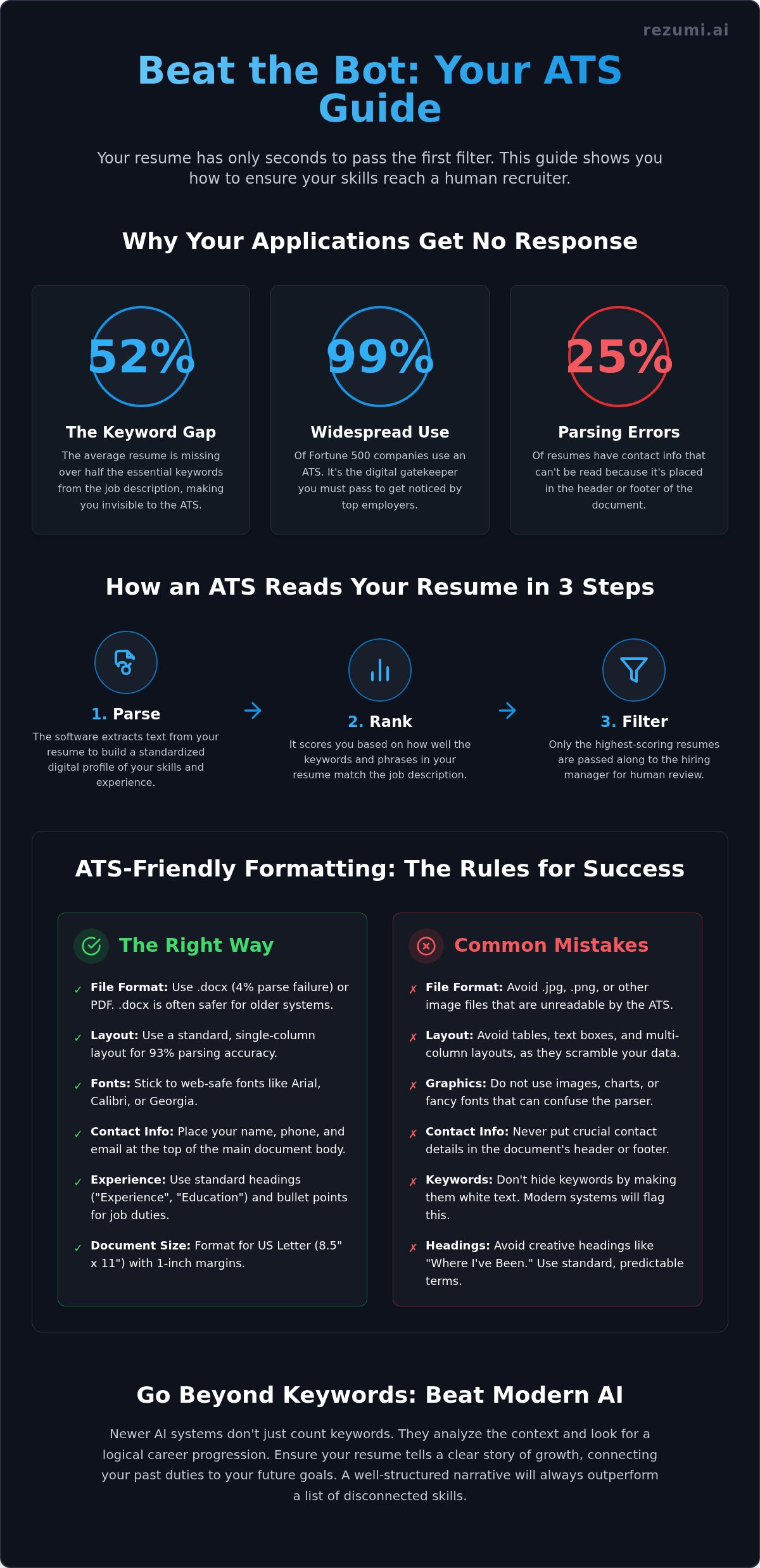
The average resume is missing 52% of the essential keywords found in the job description. Even if you are perfectly qualified, this gap means a human recruiter might never see your name. You are likely tired of sending hundreds of applications into a digital void with zero response. Learning how to beat the ats is not about tricking a robot. It's about aligning your data so the system recognizes your value.
It's normal to feel anxious about AI-driven hiring bots. You want to feel confident that your hard work actually reaches a real person. This guide will show you the exact steps to pass automated filters and get your resume into the hands of a human recruiter. We have decoded the mechanics of modern systems like Workday and Greenhouse to give you a strategic advantage. It's time to replace uncertainty with a data-backed plan.
We will break down the latest 2026 data on file formats and layout rules. You will learn how to bridge the keyword gap and fix common parsing errors that stop 25% of contact info from being read. By the end, you will have a clear, structured strategy to secure more interviews and move your career forward.
Key Takeaways
- Understand how ranking engines score your profile so you can stay visible to human recruiters.
- Use standard layouts and fonts like Arial to ensure your contact details and skills are parsed correctly.
- Learn how to beat the ats by matching your resume's phrasing to the specific keywords in the job posting.
- Prepare for modern AI sorters that look for a logical progression in your career path and job duties.
- Use automated tools to analyze job descriptions and create tailored applications that meet 2026 hiring standards.
Understanding the ATS Algorithm and Why Resumes Fail
Most large companies in North America don't read every resume by hand. They use an Applicant Tracking System (ATS) to manage the flood of applications. Over 99% of Fortune 500 companies rely on this software to collect, sort, and rank candidates. It acts as a digital gatekeeper. If you want to know how to beat the ats, you must first understand that it doesn't just store your file. It transforms your history into a searchable data point.
The system parses your resume. Parsing is the process where the software extracts text from your document and builds a standardized digital profile. Recruiters then search this database using specific skills and titles. Rejection often happens because the system cannot read your file or find matching skills. It's not a personal judgment on your career. It's a technical failure that leaves you invisible to the hiring team.
How Modern Systems Rank Your Profile
Systems look for specific keywords and years of experience to determine your fit. Your score depends on how well your resume matches the job description. Research from ResumeAdapter in 2026 shows that the average resume is missing 52% of the essential keywords found in the target posting. This massive gap keeps qualified people at the bottom of the list. High-ranking resumes are shown to recruiters first. If you aren't in the top tier, a human likely won't ever open your file.
The Truth About Automated Rejections
There is a common myth that robots auto-reject 75% of resumes. The reality is more nuanced. 92% of modern platforms rank and sort candidates rather than discarding them immediately. However, 50% of companies now use AI exclusively to make rejection decisions during the initial screening phase. This often happens through knockout questions. These are simple "yes or no" filters regarding work authorization or required licenses. If you fail a knockout question, the process ends instantly. Technical errors in your file can also make you invisible. If the bot can't read your contact info, it can't move you forward. Passing the bot is the first step to securing a human interview.
Mastering these mechanics is the only way to ensure your application survives the first pass. Learning how to beat the ats is about making your data undeniable. Once you clear this hurdle, your resume finally earns the human attention it deserves.
Mastering Technical Formatting for Seamless Parsing
Your resume's design is more than just an aesthetic choice. It is a technical specification. If you want to know how to beat the ats, you must prioritize readability for the machine. A standard layout with clear headings like Experience and Education ensures the parser knows exactly where to find your data. Stick to professional fonts like Arial, Calibri, or Georgia. These are web-safe and easy for 2026 systems to scan without errors.
Avoid using tables, text boxes, or images. While these might look good to a human eye, they confuse the parser. When the software hits a table, it often scrambles the text inside. This makes your experience unreadable. Save your file as a PDF or .docx to preserve your formatting. Data from EDLIGO in 2026 shows that .docx files have a low 4% failure rate. PDFs are also acceptable but have a higher 18% failure rate in older systems. Using a clean structure is the best way to stay visible.
Essential Layout Rules for North American Jobs
Companies in the US and Canada expect a specific document style. Use US Letter size (8.5 by 11 inches) for your document. International sizes like A4 can cause printing issues for recruiters. Keep your margins at 1 inch on all sides. This creates enough white space for readability while keeping the machine focused on the text. Use bullet points instead of long paragraphs for your duties. Short bullets are easier for the system to categorize and score than dense blocks of text.
Avoiding the Invisible Formatting Trap
Many job seekers lose opportunities because of hidden errors. Do not put your contact information in the header or footer. A study by TopResume found that 25% of ATS systems fail to parse contact details placed in these sections. If the bot can't find your phone number, you won't get the call. Avoid using columns. Single-column layouts achieve 93% parsing accuracy, while two-column layouts drop to 86%. You can check your resume format to ensure it meets current standards at choosing the best resume format.
Precision matters in a competitive market. Small errors in your layout can lead to immediate rejection before a human ever sees your skills. You can access professional tools to handle this technical work for you. Explore our resume design and export options to ensure your file is perfectly engineered for modern systems.
Strategic Keyword Integration for Higher Match Scores
Keywords are the specific terms recruiters use to filter thousands of applications. If your resume doesn't use the exact language of the job posting, you remain invisible. This is the core of how to beat the ats in 2026. You must identify the primary skills listed and mirror them in your own document. Matching these terms tells the system that you are a relevant candidate for the role.
Don't just guess which words matter. Knowing how to beat the ats requires a strategic approach to technical terms. Include both the long-form and acronym versions of skills. For example, use Search Engine Optimization and SEO to cover all possible search queries. Place these terms naturally within your professional experience bullets and your dedicated skills section to maximize your score.
Finding the Right Keywords in a Job Posting
Read the job description carefully to find words that appear more than once. These are usually the must-have requirements for the position. Focus on hard skills like specific software, programming languages, or industry certifications. A common mistake is using generic synonyms. If the posting asks for Project Management, don't write leading teams instead. You can use an ats resume checker to find missing terms. This tool compares your resume to the job description to ensure your match score is high enough to trigger a human review.
Balancing Bot Optimization with Human Readability
Beating the machine is only half the battle. Once you pass the filter, a human recruiter will spend about 6 or 7 seconds scanning your resume. Do not hide white text keywords in the background. This is an old trick that modern 2026 systems flag as a red flag. It can lead to an automatic rejection for trying to game the system. Your resume should be clean and honest.
Ensure your bullet points show actual results. A list of keywords without context doesn't prove you can do the job. Use numbers and data to show your impact in previous roles. Instead of just saying you managed budgets, say you managed a 50,000 dollar budget and reduced costs by 15 percent. This approach satisfies the bot's need for keywords and the recruiter's need for proof of your success. Strategic integration turns your resume into a high-performance tool that gets you noticed.
Beating the AI Sorter with Contextual Experience Mapping
In 2026, simple keyword matching is no longer enough to get you hired. Modern systems like Workday and Greenhouse now use natural language processing (NLP) to understand the intent behind your words. This technology allows the bot to analyze your entire career path rather than just scanning for isolated terms. If you want to master how to beat the ats, you must show a logical progression in your job titles and duties. The system evaluates the distance between your current responsibilities and the target role to determine your fit.
AI checks if your experience matches the seniority of the position. If you are applying for a leadership role, the bot looks for evidence of autonomy and decision making in your previous titles. Grouping your skills by relevance is a high-stakes strategy that helps the machine categorize you correctly. Knowing how to beat the ats in the age of AI means providing proof of your career growth through a structured, easy to read layout. This approach removes the guesswork for the recruiter and keeps your profile at the top of the stack.
How Semantic Search Changes the Game
Semantic search means modern systems can recognize related terms. For example, the bot understands that coding and programming are part of the same skill set. You don't need to repeat every possible synonym, but you do need to provide the context of how you applied those skills. Focus on the problems you solved rather than just the tasks you did. If you state that you used Python to automate data entry, the AI sees the technical skill and the tangible result. This context proves you didn't just learn a tool but used it to drive value for your employer.
Mapping Your Career to the Job Requirements
Tailor your professional summary to reflect the specific job title of the posting. If the company wants a Senior Project Manager, your summary should explicitly state that you are one. Use active verbs like managed, created, or improved to describe your impact. These words suggest movement and success to the AI sorter. Ensure your most relevant experience is at the top of the page. Recruiter review time remains low, at about 6 or 7 seconds, so your alignment with the role must be obvious the moment your file is opened.
Optimizing Your Application with Rezumi AI Tools
Manual resume editing is slow and prone to error. You don't have to rewrite your entire history by hand for every job posting. Rezumi acts as your strategic partner to handle the technical heavy lifting. You can use our platform to extract the most important data from job postings instantly. This ensures you never miss a critical keyword that could keep you from a human recruiter. Knowing how to beat the ats is about using the right tools for a complex system.
Organization is key to a successful search. You can track your applications in a single workspace to stay organized. No more lost spreadsheets or forgotten deadlines. The centralized application tracking system keeps your progress visible and manageable. It's about moving from a state of uncertainty to total control over your career path. When you use data to drive your decisions, you increase your interview conversion rates and save hours of manual work.
Automating the Tailoring Process
The platform allows you to generate tailored resumes that match ATS requirements in minutes. Simply upload your base resume and the job link to get an instant match analysis. Our AI generator suggests bullet points that fit the role and highlight your specific accomplishments. You get real-time feedback on your resume score before you ever hit the submit button. This removes the anxiety of sending applications into a digital void. You can review our pricing plans to start optimizing your strategy today.
Preparing for the Interview Phase
Passing the filters is only the first stage of the journey. Once you pass the ATS, use our AI Interview Prep to prepare for tough questions. You can practice with role-specific scenarios that build your confidence and refine your delivery. This isn't just about getting through the door. It's about having the readiness to command the room and turn your optimized resume into a firm job offer. Learning how to beat the ats is just the beginning of your professional success. We provide the technical advantage you need to win in a competitive 2026 market.
Take Control of Your Career Path
Mastering how to beat the ats is a matter of precision and data alignment. You now understand that your resume is more than a list of past jobs. It is a high-performance technical document that must be perfectly engineered for modern ranking engines. By prioritizing clean formatting and strategic keyword integration, you ensure that your qualifications are visible to the people who make hiring decisions. This transition from uncertainty to control is the foundation of a successful application strategy.
Rezumi serves as your strategic partner in this complex process. Our AI-driven resume scoring is specifically tailored for the North American market. This technology is already used by professionals at top tech companies to gain a competitive advantage. You don't have to guess if your resume will pass the automated filters. You can see your score in real time and make the necessary refinements before you hit submit.
You have the skills and the drive to succeed in your field. Now you have the expert strategy to make those skills undeniable to any hiring system. Your next interview is waiting for you.
Frequently Asked Questions
Can ATS read resume files saved as a PDF?
Yes, modern systems can read PDFs, but they are not always foolproof. Research from EDLIGO shows that .docx files have a low 4% failure rate, while PDFs fail 18% of the time in older systems. If you use a PDF, ensure the text is selectable and not a scanned image. Using a standard Word document remains the safest way to ensure the software extracts your data correctly without technical glitches.
Do I need a 100% resume score to get an interview?
No, you do not need a perfect score to secure an interview. Most recruiters look for a match rate above 80 percent to move a candidate forward. Learning how to beat the ats is about being in the top tier of applicants, not achieving perfection. Your ranking is relative to the other people applying for the same role. Focus on matching core hard skills rather than every minor detail.
Does using images or icons break the ATS parser?
Yes, images and icons frequently confuse the digital parser. When the system hits a graphic, it often skips that section or scrambles the nearby text. This includes logos, social media icons, and skill bars. Stick to plain text and standard bullets to ensure your information remains readable. If the bot cannot parse your data, a human recruiter will never see your qualifications or your contact information.
How does Workday rank candidates compared to Greenhouse?
Workday and Greenhouse use different logic to sort candidates. Workday is a massive enterprise tool that often relies heavily on knockout questions and rigid keyword matching. Greenhouse is more common in the tech industry and focuses on structured hiring and candidate scoring. Both systems prioritize resumes that align with the specific job description. Success in either system requires a clean layout and precise keyword integration to stay visible.
Should I include a cover letter to help my ATS ranking?
Yes, a cover letter provides another opportunity to include relevant keywords. While some recruiters skip the letter, the ATS often parses it to build your total candidate score. Use this document to repeat high value skills and provide context for your career path. This is a strategic way to boost your density of terms without cluttering your resume. It shows the bot and the human that you are a serious match.
How long should an ATS-friendly resume be in 2026?
An ATS friendly resume should typically be one to two pages long. If you have less than five years of experience, stick to a single page. Senior professionals can use two pages to detail their accomplishments. The system does not have a strict limit, but humans still prefer brevity. Keep your document focused on the last ten to fifteen years of your career to ensure the most relevant data is at the top.
Is it better to use a functional or chronological resume for ATS?
Use a chronological format for the best results. Functional resumes often hide the dates of your employment, which confuses the bot's calculation of your years of experience. Most systems are programmed to read your history in a linear path. A chronological layout ensures the parser accurately assigns your skills to the correct job titles. This clear structure is a vital part of how to beat the ats and prove your career progression.
Can I use a resume builder to pass the ATS?
Yes, you can use a resume builder if it is specifically designed for technical parsing. Avoid creative builders that use complex columns or non-standard fonts. Tools like Rezumi are engineered to produce files that meet 2026 North American hiring standards. These builders ensure your data is extracted correctly while providing real time feedback on your keyword match. Using a specialized tool saves you time and eliminates common formatting errors.
Disclaimer
This article is provided for general informational purposes only and does not constitute professional, legal, financial, or career advice. While Rezumi strives for accuracy, we make no warranties as to the completeness or reliability of this content. Hiring practices, ATS behavior, and job-market conditions vary by employer, industry, and region — always verify against your specific situation. Any action you take based on this article is at your own risk.