How to List Skills on a Resume in 2026: A Strategic Guide
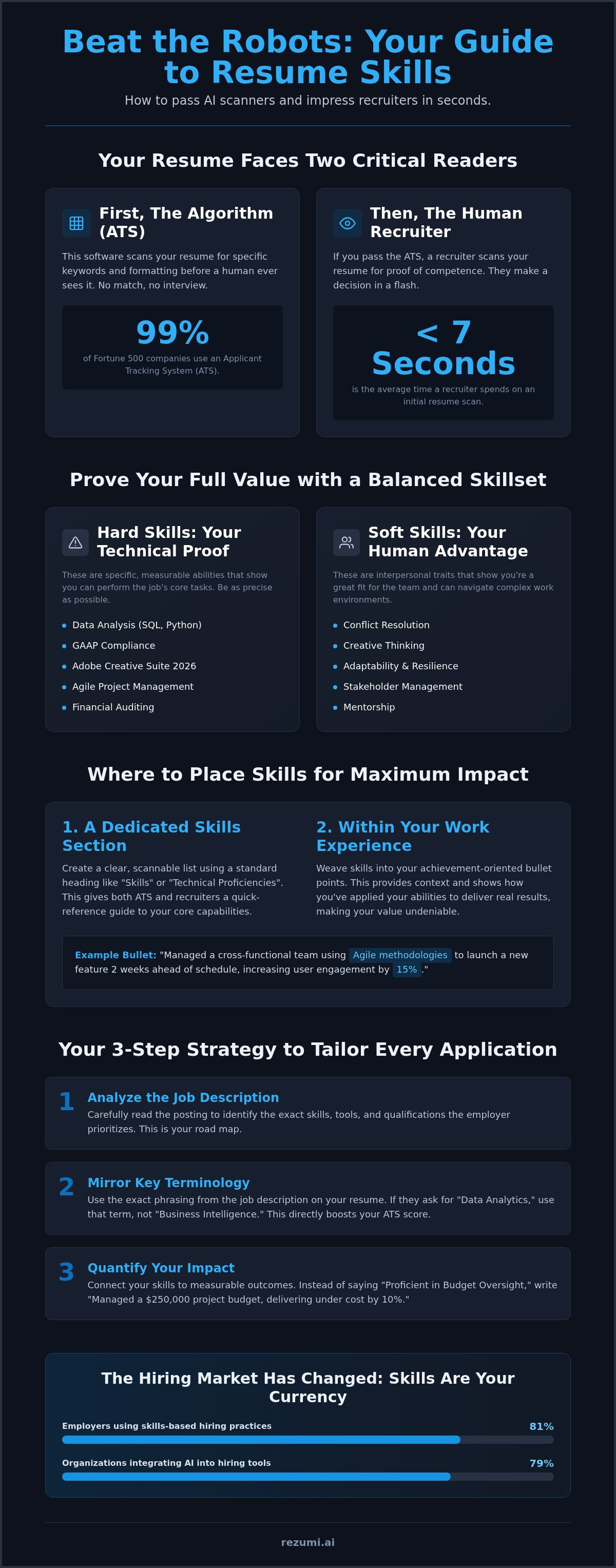
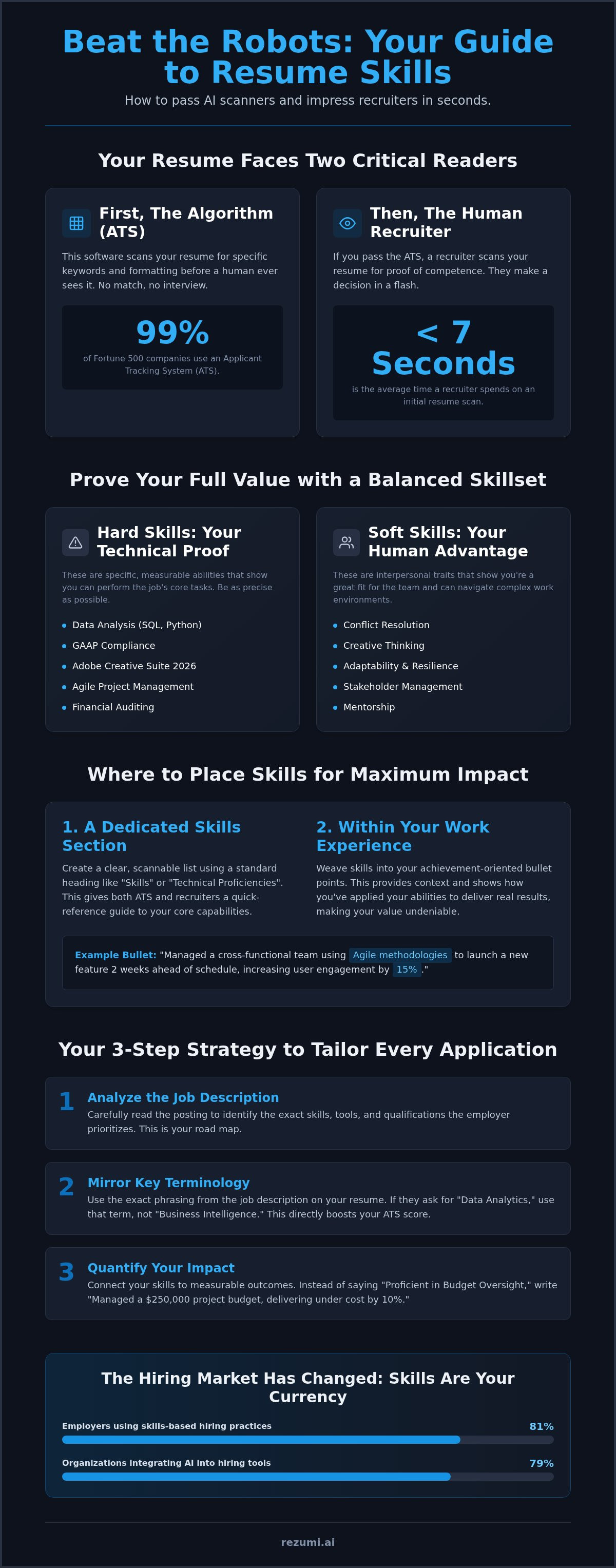
Nearly 99 percent of Fortune 500 companies now use an Applicant Tracking System (ATS) to filter candidates before a human ever sees a single word. If your application isn't optimized for these algorithms, your experience stays invisible. Learning how to list skills on a resume is no longer about just making a list. It's about data alignment. You've likely felt the frustration of applying for a role you're perfect for, only to receive an automated rejection email. It feels like shouting into a void.
We understand the pressure of a job market where 79 percent of organizations have integrated AI directly into their hiring tools. You shouldn't lose out on a career move because of a formatting error or a missing keyword. This guide shows you exactly how to select and format the right skills to pass automated scanners and prove your value to North American recruiters. We replace the anxiety of the unknown with a clear, data-backed strategy.
You'll learn the difference between high-demand technical tools and the human-centric skills that AI cannot replicate. We break down how to categorize your abilities, where to place them for maximum impact, and how to tailor every entry to a specific job description. This process turns a generic list into a strategic asset that secures interviews.
Key Takeaways
- Beat the algorithms. Pass AI filters and get noticed by recruiters who scan resumes in under seven seconds.
- Prove your full value. Combine measurable technical skills with interpersonal traits to show you are the right fit for the team.
- Optimize your placement. Learn how to list skills on a resume by putting your strengths where hiring managers look first.
- Stop sending generic applications. Identify the top priorities in a job posting to build a tailored, high-impact resume.
- Find your gaps. Use AI optimization to balance your keywords and ensure your profile meets modern North American standards.
Why Your Skills Section is the Key to Passing ATS Filters
A human recruiter spends less than seven seconds scanning your application before deciding your fate. In that brief window, they aren't reading your life story. They're looking for proof of competence. If they can't find the specific tools or traits they need within seconds, your resume ends up in the digital trash. This is why understanding how to list skills on a resume is your most important strategic move. It's the difference between a phone screen and total silence.
The stakes are even higher before a human ever sees your name. Nearly 99 percent of Fortune 500 companies use an Applicant Tracking System (ATS) to manage their hiring. These systems act as a gatekeeper. They don't just store your data; they rank you against other candidates. If your skills section is missing the specific keywords the employer wants, the system might reject you automatically. You could be the most qualified person for the job, but without the right data points, you're invisible.
How ATS Software Reads Your Skills in 2026
Modern scanners are more sophisticated than the basic keyword counters of the past. By 2026, 79 percent of organizations have integrated AI into their hiring tools to understand context. The software looks for exact matches, but it also recognizes related synonyms and clusters of expertise. If a job calls for "Project Management," the AI might also look for "Agile," "Scrum," or "Budget Oversight" to verify your level of experience. Following established résumé styles and common practices helps ensure the software can actually parse your information correctly.
- Use standard headings: Label your section "Skills" or "Technical Proficiencies" so the system knows where to look.
- Stick to clean formatting: Avoid complex graphics, tables, or unusual fonts that can scramble your text during the scan.
- Mirror the job description: Use the exact terminology found in the posting to increase your ranking score.
The Shift Toward Skill-Based Hiring in North America
The hiring market has changed. In 2024, 81 percent of employers reported using skills-based hiring practices, which is a massive jump from 57 percent just two years prior. Companies are moving away from strict degree requirements. They want to know what you can do right now. Your skills section provides immediate proof that you can handle the core tasks of the role. When you master how to list skills on a resume, you give recruiters a clear map of how you fit into their specific team needs and future growth plans. It transforms your resume from a list of past duties into a forecast of future success.
Hard Skills vs. Soft Skills: Balancing Your Technical Expertise
A successful application requires a dual strategy. Hard skills prove you can do the work; soft skills prove you are the right person to work with. Hard skills are measurable, technical abilities like data analysis, financial auditing, or proficiency in Java. Soft skills are interpersonal traits such as conflict resolution, creative thinking, and adaptability. To win in the 2026 job market, you must show a balance of both. If you focus only on tools, you appear replaceable by automation. If you focus only on personality, you lack the technical authority to pass the initial screen.
Recruiters look for a specific ratio of these abilities depending on your seniority. Entry-level roles often lean more toward hard skills to ensure you can handle the daily tasks. Senior roles prioritize soft skills like mentorship and stakeholder management. When you master how to list skills on a resume, you demonstrate that you understand these professional nuances. You show you are a well-rounded professional who brings both technical precision and human judgment to the team.
Identifying and Listing Your Hard Skills
Focus on industry-specific tools and methodologies that are in high demand. Be as specific as possible. Instead of listing "Accounting," specify "GAAP Compliance" or "IFRS Standards." Include the exact software versions you use, such as "Python 3.12" or "Adobe Creative Suite 2026." This level of detail helps AI scanners verify your level of expertise. If you have specialized training or certifications, list them clearly. These data points act as third-party verification of your technical proficiency.
The Value of Soft Skills in Professional Environments
Soft skills are the traits that AI cannot easily replicate. Employers value candidates who can lead teams, solve complex problems, and communicate clearly with clients. However, listing these as a simple bulleted list is often ineffective. You must provide context. Instead of just writing "Leadership," mention that you "led a cross-functional team of 10 to exceed quarterly targets." You can find examples of how to structure these in a skills-based resume format to ensure they carry weight. Always choose soft skills that appear in the job description to show you align with the company culture.
Technical Proficiency and Digital Literacy
By 2026, digital literacy is a baseline expectation for every role in North America. You should highlight your comfort with AI tools and project management software. Mentioning your experience with platforms like Jira, Slack, or specific Large Language Models shows you are ready for modern workflows. Highlighting your ability to learn new technologies quickly is also a core competency. If you feel your current list is missing these critical keywords, you can check your resume against industry standards to see which technical gaps you need to fill.
Where to Place Skills for Maximum Impact on Your Resume
Your resume has one job: to get you an interview. To do that, the most relevant information must appear in the top third of the page. This is the prime real estate that recruiters scan first. If your best skills are buried at the bottom, they might as well not exist. Strategic placement ensures that your value is immediate and undeniable from the moment the file opens.
Your career stage dictates where you should focus. New graduates should place their skills section near the top, just under the professional summary. This highlights your potential and technical training when you lack years of work history. Senior professionals benefit from a more condensed approach. A sidebar or a short list near the summary allows you to showcase expertise without distracting from your leadership experience. Knowing how to list skills on a resume effectively means adapting the layout to your specific professional story.
The Dedicated Skills Section Strategy
A dedicated section is essential for passing ATS filters. Use a clean, bulleted list to keep the data organized and easy to read. Group related capabilities together under subheadings like Software, Technical Tools, or Languages. This helps both humans and machines categorize your expertise quickly. Limit this section to 10 or 15 of your strongest points. Overstuffing your list with every minor tool you've ever used dilutes your primary message. Integrating a balanced mix of hard and soft skills into this layout ensures that you meet the specific requirements found in the job description.
Integrating Skills into Experience Bullets
Listing a skill is only the first step. To truly prove your value, you must show those skills in action within your work history. Use the Action Verb + Task + Result formula to build trust. Instead of just writing "SQL" in a list, create a bullet point in your experience section that says: "Increased data processing efficiency by 20 percent by optimizing SQL queries for the marketing team." This provides concrete evidence of your proficiency. Real numbers and specific outcomes turn a generic claim into a verified achievement. When you combine a dedicated list with integrated experience, you create a resume that is both searchable and persuasive.
How to Tailor Your Skills to a Specific Job Description
Sending a generic resume is a guaranteed way to stay invisible. Employers don't want a generalist; they want a specialist who understands their specific pain points. If your application doesn't address the unique requirements of the role, the ATS will likely filter you out before a human ever sees your name. Mastering how to list skills on a resume requires you to treat the job posting as a cheat sheet for success.
Read the job description carefully to identify the top three priorities for the role. These are usually the requirements listed first or mentioned multiple times throughout the text. By aligning your skills with these core needs, you show the recruiter that you aren't just looking for any job. You're looking for this job. This strategic approach to how to list skills on a resume transforms your application from a standard document into a targeted solution.
Analyzing the Job Posting for Keywords
Scan the posting for high-frequency nouns and verbs. If "Data Visualization" appears three times, it's a non-negotiable keyword. Pay close attention to the order of the skills. The most critical capabilities are almost always at the top of the list. Don't ignore the "Preferred Qualifications" section, either. These often contain hidden requirements that can give you a competitive edge over other candidates who only meet the basic criteria.
The Matching Process: Alignment and Accuracy
Maintain a master list of all your professional capabilities to make tailoring faster. When you apply for a new role, pull only the most relevant items from this list to create a bespoke experience. Accuracy is vital. Only include skills you actually possess to maintain your professional integrity. If you've never used a specific tool, don't list it. Credibility is your most valuable asset during the hiring process.
Ensure your phrasing matches the job description exactly. If the employer asks for "Customer Relationship Management," don't shorten it to "CRM" unless the posting uses both terms. AI-powered scanners look for these precise matches to verify your fit. Consistency in your terminology proves that you are attentive to detail and ready to integrate into the company's existing workflow. This process ensures you rank higher in the ATS and catch the eye of the recruiter immediately.
Optimizing Your Skills Section with AI for Better Results
AI optimization allows you to see exactly what the hiring algorithm sees before you hit the submit button. It bridges the gap between your actual experience and the way an ATS interprets your data. By using technology to audit your application, you ensure that every skill you list serves a strategic purpose. This is the most efficient way to master how to list skills on a resume for the high-stakes North American market.
Finding the right balance of keywords is a delicate process. If you include too many terms without context, you risk being flagged for "keyword stuffing." If you include too few, you remain invisible. AI tools analyze the job description to identify the optimal density of specific technical and soft skills. Once you have the right content, you must check your resume format to ensure the system can parse your new descriptions without technical errors.
Using Rezumi for Keyword Alignment
Rezumi provides a clear path from uncertainty to control. You simply upload your current document and provide the link to the job posting. Within seconds, the platform generates a compatibility score that highlights exactly where you stand. It identifies missing keywords and suggests specific phrasing that matches the employer's expectations. This data-driven approach replaces the anxiety of generic applications with a refined, targeted strategy. You can see the exact skill gaps that might be holding you back from your next career move.
- Instant scoring: Get a numerical value representing your alignment with the job requirements.
- Gap identification: See a list of required skills found in the job posting that are missing from your current draft.
- Refined descriptions: Generate context-rich bullets that prove your proficiency through measurable results.
Real-Time Feedback and Scoring
Understanding your rank in the competitive 2026 landscape is vital for success. Employers are looking for candidates who can blend technical fluency with human judgment. Rezumi provides real-time feedback on how your skill descriptions compare to successful applicants in your industry. It offers actionable advice on how to strengthen your language and improve your visibility. Before you send your next application, access the ATS resume checker to verify that your document is fully optimized. This final check ensures that your effort translates into a tangible outcome: an invitation to interview.
Take Control of Your Career Strategy
Mastering how to list skills on a resume is the fastest way to turn automated rejections into interview invitations. You now have the blueprint to align your technical expertise with the human-centric traits that North American recruiters value most. Your resume is a living document. It must evolve with every job description to remain competitive in a crowded market.
A strategic skills section removes the guesswork from your job search. By grouping your abilities and proving them with measurable results, you provide the precise data points that AI scanners need to see. You've replaced the anxiety of the unknown with a clear, data-backed strategy.
Thousands of professionals trust our platform to manage the complexities of modern hiring. Our AI-driven keyword matching is built specifically for the US and Canadian markets. This ensures your profile meets the highest professional standards every time you apply.
You have the experience. Now, you have the strategy to prove it. Take the next step and let your skills do the talking.
Frequently Asked Questions
How many skills should I list on my resume?
Aim for 10 to 15 of your most relevant capabilities. This range provides enough keywords for the ATS without overwhelming a human recruiter. Focus on the specific needs of the job posting rather than listing every tool you have ever touched. If you include too many items, you risk looking like a generalist. A concise list ensures your strongest proficiencies stand out during those critical seven seconds of human review.
Should I include soft skills in my dedicated skills section?
You should include soft skills, but they must be balanced with technical hard skills. A good rule is to keep soft skills to about 20 or 30 percent of your list. Interpersonal traits like leadership or communication are valuable, but they are hard to measure in a list. It's better to prove these traits in your experience bullets while using the skills section for searchable technical keywords.
What is the best way to list technical skills like software or coding languages?
Group your technical skills into clear subcategories to make them scannable. Use labels like "Cloud Platforms" or "Design Tools" to help the ATS and recruiters find what they need. Learning how to list skills on a resume this way shows a high level of organization. Always include specific software versions or coding languages mentioned in the job description to ensure your profile matches the employer's technical requirements exactly.
Can I include skills that I am currently learning?
You can list skills you are currently learning by labeling them as "In Progress" or "Candidate." This shows recruiters that you are proactive about your professional growth. Only add these if you have enough knowledge to discuss them in an interview. If a skill is a core requirement for the job, mentioning your current certification path can keep you in the running even if you haven't finished the course yet.
How do I know which skills are most important for a specific job?
Identify the most important skills by looking for keywords that appear multiple times in the job posting. Employers usually list their non-negotiable requirements in the first few bullet points of the "Requirements" or "Qualifications" section. You can also use AI-driven tools to scan the posting and compare it to your resume. This data-backed approach identifies the exact gaps you need to fill to reach a high compatibility score.
Is it okay to list the same skill in both the skills section and work experience?
Yes, repeating your top skills in both sections is a smart strategy for success. The skills section acts as a quick reference for the ATS to rank your profile. Your work experience section then provides the necessary context. By showing a skill in action with a specific result, you prove to the recruiter that you aren't just using keywords; you actually have the proficiency to deliver real value.
Should I include hobbies or personal interests in my skills list?
Avoid listing hobbies unless they provide direct proof of a professional capability. Most recruiters ignore personal interests like travel or reading because they don't relate to your job performance. However, if your hobby involves a technical skill like building apps or managing a large community, it can be valuable. In most cases, it is better to use that space for how to list skills on a resume that align with the company's goals.
Disclaimer
This article is provided for general informational purposes only and does not constitute professional, legal, financial, or career advice. While Rezumi strives for accuracy, we make no warranties as to the completeness or reliability of this content. Hiring practices, ATS behavior, and job-market conditions vary by employer, industry, and region — always verify against your specific situation. Any action you take based on this article is at your own risk.