How to Optimize Resume Bullet Points for ATS and Recruiters
A strong resume bullet does more than list a duty. To understand how to optimize resume bullet points for ATS, start with an action verb, match relevant language from the job description, and show the scope and impact of your work. Keep each bullet clear enough for both screening software and a recruiter to read quickly.
Turning everyday responsibilities into specific achievements can be challenging, especially when tailoring your resume for a new role. Use a repeatable structure: state what you did, include relevant tools or skills, and describe the result with a real measure when available.
This guide shows how to write focused, ATS-readable bullets without overstating your experience. Learn to choose stronger verbs, include job-description keywords in context, quantify results honestly, and make each point easy to scan. You’ll also see how to turn a generic duty into a clear statement of your contribution, so your resume explains both what you did and why it mattered.
Key Takeaways
- Start each bullet with a precise action verb, then connect relevant tools and skills to the job description.
- Show the scale of your work and its result with accurate measures, such as time saved, clients supported, or costs reduced.
- Keep each bullet focused on one accomplishment and easy for both screening software and recruiters to scan.
- Choose the strongest, most relevant examples for each role instead of giving every responsibility equal space.
- Tailor your bullets to the position, using clear language that reflects the employer’s needs without overstating your contribution.
Action verbs, tools, scope, and impact in bullets
Build each bullet around an accurate action verb, relevant tools, the scope of your work, and its impact. Use the job description to identify details that show how your experience fits.
-
Choose accurate action verbs
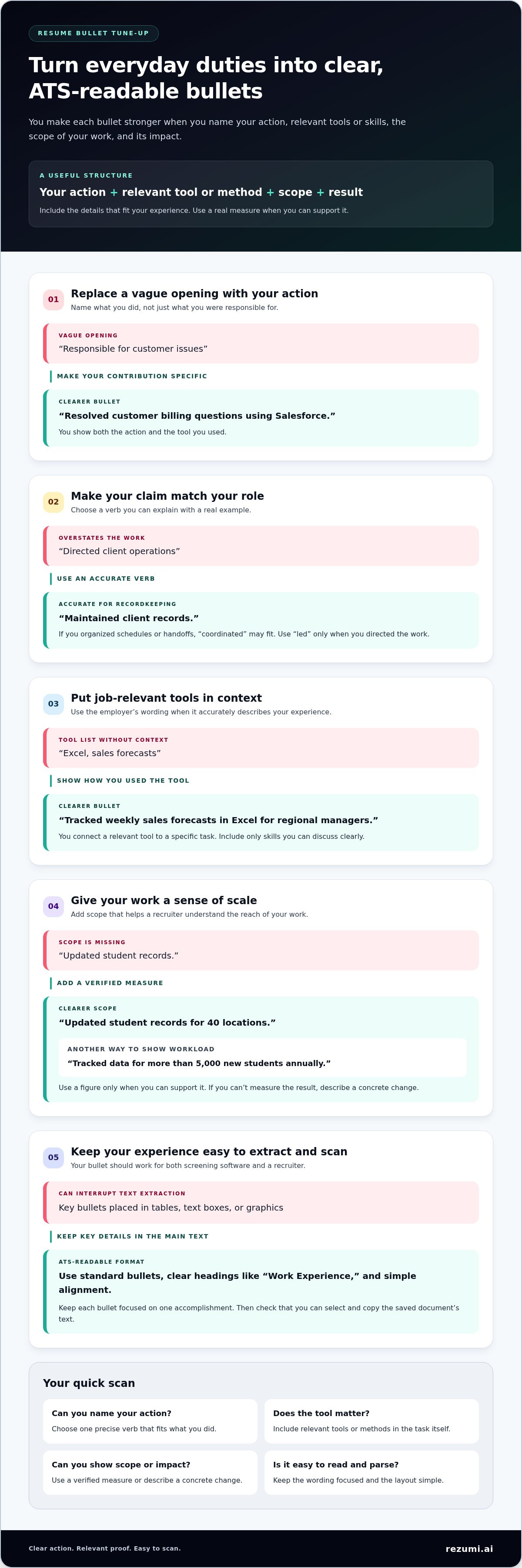
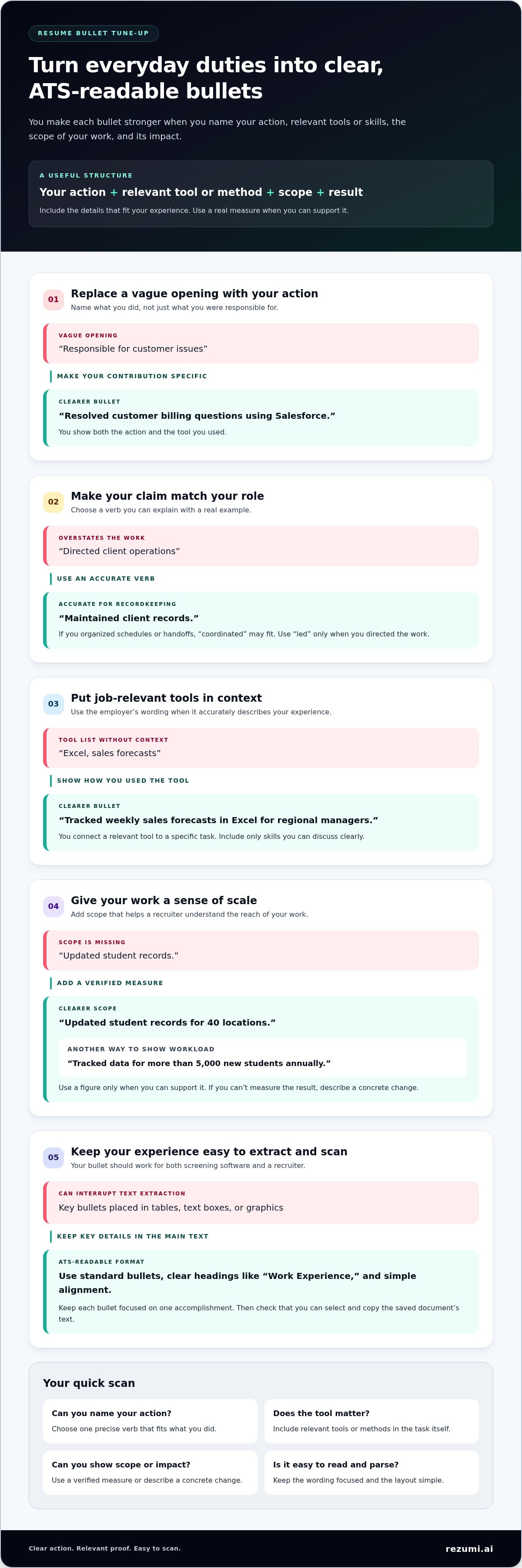
State what you personally did, then choose a verb that accurately reflects your role. Use “coordinated” if you organized schedules, people, or handoffs; use “supported” if someone else made the decisions. Avoid “led” unless you directed the work. For example, “Maintained client records” is more accurate than “Directed client operations” if your role involved recordkeeping.
Choose verbs you can support with examples in an interview. If you created a process, say “developed.” If you followed an existing process, say “used” or “applied.” This keeps your claims clear and credible.
-
Use strong action verbs
Replace vague openings like “Responsible for” with a direct verb that describes your contribution. Use “analyzed,” “built,” “resolved,” or “trained” when accurate. For example, change “Responsible for customer issues” to “Resolved customer billing questions using Salesforce.” The revised bullet names both the action and the tool.
Match the verb to the result, not your job title. “Improved” suits a process change; “reduced” describes a measurable decrease. Avoid piling up verbs, as in “helped manage and support.” One precise verb gives recruiters and ATS systems a clearer signal.
- Name relevant tools and methods. Review the target job description, then include software, equipment, or methods you actually used. If it requests Salesforce, Excel, or project scheduling, work the relevant tool into an achievement rather than listing it without context. For example: “Tracked weekly sales forecasts in Excel for regional managers.” Mention a tool only when it contributed to the work.
Use the employer’s wording when it accurately describes your experience. If a posting asks for “data analysis” and you analyzed customer trends, use that phrase in context. Don’t list tools or skills you can’t discuss clearly.
- Show scope and impact. Add a detail that helps readers understand the size or reach of your work, such as locations, customers, projects, or frequency. Then connect that scope to an outcome. For example, “Updated student records for 40 locations” shows reach; “Tracked data for more than 5,000 new students annually” makes the workload clearer.
State verified results directly. A useful pattern is action, method, and outcome: “Automated invoice checks in Excel, reducing review time.” Include a figure only if you can support it. If the result isn’t measurable, describe a concrete change, such as fewer handoffs or clearer reporting.
Read each bullet aloud. A recruiter should quickly understand what you did, which tool or method mattered, and what changed. Remove details that don’t support that message.
Balancing ATS readability with recruiter impact
Make every bullet easy to extract and scan. Use plain formatting, relevant job language, and a clear example of your contribution.
-
Understand how ATS parses bullets
Check that each bullet is selectable text and appears in a clear reading order. An applicant tracking system (ATS) extracts resume text and organizes details such as skills, employers, and experience for review. Since systems may interpret layouts differently, keep key information in the document’s main text.
ATS tools primarily help employers organize applications; they don’t automatically reject candidates in most cases. A recruiter may still review your resume, so include relevant terms alongside useful context.
-
Format bullets for ATS readability
Use standard bullet symbols, such as circles or simple dashes, consistently throughout your resume. Align each bullet with its text. Use clear section headings like “Work Experience,” and keep bullet content out of tables, text boxes, and graphics.
For example, write “Prepared weekly sales reports in Excel” as plain text beneath the relevant role. Don’t turn it into an image or place it in a decorative shape. Keep the layout simple, then open the saved file and check that you can select and copy its text.
-
Match job description keywords naturally
Compare the job posting with your experience, then use matching terms where they accurately describe your work. If a role requests “project coordination,” you might write, “Coordinated project schedules and status updates for internal teams.” This connects the keyword to a real task instead of repeating it without context.
Choose the most relevant skills and show how you used them in your bullets. Don’t copy entire phrases into every point or include skills you can’t support. Recruiters should see clear accomplishments, not a list written only for software.
-
Avoid parsing problems while retaining impact
Check for custom icons, unusual symbols, and complex layouts that may interrupt text extraction. Remove unexplained abbreviations, spelling errors, and long bullets that combine unrelated tasks. These issues can make it harder for software and recruiters to identify your experience.
Keep the outcome visible when simplifying the format. For example, “Created onboarding guides for new hires” is clearer than a bullet crowded with symbols and fragments. Before submitting, check the text order and read each bullet from a recruiter’s perspective.
If you want help aligning your resume with a target role, explore ATS resume optimization as a next step.
ATS systems can parse numbers and symbols such as $, %, and #, but may struggle with tables, text boxes, or elaborate layouts. Use standard bullets, clear headings, simple alignment, and readable metrics. Stick to dashes, circles, squares, or arrows rather than custom icons, emojis, or graphics.
The University of Illinois Chicago career-services guide recommends spelling out terms alongside abbreviations or acronyms. Recruiters discard 60% of ATS-passing resumes because they lack a compelling impact story.
Quantifying achievements and scope
Use accurate numbers to show the scale of your work and its results. If exact figures aren’t available, describe the scope with concrete details instead.
- Find the measure behind the task. Review each responsibility and identify what changed, how much work you handled, or who benefited. Look at records such as sales reports, project logs, customer records, or team schedules. For example, “Answered customer questions” becomes more specific when you can verify how many clients you supported or issues you resolved.
Use only figures you can explain. If you can’t verify a percentage, don’t estimate one to make a bullet sound stronger. A clear description of your work is more credible than an unsupported claim.
- Show the scale of your contribution. Add a measure such as people served, locations supported, projects completed, or work handled over time. A sample compliance bullet might say, “Tracked data for more than 5,000 new students annually.” That figure helps readers understand workload, not just the task.
Choose a measure that fits the role. A recruiter reviewing operations experience may value locations or processes; a sales role may call for accounts or revenue. Keep the scope tied to your actual responsibilities.
- Connect your action to a result. A useful pattern is action, method, and outcome. For example, “Revised the training manual, preparing trainees to use the tracking system two weeks earlier than expected.” The result shows why the work mattered, while the method adds context.
Use a percentage when it describes a real change. “Reduced operating expenses by 15%” is clear only when your records support that result. State what changed and the period or group it refers to when that context helps explain the figure.
- Select a metric that matches the accomplishment. Revenue growth can show sales impact; time saved can show process improvement; retention can show customer success. For example, a sample bullet describes increasing net revenue retention from approximately 50% to 80%, while preserving approximately $150 million in revenue.
Don’t crowd a bullet with unrelated measures. Pick the strongest figure, then explain the action behind it. This makes the result easier for recruiters to understand.
- Use a truthful alternative when numbers aren’t available. Describe the audience, frequency, complexity, or purpose of the work. “Coordinated semi-annual training for operations managers and technology teams” gives a clear sense of scope without inventing a result.
Before submitting, check every figure against a report, review, or other reliable record. A sample bullet might show a 20% increase in delivery efficiency, but use that figure only if it reflects your own verified achievement. Accurate scope makes your contribution easier to assess.
Recommended number of bullets per role
Choose bullets for relevance, not to meet a fixed quota. Give more space to recent roles that match the target job, and trim older or less relevant experience. For example, a project manager’s recent delivery role may warrant more detail than an early campus job.
- Rank each role by relevance. Compare your experience with the target posting. Identify roles that demonstrate its core duties, tools, or level of responsibility. For someone applying for customer success, a software support role deserves more space than unrelated seasonal work.
Start with the closest match, then choose accomplishments that prove it. If a role offers several relevant examples, keep the clearest ones. Remove bullets that repeat a skill without adding evidence.
- Give recent, relevant work room to show range. Use bullets to cover distinct parts of the role, such as team coordination, reporting, and process improvement. For example, an operations analyst could describe tracking requests, preparing reports, and resolving a workflow issue.
Don’t give every task its own bullet. Combine related duties when they support one achievement. Keep them separate when they demonstrate different skills the target employer needs.
- Trim older or less relevant roles. Keep details that explain your career path or support the target position. An early retail role may demonstrate customer service for a client-facing application, but add little for a senior data role.
Keep the most useful evidence and shorten the rest. A concise entry for an older role can include its title, employer, and main contribution without listing routine duties. This makes your priority experience easier to find.
- Adjust for promotions and changing duties. Show clear progression when one employer gave you broader responsibilities. Separate roles under the same organization when the title or work changed substantially. For example, distinguish a coordinator position from a later team lead role.
Use each entry to show what changed. Focus earlier bullets on the original scope and reserve leadership outcomes for the later position. This keeps one long list from obscuring your career growth.
- Make room for limited experience. Recent graduates can include relevant internships, projects, research, or volunteer work. A student applying for communications roles might describe a campus campaign involving writing, event planning, or audience outreach.
Choose examples that demonstrate skills in the posting. Don’t add unrelated bullets just to make an entry look longer. A focused project description can show relevant work without overstating its setting.
- Review the full page as a recruiter would. Scan your roles in order and notice where the detail becomes overwhelming. If an older position takes up more space than a recent, directly related role, move useful detail toward the stronger match.
For each bullet, ask whether it gives a distinct reason to consider you. Keep it if it shows relevant responsibility, skill, or result. Cut it if another bullet already makes the same point.
Writing specific resume bullet points
Make every bullet prove a skill with a clear, relevant example. To learn how to optimize resume bullet points for ATS, compare each point with a real job posting, then refine the wording without changing the facts.
-
Tailor bullets to each job application
Compare the posting with your experience before editing. Select 8 to 20 relevant keywords, then use them in bullets that show your actual work. If a role asks for “vendor management,” you might write, “Reviewed vendor bids and tracked contract milestones for the facilities team.” That example connects the requested skill to a real task.
Keep a master resume, then adapt the most relevant bullets for each application. Optimizing resume bullet points for ATS means emphasizing what fits the role, not adding skills you don’t have. Use the employer’s wording only when it accurately describes your experience.
-
Set bullet length and sentence style
Focus each bullet on one accomplishment, ideally in one or two lines. Complete sentences aren’t required, but keep grammar and punctuation consistent. For example, choose either “Prepared client reports” or “Prepared client reports.” Avoid emojis, decorative symbols, and unusual characters that can distract readers.
Use one standard bullet symbol consistently and align it with the text. Check that the action and outcome are clear without extra wording. Recruiters should be able to scan the point without stopping to decode it.
- Check the saved file’s name and version. Choose a descriptive filename that includes your name and target role, such as “Jordan-Lee-Project-Manager-Resume.” This helps distinguish a tailored version from your master copy when preparing several applications.
Before submitting, open the file you intend to upload and confirm it contains the right role-specific content. Check the employer name, target title, and selected accomplishments. This final review helps prevent you from sending a version tailored for another application.
- Replace general claims with evidence. “Helped with customer requests” doesn’t explain what you handled. A clearer version might say, “Resolved billing questions and documented repeat issues for the account team.” Add a measure only when your records support it.
Give each bullet one main idea. Split distinct accomplishments into separate points, or remove details that don’t support the target role. This makes your most relevant evidence easier to find.
- Proofread for clarity and consistency. Check verb tense, spelling, and abbreviations. If a posting uses “customer relationship management,” spell it out before adding “CRM” when space allows. This gives readers the full term and its common abbreviation.
Read the bullets in order and check that each makes sense on its own. Recruiters should understand your contribution without decoding fragments or unexplained shorthand. Review the saved file once more before submitting it.
Rezumi: ATS Resume Optimization
Rezumi helps you tailor resume content to a specific job description with ATS Resume Optimization. Use it when you’ve identified relevant experience but need help aligning your bullet points with the role’s language. Review each suggested change to make sure your skills, tools, and results accurately reflect your work.
Once your resume is focused, prepare the rest of your application with Rezumi’s AI Cover Letter Generator and AI Interview Prep. Resume Design & PDF Export helps you prepare a polished file for submission. Choose the tool that fits your next step, and make sure your final materials reflect your actual experience.
Visit Rezumi to work on your next application.
Make Your Next Application More Focused
Knowing how to optimize resume bullet points for ATS gives you a practical way to present your experience clearly. Apply the approach to a real job posting: choose one role, compare its requirements with your experience, and refine the bullets that best show your fit. Keep every claim accurate and make sure the final resume still sounds like you.
Rezumi’s ATS Resume Optimization helps you tailor your resume to a job description. You can also use its AI Cover Letter Generator and AI Interview Prep to prepare the rest of your application. Each tool supports a different part of your job search, so choose the one that fits your current task.
Start with one focused application. Keep refining your materials as you find roles that match your goals.
Frequently Asked Questions
What action verbs and measurable results make resume bullets stronger?
Choose a verb that names your contribution, then pair it with a result you can support. “Negotiated” signals a different role than “processed,” while “designed” shows ownership of a deliverable. For example, “Negotiated supplier terms, cutting delivery delays by 12%” links an action to an outcome. Use measures such as time saved, revenue gained, errors reduced, or projects completed only when accurate.
How many bullet points should each job entry include?
There’s no fixed number of bullets that suits every job entry. Include enough to show the role’s most relevant contributions, then remove routine duties and repeated skills. A recent position closely related to your target role may need more detail than an older, unrelated one. For an internship or short project, one focused accomplishment may be more useful than several thin bullets.
What resume file format is best for ATS: DOCX or PDF?
Both Word documents and PDFs can be ATS-friendly when the resume is readable and text-based. Use DOCX when permitted. If you choose PDF, make sure it isn’t a scanned image and that its text can be selected and copied.
Disclaimer
This article is provided for general informational purposes only and does not constitute professional, legal, financial, or career advice. While Rezumi strives for accuracy, we make no warranties as to the completeness or reliability of this content. Hiring practices, ATS behavior, and job-market conditions vary by employer, industry, and region — always verify against your specific situation. Any action you take based on this article is at your own risk.