How to Prepare for a Phone Screen Interview: Busting the Quick Chat Myth
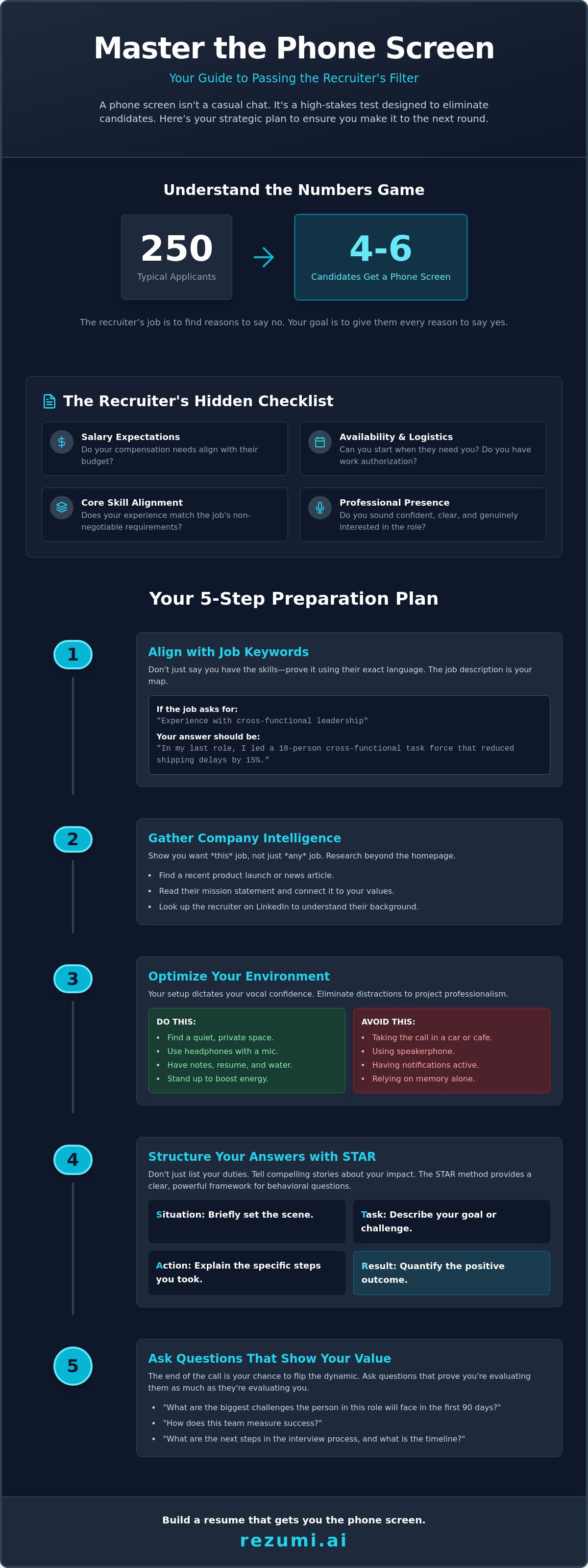
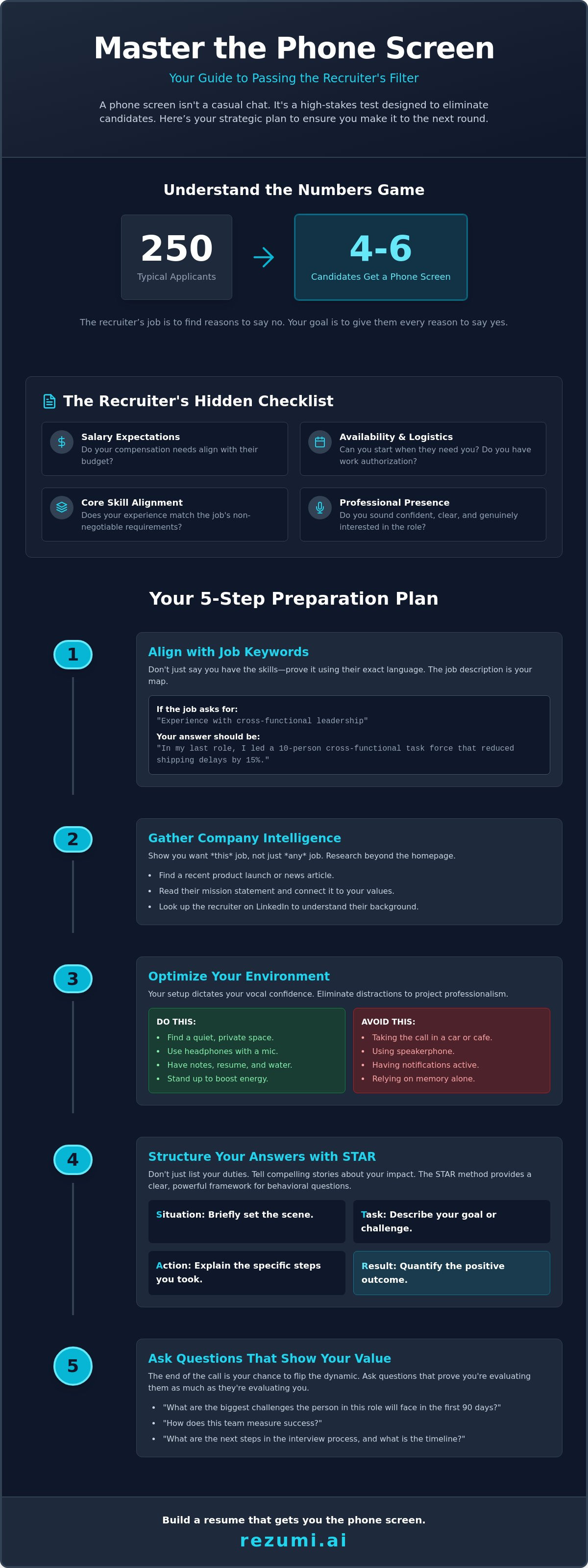
A phone screen is not a "quick chat." It is a precision-engineered filter. Its goal is to eliminate most candidates before they ever meet a hiring manager. A typical corporate job attracts 250 applications, but only four to six people reach this stage. Knowing how to prepare for a phone screen interview is your most important hurdle. You might feel like you just need to "be yourself" and hope for the best. That approach usually leads to awkward silences. It's normal to feel anxious about behavioral questions when you don't know the recruiter's hidden checklist.
This guide shifts your focus from surviving the call to mastering the filter. You will learn why the recruiter acts as a gatekeeper. We provide a strategic framework to help you secure the next round. We also include sample interview questions and answers. You will gain the confidence to move past the screen and impress the hiring manager. This is the transition from uncertainty to control.
Key Takeaways
- Treat the phone screen as a strategic filter where recruiters look for reasons to say no, rather than a casual chat.
- Discover how to prepare for a phone screen interview by aligning your career wins with the specific keywords found in the job posting.
- Set up a professional environment that boosts your vocal confidence and eliminates technical distractions.
- Use the STAR framework to answer behavioral questions naturally instead of relying on a stiff, pre-written script.
- Flip the power dynamic in the final minutes of the call by asking questions that prove you are evaluating the company as much as they are evaluating you.
The Gatekeeper Myth: Why the Phone Screen Is Your Most Important Interview
The phone screen is often dismissed as a casual check-in. This is a dangerous mistake. It is actually a precision-engineered filter designed to protect the hiring manager's schedule. Recruiters use screening interviews to eliminate candidates who don't meet strict baseline criteria. They aren't looking for reasons to hire you yet. They are looking for reasons to say no. If you want to know how to prepare for a phone screen interview, you must first understand the gatekeeper's mindset.
A typical corporate job posting pulls in 250 applications. From that pile, only a handful make it to the phone. The recruiter's job is to cut that list even further. They need to ensure that the time spent in the next round is worth the company's investment. This is the only stage where your verbal communication and soft skills are the primary metrics. You are being judged on your ability to articulate your value clearly and professionally. If you can't pass this verbal test, your technical skills won't matter.
The Recruiter Agenda
Recruiters operate with a specific checklist. They need to verify three main things: your salary expectations, your availability, and your basic technical alignment. They are also listening for your professional presence. Does your voice project confidence? Do you sound genuinely interested in the role? Their goal is to take a pool of fifty viable candidates and narrow it down to the top five. If you miss a single beat on salary or technical requirements, you are out. They protect the hiring manager from wasting time on candidates who are over budget or unavailable.
Why Your Resume Is Only Half the Story
Your resume got you the call, but it won't get you the job. The recruiter has already reviewed your profile and likely checked your score from an ATS resume checker. They know the data on the page looks good. Now, they need to see if the person matches that data. Many candidates fail because they can't explain their own experience out loud. You must be able to speak about your achievements with the same precision as your optimized CV.
When you learn how to prepare for a phone screen interview, you focus on translating bullet points into compelling verbal stories. If you sound unsure about your own history, the recruiter will assume the resume was exaggerated. Precision in your speech confirms the accuracy of your application. You are proving that you are the expert the data claims you are. This verification step is what moves you from the "maybe" pile to the "must-interview" list.
Debunking the Winging It Strategy: Preparation Beyond the Page
Most candidates fail because they rely on their personality to carry the call. This is a tactical error. Success in a high-stakes filter is built on data and alignment, not just charm. You need to know how to prepare for a phone screen interview by looking past your own resume and deep into the company's specific requirements. Winging it is not a strategy; it is a gamble that usually ends in a rejection email. Real preparation requires a structured approach that mirrors the recruiter's own checklist.
Keyword Alignment
Your preparation must start with the job description. This document is a map of exactly what the recruiter needs to hear to pass you to the next round. Identify the top five skills or requirements mentioned most frequently in the posting. For each skill, create a one-sentence proof point from your past roles. If the role requires "cross-functional leadership," don't just agree that you have it. Say, "I led a 10-person task force that reduced shipping delays by 15%." Using their exact terminology triggers the recruiter's mental checklist. It signals that you are a low-risk, high-reward candidate who fits the mold perfectly.
Company Intelligence
Recruiters are impressed when you understand their current market position. In June 2026, the North American landscape is shifting rapidly with new pay transparency mandates taking effect in states like Maine and Virginia. Show you are informed by researching recent product launches or news from this year. Check the company mission statement to see how they describe their culture. If they value "radical transparency," highlight times you've practiced that in your career. This level of research proves you aren't just looking for any job. You are looking for this specific job because you understand their goals.
The Recruiter and Your Cheat Sheet
Never enter a call without knowing who is on the other end. Find the recruiter on LinkedIn to see their tenure and professional background. If they have been there for five years, they know the company culture deeply. If they are new, they might stick closer to a standard script. Use this information to tailor your tone and the depth of your answers. Finally, prepare a physical cheat sheet. Write down your top three achievements and key metrics in large, clear text. Having this paper in front of you is better than using a digital screen. It stops you from clicking around, which can be a noisy and unprofessional distraction for the person listening.
If you want to ensure your responses are as sharp as possible, our AI interview prep can help you practice these talking points until they feel natural. This moves you from a state of anxiety to a position of total control.
The Environment Fallacy: Why Your Setup Dictates Your Success
Your physical space is more than a backdrop. It is a tool that dictates how you sound and how you feel. Many candidates assume that as long as the room is quiet, they are ready. This is a mistake. Your environment directly influences your vocal confidence and your ability to process information quickly. If you want to know how to prepare for a phone screen interview, you must treat your setup as a high-performance zone rather than just a quiet corner.
Technical glitches are never just "bad luck" in the eyes of a recruiter. They are interpreted as a lack of professional preparation. In a market where 72% of candidates expect a fast recruitment process, friction caused by poor audio or a dropped call can end your candidacy instantly. You are proving that you can manage a professional interaction from start to finish. A flawless technical setup signals that you are reliable and tech-savvy. It shows you respect the recruiter's time and the importance of the role.
Technical Reliability
Start with your gear. Bluetooth headsets are convenient but risky. They can run out of battery or lose connection at the worst possible moment. Use a wired headset to ensure consistent audio quality. If you are using a mobile phone, make sure you have full signal bars. If your home has "dead zones," find them before the call starts. Disable every notification on your computer and phone. A single ping from an incoming email can break your concentration and make you sound distracted to the recruiter. Silence is the baseline; total focus is the goal.
The Standing Desk Advantage
How you position your body changes the physics of your voice. Stand up during the call if you have the option. Standing opens your diaphragm and improves your breath support. This makes your voice sound more authoritative and energized. It also keeps you from slouching, which can make you sound tired or disinterested. If you must sit, sit on the edge of your chair with your back straight to maintain that same energy.
- Smile while you speak: This isn't just a cliché. Smiling physically changes the shape of your mouth and the tone of your voice. It makes you sound more welcoming and enthusiastic without you having to try harder.
- Keep documents at eye level: Tape your resume and the job description to the wall or a monitor at eye level. Looking down at a desk compresses your airway and makes you sound muffled. It also makes it harder to read your notes quickly.
- Control your lighting: Even if there is no video, being in a well-lit room helps you stay alert and professional. Avoid dark, cramped spaces that might lower your mood or energy.
By mastering these physical details, you transition from a passive participant to an active professional. This setup ensures that when you think about how to prepare for a phone screen interview, you see your environment as the foundation of your success. You aren't just talking. You are performing at a high level.
The Scripting Trap: Mastering the Sample Interview Question and Answer
Reading from a script is the fastest way to lose a recruiter's trust. They can hear the paper rustling through the phone. They can sense the lack of spontaneity in your voice. When you learn how to prepare for a phone screen interview, you must focus on frameworks rather than full sentences. You need to sound natural and adaptable. Frameworks give you a logical structure to follow while allowing your personality to come through. This balance makes you sound like a confident professional rather than a rehearsed robot.
Recruiters use these calls to verify your communication style. If you sound scripted, they will worry that you can't think on your feet. In 2026, 79% of job seekers use AI tools to help prepare their applications. Recruiters are now more sensitive than ever to "canned" or generic responses. They want to hear your real-world experience articulated with precision and energy. Moving from a script to a framework is the transition from being a candidate to being a high-value partner.
Behavioral Question Frameworks
The STAR technique (Situation, Task, Action, Result) is your most powerful tool for behavioral questions. Many candidates spend too much time on the Situation and Task. This is a mistake. Spend only 30% of your time setting the scene. Focus the remaining 70% of your answer on the Action and Result phases. Recruiters want to know exactly what you did and what happened because of your work. Every story must end with a clear, measurable outcome. For instance, don't just say you "resolved a conflict." Say you "mediated a dispute between the design and engineering teams that saved two weeks of development time." Use specific numbers, like a 20% revenue increase or a $15,000 budget saving, to anchor your success in reality.
The Elevator Pitch
The "Tell me about yourself" opener is not an invitation to recite your life story. It is a 90-second highlight reel. Start with your current role and your primary responsibility. Immediately transition into your biggest professional win. This should be a specific achievement that aligns with the job description you analyzed earlier. Finally, explain why you want this specific job at this specific company. End your pitch with a hook that invites the recruiter to engage. You might say, "I'm happy to go into more detail about how I managed that department transition if you'd like." This shows you are confident and ready to provide more value.
Refining these talking points takes practice. You can use our AI Interview Prep to run through your STAR stories and elevator pitch until they feel effortless. This tool provides the feedback you need to ensure you sound authoritative and ready for the next round. Stop memorizing lines and start mastering the frameworks that secure job offers.
The Power Dynamic Shift: Questions That Secure the Second Round
The final five minutes of your call are not for winding down. They are for winning. Most candidates treat this time as a formality. They wait for the recruiter to hang up. This is a missed opportunity to flip the power dynamic. You aren't just a name on a list. You are a professional evaluating a potential partnership. When you master how to prepare for a phone screen interview, you realize that your questions are just as important as your answers. You must move from being a passive subject to an active investigator. This shift in energy proves you're a high-value candidate who knows their worth.
Strategic Inquiry
Strategic questions prove you're thinking about the actual work. Ask the recruiter: "What does success look like in this role after the first six months?" This signals that you're focused on results from day one. Inquire about the biggest challenge the team is currently facing. This shows you're ready to solve problems, not just fill a seat. You can even reference a detail from your application, like a specific skill highlighted in your cover letter template google docs. This level of consistency proves you're thorough and organized. Never ask about vacation time or benefits during this initial screen. Save those for the hiring manager or the offer stage. Right now, your only goal is to show you're the solution to their problem.
The Professional Close
Closing the call with authority leaves a lasting impression. Always ask about the specific timeline for next steps. There is often a mismatch in expectations here. Statistics show 72% of candidates expect the process to take three weeks or less. The national average time to fill a role was between 63 and 68 days as of January 2026. Knowing their internal timeline prevents unnecessary anxiety during the wait. It also shows you understand the mechanics of corporate hiring and respect the process.
Thank the recruiter by name before you hang up. It sounds simple, but it builds immediate rapport and signals high emotional intelligence. Reiterate your enthusiasm for the role based on the specific details you just discussed. Your work isn't done when the line goes dead. Send a brief, professional thank-you email within two hours of the call. Mention one specific insight the recruiter shared. This small act of professional courtesy often separates the top five candidates from the rest of the pack. It confirms you're the right person for the next round and keeps your name at the top of their list.
Secure Your Spot in the Final Round
The phone screen is your most important gatekeeper. It is the high-stakes filter that decides if you are worth the hiring manager's time. By treating it as a strategic session rather than a casual chat, you separate yourself from the hundreds of other applicants. You now have the frameworks and the environmental setup to project total confidence. Now that you understand how to prepare for a phone screen interview, you can turn every call into a definitive move toward a job offer.
Winning this round requires the right tools to back up your strategy. You can master your next interview with Rezumi AI coaching. Our platform provides AI-driven interview coaching and ATS-optimized resume feedback. Everything we build is specifically tailored for the North American market to help you meet local hiring standards. It's time to replace your interview anxiety with a data-backed plan that actually works. You have the talent and the preparation to win. Take control of your career today.
Frequently Asked Questions
What is the most common sample interview question and answer for phone screens?
The most common question is "Tell me about yourself." You should answer with a 90-second elevator pitch that covers your current role, a major professional win, and why you want this specific job. Focus on a concrete achievement, like reducing project costs by 12%, to prove your value immediately. This shows the recruiter that you are a results-oriented professional who understands the role's requirements.
How long does a typical phone screen interview last in 2026?
A typical phone screen lasts between 15 and 30 minutes. Recruiters use this short window to verify your baseline qualifications and ensure you meet the company's salary and availability needs. Because the timeframe is tight, you must provide concise answers that deliver the most important data points first. Every minute counts when you are trying to move past this initial filter.
Should I talk about salary expectations during the first phone call?
Yes, you should be prepared to discuss salary because it is a standard part of the screening process. In 2026, many North American states require employers to disclose salary ranges, and recruiters will ask for your expectations to ensure alignment. Provide a researched range based on your experience and the current market. This prevents you from wasting time on roles that don't meet your financial requirements.
What should I do if I miss the recruiters call?
Call the recruiter back immediately if you miss their call. If they don't answer, leave a brief, professional voicemail and follow up with an email within 30 minutes. Recruiters manage high volumes of candidates and often have back-to-back calls. A fast response shows that you are reliable and proactive, which are two traits every hiring manager values in a new hire.
Is it okay to use notes during a phone interview?
Using notes is a major strategic advantage when you learn how to prepare for a phone screen interview. Keep a physical cheat sheet with your top three achievements and the job description at eye level. This helps you stay focused and ensures you don't forget key metrics. Avoid using a computer for notes, as the sound of typing can be loud and distracting for the recruiter.
How soon should I expect to hear back after a phone screen?
You can typically expect to hear back within two to five business days. While the national average time to fill a job was between 63 and 68 days in early 2026, the initial screening stage usually moves faster. If you don't hear back within a week, send a polite follow-up email. This reiterates your enthusiasm and keeps your application at the top of the recruiter's mind.
What are the red flags recruiters look for during a phone screen?
Recruiters look for red flags like a lack of enthusiasm, vague answers about your work history, and a lack of research into the company. Poor audio quality or frequent distractions during the call also signal a lack of professional preparation. They want to see that you can communicate your value clearly and that you have a genuine interest in the specific role they are filling.
Can I ask for a video call instead of a phone screen?
No, you should stick to the format the recruiter has requested. Asking for a video call when they have scheduled a phone screen can disrupt their established workflow and make you seem difficult to manage. Master your vocal tone and energy to make a strong impression over the phone. Showing that you can be effective in any format proves you are an adaptable and low-friction candidate.
Disclaimer
This article is provided for general informational purposes only and does not constitute professional, legal, financial, or career advice. While Rezumi strives for accuracy, we make no warranties as to the completeness or reliability of this content. Hiring practices, ATS behavior, and job-market conditions vary by employer, industry, and region — always verify against your specific situation. Any action you take based on this article is at your own risk.